H O N O L U L U D a v i d Y . I g e G O V E R N O R Workforce - - PDF document

h o n o l u l u
SMART_READER_LITE
LIVE PREVIEW

H O N O L U L U D a v i d Y . I g e G O V E R N O R Workforce - - PDF document

H O N O L U L U D a v i d Y . I g e G O V E R N O R Workforce Committee Meeting Minutes July 23, 2015 3:00pm- 4:30pm Committee Members Committee Members Excused: Josh Green Present: Helen Aldred Mary Boland Carol Kanayama


slide-1
SLIDE 1

Work Force Committee Minutes 7-23-15 1

H O N O L U L U 

D a v i d Y . I g e

G O V E R N O R

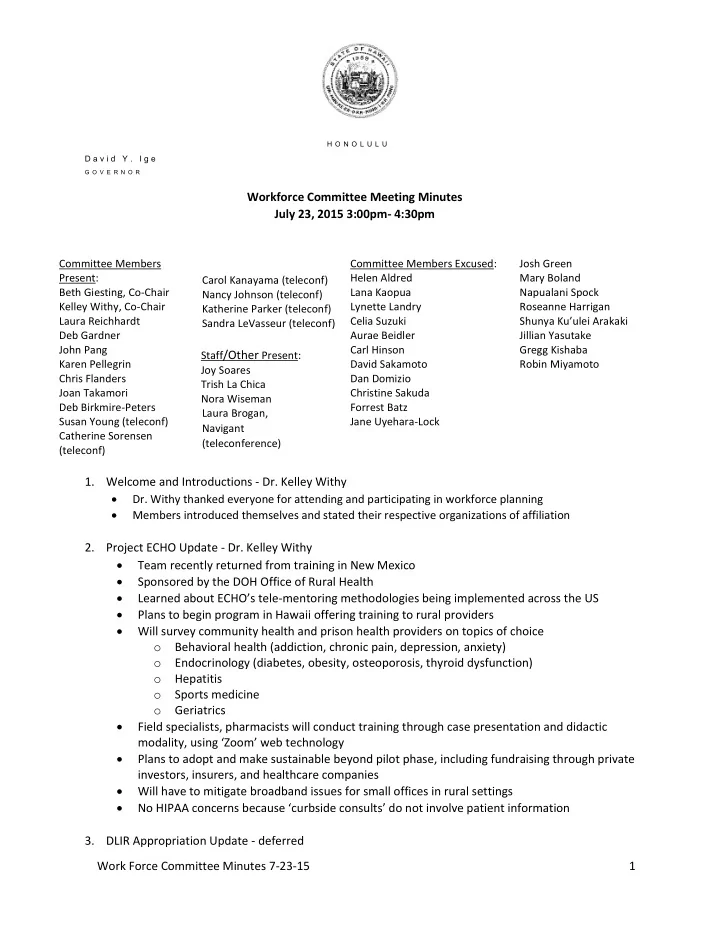
Workforce Committee Meeting Minutes July 23, 2015 3:00pm- 4:30pm

Committee Members Present: Beth Giesting, Co-Chair Kelley Withy, Co-Chair Laura Reichhardt Deb Gardner John Pang Karen Pellegrin Chris Flanders Joan Takamori Deb Birkmire-Peters Susan Young (teleconf) Catherine Sorensen (teleconf) Carol Kanayama (teleconf) Nancy Johnson (teleconf) Katherine Parker (teleconf) Sandra LeVasseur (teleconf) Staff/Other Present: Joy Soares Trish La Chica Nora Wiseman Laura Brogan, Navigant (teleconference) Committee Members Excused: Helen Aldred Lana Kaopua Lynette Landry Celia Suzuki Aurae Beidler Carl Hinson David Sakamoto Dan Domizio Christine Sakuda Forrest Batz Jane Uyehara-Lock Josh Green Mary Boland Napualani Spock Roseanne Harrigan Shunya Ku’ulei Arakaki Jillian Yasutake Gregg Kishaba Robin Miyamoto

  • 1. Welcome and Introductions - Dr. Kelley Withy

  • Dr. Withy thanked everyone for attending and participating in workforce planning

 Members introduced themselves and stated their respective organizations of affiliation 

  • 2. Project ECHO Update - Dr. Kelley Withy

 Team recently returned from training in New Mexico  Sponsored by the DOH Office of Rural Health  Learned about ECHO’s tele-mentoring methodologies being implemented across the US  Plans to begin program in Hawaii offering training to rural providers  Will survey community health and prison health providers on topics of choice

  • Behavioral health (addiction, chronic pain, depression, anxiety)
  • Endocrinology (diabetes, obesity, osteoporosis, thyroid dysfunction)
  • Hepatitis
  • Sports medicine
  • Geriatrics

 Field specialists, pharmacists will conduct training through case presentation and didactic modality, using ‘Zoom’ web technology  Plans to adopt and make sustainable beyond pilot phase, including fundraising through private investors, insurers, and healthcare companies  Will have to mitigate broadband issues for small offices in rural settings  No HIPAA concerns because ‘curbside consults’ do not involve patient information

  • 3. DLIR Appropriation Update - deferred
slide-2
SLIDE 2

Work Force Committee Minutes 7-23-15 2

  • 4. SIM Scope of Work - Beth Giesting

 Expanded population focus to include behavioral health integration for both children and adults in Medicaid  Context of ‘healthy families’ and exploring opportunities for health intervention and prevention among multiple generations  Also working on strategies to improve oral health for Medicaid enrollees (see below)

  • 5. SIM Committee Updates (see PPT slides) - SIM Team

 Oral Health Committee

  • Working to restore coverage for adults; priorities for pregnant women and

adults with DD

  • Expand access to preventive services for kids in schools

 Steering Committee

  • Discussed Innovation Structure and Funding for Reform
  • Plan to collect feedback and continue discussion on Hawai‘i Health Care

Innovation Roadmap

  • Determine whether DSRIP is a next step for Hawai‘i

 Delivery and Payment Committee

  • Plan to decide on target population, discuss possible integration strategies (e.g.

screening), leverage expertise from Navigant  HIT Update

  • SIM team met with HIE to explore next steps for SIM-related work
  • ONC provided TA regarding case examples for privacy and security of

information exchange

  • Discussion about IAPD as an ongoing process

 Population Health Committee

  • Expanded focus to include children and adults – looking at the entire family,

and identifying best strategies that will provide services to these two populations

  • DOH talked about current initiatives and opportunities on diabetes, obesity,

tobacco cessation, and ‘health in all’ policies

  • 6. Community Health Worker Training Program (see PPT slides) - Deb Gardner

 TAACCCT (Trade Adjustment Assistance Community College Career Training) program  Hawaii currently has 120 CHW, but the career is low-paying and insecure  Program addresses health and economic opportunities, employer engagement  Plans to create a common definition of CHW, outline scope of practice  Standardizes curriculum and training to provide career pathway  Forum for academic/community discussion about CHW to take place at September primary care summit, engaging local thought leaders  Issues for discussion include

  • Development of advisory board
  • Certification at state level
  • Leveraging School Health Aide (SHA) program strategy to build scale
slide-3
SLIDE 3

Work Force Committee Minutes 7-23-15 3

  • 7. Community Pharmacists (see PPT slides) - Karen Pellegrin, John Pang

 Pharm 2 Pharm is a consulting pharmacist pilot program, which shares and builds upon pharmacy expertise across the continuum of care  Re-education of dispensing pharmacists to become community/clinical in scope  Responsibilities with high-risk patients include

  • Medication reconciliation
  • Patient education
  • Readmission reviews
  • Planned handoffs

 Goals are to remedy discrepancies, achieve effectiveness, and ensure adherence  HCS Med 360 is EHR for pharmacists, includes full patient history, medical documentation, and drug therapy responses  Opportunity to contribute to BH in primary care setting: psycho-pharm monitoring and management to assist PCPs with patients’ medications

  • 8. Workforce Targets and Strategies - Joy Soares

 To incorporate CHW and consulting pharmacists in workforce expansion plans, as part of the overall coordinated care team approach to addressing behavioral health among children, adults, and families within the primary care setting

  • 9. Next steps - Dr. Kelley Withy

 Brief mention of recently expanded privileges and responsibilities for APRNs  Deferred update about the Longview Conference (National Workforce for Nursing)  Continue discussion about workforce goals, strategies, and resources The next meeting will be Thursday, August 27th from 3:00-4:30

slide-4
SLIDE 4

STATE OF HAWAI'I, HEALTH CARE INNOVATION OFFICE

1

Workforce Committee Meeting Agenda State Office Tower Rm. 1403/Leiopapa a Kamehameha July 23, 2015 3:00pm- 4:30pm Teleconference Line 1-855-640 640-8271, Code 6537 5199#

  • Welcome and Introductions
  • Dr. Kelley Withy
  • Project ECHO Update
  • Dr. Kelley Withy
  • DLIR Appropriation Update

Jillian Yasutake

  • SIM Scope of Work

Beth Giesting

slide-5
SLIDE 5

STATE OF HAWAI'I, HEALTH CARE INNOVATION OFFICE

2

SIM Committee Updates

SIM Committee Updates SIM Team

  • Steering
  • Delivery & Payment
  • Population Health
  • Oral Health
  • Health Information Technology
slide-6
SLIDE 6

STATE OF HAWAI'I, HEALTH CARE INNOVATION OFFICE

3

July SIM Committee Updates

Steering:

  • SIM presented a draft Road Map for Health Care Innovation
  • Discussed Innovation Structure and Funding for Reform

Next Steps:

  • Collect feedback and continue discussion on Hawai‘i Health Care Innovation Roadmap
  • Determine whether DSRIP (Delivery System Reform Incentive Payment) is a next step for

Hawai‘i

slide-7
SLIDE 7

STATE OF HAWAI'I, HEALTH CARE INNOVATION OFFICE

4

July SIM Committee Updates

Delivery and Payment:

  • Dr. Bruce Goldberg presented framework and approaches to behavioral health integration
  • Next steps: decide on target population, discuss possible integration strategies (e.g.

screening), leverage expertise from Navigant

slide-8
SLIDE 8

STATE OF HAWAI'I, HEALTH CARE INNOVATION OFFICE

5

July SIM Committee Updates

Population Health Updated Health Innovation Focus: Nurturing Healthy Families

  • Include children and adults – looking at the entire family, and identifying best strategies that will

provide services to these two populations

DOH talked about current initiatives and opportunities on: diabetes and obesity, tobacco cessation, and health in all policies Next steps:

  • Committee will review the SIM Population Health Assessment draft and provide feedback
slide-9
SLIDE 9

STATE OF HAWAI'I, HEALTH CARE INNOVATION OFFICE

6

July Committee Updates – Oral Health

Oral Health:

  • Committee agreed on goals:

1. Identify strategies that improve access to and utilization of dental health care and address prevention of dental caries 2. Review current practice restrictions on applying sealants/varnishes for underserved children and the settings in which the practice would be permitted 3. Identify strategies to provide dental coverage to low-income adults

  • Committee agreed on strategies to achieve goals

1. Scope of practice issues 2. School-based services 3. Coverage for Medicaid adults

  • Committee agreed to focus on oral health for pregnant women, possibly ABD population as well
  • Next steps are to determine legislation strategies
slide-10
SLIDE 10

STATE OF HAWAI'I, HEALTH CARE INNOVATION OFFICE

7

July SIM Committee Updates

Health Information Technology

  • Bruce Goldberg, Tina Edlund, and Patricia MacTaggart provided on-site June 15-17 for

CMS/ONC technical assistance

  • Comprehensive ‘roadmap’ planning session with staff from SIM, DHS, and DOH
  • SIM team met with HIE to explore next steps for SIM-related work
  • Discussion about IAPD as an ongoing process

Next steps: Determine specific Committee work and membership

slide-11
SLIDE 11

STATE OF HAWAI'I, HEALTH CARE INNOVATION OFFICE

8

Community Health Worker Training Program Update

Community Health Worker Training Program Update Deb Gardner

  • Background Information
  • Stakeholder Management
  • Coordination of Efforts
  • Key Decision Points/Timeline
slide-12
SLIDE 12

Department of Labor Trade Adjustment Assistance Community College and Career Training (TAACCCT) Grants Program Round 4 Awarded to University of Hawaii Community Colleges Consortium*

* UH Maui Community College

Hawaii Community College Honolulu Community College Kauai Community College Kapiolani Community College Leeward Community College Windward Community College

slide-13
SLIDE 13

Primary Purpose: to help advance the Community Health Worker (CHW) as a viable career, in the context of a transformed health care system that provides greater access to high quality and affordable health care to high-risk and vulnerable populations including low-income minority populations.

slide-14
SLIDE 14

TAACCCT Round 4 Health Goal

Health is targeting CHW training (an entry level position) to provide improved job opportunities, potential wage increases, and engage CHWs in career paths to additional certificates and degrees in Nursing, Medical Assisting and Public Health.

slide-15
SLIDE 15

DRAFT DEFINITION OF COMMUNITY HEALTH WORKER (CHW)

A Community Health Worker (CHW) is a frontline public health worker who is a trusted member of and/or has an unusually close understanding of the community served. This trusting relationship enables the CHW to serve as aliaison⁄link⁄intermediary between health⁄social services and the community to facilitate access to services and improve the quality and cultural competency of service delivery. A CHW also builds individual and Community capacity by increasing health knowledge and self-sufficiency through a range of activities such as

  • utreach, community education, informal counseling, social support and advocacy. (Am. Public Health Assoc.)

The duties of a CHW include:

  • Assisting individuals and communities to adopt healthy behaviors
  • Conducting outreach for medical personnel or health organizations to implement programs in the

community that promote, maintain, and improve individual and community health

  • Providing information on available resources
  • Providing social support and informal counseling
  • Advocating for individuals and community health needs
  • Providing services such as first aid and blood pressure screening
  • Collecting data to help identify community health needs
slide-16
SLIDE 16

According to a national HRSA survey*, there are three main trends in CHW workforce development:

1. Certificates or degrees at the community college level, which provide career advancement opportunities 2. On–the–job training, to improve standards of care, CHW income, and retention 3. Certification at the state level, which recognizes the work of CHWs and facilitates Medicaid reimbursement for CHW services

*Community Health Worker National Workforce Study (PDF: 1.14MB/285 pages),

Education, Training and Certification

slide-17
SLIDE 17

TAACCCT ROUND 4 CHW Products & Deliverables

Products & Deliverables Kauai KCC Maui Windward

Develop Basic Curriculum Certificate/Program Approval Create CHW Advisory Board

Engage Stakeholders with content development

 Vet Curriculum to stakeholders  Approval/Adoption of Curriculum Ensure resources are in place for delivery of curriculum (faculty, course approval, testing, counseling/coaching, field placements) Recruitment of students Collaborate with State Policy makers to support payment reform for CHWs Identify current CHWs for guidance and leadership in curriculum and employee engagement

slide-18
SLIDE 18

TAACCCT Round 4

Needs Assessment ( supply/demand)

Curriculum Development Faculty Preceptors Certificates New Education Pathways Evaluation Measurable Outcomes

Consistent Data Collection

  • pre/post test
  • graduates
  • employment
  • salary

Recognized Interdependence T3C4 Collaborative

Communication Equal Voice

slide-19
SLIDE 19

HCC Consortium: TAACCCT R4 Grant

COORDINATION OF HEALTH INNOVATION EFFORTS

slide-20
SLIDE 20

CHW Questions/Challenges

#1 Creating a “shared” definition of CHW role(s) #2 Best strategies for education and outreach across the state #3 Best approach for engaging current CHWs (approx. est. of 120) #4 Best approaches for engaging employers/agencies with next steps #4 Once agreement is reached on basic role of CHW there is compelling need for specialized training like the Behavioral Health CHW-who decides? #5 Identification of programs/agencies that will or already use BH – CHWs #6 Need shared decision making on CHW training & education foci e.g., elderly population, behavioral health, chronic illness #7 Development of proposed model that will lead to payment for CHW services #8 Defining Scope of Practice – Licensure issues #9 Best way for CHW Advisory Board to interact with other ad boards?

slide-21
SLIDE 21

Key Components in the Development & Implementation of the CHW Role

  • Infrastructure
  • Establish CHW advisory body
  • Workforce Development
  • CHW certification or training process
  • Standard curriculum with core skills/competencies
  • Professional Identity
  • CHW scope of practice
  • Financing
  • State reimburses or creates incentives for CHW services
  • Integrates CHWs into team based care
slide-22
SLIDE 22

Infrastructure For Developing the CHW Role In Hawaii

  • T4 opened up the opportunity for CHW curriculum development
  • SIM project which is to develop a plan for the integration of behavioral health into primary care is an opportunity for the CHW role to assist in

this goal

  • Workforce Committee is still active and provides a forum for further development of this role
  • What forums already exist to present and develop this project with:

– Papa Ola Lokahi

  • Need to identify key stakeholder groups

– Review ideas and engage them in a discussion of what competencies are needed by CHWs – Develop a plan for meeting those needs and revisit that plan with stakeholders

slide-23
SLIDE 23

Proposed CHW Advisory Group

Academic Employer Perspective Payer – Public & Commercial CHW Leaders State & Federal Health Policy State Agencies Labor

slide-24
SLIDE 24

Infrastructure Options For Developing the CHW Role

Legislative Mandate Model: In 2014, New Mexico enacted SB 58, which requires the Secretary of Health to promulgate certification rules for CHWs, such as education, training, and experience; procedures for recertification; continuing education standards; and disciplinary actions. The bill creates the Board of Certification of Community Health Workers, which makes recommendations to the Secretary of Health about education and certification requirements for CHWs to practice as Certified CHWS (CCHWs). Each CHW is certified for two years. All fees collected during the certification process must be used for the administration of the program. The Department must conduct criminal background checks, including finger printing, for all

  • CHWs. All CHWs must maintain possession of CHW certification documents at all times

when performing duties as a CCHW. CHWs may not perform services that require a license from a professional licensing board.

slide-25
SLIDE 25

Infrastructure Options for Developing the CHW

  • Centralized Model: The CHW Advisory Board develops core competencies for the training

and certification of CHWs. The Board’s report must include research related to best practices, curriculum, and training programs for CHW certification; recommendations for CHW certification and renewal processes; and curriculum recommendations containing the content, methodology, development, and delivery of all proposed programs. (e.g., Illinois- legislation to identify minimum requirements for core competencies, which are those competencies that are essential to expand health and wellness and to reduce health

  • disparities. CHWs are prohibited from performing services that require a license from a

professional licensing board.)

  • Agency Partnership Model: the Mississippi State Department of Health and the Tougaloo

College/Central Mississippi Area Health Education Center joined together to develop a formal CHW certification program. The program’s goal is to credential CHWs and recognize them as an important part of health services in Mississippi.

slide-26
SLIDE 26

Infrastructure Options For Developing the CHW Role

  • An Independent Organization Model: Choose an independent organization to administer the

training and certification services. (e.g., in Indiana, CHWs must attend a three-day training and pass an exam)

  • Adoption of a CHW Training Model from another State: Washington State used the

Massachusetts Department of Public Health’s CHW training curriculum to develop its own CHW training program. The primary training course is the Core Competencies Course. The training may be completed online or in-person, and training is conducted quarterly.

slide-27
SLIDE 27

Infrastructure Options For Developing the CHW Role

  • CHW Training Development by Agency with Focus on Specific Populations:

New York’s Department of Health created the Community Health Worker Program, which targets communities with high infant mortality rates, little or no prenatal care, and high rates of teen pregnancies, among others. The program’s goal is to provide early, consistent care to pregnant women. The program trains CHWs, with a focus on basic health education, referrals for services, and navigation of the health system. In 2013, Nevada created an eighteen month pilot program to train and certify CHWs, with a focus on targeting the Latino

  • population. Twelve individuals were entered into the training program consisting of seven core areas. At the conclusion of the

training, the CHWs will have completed roughly 80 hours of training and are expected to work with 100 families.

slide-28
SLIDE 28

UHM Draft CHW Curriculum

UH Maui Community College has developed the first basic competency curriculum for the CHW to vet with key stakeholders for further development. Like many states, Hawaii- Maui is proposing a competency-based 15 credit certificate program that will create a pathway for students interested in a wide range of health and social services careers. KCC is developing a plan to offer a CHW curriculum in higher education (e.g.,AS degree in public health).

Core competencies – 15 credits

  • Community Health Worker Fundamentals: 3 credits

– examines CHW field, public health efforts, advocacy, role, culturally based health beliefs

  • Health Promotion/Disease Prevention: 3 credits

– examines the behavioral and environmental risk factors for illness and disease, identifies health promotion strategies, how to access and analyze health information, as well as apply health promotion teaching concepts to prevent chronic disease and promote healthy behaviors

  • Case Management: 3 credits

– develops effective interviewing skills, intake, assessment, service planning and care coordination, discharge planning, and referral

  • Introduction to Counseling & Interviewing: 3 credits

– introduces a strengths-based model for evaluating and working with individuals to engage and facilitate health and lifestyle related behavior changes

  • Capstone Practicum: 3 credits

– provides individualized training in community services with a supervisory experience. Includes weekly seminar giving students an opportunity to discuss and share practicum experiences

slide-29
SLIDE 29

Health Module Sessions/Courses

What will be our focus? What are our populations biggest health issues?

  • Chronic Disease – Asthma, COPD; Diabetes, Hypertension, Obesity,
  • Mental Health- Behavioral Health
  • Adolescent Health
  • Geriatric Care-Dementia, ADL’s, Home Safety/Falls Prevention, Depression
  • Substance Abuse
  • Domestic Violence
slide-30
SLIDE 30

STATE OF HAWAI'I, HEALTH CARE INNOVATION OFFICE

27

Community Pharmacists

Community Pharmacists Karen Pellegrin, John Pang

  • Ensuring Patient Wellness
  • Role and Scope of Practice
  • Education and Training
  • Payment Reform
slide-31
SLIDE 31

Karen L. Pellegrin, PhD, MBA

Direct ector, , Contin tinuin uing g Educ ucati ation and Strat ategic egic Plann nning ing Foundin ding Direc ector

  • r,

, Center er for Rural al Health alth Scie ience Principal ipal Invest estigat igator

  • r,

, Pharm2P m2Phar harm m Healt alth h Care Innovatio ation Awar ard Daniel iel K. Inouye Colle llege e of Pharmac rmacy

slide-32
SLIDE 32

THE VISION OF PHARM-2-PHARM

Leverage erage un underuti derutili lized zed pharma rmaci cist st exper erti tise se across

  • ss the

e conti tinuum nuum of care to achie ieve e the e three ree-par art t aim of the e CMS Inno novat ation ion Cent nter: r:

  • Better care
  • Better health
  • Lower total costs

“Pharm2Pharm” = “Hospital Pharmacist to Community Pharmacist” care transition and coordination model focused on medica catio tions ns

slide-33
SLIDE 33
slide-34
SLIDE 34

THE VISION

Leverag eraging ing the e un underutilized derutilized comm mmun unit ity y pharmac rmacis ist t to achie ieve e the e three ree-pa part t aim of the e CMS Inno novat ation ion Cent nter: r:

  • Better care
  • Better health
  • Reduced costs
slide-35
SLIDE 35

PHARM-2-PHARM MEDICATION PROCESSES*

*Adapted from: Pharmaceutical Care Practice – The Patient Centered Approach, Cipolle, Morley, and Strand, 3rd Edition, McGraw Hill, 2012

slide-36
SLIDE 36

MODEL IMPLEMENTATION

Launched hed in all 4 counti ties es in Hawa waii: : Maui ui, , Kauai, , Hawa waii, , Honolul ulu > 2,500 0 pati tient nts enrolled ed and handed off to Community nity Consul ulti ting ng Pharmacist cists

slide-37
SLIDE 37

HEALTH INFORMATION TECHNOLOGY IMPLEMENTED BY HAWAII HEALTH INFORMATION EXCHANGE

Secure re messa saging ging: Care transit nsition

  • n

docume ments nts sent t from the Hospi pita tal Consulting sulting Pharmaci cist st to the Communit unity y Consulting Pharmacist via HHIE’s secure messa saging ging syst stem % of care transition documents sent from Hospital to Community Pharmacist via HHIE Virtua tual transl nslation ation servi vice ce: : Ava vailable to Community unity Consulting sulting Pharmaci cist sts s 24/7, , allowing ng non-En Engli lish h speaking king pati tient nts s to be e enrolled d Lab ac access ss: Consul nsulti ting ng Pharmaci cists ts have immedi ediate e e- access s to pati tient nt labs via HHIE communit unity y health th record d HC HCS med 360: Consulting sulting Pharmaci cists ts use HC HCS to: - check k fill hist story

  • docume

ment nt reconci nciled medica cati tion

  • n list*
  • docume

ment nt drug ug thera rapy y probl blems ms* *int nter erface ce to HHIE communi nity ty health th record d

http://files.hawaii.gov/dbedt/census/acs/Report/Data-Report-Non-English-Speaking-Profile-Hawaii.pdf

18.5% of Hawaii’s population reports speaking English “not well” or “not at all.”

slide-38
SLIDE 38

HCS MEDICATION RECONCILIATION AND DECISION SUPPORT TOOL

14+ Robust st data source ces s including uding but not

  • t limit

mited d to:

PBM’s

  • MedCo, Caremark, Catamaran, ExpressScripts, Argus

Pharmacies

  • CVS, Walgreens, Safeway

Insurance

  • HMSA, Wellpoint, Aetna, Humana

Surescripts

slide-39
SLIDE 39

HCS MEDICATION MODULE VIA HHIE

Longitudinal fill history screen shot: shows gaps in med use

slide-40
SLIDE 40

HCS MEDICATION MODULE VIA HHIE

Completed Med Rec Screen Shot: shows “inactivated med’s” (previous doses and regimens), clinician-added OTC’s and herbals

slide-41
SLIDE 41

HCS MEDICATION MODULE VIA HHIE

Printable Completed Med Rec: shows dose, route, frequency and recommended changes.

slide-42
SLIDE 42

IMPACT ON HOSPITAL

For 36% of enrolle

  • lled patien

ients, ts, the HCP is finding ing medic edication tion discr screp epanc ancies ies that were missed sed by ot

  • ther

er clin inician icians s (this s finding ing is consis sistent t with th published ished resea search on medic dicatio ation rec econci

  • ncilia

liatio ion perfor

  • rme

med d by pharma macists sts) Over er 90% of discr screpanci ancies es found d are e resolv solved ed by dischar scharge HCPs s are e provi vidin ing gener eral l medic dicatio ation educatio ion as well ll as dischar scharge e medic dicatio ation-specif ific ic educatio ion to near arly ly 100% % of enrolle

  • lled patien

ients ts Drug therapy probl

  • blems

ms iden entif ifie ied d by the HCPs reflec flect the follo lowi wing cat ateg egor

  • ries

ies (simila ilar to the percentag tages s found d by CCPs) s):

  • 32% are indic

icati ation

  • n problems (one-third of these are drug therapy not indicated; two-thirds are drug therapy needed for

an untreated indication)

  • 25% are effec

ecti tiven enes ess problems (majority of these are dose too low; others are need a more effective drug)

  • 23% are safety

ety/side ide effec ect problems (majority of these are need a drug with lower risk of adverse events; others are dose too high)

  • 20% are adheren

rence problems (which may be addressed via patient counseling and/or prescription change)

38% of HCP reco ecommendation dations to pres escribe ibers rs to resolv lve drug therap rapy proble

  • blems are

e implem lemented d prior

  • r to

dischar scharge The e majo jority ity of patien ients ts are e success essfu fully lly contac tacted ed within hin 1 day post-disc discharge harge to ensure they have e their ir medic dicatio ions s and know w whic ich h to take e and whic ich h not

  • t to take
slide-43
SLIDE 43

IMPACT ON AMBULATORY CARE

majori rity ty of pati tients nts have their eir first t visit sit with th the CCP within thin 3 days s post-dis discharg harge 86 86% of patients’ medications were reconciled by the CCP within 30 days post disch scharg arge >6,000 00 drug thera rapy y proble lems s were iden enti tified d duri ring patient nt visit sits s (see types es on next t two pages) 44% of drug g therap apy problems ms ident ntified fied were resol

  • lved

d by t the next t pati tient nt visit sit

slide-44
SLIDE 44

DRUG THERAPY PROBLEMS BY CATEGORY

slide-45
SLIDE 45

RECOMMENDATIONS TO PRESCRIBERS TO RESOLVE DRUG THERAPY PROBLEMS

For INDICATION problems For EFFECTIVENESS problems For SAFETY problems For ADHERENCE problems

slide-46
SLIDE 46

Tot

  • tal pati

tients nts enrolled ed and hande ded d off throug

  • ugh December

r 2014 2,052 Average per pati tient nt acute care uti tilizat zation

  • n 365 days prior

r to their eir Pharm2P 2Pharm harm enrollment/ ent/ha hand nd-off 3.3 Tot

  • tal cost

t of acute care for these ese patient nts s 365 days s pri rior r to their eir Pharm2P 2Pharm harm enrollment/ ent/ha hand nd-off $54.5M Average per pati tient nt acute care cost t 365 days prior

  • r to their

r Pharm2P 2Pharm harm enrollment/ ent/ha hand nd-off $26,550 % of pati tients nts by r race/ethni ethnici city 31% White/Caucasian 26% Hawaiian 17% Filipino 14% Japanese 5% Other Pacific Islander 2% Hispanic/Latino 1% Chinese 0.7% Black 0.2% American Indian 2% Other/unknown % of pati tients nts by ag age 1% 18-44 4% 45-54 7% 55-64 38% 65-74 34% 75-84 15% 85+ Data source ce: Hawai waii Health h Informa rmati tion n Corp rpora

  • rati

tion

slide-47
SLIDE 47

Data source ce: Hawai waii Health h Informa rmati tion n Corp rpora

  • rati

tion

slide-48
SLIDE 48

Data source ce: Hawai waii Health h Informa rmati tion n Corp rpora

  • rati

tion

slide-49
SLIDE 49
slide-50
SLIDE 50

4.8 4.7 4.4 4.6 4.7 4.7 4.6 4.6 4.8

0.0 0.5 1.0 1.5 2.0 2.5 3.0 3.5 4.0 4.5 5.0

Careful review of what medications you are taking Monitoring how you are doing on your medications Working with your doctor to adjust your medications when needed Helping you achieve your health goals Helping you understand the purpose of your medications Explaining how to take your medications safely and correctly Helping you remember when to take your medications Assistance getting your medications Overall rating of this pharmacist

Patient mean ratings of CCP (1=Poor, 2=Fair, 3=Good, 4=Very Good, 5=Excellent)

slide-51
SLIDE 51
slide-52
SLIDE 52

PATIENT COMMENTS

Too many positive commen ents to list here, e, but they y include de:

  • She gave me a p

print nt out list of all my meds and dosages.

  • s. I made copi

pies s and now carry that in my purse se for emergency ncy. . This s wa was incred edibly ly imp mpor

  • rt and va

valua uable.

  • le. Being

ng called and check cked on helped ed me stay on track

  • Keeps me on my toes
  • helped a lot by discussing each medication and what it does for you or not
  • This pharmac

macist st has kept me out of the hospi pital l on at least 2-3 occasions. Kept me out of ER 3+ times… Un Underst stand anding ng your meds is so imp mpor

  • rtant

ant. . They y do a s super er job. Every day coun unts. s.

  • Ever since I met this Pharmacist I became very interested into listening an paying attention to everything she

said and I got really interested doing things I never done before. Do not stop this program there's people out there that need this services

  • We sat down

n toget ether er and expla lained ned what each pill l does for me. I wa was so thank nkful ul for him to help p me back to my old self. I would ld never "trade" him for any ot

  • ther

r pharma macis cist in the world. . He's the BEST

  • My Pharmacist was extremely helpful beyond my expectations.
  • Very professional and knowledgeable. Seemed very interested in my health. I was able to communicate with

her very well.

  • This progr

gram am has chang nged ed my life - I h have ret eturned ed to my old self; ; I can sleep at night, , fear of never wa waking ng is gone.

  • e. No more inhale

ler r and wheezi zing ng. . Not

  • t so many

y pills s and knowin wing g when n or when n not

  • t to take them also

the security of knowing ng I h have someon

  • ne to talk with when

n I have a qu ques estion

  • n or prob
  • ble

lem.

  • m. Thank

ank you for my life back, , and I really mean this

  • A very enlightened program. Pharmacists are underutilized. They have a wealth of experience and

knowledge

slide-53
SLIDE 53

PROJECT FOCUS

LAUNCH

Year ar 1

  • Staff
  • Contracts
  • SOPs & tools
  • Training
  • Evaluation Plan
  • Enrollment

IMPROVE

Year ar 2

  • CQI
  • HIT
  • Provider

collaborations

SUSTAIN

Year r 3

  • Payment models
  • Partnerships

EVALUATE

Year r 4

  • Final model
  • Stakeholder

adoption

  • Spread
slide-54
SLIDE 54

SOME KEYS TO SPREAD…

Procedures dures Tools/t s/templat plates Measures ures Traini aining

slide-55
SLIDE 55

SUSTAINABILITY PILOTS: CAN WE MAKE IT “STICK” THROUGH ALIGNMENT?

Pot

  • tenti

ntial pilots

  • ts:
  • Hospi

pital comp mponen nent of Pharm2Pharm:

  • Hospitals fund HCP / pharmacy technicians
  • College of Pharmacy launch a state-wide care transition rotation for P4s
  • Communi

unity ty comp mponen nent of Pharm2Pharm:

  • Formal collaborations between pilot physicians and high-performing CCPs with

potential for sustainability via (esp. with CDTAs):

  • Increased P4Q revenue to provider
  • Increased capacity to manage more patients via CCP support
  • Current/new billing codes
  • Out-of-pocket payments from patients to pharmacy
  • He

Health h Informati

  • rmation

n Techno nolo logy y supporting Pharm2Pharm

  • Improved efficiency for HIT users to validate subscription fees
  • Traini

aining supporting Pharm2Pharm

  • Online CE module being developed, offered by College of Pharmacy
slide-56
SLIDE 56

FINAL MODEL AIMS

Better health Better care Lower costs

Patients Providers Payers Pharm2Pharm alignment and integration

slide-57
SLIDE 57

ACKNOWLEDGEMENT OF FEDERAL FUNDING

The project described is supported by Funding Opportunity Number CMS-1C1-12-0001 from Centers for Medicare and Medicaid Services, Center for Medicare and Medicaid Innovation. Its contents are solely the responsibility of the authors and do not necessarily represent the official views of HHS

  • r any of its agencies.
slide-58
SLIDE 58

STATE OF HAWAI'I, HEALTH CARE INNOVATION OFFICE

55

Final Notes

Workforce Targets and Strategies Joy Soares

  • Access and capacity issues

Next steps

  • Dr. Kelley Withy
  • The next meeting will be Thursday, August 27th from 3:00-4:30