H.245 Control Signaling Used between session participants to - - PowerPoint PPT Presentation

h 245 control signaling
SMART_READER_LITE
LIVE PREVIEW

H.245 Control Signaling Used between session participants to - - PowerPoint PPT Presentation

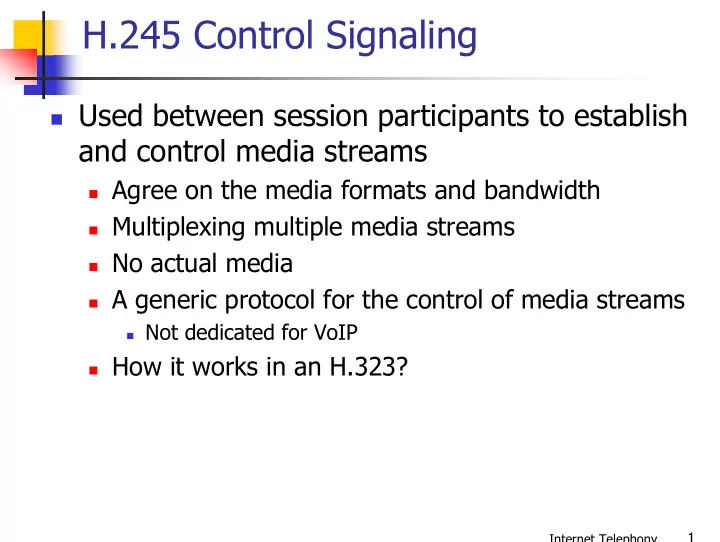
H.245 Control Signaling Used between session participants to establish and control media streams Agree on the media formats and bandwidth Multiplexing multiple media streams No actual media A generic protocol for the control of


slide-1
SLIDE 1

1

Internet Telephony

H.245 Control Signaling

Used between session participants to establish

and control media streams

Agree on the media formats and bandwidth Multiplexing multiple media streams No actual media A generic protocol for the control of media streams

Not dedicated for VoIP

How it works in an H.323?

slide-2
SLIDE 2

2

Internet Telephony

H.245 Message Groupings

Requests

Require the recipient to perform some action and to send

an immediate response

Responses

In reply to Requests

Commands

Require the recipient to perform some action, but no

explicit response is required.

Indications

Of an informational nature only (no action and response

is expected.)

slide-3
SLIDE 3

3

Internet Telephony

The Concept of Logical Channels

A Logical channel

A unidirectional media path An IP address and port number Has a number that is specified by the sending entity

A two-party conversation

Two logical channels exist Potentially in different formats

An endpoint issues Open Logical Channel

Logical channel number and media information (RTP payload type)

Far endpoint responds with Open Logical Channel Ack

An RTP port

Messages over H.245 Control Channel (channel number 0)

Permanently open as long as the endpoint is involved a call

slide-4
SLIDE 4

4

Internet Telephony

Capability Exchange [1/2]

Share information regarding receive and transmit

capabilities

Indicate a preference TerminalCabilitySet message

A request message A sequence number plus the types of audio and video

formats

TerminalCapabilitySetAck

with a sequence number

TerminalCapabilitySetReject

With a reason for rejection

slide-5
SLIDE 5

5

Internet Telephony

Capability Exchange [2/2]

TerminalCapabilitySetRelease

If no response within a timeout period

SendTerminalCapabilitySet

Request Terminal Capability information A command message that does not requires a specific

response

The endpoint that receives the messages should

subsequently send a TerminalCapabilitySet message.

slide-6
SLIDE 6

6

Internet Telephony

Master-Slave Determination

One of the endpoints needs to be the master

Of particular importance for the setup of a multi-party

conference

Compare two pieces of information at each entity

A terminal type value A terminal without an MC: 50 A gateway without an MC: 60 An MCU for audio, video: 190 An MCU managing a conference: 240 (the highest) A random number (1..16,777,215)

Master-Slave Determination message Master-Slave Determination Ack

A “master” or “slave” indication

slide-7
SLIDE 7

7

Internet Telephony

Open Unidirectional Logical Channel

slide-8
SLIDE 8

8

Internet Telephony

Open Bidirectional Logical Channels

slide-9
SLIDE 9

9

Internet Telephony

Closing Logic Channels and Ending a Session

CloseLogicalChannel,

CloseLogicalChannelAck

Only the initiator can issue Or the receiving end can

humbly request

A bidirectional channel

can be closed by either end

Once all logical channels

are closed

EndSession, EndSession

commands

slide-10
SLIDE 10

10

Internet Telephony

A Slow Start

Plus Capability exchange Master-slave determination

slide-11
SLIDE 11

11

Internet Telephony

Fast-connect Procedure

Q.931

A faststart element : OpenLogicalChannel requests No H.245 control channel

slide-12
SLIDE 12

12

Internet Telephony

H.254 Message Encapsulation

H.245 message encapsulated with Q.931

messages as octet strings

Set the element h245Tunneling to true The encapsulated data is contained within the

h245Control element.

A conflict exists between encapsulation and fast-

start.

What happens if an endpoint needs to send an

H.245 message at a time when it does not have a need to send a Q.931 message?

slide-13
SLIDE 13

13

Internet Telephony

Conference Calls

MC manages multi-point conference A Pre-Arranged Conference

Establish a call with the MCU

The MCU specifies the conference mode

(centralized or de-centralized).

Communication Mode command (H.245) Specify all the sessions in the conference

slide-14
SLIDE 14

14

Internet Telephony

An Ad-Hoc Conference

Expand an existing two-party call to a conference call

One the endpoints must contain an MC (master).

slide-15
SLIDE 15

15

Internet Telephony

The Decomposed Gateway

  • The H.323 gateway can comprise
  • Media Gateway (MG): handles media stream
  • Media Gateway Controller (MGC): performs call control
  • Signaling Gateway (SG): interfaces with external signaling network

(e.g., SS7)

  • The function of MGC is separate from that of GK.
slide-16
SLIDE 16

iGSM: VoIP Service for Mobile Network

slide-17
SLIDE 17

17

Internet Telephony

Introduction to iGSM [1/2]

A VoIP value-added service for mobile network iGSM supports user mobility for GSM subscribers

to access VoIP services.

With the same identity, a GSM subscriber can receive

the service when he changes the terminal from the GSM MS to the H.323 terminal.

The GSM network remains the same.

Terminal Mobility, Session Mobility, Service

Mobility

slide-18
SLIDE 18

18

Internet Telephony

Introduction to iGSM [2/2]

iGSM Gateway performs the conversion for

communication protocols and transmission formats between GSM and H.323 networks.

GSM MAP and RAS protocol translation GSM/PSTN/IP call setup and release

iGSM Gatekeeper records location information as the

VLR in GSM network.

slide-19
SLIDE 19

19

Internet Telephony

iGSM Architecture

slide-20
SLIDE 20

20

Internet Telephony

iGSM Gatekeeper

The iGSM gatekeeper maintains an database

that stores information for all iGSM subscriber.

MSISDN of the MS Transport address of the H.323 terminal (MS resides) Password of the iGSM subscriber HLR address of the iGSM subscriber IMSI of the MS User profile that indicates the service features and

restrictions of the iGSM subscriber

Presence indication

slide-21
SLIDE 21

21

Internet Telephony

Registration

slide-22
SLIDE 22

22

Internet Telephony

Message Flow (Registration)

slide-23
SLIDE 23

23

Internet Telephony

Message Flow (De-registration)

slide-24
SLIDE 24

24

Internet Telephony

Call Delivery

slide-25
SLIDE 25

Message Flow (Call Delivery)

slide-26
SLIDE 26

26

Internet Telephony

Mis-routing Scenario [1/2]

slide-27
SLIDE 27

27

Internet Telephony

Mis-routing Scenario [2/2]

The incoming calls to the user are misrouted

until one of the following events occurs.

The subscriber originates a call. The subscriber moves to another location area (LA).

We proposed an analytic model to study mis-

routing due to user mobility in iGSM.

slide-28
SLIDE 28

28

Internet Telephony

Summary

The results indicate that the probability of one mis-

routed call delivery is about 1~20%.

To avoid the mis-routing problem, the iGSM subscriber

should turn off their MS when moving to the IP network.

The “turn-off” action results in a detach GSM message to de-

register the MS.

When the subscriber turns on the MS in the GSM coverage area,

an explicit registration is performed.

Mis-routing calls are not necessarily lost. With call

forwarding on no reply, these calls can be forwarded to an appropriate destination or mailbox.