SLIDE 1 1
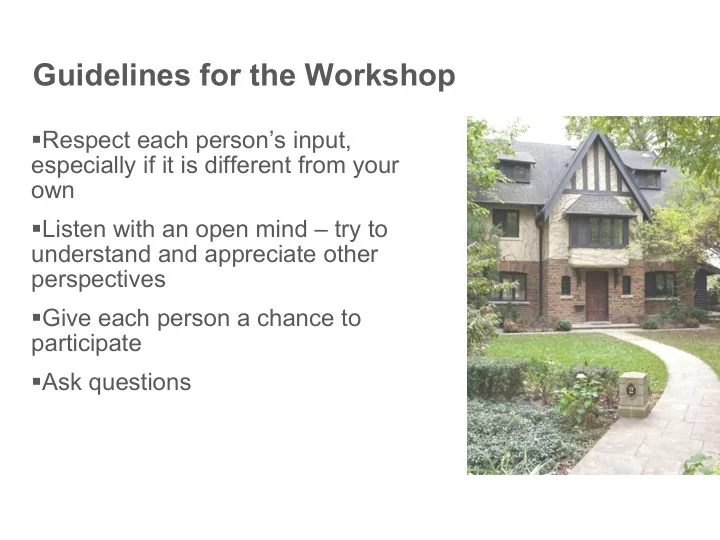
- Respect each person‟s input,
especially if it is different from your
- wn
- Listen with an open mind – try to
understand and appreciate other perspectives
- Give each person a chance to
participate
Guidelines for the Workshop
SLIDE 2 The Project Team and Stakeholders
City of Burlington
Andrea Smith, Acting Manager of Policy and Research Rosa Bustamante, Project Manager
Key Stakeholders
Roseland residents and landowners, residents of Burlington, development community, etc.
Brook McIlroy
Anne McIlroy, Principal-in-Charge Matt Reid, Project Manager/Urban Designer Maryann Alisch, Planner
SLIDE 3 City of Burlington
Official Plan Review: Roseland Character Area Study
May 1, 2013 Public Visioning Workshop
SLIDE 4 Tonight‟s Schedule
6:30 – 6:35 City‟s Introduction 6:35 – 7:05 Presentation 7:05 – 8:15 Workshop Exercise and Reporting Back 8:15 – 8:30 Wrap-up and Next Steps
SLIDE 5 1. Character Area Study 2. The Study Area 3. Precedent Review 4. Character Area Components 5. Development Process Considerations 6. Workshop Exercises 7. Next Steps
Presentation Outline
SLIDE 6
Approximately 115 acres and 260 dwellings Located east of the QEW on north shore of Lake Ontario One of the oldest neighbourhoods in the city Area has cultural heritage significance Residential Area in Burlington Official Plan Zoned as Low Density Residential in Burlington Zoning By-Law 2020
Roseland Neighbourhood
SLIDE 7 What is Neighbourhood Character?
Neighbourhood character refers to the 'look and feel of an area'. Character Areas are areas of the community that have achieved a distinct, recognizable, character that is different from neighbouring areas. These differences may be the result of topography, age and style of housing, built environment, land use patterns, landscaping, street patterns, open space, and streetscapes.
Character Area Study
SLIDE 8 What is a Character Area Study? The Roseland Character Area Study is a process that will:
- Identify and define the private and
public realm character components
distinguish it from other areas of Burlington
- Develop tools to improve the
management of neighbourhood character issues related to development applications
- Protect and support the character of
the Roseland neighbourhood
Character Area Study
SLIDE 9
How can the Character Area Study protect the Roseland neighbourhood? Work with the community to determine the elements that are important to protect Define a Character Area Statement for Roseland for inclusion in the OP Review Outline recommended policy updates and amendments (i.e. enhanced zoning)
Character Area Study
SLIDE 10
Build on existing policies and planning tools: Official Plan Policies (High level land use permissions; neighbourhood vision and intent) Urban Design Guidelines (Private and public realm directions for new and infill development) Existing zoning standards (“on the ground” built form requirements)
Character Area Study
SLIDE 11
Character Area Study
Our Process Detailed site visits Background and policy review Precedent review Detailed qualitative and quantitative review of neighbourhood mapping Extensive consultation with community members
SLIDE 12 12
Neighbourhood Character Study Identify distinct elements and establish guidelines (i.e. Boroondara, Australia) Private Tree Protection By-Laws Designate individual significant private trees based on assessment from arborist (i.e. City of Toronto, Surrey, BC) Private and Public Realm Design Guidelines Provide direction for built form, streetscapes, etc.
Precedent Review Neighbourhood Character Protection Tools
Port Credit, Mississauga
SLIDE 13 13
Official Plan Amendments Prescribe a detailed vision that outlines the character to be preserved Enhanced Zoning Update zoning regulations to protect key elements of the neighbourhood character (i.e. lot coverage, setbacks, etc.) Increased Heritage Designation City designated individual properties for long-term protection
Precedent Review Neighbourhood Character Protection Tools
Trafalgar Road, Oakville
SLIDE 14 14
Heritage Conservation District Designates more than just buildings, including views, landmarks, etc. (i.e. Port Credit, Oakville, Wychwood Park) Heritage Revitalization Agreement Joint protection between owner and local government that supersedes zoning (i.e. New Westminster, Burnaby, Vancouver)
Precedent Review Neighbourhood Character Protection Tools
Wychwood Park, Toronto
SLIDE 15 15
Large Mature Trees
- 1. Continuous tree canopy
creates a sense of enclosure
- 2. Shaded streetscapes for
residents and visitors
- 3. Tree-lined streets create an
attractive public realm
- 4. Public/private trees enhance
privacy
- 5. Trees (front and rear-yard)
augment the City‟s urban tree canopy
Public Realm Character Area Components
SLIDE 16 16
Private Enclave
- 1. Non-Linear internal street
network helps to control through traffic
- 2. Crescent streets (i.e.
Roseland Crescent, Hampton Crescent) create private areas with minimal traffic
- 3. Safe streets where kids can
play
Public Realm Character Area Components
SLIDE 17 17
Streets and Streetscapes 1.Streets are typically narrow (i.e. 2-lanes) 2.Sidewalks are narrow and
- ften located on a single side
- f the street
3.Network of through streets and winding roads
Public Realm Character Area Components
SLIDE 18 18
Topography
reinforces the public/private realm transition
- 2. Changing topography creates
visual interest throughout neighbourhood
accommodate unique landscape elements (i.e. planting beds, garden walls, stairs, etc.)
Public Realm Character Area Components
SLIDE 19 19
Views
- 1. Waterfront views occur at Guelph
Line and between waterfront properties
- 2. Rossmore Boulevard stretches
the length of the neighbourhood, creating a continuous neighbourhood vista
- 3. Terminus views throughout the
neighbourhood are created at intersections
Public Realm Character Area Components
SLIDE 20 20
Parks and Open Spaces Roseland Park is:
- 1. A central community gathering
place
- 2. A place for passive and active
recreation: tennis courts, baseball diamond
- 3. Easily accessible for all
residents
Public Realm Character Area Components
SLIDE 21 21
Spacious Properties
- 1. Large lot frontages provide
ample space between homes
- 2. Large lots allow for large
gardens, private outdoor space and tree planting
- 3. Dwelling setbacks reinforce
privacy for residents
- 4. Setbacks provide space for
private landscaping
Private Realm Character Area Components
SLIDE 22 22
Height and Scale of Houses
- 1. A variety of building heights (1½
to 2½-storeys) creates a varied streetscape
- 2. Scale and massing that is
generally well-proportioned to the lot size
- 3. Scale and massing that is
generally consistent between adjacent properties
- 4. Garages do not dominate the
dwelling frontage
Private Realm Character Area Components
SLIDE 23 23
Style of Architecture
- 1. Mix of historic architectural
styles: Arts & Crafts, Georgian
- 2. Houses with pitched roofs and
varied architectural period detailing
- 3. Housing is complementary in
character
Private Realm Character Area Components
SLIDE 24 24
Private Landscaping
- 1. Gives each property a distinct,
clearly defined character
- 2. Landscaping delineates
public/private realm in a natural way
- 3. Creates open space/park-like
appearance
Private Realm Character Area Components
SLIDE 25
Currently, a series of policies must be considered when evaluating new development applications in Roseland, including: Growth Plan Policies Official Plan Policies (intensification goals; dwelling types; density and infill requirements; compatibility) Urban Design Guidelines (i.e. Site Plan Design Guidelines) Existing zoning standards (guides built form „on-the-ground‟)
Development Planning Framework
SLIDE 26 Zoning Considerations
‘As-of-Right’ Zoning Example # 1 (R1.2 Zone) 54m lot severed into two 27m lots ‘As-of-Right’ Zoning Example # 2 (R1.2 Zone) 30 & 45m lot consolidated, and severed into three lots (24 and 27m)
SLIDE 27 ‘As-of-Right’ Zoning Example # 3 (R2.3 Zone) 37m lot severed into two 18.5m lots
Zoning Considerations
SLIDE 28 ‘As-of-Right’ Zoning Example # 4 (R1.2 Zone) 37m lot redeveloped with no severance
Zoning Considerations
SLIDE 29 29
Are you someone who….
(Pick all that apply)
- 1. 1. Lives in Roseland
- 2. 2. Lived in Roseland, but no
longer lives there
- 3. 3. Visits Roseland
- 4. 4. Has never been to Roseland
- 5. 5. Owns property in Roseland
- 6. 6. Rents property in Roseland
- 7. 7. Has development interests
in Roseland
SLIDE 30 30
How long have you lived in Roseland?
- 1. Less than 5 years
- 1. 2. Between 5-10 years
- 2. 3. Between 10-20 years
- 3. 4. Between 20-30 years
- 4. 5. Between 30-40 years
- 5. 6. More than 40 years
- 6. 7. You do not live in Roseland
SLIDE 31
Turning Point Questions
Of the public realm character area components, which do you feel require specific tools to be managed? (Pick all that apply) 1. Large Mature Trees (Public Realm) 2. Private Enclave 3. Streets and Streetscapes 4. Topography 5. Views 6. Parks and Open Spaces
SLIDE 32
Turning Point Questions
Of the private realm character area components, which do you feel require specific tools to be managed? (Pick all that apply) 1. Large Mature Trees (Private Realm) 2. Spacious Properties 3. Height and Scale of Houses 4. Style of Architecture 5. Private Landscaping
SLIDE 33 To protect/preserve the character components, interventions would be required in both the public and private realm. How comfortable are you with: Recommendations that impact the public realm (i.e. tree protection, streetscape improvements, open space improvements)
Turning Point Questions
1 2 3 4 5
Not Comfortable Very Comfortable Somewhat Comfortable Neutral Comfortable
SLIDE 34 Recommendations that impact the public realm
- 1. Not Comfortable
- 2. Somewhat Comfortable
- 3. Neutral
- 4. Comfortable
- 5. Very Comfortable
SLIDE 35 To protect/preserve the character components, interventions would be required in both the public and private realm. How comfortable are you with: Recommendations that impact the private realm (i.e. built form urban design guidelines, changes to the zoning by-law)
Turning Point Questions
1 2 3 4 5
Not Comfortable Very Comfortable Somewhat Comfortable Neutral Comfortable
SLIDE 36 Recommendations that impact the private realm
- 1. Not Comfortable
- 2. Somewhat Comfortable
- 3. Neutral
- 4. Comfortable
- 5. Very Comfortable
SLIDE 37 Workshop Exercises
Team Introductions
- Introduce yourself to your table
- Assign a note taker, and someone to
report back
Group Discussions
- Complete the worksheet at your table
Report Back
- Summarize the key findings of your group
SLIDE 38 Next Steps
Prepare Summary of Workshop
Steering Committee Meeting
Prepare Interim Report of Findings
Second Public Workshop