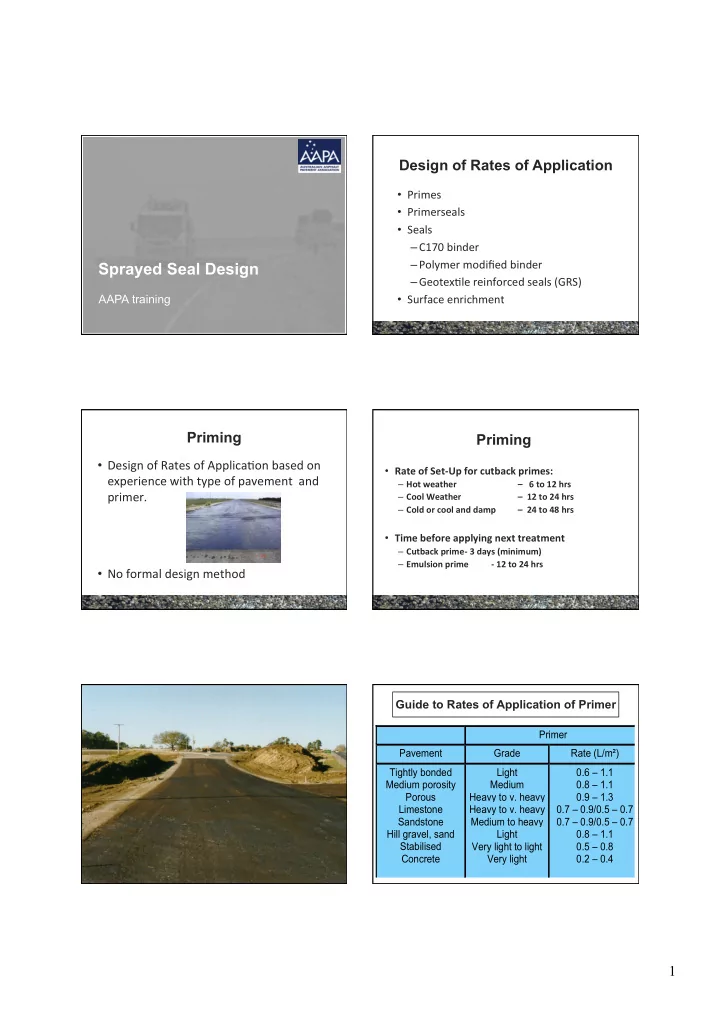
Guide to Rates of Application of Primer Primer Pavement Grade Rate - - PDF document

guide to rates of application of primer
SMART_READER_LITE
LIVE PREVIEW

Guide to Rates of Application of Primer Primer Pavement Grade Rate - - PDF document

Design of Rates of Application Primes Primerseals Seals C170 binder Polymer modified binder Sprayed Seal Design Geotexle reinforced seals (GRS) AAPA training


slide-1
SLIDE 1

1

AAPA training

Sprayed Seal Design

Australian ¡Asphalt ¡Pavement ¡Associaon ¡

Design of Rates of Application

Primes ¡ Primerseals ¡ Seals ¡ – C170 ¡binder ¡ – Polymer ¡modified ¡binder ¡ – Geotexle ¡reinforced ¡seals ¡(GRS) ¡ Surface ¡enrichment ¡

Australian ¡Asphalt ¡Pavement ¡Associaon ¡

Priming

Design ¡of ¡Rates ¡of ¡Applicaon ¡based ¡on ¡ experience ¡with ¡type ¡of ¡pavement ¡ ¡and ¡

  • primer. ¡

No ¡formal ¡design ¡method ¡ ¡ ¡

Australian ¡Asphalt ¡Pavement ¡Associaon ¡

Priming

Rate ¡of ¡Set-­‑Up ¡for ¡cutback ¡primes: ¡

– Hot ¡weather ¡ ¡ ¡– ¡ ¡ ¡6 ¡to ¡12 ¡hrs ¡ – Cool ¡Weather ¡ ¡ ¡– ¡ ¡12 ¡to ¡24 ¡hrs ¡ – Cold ¡or ¡cool ¡and ¡damp ¡– ¡ ¡24 ¡to ¡48 ¡hrs ¡

Time ¡before ¡applying ¡next ¡treatment ¡

– Cutback ¡prime ¡-­‑ ¡3 ¡days ¡(minimum) ¡ – Emulsion ¡prime ¡ ¡ ¡-­‑ ¡12 ¡to ¡24 ¡hrs ¡

¡

Australian ¡Asphalt ¡Pavement ¡Associaon ¡

Primer Pavement Grade Rate (L/m²) Tightly bonded Medium porosity Porous Limestone Sandstone Hill gravel, sand Stabilised Concrete Light Medium Heavy to v. heavy Heavy to v. heavy Medium to heavy Light Very light to light Very light 0.6 – 1.1 0.8 – 1.1 0.9 – 1.3 0.7 – 0.9/0.5 – 0.7 0.7 – 0.9/0.5 – 0.7 0.8 – 1.1 0.5 – 0.8 0.2 – 0.4

Guide to Rates of Application of Primer

slide-2
SLIDE 2

2 Priming – small scale trial

Small scale trial Apply measured quantity by hand Distribute evenly Observe performance Design rate § ¡ ¡Apply ¡measured ¡quanty ¡ ¡ ¡ ¡ ¡by ¡hand ¡(say ¡1L) ¡ ¡ § ¡ ¡Distribute ¡evenly ¡with ¡brush ¡ § ¡ ¡Observe ¡performance ¡ § ¡ ¡Decide ¡on ¡grade ¡and ¡rate ¡

Australian ¡Asphalt ¡Pavement ¡Associaon ¡

Primersealing

Primerbinder ¡-­‑ ¡Rates ¡of ¡Applicaon ¡ No ¡formal ¡design ¡procedure ¡ AUSTROADS ¡design ¡based ¡on: ¡ ¡ ¡

– Traffic ¡ranges(v/l/d) ¡ – Nominal ¡aggregate ¡size ¡ – Type ¡of ¡primerbinder ¡ – Pavement ¡condion ¡ – Local ¡experience ¡ ¡

Australian ¡Asphalt ¡Pavement ¡Associaon ¡

Primersealing

Primerbinder ¡– ¡Rates ¡of ¡Applicaon ¡

Determine ¡base ¡rates ¡from ¡AP-­‑T68 ¡ Add ¡allowances ¡for: ¡ – ¡Pavement ¡texture ¡ – ¡Possible ¡absorpon ¡ – ¡Possible ¡aggregate ¡embedment ¡based ¡on ¡using ¡ball ¡ embedment ¡test ¡ Total ¡allowances: ¡ – ¡generally ¡averages ¡ ¡ ¡+ ¡0.2 ¡to ¡+ ¡0.3 ¡L/m² ¡

Primersealing

Primerbinder application rate L/m² @ 15 °C

DesignTraffic

(v/l/d)

Aggregate size (mm)

Cutback bitumen Bitumen emulsion

60%

  • 150

7 or 5 10 1.3 1.4 1.6 1.8 150 - 1200 7 or 5 10 1.2 1.3 1.5 1.6 1200+ 7 or 5 10 1.1 1.2 1.4 1.5

Aggregate spread rates

Size of aggregate mm Aggregate spread rate m²/m³ Sand, size 5, size 7 Size 10 130 – 150 110 – 120

Primersealing

Typical Aggregate Spread Rates

Australian ¡Asphalt ¡Pavement ¡Associaon ¡

Update ¡of ¡the ¡ Austroads ¡ Sprayed ¡Seal ¡ Design ¡Method ¡ AP-­‑T68/06 ¡ ¡

slide-3
SLIDE 3

3

Australian ¡Asphalt ¡Pavement ¡Associaon ¡

Design Philosophy

Basis ¡for ¡method: ¡

Use ¡of ¡one-­‑sized ¡aggregate ¡ ¡ Binder ¡should ¡be ¡50 ¡to ¡60% ¡up ¡the ¡height ¡of ¡the ¡aggregate ¡ Aggregate ¡parcles ¡may ¡embed ¡into ¡base ¡ Binder ¡may ¡be ¡absorbed ¡into ¡base ¡ Reseals ¡interlock ¡into ¡the ¡substrate ¡

Design Philosophy

14

Texture ¡for ¡skid ¡ resistance ¡ Maximum ¡binder ¡ level ¡(65%) ¡ Void ¡loss ¡due ¡to ¡ meshing ¡with ¡exisng ¡ surface ¡ex. ¡concrete ¡ (different ¡to ¡ embedment ¡in ¡ “green” ¡base) ¡ Minimum ¡ binder ¡level ¡to ¡ provide ¡ adhesion ¡of ¡ aggregate ¡to ¡ base ¡(30%) ¡ ALD 100% Reorientaon ¡

  • nto ¡ALD ¡

(most ¡stable ¡ posion) ¡

Australian ¡Asphalt ¡Pavement ¡Associaon ¡

AP-T68/06 Design

Sprayed ¡seals ¡are ¡a ¡system ¡

– Binder ¡and ¡aggregate ¡spread ¡rate ¡are ¡both ¡important ¡

Binder ¡design ¡rate ¡of ¡applicaon ¡for ¡ ¡

– S/S ¡ ¡ – Unmodified, ¡modified, ¡emulsion ¡binders ¡ – Geotexle ¡and ¡Fibre ¡Reinforced ¡Seal ¡

Aggregate shape adjustment: Va Traffic adjustment: Vt

Embedment allowance Ae Existing surface condition allowance

As

Absorption allowance

Basic voids factor: Vf

Design voids factor:

VF (Vf+Va

+Vt)

Design Traffic volume

ALD

Basic binder application rate:

Bb

Design binder application rate;

Bd

DESIGN ¡FLOW ¡ CHART ¡

Binder ¡applicaon ¡rate ¡ Treatment ¡known ¡ AADT ¡known ¡

¡

Aggregate shape adjustment: Va Traffic adjustment: Vt

Embedment allowance Existing surface condition allowance Absorption allowance

Basic voids factor: Vf

Design voids factor: VF (Vf+Va+Vt)

Design Traffic volume (v/l/d)

ALD Basic binder application rate: Bb

Design binder application rate; Bd

Step ¡1 ¡-­‑ ¡Collect ¡input ¡data ¡ Aggregate ¡

  • Grading ¡(one ¡sized) ¡
  • Flakiness ¡Index ¡(FI) ¡
  • ALD ¡(A) ¡

Design ¡Traffic ¡

  • Vehicles/lane/day ¡calculated ¡

from ¡AADT ¡

  • Commercial ¡vehicles ¡

Road ¡geometry ¡

  • Climbing/channelised ¡lanes ¡

Surface ¡effects ¡ ¡

  • Texture ¡(sand ¡patch) ¡
  • Aggregate ¡embedment

¡ ¡(new ¡ work) ¡

  • Pavement ¡absorpon ¡(not ¡

applicable ¡if ¡correctly ¡primed) ¡

Design Input Data - Traffic

Annual ¡Average ¡Daily ¡Traffic ¡

– Representave ¡ – Current ¡

¡ AADT ¡is ¡over ¡all ¡lanes ¡ Design ¡traffic ¡

– Vehicles ¡in ¡each ¡lane ¡

slide-4
SLIDE 4

4

Aggregate shape adjustment: Va Traffic adjustment: Vt

Embedment allowance Existing surface condition allowance Absorption allowance

Basic voids factor: Vf Design Traffic volume (v/l/d)

ALD

Basic binder application rate: Bb

Design binder application rate; Bd

Design voids factor: VF (Vf+Va+Vt)

Step ¡2 ¡– ¡Determine ¡basic ¡ voids ¡factor ¡Vf ¡ Charts ¡using ¡design ¡traffic ¡

  • Two ¡charts ¡for ¡different ¡traffic ¡

ranges ¡

  • Use ¡target ¡line ¡

Australian ¡Asphalt ¡Pavement ¡Associaon ¡ Australian ¡Asphalt ¡Pavement ¡Associaon ¡ Aggregate shape adjustment: Va Traffic adjustment: Vt

Embedment allowance Existing surface condition allowance Absorption allowance

Basic voids factor: Vf Design Traffic volume (v/l/d)

ALD

Basic binder application rate: Bb

Design binder application rate; Bd

Design voids factor: VF (Vf+Va+Vt)

Step ¡3 ¡– ¡Determine ¡ adjustments ¡Va ¡& ¡Vt ¡ Aggregate ¡shape ¡Va ¡

  • Table ¡2.1 ¡
  • Flakiness ¡index ¡

Traffic ¡Vt ¡

  • Table ¡2.2 ¡
  • Heavy ¡vehicles ¡
  • Climbing ¡lanes ¡
  • Channelised ¡lanes ¡

Table 2.1: Adjustment to Basic Voids Factor for Aggregate Shape (Va)

Aggregate type Aggregate shape Flakiness index (%) Shape adjustment Va (L/m2/mm) Crushed or partly crushed Very Flaky > 35

Not ¡recommended ¡for ¡ sealing ¡

Flaky 26 to 35 0 to - 0.01 Angular 15 to 25 Nil Cubic < 15 + 0.01 Rounded NA 0 to + 0.01 Not crushed Rounded NA + 0.01

Table 2.2: Adjustment to Basic Voids Factor for Traffic Effects (Vt)

Traffic

Adjustment to Basic Voids Factor (L/m2/mm) Flat or downhill Slow moving – climbing lanes Normal Channelised* Normal Channelised* On overtaking lanes of multi-lane rural roads where traffic is mainly cars with ≤10% of HV

+0.01 0.00 N/A

N/A Non-trafficked areas such as shoulders, medians, parking areas

+0.02 N/A N/A N/A 0 to 15% Equivalent Heavy vehicles (EHV) Nil

  • 0.01
  • 0.01
  • 0.02

16 to 25% Equivalent Heavy vehicles (EHV)

  • 0.01
  • 0.02
  • 0.02
  • 0.03

26 to 45% Equivalent Heavy vehicles (EHV)

  • 0.02
  • 0.03
  • 0.03
  • 0.04**

> 45% Equivalent Heavy vehicles (EHV)

  • 0.03
  • 0.04**
  • 0.04**
  • 0.05**
slide-5
SLIDE 5

5

Australian ¡Asphalt ¡Pavement ¡Associaon ¡ Australian ¡Asphalt ¡Pavement ¡Associaon ¡ Aggregate shape adjustment: Va Traffic adjustment: Vt

Embedment allowance Existing surface condition allowance Absorption allowance

Basic voids factor: Vf Design Traffic volume (v/l/d)

ALD Design voids factor: VF (Vf+Va+Vt)

Basic binder application rate:

Bb

Design binder application rate;

Bd

Step ¡4 ¡– ¡Determine ¡design ¡ voids ¡factor ¡VF ¡ VF ¡ ¡= ¡ ¡Vf ¡ ¡+ ¡Va ¡ ¡+ ¡Vt ¡

  • Is ¡VF ¡outside ¡of ¡upper ¡& ¡lower ¡

limits? ¡

Step ¡5 ¡– ¡Basic ¡binder ¡ applicaon ¡rate ¡Bb ¡ Bb ¡(L/m2) ¡= ¡VF ¡x ¡ ¡ALD ¡

Australian ¡Asphalt ¡Pavement ¡Associaon ¡

Design Input Data - Aggregate

Average ¡Least ¡Dimension ¡

– May ¡use ¡typical ¡values ¡for ¡inial ¡design ¡

Need ¡values ¡for ¡lot ¡to ¡be ¡used ¡for ¡final ¡design ¡

7mm ¡ 3.5 ¡– ¡4.5 ¡mm ¡ 10mm ¡ 5.0 ¡– ¡6.0 ¡mm ¡ 14mm ¡ 7.5 ¡– ¡9.0 ¡mm ¡ 20mm ¡ 10.5 ¡– ¡12.0 ¡mm ¡

Australian ¡Asphalt ¡Pavement ¡Associaon ¡

Polymer Modified Binder & Emulsion Seals

Apply ¡a ¡Polymer ¡Factor ¡(PF) ¡varies ¡with ¡PMB ¡& ¡type ¡

  • f ¡seal ¡

Add ¡normal ¡allowances ¡ Aggregate ¡design ¡spread ¡rate: ¡

– 10% ¡heavier ¡than ¡normal ¡

Emulsion ¡seals ¡– ¡replace ¡PF ¡with ¡EF ¡

Step ¡5 ¡– ¡Modified ¡Basic ¡binder ¡applicaon ¡rate ¡Bbm ¡ Bbm ¡(L/m2) ¡= ¡VF ¡x ¡ ¡ALD ¡x ¡PF ¡

slide-6
SLIDE 6

6

Aggregate shape adjustment: Va Traffic adjustment: Vt

Embedment allowance Existing surface condition allowance Absorption allowance

Basic voids factor: Vf Design Traffic volume (v/l/d)

ALD Design voids factor: VF (Vf+Va+Vt)

Basic binder application rate:

Bb

Design binder application rate;

Bd

Step ¡6 ¡– ¡Design ¡binder ¡ applicaon ¡rate ¡Bd ¡ Bd ¡ ¡= ¡ ¡Bb ¡ ¡+ ¡As ¡ ¡+ ¡Ae ¡

  • Round ¡to ¡nearest ¡0.1 ¡l/m2 ¡

Australian ¡Asphalt ¡Pavement ¡Associaon ¡

Allowances (L/m2)

As ¡-­‑ ¡Surface ¡texture ¡

– Sand ¡patch ¡texture ¡depth ¡(mm) ¡

Ae ¡-­‑ ¡Aggregate ¡embedment ¡

– Ball ¡penetraon ¡test ¡ – Negave ¡allowance ¡

Absorpon ¡of ¡binder ¡by: ¡

– pavement ¡ – aggregate ¡(not ¡common) ¡

Allowances ¡are ¡cumulave ¡

¡

Australian ¡Asphalt ¡Pavement ¡Associaon ¡

Sand patch test – 50cc spread uniformly to calculate texture in mm – determine AS allowance from Table

Aggregate size

  • f proposed

seal Measured texture depth (mm) Surface texture allowance (L/ m2) Aggregate size

  • f proposed

seal Measured texture depth (mm) Surface texture allowance (L/m2) Existing: 14, 16 or 20 mm seal Existing: 5 or 7 mm seal 5 or 7 mm

0 to 0.3 Note 1

5 or 7 mm

0 to 0.3 Note 1 0.4 to 0.6 Note 2 0.4 to 0.9 +0.1 0.7 to 0.9 +0.1 1.0 to 1.5 +0.2 1.0 to 1.3 +0.2 1.6 to 2.2 +0.3 1.4 to 1.9 +0.3 2.3 to 3.2 +0.4 2.0 to 2.9 +0.4 >3.2 +0.5 >2.9 +0.5

10 mm

0 to 0.3 Note 1

10 mm

0 to 0.3

  • 0.1

0.4 to 0.7 +0.1 0.4 to 0.5 0.8 to 1.1 +0.2 0.6 to 0.7 +0.1 1.2 to 1.8 +0.3 0.8 to 0.9 +0.2 >1.8 Note 3 1.0 to 1.3 +0.3

14 mm

0 to 0.2 Note 1 1.4 to 1.8 +0.4 0.3 to 0.6 +0.1 >1.8 Note 3 0.7 to 0.9 +0.2

14 mm

0 to 0.3

  • 0.1

1.0 to 1.4 +0.3 0.4 to 0.5 1.5 to 2.0 +0.4 0.5 to 0.6 +0.1 >2.0 +0.5 0.6 to 0.7 +0.2

Existing: asphalt/slurry surfacing

0.8 to 0.9 +0.3

All

0 to 0.1 1.0 to 1.3 +0.4 0.2 to 0.4 +0.1 1.4 to 1.8 +0.5 0.5 to 0.8 +0.2 >1.8 Note 3 0.9 to 1.4 +0.3

Existing: 10 mm seal

>1.4 +0.4

5 or 7 mm

0 to 0.3 Note 1 Notes: Embedment considerations dominant Specialised pre-treatments may be necessary This treatment might not be advisable depending on the shape and interlock

  • f aggregates so alternative treatments (surface enrichment, small

size seal or others) should be considered For application of aggregate sizes greater than 14 mm, adopt allowances applicable to 14 mm aggregate. 0.4 to 0.9 +0.1 1.0 to 1.4 +0.2 1.5 to 2.0 +0.3 2.1 to 2.7 +0.4 >2.7 +0.5

10 mm

0 to 0.3 Note 1 0.4 to 0.7 +0.1 0.8 to 1.1 +0.2 1.2 to 1.7 +0.3 >1.7 Note 3

14 mm

0 to 0.2 Note 1 0.3 to 0.6 +0.1 0.7 to 0.9 +0.2 1.0 to 1.2 +0.3 1.3 to 1.7 +0.4 >1.7 Note 3

Surface ¡texture ¡ allowance ¡takes ¡into ¡ account ¡ ¡ Exisng ¡surface ¡ Proposed ¡seal ¡ Gives ¡us ¡warnings ¡ about ¡our ¡seal ¡ selecon ¡ ¡ ¡

Australian ¡Asphalt ¡Pavement ¡Associaon ¡

Allowances (L/m2)

As ¡-­‑ ¡Surface ¡texture ¡

– Sand ¡patch ¡texture ¡depth ¡(mm) ¡

Ae ¡-­‑ ¡Aggregate ¡embedment ¡

– Ball ¡penetraon ¡test ¡ – Negave ¡allowance ¡

Absorpon ¡of ¡binder ¡by: ¡

– pavement ¡ – aggregate ¡(not ¡common) ¡

Allowances ¡are ¡cumulave ¡

¡

Ae – Aggregate Embedment Allowance

1 2 3 4 1000 2000 3000 4000 5000 Traffic volume (vehicles/lane/day) Ball penetration (mm) Nil

  • 0.1 L/m2

See note

  • ­‑ ¡0.2 ¡l/m2 ¡
slide-7
SLIDE 7

7

Australian ¡Asphalt ¡Pavement ¡Associaon ¡

Allowances (L/m2)

As ¡-­‑ ¡Surface ¡texture ¡

– Sand ¡patch ¡texture ¡depth ¡(mm) ¡

Ae ¡-­‑ ¡Aggregate ¡embedment ¡

– Ball ¡penetraon ¡test ¡ – Negave ¡allowance ¡

Absorpon ¡of ¡binder ¡by: ¡

– pavement ¡ – aggregate ¡(not ¡common) ¡

Allowances ¡are ¡cumulave ¡

¡

Aggregate shape adjustment: Va Traffic adjustment: Vt

Embedment allowance Existing surface condition allowance Absorption allowance

Basic voids factor: Vf Design Traffic volume (v/l/d)

ALD Design voids factor: VF (Vf+Va+Vt)

Basic binder application rate:

Bb

Design binder application rate;

Bd

Step ¡6 ¡– ¡Design ¡binder ¡ applicaon ¡rate ¡Bd ¡ Bd ¡ ¡= ¡ ¡Bb ¡ ¡+ ¡As ¡ ¡+ ¡Ae ¡

  • Round ¡to ¡nearest ¡0.1 ¡l/m2 ¡

Reality ¡Check ¡

Will ¡this ¡work ¡considering ¡ ¡

  • The ¡condions ¡at ¡me ¡of ¡

placement ¡

  • The ¡resources ¡that ¡will ¡be ¡

available ¡

  • The ¡traffic ¡stresses ¡

Australian ¡Asphalt ¡Pavement ¡Associaon ¡

Double/double Seal Design

Design method applies if both applications applied within 24 hours

Australian ¡Asphalt ¡Pavement ¡Associaon ¡

Double/double Seal Design

First Application (larger aggregate) – Vf1 reduced as voids are partly filled by smaller aggregate – Solid line in Figure 2.1 & 2.2 (Update to D/D design) – Same adjustments & allowances as single/single design added

Australian ¡Asphalt ¡Pavement ¡Associaon ¡

Double/double Seal Design

Second Application (smaller aggregate) – Vf2 dotted line in Figure 2.1 & 2.2 (Update to D/D design) – Same process as single/single design – BUT NO ALLOWANCES for

Surface texture Embedment Pavement absorption

Australian ¡Asphalt ¡Pavement ¡Associaon ¡

Basic Voids Factor Vf for D/D Seal 0 – 500 v/l/d

slide-8
SLIDE 8

8

Australian ¡Asphalt ¡Pavement ¡Associaon ¡

Basic Voids Factor Vf for D/D Seal 500 – 15000 v/l/d

Australian ¡Asphalt ¡Pavement ¡Associaon ¡

Geotextile Reinforced Seals

Design ¡procedure ¡

  • 1. Seal ¡design ¡as ¡described ¡
  • 2. Add ¡fabric ¡retenon ¡allowance ¡AR ¡ ¡

¡(for ¡a ¡140g/m2 ¡~ ¡0.9 ¡L/m²) ¡

  • 3. Apporon ¡binder ¡to ¡bond ¡coat ¡

¡Bond ¡coat ¡-­‑ ¡0.6 ¡L/m2 ¡

  • 4. Second ¡applicaon ¡of ¡binder ¡ ¡

¡Total ¡minus ¡bond ¡coat ¡applicaon ¡(e.g. ¡ ¡2.8 ¡– ¡0.6 ¡= ¡2.2) ¡

Hot ¡day ¡+ ¡heavy ¡bond ¡coat ¡rate ¡+ ¡traffic ¡on ¡a ¡bare ¡geotexle ¡

Aggregate spread rate (m²/m³)

Calculated ¡from ¡ALD ¡of ¡aggregate ¡ Spread ¡rate ¡(ASR) ¡in ¡m²/m³ ¡ General ¡work ¡= ¡900/ALD ¡

– varies ¡for ¡traffic ¡and ¡type ¡of ¡binder ¡ – ranges ¡from ¡900/ALD ¡to ¡750/ALD ¡ – in ¡pracce, ¡designed ¡to ¡nearest ¡10 ¡m²/m³ ¡

Example of S/S seal design

Site ¡Details ¡

Traffic ¡ 2 ¡lanes, ¡each ¡3.6m ¡ ¡ AADT ¡– ¡800 ¡ % ¡EHV ¡= ¡10% ¡ ¡ Exisng ¡surface ¡ ¡ Aggregate: ¡10mm ¡ Texture: ¡1.2mm ¡ No ¡cracking ¡ Proposed ¡Reseal: ¡14mm ¡ Binder: ¡C170 ¡

Example of S/S seal design

Step ¡1 ¡– ¡Input ¡Informaon ¡ Design ¡Traffic ¡

– For ¡2 ¡lanes ¡= ¡½ ¡AADT ¡ – DT ¡= ¡½ ¡x ¡800 ¡= ¡400 ¡v/l/d ¡ – EHV ¡= ¡10% ¡

Aggregate ¡ ¡

– Crushed ¡ – FI ¡ ¡-­‑ ¡22% ¡ – ALD ¡– ¡8.5mm ¡

slide-9
SLIDE 9

9 Example of S/S seal design

Step ¡2 ¡– ¡Determine ¡Vf ¡

Vf ¡= ¡0.18 ¡L/m2/mm ¡

Example of S/S seal design

Step ¡3 ¡– ¡Adjustments ¡for ¡aggregate ¡& ¡traffic ¡ Va ¡– ¡Table ¡2.1 ¡

– FI ¡– ¡22% ¡ – Va ¡= ¡0 ¡

Vt ¡– ¡Table ¡2.2 ¡ ¡

– EHV ¡= ¡10% ¡ – Road ¡geometry ¡– ¡ ¡ – ¡Vt ¡= ¡0 ¡ flat, not channelised

Example of S/S seal design

Step ¡4 ¡– ¡Determine ¡design ¡voids ¡factor ¡VF ¡ VF ¡= ¡ ¡Vf ¡+ ¡Va ¡+ ¡Vt ¡

– Vf ¡= ¡0.18 ¡ – Va ¡= ¡0 ¡ – Vt ¡= ¡0 ¡

VF ¡= ¡0.18 ¡L/m2/mm ¡ Step ¡5 ¡– ¡Calculate ¡basic ¡binder ¡rate ¡ ¡Bb Bb = VF x ALD = 0.18 x 8.5 Bb = 1.53 L/m2

Example of S/S seal design

Step ¡6 ¡– ¡Calculate ¡design ¡binder ¡rate ¡Bd ¡ Bd ¡= ¡ ¡Bb ¡+ ¡As ¡+ ¡Ae ¡

– No ¡embedment. ¡ ¡Ae ¡= ¡0 ¡ – Surface ¡texture ¡= ¡1.2mm ¡ – As ¡= ¡0.3 ¡l/m2 ¡

Bd = 1.53 + 0.3 = 1.8 L/m2

(round to nearest 0.1L/m2)

Loose aggregate spread rate for C170, 320, multigrade

Traffic conditions Aggregate Spread Rate (m2/m3) Traffic > 200 v/l/d 900 / ALD Very low traffic ≤ 200 v/l/d 850 / ALD Spread ¡Rate ¡= ¡900/8.5 ¡= ¡105 ¡m2/m3 ¡