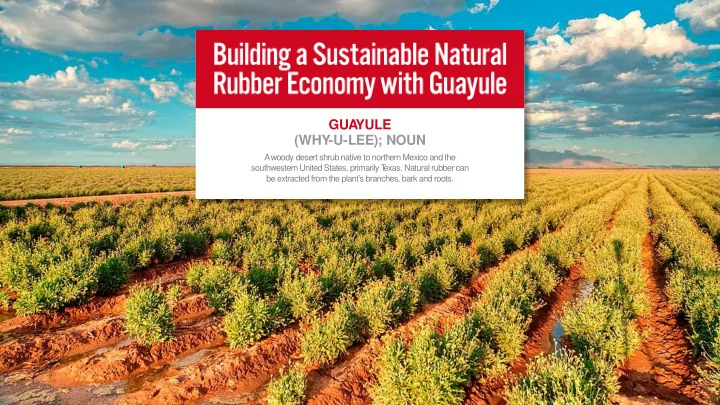
GUA YULE (WHY
- U-LEE); NOUN
A woody desert shrub native to northern Mexico and the southwestern United States, primarily T
- exas. Natural rubber can
be extracted from the plant’s branches, bark and roots.
GUA YULE (WHY -U-LEE); NOUN A woody desert shrub native to northern - - PowerPoint PPT Presentation
GUA YULE (WHY -U-LEE); NOUN A woody desert shrub native to northern Mexico and the southwestern United States, primarily T exas. Natural rubber can be extracted from the plants branches, bark and roots. The Case for Guayule - The
GUA YULE (WHY
A woody desert shrub native to northern Mexico and the southwestern United States, primarily T
be extracted from the plant’s branches, bark and roots.
The Case for Guayule - The Rubber-Centric View
Global = 12,300,000 MT Asia-Pacific = 11,300,000 MT US = 0
US = 1,700,000 MT ~ 70% used for tires
Natural Rubber: 28%
Textile: 3% Chemical: 5% Steel: 15% Synthetic Rubber: 23% Filler: 26%
Asia 8,747 93% Africa 482 5%
180 2% TOTAL 9,704 /1000ha % Total Production
Production by Region
Overview: Natural Rubber Today
500% fluctuation in 5-years 100% increase in 10-months
Natural Rubber – The Situation
Clonal mono-cultures Disease issues Biodiversity
Rapidly increasing labor costs Competition with low-labor alternative crops (palm oil) Climate change risk Geo-Political issues / Political instability Supply-demand imbalance as China/India demand grows
Long Term Vision for Natural Rubber Supply – Biologically Diversified
Hevea
(Hevea brasiliensis)
Guayule
(Parthenium argentatum)
Sustainable
Russian Dandelion
(Taraxacum kok-saghyz)
Hevea Tropical Climates Guayule Arid Climates Russian Dandelion Temperate Climates
Long Term Vision for Natural Rubber Supply – Geographically Diversified Sustainable
Bridgestone Approach to Guayule Rubber
is the world’s largest tire and rubber company, operating in more than 150 countries around the globe
Bridgestone Approach to Guayule Rubber
Bridgestone Biorubber Process Research Center (Mesa, AZ) Bridgestone Agro Operations Research Farm (Eloy , AZ)
Agriculture Program and Associated Challenges
Goal
To create a crop that can effectively integrate into and compete within the existing agricultural economy
Process & Rubber Product Optimization
We must balance technical needs, process complexity , up-time capability and investment to deliver a cost-competitive product
Bio-Rubber Process Research Center - Site Aerial View
Adopting a Bio-Refinery Approach
processes)
HARVESTED
Field Dried Shrub (15% water) 100%
HARVESTED & DEFOLIATED
Defoliated Shrub 92%
Rubber = 5.5% Resin = 6.5% Water = 15% Bagasse = 73%
Envisioning a New Domestic Industry
Agriculture:
Direct Seed 2 years Cutting harvest 1 2 years Cutting harvest 2 2 years Final harvest
Process: Products:
Bagasse 3.65 Million MT/yr Resin Rubber
Weight Basis)
moisture)
1,390 MT/day processing rate 350 annual operating days 487,000 MT/yr biomass input
USD Revenue
Per Factory
ethanol + RIN’s
Revenue
A $3.5+ Billion USD Industry at 25% scale
(domestic rubber basis)
“FROM SEED TO TREAD: BRIDGESTONE REVEALS FIRST TIRES MADE ENTIRELY OF NATURAL RUBBER COMPONENTS FROM COMPANY’S GUAYULE RESEARCH OPERATIONS”
The Bridgestone Group will continue its research activities with guayule and various other raw materials with the aim of achieving its long-term environmental vision of shifting towards 100 percent sustainable materials in tires by 2050.