Grown-ups Are People Too Promoting caregiver bonding with awesome - - PowerPoint PPT Presentation

grown ups are people too
SMART_READER_LITE
LIVE PREVIEW

Grown-ups Are People Too Promoting caregiver bonding with awesome - - PowerPoint PPT Presentation

Grown-ups Are People Too Promoting caregiver bonding with awesome early literacy programming Julie Crabb, Anythink Libraries Who am I? Julie Crabb Lilah Sue Crabb Why are we here? Why are we here? Caregiver Bonding Caregiver Bonding


slide-1
SLIDE 1

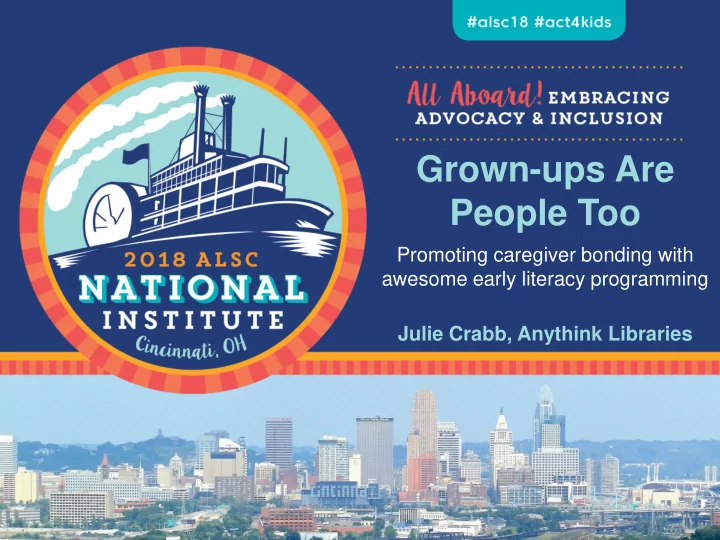
Grown-ups Are People Too

Promoting caregiver bonding with awesome early literacy programming Julie Crabb, Anythink Libraries
slide-2
SLIDE 2

Who am I?

Julie Crabb

Lilah Sue Crabb

slide-3
SLIDE 3

Why are we here?

slide-4
SLIDE 4

Why are we here?

slide-5
SLIDE 5

Caregiver Bonding

slide-6
SLIDE 6

Caregiver Bonding

  • Brain development (including

emotional, social and cognitive development) depends LARGELY

  • n a loving relationship with a

primary grown-up.

slide-7
SLIDE 7

Caregiver Bonding

Neglect and lack of attachment can lead to:

  • Increased depression risk due to a lack of growth in

the left hemisphere.

  • Anxiety disorders due to sensitivity in the limbic

system.

  • Learning disabilities and memory impairments due

to minimal growth of the hippocampus.

Rutter M. Resilience in the face of adversity. Protective factors and resistance to psychiatric disorder. The British Journal of Psychiatry. 1985;147:598–611. Teicher MD. Wounds that time won’t heal: the neurobiology of child abuse. Cerebrum: The Dana Forum on brain science. 2000;2:50–67.

slide-8
SLIDE 8

Caregiver Bonding

Lab mice put in the care of a loving adult (whether it was related or not) grew up to be a more loving parent to their own pups. Methylation changes – chemical patterns passing over generations

Champagne FA, Francis DD, Mar A, Meaney MJ. Variations in maternal care in the rat as a mediating influence for the effects of environment on development. Physiol.

  • Behav. 2003;79:359–371. doi: 10.1016/S0031-9384(03)00149-5.
slide-9
SLIDE 9

Caregiver Bonding

  • Children pick up what we throw down.
  • If positive experiences do not happen, the neural

pathways for the child may be lost.

  • If positive experiences do not happen, the grown-up

isn’t coming back.

slide-10
SLIDE 10

Caregiver Bonding

slide-11
SLIDE 11

Can I be cool?

slide-12
SLIDE 12

What I Did and Do

  • Step One: Slight adjustments to what I already do.
slide-13
SLIDE 13

Pop Songs in Storytime

I said a hip hop Hippie to the hippie To the hip, hip a hop, And you don't stop, A rock it To the bang bang boogie, Say up jump the boogie To the rhythm of The boogie, the beat

slide-14
SLIDE 14

Popular Culture Storytime

slide-15
SLIDE 15

Time for a Challenge

slide-16
SLIDE 16

What I Did and Do

  • Step One: Slight adjustments to what I already do.
  • Step Two: Research: What do grown-ups like to do?
slide-17
SLIDE 17

Research

slide-18
SLIDE 18

Mocktails & Masterpieces

slide-19
SLIDE 19

What I Did and Do

  • Step One: Slight adjustments to what I already do.
  • Step Two: Research: What do grown-ups like to do?
  • Step Three: Bring the cool stuff to the library.
slide-20
SLIDE 20

Cool Things That Cost Me $

  • Touched a Truck
  • Petted Instruments
  • Learned American Sign Language
  • Listened to Jazz Guitar
  • Watched a Polynesian Dance Performance
  • Had a Real Life Scientist Explain the Senses
  • Attempted Clay Sculptures
  • Created Abstract Art
  • Glued Collages
  • Drum Circle
  • Yoga Posed on the Patio
slide-21
SLIDE 21

Cool Things That Cost Me No $

  • Storytime Special
  • Opera Singer
  • Ballerina
  • Marching Band
  • Quarterback
  • Firefighter
  • Police Officers
  • Veterinarian
  • Dentist
  • Construction Worker
slide-22
SLIDE 22

What I Did and Do

  • Step One: Slight adjustments to what I already do.
  • Step Two: Research: What do grown-ups like to do?
  • Step Three: Bring the cool stuff to the library.
  • Step Four: Bring the library to the cool stuff.
slide-23
SLIDE 23

What I Did and Do

  • Step One: Slight adjustments to what I already do.
  • Step Two: Research: What do grown-ups like to do?
  • Step Three: Bring the cool stuff to the library.
  • Step Four: Bring the library to the cool stuff.
  • Step Five: Get trendy.
slide-24
SLIDE 24

GroovaRoo

“GroovaRoo Babywearing Dance Class - *ICE, ICE BABY* Line Dance.” YouTube, uploaded by GroovaRoo Dance, 16 March 2016, https://youtu.be/VelRPENV2eQ

slide-25
SLIDE 25

Babywearing Dance Primer

  • 1. Choose your music.
  • 2. Plan your routines.
  • 3. Know your safety and modifications.
  • 4. Promote!
  • 5. Wear a baby or baby-sized friend.
  • 6. Get your dance on!
slide-26
SLIDE 26

Babywearing Dance Primer

slide-27
SLIDE 27

Get Trendy

slide-28
SLIDE 28

Get Trendy Kid Pins Craft Club

  • Group voted on next

month’s project ahead of time

  • Library provided supplies
  • Sometimes we failed, but it

was funny

  • SOO many options
  • Plug that early literacy!
slide-29
SLIDE 29

What I Did and Do

  • Step One: Slight adjustments to what I already do.
  • Step Two: Research: What do grown-ups like to do?
  • Step Three: Bring the cool stuff to the library.
  • Step Four: Bring the library to the cool stuff.
  • Step Five: Get trendy.
  • Step Six: Evaluate, update and repeat.
slide-30
SLIDE 30

Stuff Does Not Stay Trendy Long

Change it up often Get young friends who know what’s cool Don’t stop, keep trying

slide-31
SLIDE 31

What Do I Hope You Took Away?

  • ALSC Competencies

– I. Commitment to Client Group

  • #6 - Assesses and responds on a regular and systematic basis to the needs and

preferences of children, their caregivers, educators, and other adults who use the resources of the children’s department, including those unserved and underserved by the library.

  • #7 - Cultivates an environment for enjoyable and convenient use of library

resources, specifically removing barriers to access presented by socioeconomic circumstances, culture, privilege, language, gender, ability, and other diversities.

– III. Programming Skills

  • #1 - Designs, promotes, presents, and evaluates a variety of programs for children,

with consideration of developmental stages and the needs, interests, and goals of all children, their caregivers, and educators in the community.

  • #4 - Integrates literacy-development techniques in program design and delivery,

engaging and empowering caregivers in a culturally competent way.

  • #6 - Establishes programs and services for parents, individuals and agencies

providing childcare, educators, and other professionals in the community who work with children.

  • #7 - Delivers programs outside or inside the library to meet users where they are,

addressing community and educational needs, including those of unserved and underserved populations.

slide-32
SLIDE 32

What Do I Hope You Took Away?

slide-33
SLIDE 33

Contact Me juliethecrabb@gmail.com @StorytimeCrabb talesforthetiny.com storytimeunderground.com