
SLIDE 1
Group presentation
March 2017
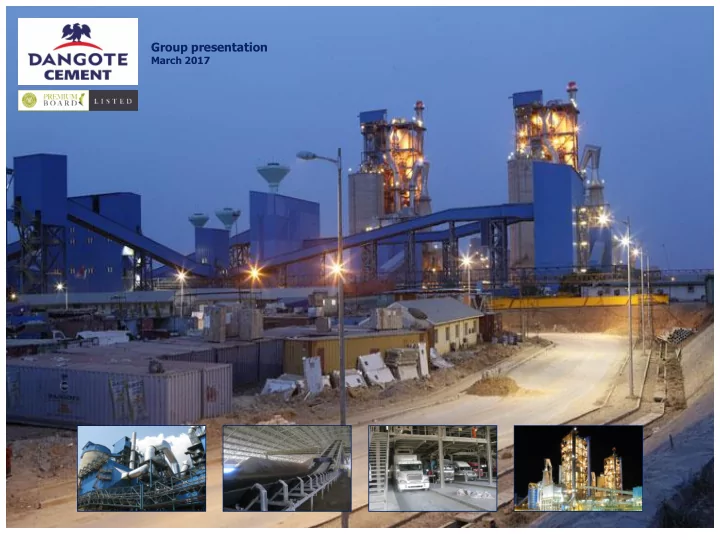
Group presentation March 2017 At a glance Largest cement producer - - PowerPoint PPT Presentation
Group presentation March 2017 At a glance Largest cement producer in Africa, 45.8Mta capacity as of March 2017 Operations in 10 countries across Africa Delivering strong financial and operating performance 23.6Mt cement sold
Group presentation
March 2017
2
– Operations in 10 countries across Africa
– 23.6Mt cement sold through operations in eight countries in 2016, up 25% on 2015 – FY 2016 revenues of ₦615.1bn, up 25% on 2015 – FY 2016 EBITDA of ₦257.2bn at 41.8% margin – Net debt of ₦240.8B, 0.94x EBITDA
– Market capitalisation $9bn; ca. 30% of total NSE capitalisation – A bellwether on the cement sector and on Africa’s growth
100 200 300 400 500 600 700 2010 2011 2012 2013 2014 2015 2016 Revenues (₦B) EBITDA (₦B)
3
₦B
20.3% CAGR 13.9% CAGR
5 10 15 20 25 2010 2011 2012 2013 2014 2015 2016 Nigeria Cameroon Ethiopia Ghana Senegal South Africa Tanzania Zambia
4
20.4% CAGR
Million tonnes
5
6
Cement demand driven by increasing population, urbanisation and prosperity Sub-Saharan Africa significantly lags global average per-capita cement consumption Huge opportunity for African producers to expand, replace imports, especially in West Africa, much of which lacks limestone Africa is the last major growth market for cement with relatively little surplus capacity at present High capital cost of entry, construction time and access to resources are key barriers to entry Key markets are Nigeria, Ethiopia, South Africa; cement ‘majors’ with high net debt/EBITDA are less able to take on additional debt to to finance entry to these markets Cement is an essential building material with no viable substitutes, Africa needs billions of tonnes in the coming decades Many incumbents are sub- scale, use older technologies, so are vulnerable to well- funded industry disruptors
7
financial services e.g. banking, mortgages, credit
urbanisation continues across the continent, demanding more infrastructure, housing and commercial building
Positive long-term mega-trends
Source: Industry Sources, BMI, World Bank, IMF 1. Global average includes China.
and exports)
multipliers’ e.g. infrastructure, with positive feedback for cement demand
Supportive growth factors
Attractive long-term economic potential Rapid Increase in Urbanisation Presents Strong Opportunity
408m 1,427m 634m 1,046m 1,041m 2,473m 2010 2050
Urban Rural Liberia Niger Ethiopia Mali Zimbabwe Sierra Leone Tanzania Senegal Kenya Nepal Cameroon Côte d’Ivoire Zambia Ghana
Laos
Congo
Palestine Pakistan
Nigeria 100 200 300 400 500 600 1,000 2,000 3,000 4,000 5,000 6,000
Global Average: 573kg(1)
Materially Lower Cement Consumption in Africa
GNI US$ Per-capita cement consumption (Kg)
> 4x North America’s current population
8
is the key and irreplaceable ingredient
scarce across many parts of Africa – Ideally need high-quality limestone to be near demand centres, fuel and distribution network
especially in key southern regions near to demand centres, export facilities – Nigeria also has good-quality coal that we will mine to achieve self-sufficiency in fuel
especially coastal states, forces those countries to import bulk cement or its intermediate product, clinker, usually from Far East and Nigeria
life of mine in excess of 30 years
serve West Africa and Cameroon from Nigerian factories, exporting by road and in time by sea
Limestone in Nigeria is high quality and close to demand centres
9
Grow and diversify across the last and potentially most attractive major growth market for cement
Strategic Pillars / Long-Term Goals Consolidate expansion across Africa Achieve leadership in key markets Tap high-value export markets Capture local markets with superior quality and service Adhere to global standards of governance Improve sustainability
Strive to obtain a #1 or #2 position in each market, with at least 30% share Serve landlocked markets with high sales prices and margins, generate FX to offset imported raw materials Serve markets with delivered product instead of factory gate sales; use financial strength to improve service, reduce costs Achieving international standing through good governance enables us to access global financial markets Be most energy and CO2 efficient company in our industry, with low environmental footprint when compared to peers
– Target high-growth, populous markets with cement deficits and older/less efficient producers – Be the leader in quality, costs and service wherever we operate – Expand quickly and profitably when rivals are hampered by debt or smaller scale
Size and buying power enables favourable procurement of plants at lower cost; brownfield increases returns Careful market selection looks for countries with good resources, cement deficit, ageing peers and investment incentives Larger scale of plants built with high degree of standardisation and prefabrication to reduce capex, improve returns New quarries enable
highest quality raw materials, improving product quality Good emissions control helps environment, improves competitiveness in face of increasing industry regulation Strong focus on quality ensures best-quality materials, manufacturing processes and end products, reduces waste Fuel strategy improves margins by bulk procurement, switch to lower-cost kiln/power fuels e.g. coal Larger kiln sizes enables higher-efficiency production of clinker in most expensive step of production Use of modern vertical rolling mills enables finer cement grinding, improves quality with positive impact on setting time for block makers Highly automated packing and loading reduces manual loading, enables higher throughput through packing lines Ability to buy/operate trucks in bulk enables superior distribution capabilities, extends market reach
10
11
Board of Directors
Aliko Dangote (1) Onne van der Weijde Olakunle Alake Sani Dangote Abdu Dantata Ernest Ebi* Devakumar Edwin Emmanual Ikazoboh* Fidelis Madavo Joseph Makoju Olusegun Olusanya * Dorothy Ufot * Douraid Zaghouani
Finance & General Purpose Committee Olusegun Olusanya(1) Olakunle Alake Sani Dangote Ernest Ebi Devakumar Edwin Emmanuel Ikazoboh Fidelis Madavo Audit, Compliance & Risk Committee Ernest Ebi(1) Olakunle Alake Sani Dangote Devakumar Edwin Emmanuel Ikazoboh Fidelis Madavo Olusegun Olusanya Dorothy Ufot Remuneration & Governance Committee Emmanuel Ikazoboh Sani Dangote Abdu Dantata Ernest Ebi Devakumar Edwin Joseph Makoju Olusegun Olusanya Dorothy Ufot Nomination Committee Aliko Dangote(1) Ernest Ebi Emmanuel Ikazoboh Olusegun Olusanya Fidelis Madavo Technical Committee Fidelis Madavo(1) Olakunle Alake Abdu Dantata Ernest Ebi Devakumar Edwin Joseph Makoju Douraid Zaghouani Statutory Audit Committee(2) Robert Ade-Odiachi(1) Nicholas Nyamali Sheriff Yussuf Olakunle Alake Olusegun Olusanya Emmanuel Ikazoboh
Note: * denotes Independent Non-Executive Directors. 1. Chairman of Committee. 2. The Statutory Audit Committee is not a Committee of the Board.
56 58 106 106 166 214 232 50 100 150 200 250 2010 2011 2012 2013 2014 2015 2016
Annual Report Pages
12
and greater transparency
International standards of governance EHSS commitments
Improving corporate disclosure
13 +45.4%
14
Regional revenues (₦B)
Year to 31st December 2016 2015 Change Nigeria 426.1 389.2 9.5% Pan Africa 195.0 103.5 88.5% Inter-company sales (6.1) (1.0) 526% Total 615.1 491.7 25.1%
Regional sales volumes (‘000 tonnes) +45.4% +00.0%
13,290 15,128 5,609 8,639 5,000 10,000 15,000 20,000 25,000 2015 2016 Nigeria Pan-Africa
Before inter-company eliminations
Year ended 31st December 2016 2015 ₦B ₦B % change Comments Revenue 615.1 491.7 25.1%
Driven by strong volume growth
Cost of sales (323.8) (201.8) 60.5% Gross profit 291.3 289.9 0.5% Gross margin 47.4% 59.0% EBITDA 257.2 262.4 (2.0%)
Lower average pricing, unfavourable fuel mix, Pan-Africa dilution
EBITDA margin 41.8% 53.4% EBIT 182.5 207.8 (12.2%) EBIT margin 29.7% 42.3% Net finance income (1.6) (19.5) (92.0%)
Includes net FX gain of ₦41B
Profit before tax 180.9 188.3 (3.9%) Income tax (expense)/credit 5.7 (7.0)
2% effective tax rate in Nigeria
Profit for the period 186.6 181.3 2.9% Earnings per share 11.34 10.86 4.5% Dividend per share 8.5 8.0 6.25% 15 Income Statement
16 Movement in net debt Cash ₦B Debt ₦B Net debt ₦B As at 1st January 2016 40.8 (245.0) (204.2) Cash generated from operations before changes in working capital 243.9 243.9 Changes in working capital 35.9 35.9 Income tax paid (1.1) (1.1) Additions to fixed assets* (136.2) (136.2) Other investing activities (0.7) (0.7) Change in non-current prepayments 17.3 17.3 Net interest payments** (36.4) (36.4) Net loans obtained (repaid) 84.2 (84.2)
4.4 (27.3) (22.9) Dividend paid (136.3) (136.3) As at 31st December 2016 115.7 (356.5) 240.8
*Completion of Tanzania, Congo, Sierra Leone, coal conversions and trucks **Average rate on loans is 13%
17 As at As at 31/12/16 31/12/15 ₦B ₦B Property, plant and equipment 1,155.7 917.2 Other non-current assets 64.9 25.1 Intangible assets 4.1 2.6 Current assets 187.5 125.2 Cash and cash equivalents 115.7 40.8 Total Assets 1,527.9 1,110.9 Non-current liabilities 65.8 57.2 Current liabilities 308.3 164.1 Debt 356.5 245.0 Total liabilities 730.6 466.2 Net Assets 797.3 644.7 Net debt as % of net assets 30.2% 31.2%
Balance sheet
18
*Including overdraft
19
1996 1997 1998 1999 2000 2001 2002 2003 2004 2005 2006 2007 2008 2009 2010 2011 2012 2013 2014 2015 2016
Manufactured Imported Million tonnes
20
– 14.8Mt sold within Nigeria, despite recession
– Most of uplift was from pricing, but cheaper fuel mix helped
– Exports of 366kt higher than imports of c350kt
– Own-mined coal expected soon – Advantage of self-sufficiency and reduced need for FX
– National promotions reward consumers and retailers – Strong brand recognition
– 241,000km covered Nigeria performance
Year to 31st December 2016 2015 Change
Volumes* (kt) 15,128 13,290 13.8% Revenue* (₦B) 426.1 389.2 9.5% EBITDA* (₦B) 242.0 247.5 (2.2%) EBITDA margin 56.8% 63.6%
1,000 2,000 3,000 4,000 5,000 Q1 Q2 Q3 Q4 2014 2015 2016
Quarterly sales (‘000 tonnes)
* Excl. corporate costs and inter-company eliminations (see note 4 to accts)
21
22
₦ 1,327 ₦ 1,462 ₦ 1,150 ₦ 1,567 ₦ 1,581 ₦ 1,629 ₦ 1,652 ₦ 1,367 ₦ 1,271 ₦ 1,414 ₦ 1,462 ₦ 2,033 ₦ 2,081 ₦ 2,224 ₦ 2,462
$167 $177 $142 $189 $176 $164 $166 $137 $128 $142 $145 $131 $134 $141 $156
$120 $130 $140 $150 $160 $170 $180 $190 $200 ₦ 0 ₦ 500 ₦ 1,000 ₦ 1,500 ₦ 2,000 ₦ 2,500 Jan-14 Feb-14 Nov-14 Dec-14 Feb-15 Mar-15 May-15 Sep-15 Oct-15 May-16 June-16 Aug-16 Sep-16 Jan-17 Feb-17
₦/bag (LH scale) $/tonne (RH scale)
23
– Better fuel mix – Additional price adjustment of +₦150/bag at start of Q1 and ₦250 in February, inc VAT
₦ 23,743 ₦ 25,738 ₦ 28,192 ₦ 37,817 ₦ 14,549 ₦ 13,729 ₦ 12,407 ₦ 24,859 3,000 3,500 4,000 4,500 5,000 ₦ 0 ₦ 5,000 ₦ 10,000 ₦ 15,000 ₦ 20,000 ₦ 25,000 ₦ 30,000 ₦ 35,000 ₦ 40,000
Q1 Q2 Q3 Q4
Revenue per tonne EBITDA Per Tonne Volume ('000 tonnes)
61.3% 53.3% 44.0% 65.7%
24
Kiln fuel (cement plant) 36% Power Plant 12% Limestone 0.4% Mine costs 2% Gypsum 4% Packaging 9% Refractories 1% Other variable 3% Maintenance 5% O&M contract 4% Direct wages 6% Plant general 6% SG&A 12%
% of average cash costs per tonne (Nigeria, 2016) Approximately 55%-60% of cash costs are US$ based
25
since 2014
production shutdowns prior to use of coal (especially 2014)
+46% +47%
Relative cost of alternative fuels vs gas per tonne of clinker Obajana Ibese Own-mined coal 0.7x 0.7x Locally bought coal 0.8x 0.8x Imported coal 1.2x 0.9x Gas 1.0x 1.0x LPFO 2.5x 1.8x Obajana & Ibese fuel mix
63% 55% 38% 43% 23% 9% 15% 23% 72% 81% 39% 49% 43% 32% 22% 33% 27% 28% 43% 40% 45% 24% 19% 61% 50% 35% 5% 23% 29% 30% 48% 48% 45% 31% 5% 22%
0% 20% 40% 60% 80% 100% Jan Feb Mar Apr May Jun Jul Aug Sep Oct Nov Dec Average
Gas Coal LPFO
26
+46% +47%
Ibese Obajana Mines Gboko
27
+46% +47%
Gboko 2008 2009 2010 2011 2012 2013 2014 2015 2016 2017 2018 2019 Line 1 Line 2 Ibese 2008 2009 2010 2011 2012 2013 2014 2015 2016 2017 2018 2019 Line 1 Line 2 Line 3 Line 4 Feb Obajana 2008 2009 2010 2011 2012 2013 2014 2015 2016 2017 2018 2019 Line 1 Line 2 Line 3 Line 4 Feb Tax holiday
28
– Start-up and diesel costs in Tanzania weighed on margins
– But proves benefits of diversified production/revenue base
Cement sales ('000 tonnes)
1,000 2,000 3,000 4,000 5,000 6,000 7,000 8,000 9,000 2015 2016
Rest of Africa performance
Year ended 31st December 2016 2015 Change
Volumes sold (kt) 8,639 5,609 54.0% Revenue (₦B) 195.0 103.5 88.5% EBITDA* (₦B) 26.5 25.1 5.5% EBITDA margin 13.6% 24.2%
* Excluding corporate costs and eliminations (see note 46to accounts)
29
30
31
by gas turbines in June/July
+46% +47%
32
+46% +47%
pilot monitoring studies
management reviews
33