Greg Hager, Johns Hopkins University - - PowerPoint PPT Presentation
Subcommittee on Research and Technology Hearing A Review of the Networking and Information Technology Research and Development (NITRD) Program Greg Hager, Johns Hopkins University
NITRD Review: Context
Cochair (with Susan Graham) of NITRD review
– Biannual examination of coordination program spanning computing research across 18 Federal agencies
Several recommendations related to
reorganization as well as highlighting the evolution of the field
Testimony to the Research and Technology
subcommittee of the Space, Science, and Technology committee
1
R&T Subcommittee
Subcommittee of Science, Space, and Technology The Subcommittee on Research and Technology has
legislative jurisdiction and general oversight and investigative authority on all matters relating to science policy and science education
– Intergovernmental mechanisms for research – National Science Foundation – NIST – DoT R&T – DHS R&T – ….
2
https://science.house.gov/subcommittees/subcommittee-research-and-technology-114th-congress
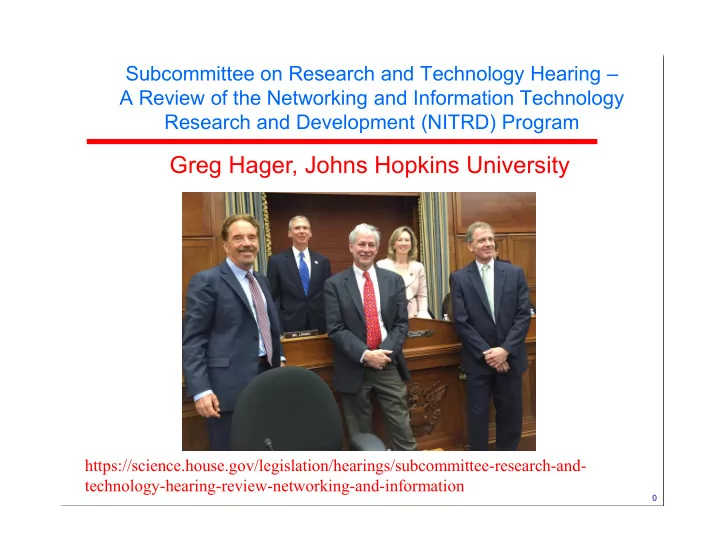
Subcommittee on Research and Technology Hearing – A Review of the Networking and Information Technology Research and Development (NITRD) Program
3
https://science.house.gov/legislation/hearings/subcommittee-research-and- technology-hearing-review-networking-and-information
More Context
The “Truthy” incident in CISE; SBE under siege
4
Science, Oct 2014
More Context
The “Truthy” incident in CISE; SBE under siege Prior reports went relatively unnoticed – a chance to
make the case for computing
Keith Marzulo in NCO – more effective at implementing
recommendations
Siedel --- unknown to me, but in the HPC world which
ties to history of NITRD
No industry person on the panel.
5
The Game Plan
- Highlight the importance of an expansive view of Computing
Research and its ties to national priorities
– Cybersecurity – IT & Health – IT & the Physical World (Robotics, IoT) – Cyber-human Systems – Privacy – High-Capability Computing – Big-Data & Data Intensive Computing – Foundational IT Research – Education and Training
- Argue for reorganizing NITRD to better reflect these priorities
- Hope it’s a friendly hearing that doesn’t include Lamar Smith
6
My remarks tended to emphasize the value
- f SBE collaboration
Hearing Day!
Surprise 1: Lamar Smith is there! Surprise 2: Ed Seidel says this:
8
Hearing Day: Back and Forth
Two examples Q&A with video – Interesting chit-chat afterwards with the
subcommittee co-chairs
9
Post Hearing Day: Questions
Hultgren
– How can we improve the effectiveness of NITRD?
Lipinski
– Siedel: More coordination between NITRD and Committee on Science? – Should we broaden the notion of infrastructure? To what? – Can/should NITRD be more strategically oriented?
Esty
– How can we better grow the K-12 pipeline; how are your recommendations different?
10
Post Hearing Day: Questions
Comstock
– How do you choose the areas? – What is most important? – How can NITRD improve cybersecurity? – Are agencies responding to cybersecurity needs? – Is there more they can do? – How does NITRD support supercomputing research efforts like COMET? – Why is investing in NITRD activities important? – Where can we save money? – How can we grow the student pipeline? – How does NIT enhance national security and competitiveness? – Should industry be involved? – Explain end-to-end security – What are the important areas for research in the future?
11
Why is investing in NITRD activities important?
12
Where should Congress focus its federal IT R&D investments when it faces tough budget and deficit decisions and why?
13
… I would strongly advocate that Congress, rather than mandating where funding is spent, allow the NITRD agencies to set their own priorities to ensure they maintain a robust and broad-based program, and one which encourages the most creative and enterprising researchers to pursue their ideas.
14
Information technology evolves continuously and rapidly. As our Working Group noted in the report, our choices today are governed by the evolution of technology itself, the implications of that technology for society, and the influence of society on technology needs. The research questions of the future will be necessarily different from the issues of the present and are difficult to predict. Indeed, this is why continuous review of our research investments in IT R&D is important -- to keep identifying the important topics of the time in order to maintain the lead that the U.S. has enjoyed so far.
What are the important areas for research in the future?
The final result:
15