Greater Cincinnati Water Works – 1817 to 2017 - H200 – Celebrating 200 Years
Greater Cincinnati Water Works: Lead Service Line Replacement - - PowerPoint PPT Presentation
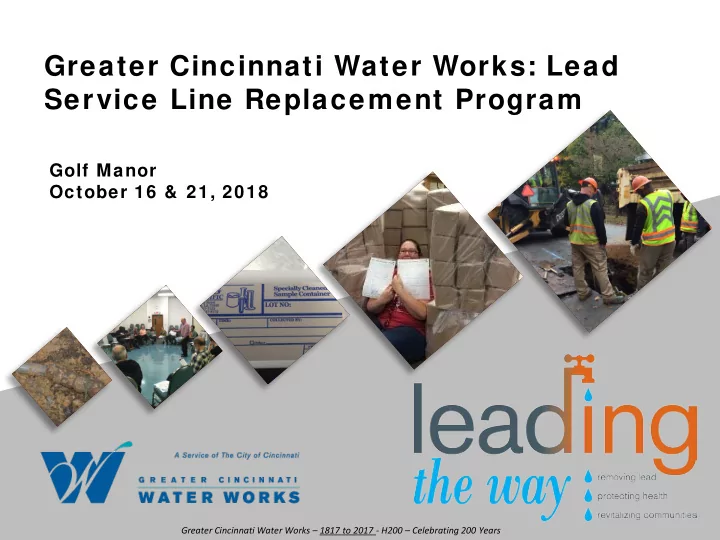
Greater Cincinnati Water Works: Lead Service Line Replacement Program Golf Manor October 16 & 21, 2018 Greater Cincinnati Water Works 1817 to 2017 - H200 Celebrating 200 Years Presentation Agenda Harmful effects of lead
Greater Cincinnati Water Works – 1817 to 2017 - H200 – Celebrating 200 Years
- Harmful effects of lead
- Problems of lead in drinking water
- GCWW lead service lines (LSL) issues
- GCWW Lead Service Line Replacement Program (LSLRP)
- Challenges faced with the LSLRP
- LSL Replacement example showing cost/benefits
- Questions
Presentation Agenda
Greater Cincinnati Water Works – 1817 to 2017 - H200 – Celebrating 200 Years
The Extent of the Problem Lead Service Lines by State
Cincinnati Health Department (CHD)
Childhood Lead Poisoning Prevention Program (CLPPP)
- CHD CLPPP Formed in 1974
- 1978 Lead-based Paint is banned from residential use
- Public Health Lead Investigations for children with
Elevated Blood Lead Levels
CHD CLPPP
Public Health Lead Investigation
- Directed by state law to determine the source of lead
- Primary focus is lead-contaminated dust from:
- Deteriorated Lead-Based Paint
- Soil contaminated from LBP and/or use of leaded gasoline
CHD CLPPP
Childhood Lead Poisoning
Lead Poisoning, #1 Environmental Disease in Children
- Lead is a powerful neurotoxin
80% of childhood lead poisoning is from their home
- Lead Based Paint was in residential use until 1978
Lead Poisoning is entirely preventable
- Outreach and Education
- Proper control of Lead Hazards
CHD CLPPP
Childhood Lead Poisoning
Deteriorated Lead Based Paint (LBP)
- A result of “deferred maintenance”
- Improper repair makes the problem worse
Lead Contaminated Dust
- Children are exposed from hand-mouth behavior
- Created from LBP and contaminated soil
Lead Contaminated Soil
- From LBP and fumes from leaded gasoline
- Tracked into the home
CHD CLPPP
Partnership with Greater Cincinnati Water Works (GCWW)
Lead Contaminated Water
- Lead Service Lines
- Lead solder/Lead-containing fixtures
Water Exposure
- Higher levels in hot or stagnant water
- Formula-fed infants at greater risk
Sampling
- Nurses draw a water sample at PHLI
- Advice on
- Consuming from cold tap
- Flushing before consumption
CHD CLPPP
Lead in the Body
How it enters
- Through the digestive tract
- Through the lungs
Within the body
- Mistaken for Iron and/or Calcium
- Absorbed in the blood and bones/teeth
Rate of Absorption
- Children up to 50%
- Adults 5-10%
CHD CLPPP
There is No Safe Level of Lead in the Body
Effects on the child
- Causes lowered IQ
- Causes behavioral issues
Effects in Education
- Causes attention deficits/speech delays/learning problems
- Causes a higher drop-out percentage
Effects to Society
- Lower lifetime earning potential
- Linked to adult criminal behavior
CHD CLPPP
There is No Safe Level of Lead in the Body
Effects on adults
- Headache/Nausea
- Irritability/Fatigue
- Impaired Concentration/Linked to Alzheimer’s
- Reproductive issues
- Anemia
- Osteoporosis
- High Blood Pressure/Heart disease
CHD CLPPP
Is it Lead?
CHD CLPPP
Is it Lead?
CHD CLPPP
Other Potential sources of Lead
- Imported powders
- Hobbies
- Containers
- Occupation
- Food/Candy
- Play Jewelry
- Remodeling
CHD CLPPP
Other Potential sources of Lead: Hobbies/Occupation
- Gardening
- Demolition
- Ceramic Glazes
- Fishing
- Firearms
- Vehicles
- Preparation for Painting
CHD CLPPP
Other Potential sources of Lead: Containers
- Cans
- Pewter
- China
- Cut-glass
- Brass
- Ceramics
- Pottery
CHD CLPPP
What Can You Do?
- Wash Hands
- Cover Soil
- Wet Clean
- Vacuum
- Remove Shoes
- Healthy Diet
- Flush/Filter/Replace Water Lines
CHD CLPPP
What Can You Do?
- Have your child tested
- Consider having yourself tested
- Have your water tested
- Learn about Lead Safety
CHD CLPPP
Required for Pre-1978 Homes
- When buying or renting
- When renovating/repairing
- r any window replacement
- EPA Certified Firm
CHD CLPPP
Partnership with Greater Cincinnati Water Works (GCWW)
Grant Funds for Low-Income Families
- HUD - City partnered with Hamilton County to receive
- $3 million for Lead Paint Hazard Control
- $400,000 in supplemental Healthy Homes funds
- May be used to remove/replace private lead service line
- Medicaid – Statewide SCHIP funds
- Lead Paint Hazard Control
- No $$ for Lead Service Lines
Greater Cincinnati Water Works – 1817 to 2017 - H200 – Celebrating 200 Years
What does GCWW do to control lead in drinking w ater?
- Lead & Copper Rule (LCR)
– Must provide optimal corrosion control treatment (to contain lead) – Test “worst case” homes to ensure it is working
- GCWW has had corrosion control treatment for years
– Goal to immobilize lead through coating deposition on pipe walls – Corrosion control treatment is working – Less than 15 parts per billion in more than 90 percent of the samples (97% of 3,907 tests analyzed)
- However, only so much can be controlled by water utility
Greater Cincinnati Water Works – 1817 to 2017 - H200 – Celebrating 200 Years
Why is lead a problem in drinking w ater systems?
- The lead risk in water:
– Water services lines. Estimated 6.1 Million in U.S.* – Fixtures and fittings containing lead
- The solution for drinking water:
– Keep lead contained (via a pipe coating) OR – Remove lead bearing materials
- However:
– Containment doesn’t always work, or gets disrupted
- Flint, MI – no corrosion control treatment
- Disturbance of a water service (such as water main replacement
project or home plumbing work) can cause spikes in lead
- Stagnant water or low usage fixtures can result in elevated lead
levels – Removal is the only way to permanently mitigate risk * From Cornwell, et al. JAWWA 2016
Greater Cincinnati Water Works – 1817 to 2017 - H200 – Celebrating 200 Years
Lead Service Line Replacement Problem - It’s Expensive
- GCWW stopped using lead service lines in 1927
– GCWW records indicate ~44,000 lead service line
- ~39,000 lead service lines within Cincinnati limits
- ~5,000 lead service lines within surrounding municipalities
we serve
- ~22 within Golf Manor (as per GCWW records)
- Replacement costs:
– Current estimate around $5,500 per branch, private side replacement only – That’s at least a $242,000,000 bill
Greater Cincinnati Water Works – 1817 to 2017 - H200 – Celebrating 200 Years
GCWW Enhanced Lead Program Brief History
- Flint, MI and national attention towards lead
service lines
- October 2016 Cincinnati City Council passes
Ordinance No. 326-2016
– Replace all known public and private LSL within fifteen years – Property assessment as financing option – Establish a customer assistance program, Help Eliminate Lead Pipes (HELP), to help-low income property owners with replacement costs
- Created a two tier approach
Greater Cincinnati Water Works – 1817 to 2017 - H200 – Celebrating 200 Years
Tier 1 Lead Program Solutions: Communication and Education
- lead.mygcww.org
- 513-651-LEAD Hotline
- Social Media
- Letters sent to customers who have lead
service branches
- Free Lead Testing
- School Lead Testing
- Partnership with local Health Departments
- Water Filter Pitchers
- LSL Lookup Map
Greater Cincinnati Water Works – 1817 to 2017 - H200 – Celebrating 200 Years
Lead Aw areness Website:
Lead.myGCWW.org
Greater Cincinnati Water Works – 1817 to 2017 - H200 – Celebrating 200 Years
LSL Lookup Map
Greater Cincinnati Water Works – 1817 to 2017 - H200 – Celebrating 200 Years
Tier 2 Lead Program Solutions: Lead Service Line Replacement Program (LSLRP)
- June 2017 Cincinnati City Council passed several
- rdinances to establish our LSLRP. LSLs are no
longer permissible ‒ Ordinance No. 185-2017 modified provisions of Cincinnati Municipal Code (CMC) Chapter 401 giving GCWW the authority to operationalize the LSLRP and replace LSLs in our service area ‒ Ordinance No. 186-2017 established the funding needed to perform the LSLRP ‒ Ordinance No. 187-2017 established the mechanisms necessary to start the customer assistance program.
Greater Cincinnati Water Works – 1817 to 2017 - H200 – Celebrating 200 Years
Lead Service Line Replacement Program
When are LSLs Replaced?
- As part of GCWW water main replacement project
‒ Capital Improvement Projects ‒ Street Improvement Projects
- “One-Off’s” (Pre-qualified Plumbers/Contractors List)
‒ Customer contacts GCWW and wants their LSL replaced ‒ Customer has leaking or damaged LSL needing replacement ‒ Customer has missing meter and service line is a LSL ‒ As part of development project requiring new water main with existing LSL ‒ Home demo/renovations requiring LSL work
Greater Cincinnati Water Works – 1817 to 2017 - H200 – Celebrating 200 Years
Lead Service Line Replacement Program
Replacement Process
- Initial water main replacement letter (water main
replacement projects only)
- 45-day letter notification – Property owner contract
‒ Option 1; self-perform replacement ‒ Option 2; join LSLRP program
- Replacement of LSL
- Post construction information/water filter pitcher
- Final bill to property owner with payment options
‒ Pay in full, partial pay or assessment option (Cincinnati Only) ‒ Pay in full, if no assessment option available
Greater Cincinnati Water Works – 1817 to 2017 - H200 – Celebrating 200 Years
Lead Service Line Replacement Program
Program Benefits
- GCWW coordinates all the work
- Cost Sharing Program, up to 40% ($1,500 Max.) of
private side replacement cost will be provided by utility (all property owners)
- Property Assessment (0% interest) to pay balance over
5 or10 year period (Cincinnati only)
- Customer Assistance Program (HELP) for low-income
customers to obtain additional money towards the
- balance. Currently 30% reduction of final bill after
GCWW cost participation
Greater Cincinnati Water Works – 1817 to 2017 - H200 – Celebrating 200 Years
Lead Service Line Replacement Program
Challenges - Affordability
- Across Hamilton County, over one-third of households, more
than 110,000, are burdened by the cost of their housing and spend more than 30% of their income on housing costs.1
- Water/sewer bill already financially challenging for many
- Payback options limited for jurisdictions outside of Cincinnati
‒ Traditional or home equity loans ‒ Hamilton Co. Home Improvement Program
- No grant assistance available for Ohio
‒ State Revolving Fund (SRF) loans are available
1 Housing Affordability in Hamilton County; An analysis of households, housing affordability,
and housing subsidy in Hamilton County and Cincinnati, Ohio, February 2017; Community Building Institute (CBI) at Xavier University and Local Initiatives Support Corporation (LISC)
- f Greater Cincinnati & Northern Kentucky
Greater Cincinnati Water Works – 1817 to 2017 - H200 – Celebrating 200 Years
Lead Service Line Replacement Program
H.E.L.P. – Help Eliminate Lead Pipes
- Customer assistance program for qualified property owners
to assist in cost of LSL replacements
- Any property owner may apply
- Donations fund the program. Partnering with a non-profit
(501c3)
- One-time cost benefit applied as a credit on the LSL
replacement final bill
- Property owner income must be equal to or less than the
Low-Income (80%) Limits for Hamilton County as defined by HUD Income Limits Summary.
- Qualifying customers receive a 30% credit applied to their
final LSL replacement bill after any GCWW cost participation benefits have been applied.
Greater Cincinnati Water Works – 1817 to 2017 - H200 – Celebrating 200 Years
Lead Service Line Replacement Program
Replacement Example
- $5,500 replacement cost
- Minus $1500 cost share by GCWW
- $4,000 remaining property owner balance
- Property owner elects to pay back over 10 years
- divided by 10 payments (2/yr)
- = $200 added to semiannual tax bill
- = $33.33 per month
- If qualified for HELP Program = $23.33 per month
- Monthly payments is approximately 50% less than
- riginal amount
Greater Cincinnati Water Works – 1817 to 2017 - H200 – Celebrating 200 Years
Kathy Frey GCWW Community Liaison Lead Hotline #: 513-651-LEAD (5323) Email : kathleen.frey@gcww.cincinnati-oh.gov Jason DeLaet, P.E. GCWW Enhanced Lead Program Manager Supervising Engineer Office #: 513-591-5007 Email : jason.delaet@gcww.cincinnati-oh.gov Cynthia McCarthy, Senior Sanitarian Cincinnati Health Department HUD Program Manager Office #: 513-357-7433 Email : cynthia.mccarthy@cincinnati-oh.gov