WIC to 5:Retention of Participants Through the First Five Years - - PDF document

wic to 5 retention of participants through the first five
SMART_READER_LITE
LIVE PREVIEW

WIC to 5:Retention of Participants Through the First Five Years - - PDF document

6/1/2015 WIC to 5:Retention of Participants Through the First Five Years Update STEPHANIE BESS, MS, RD, LDN ILLINOIS WIC NUTRITION SERVICES COORDINATOR Outline Background and purpose Description of the WIC to 5 program What do we know to


slide-1
SLIDE 1

6/1/2015 1

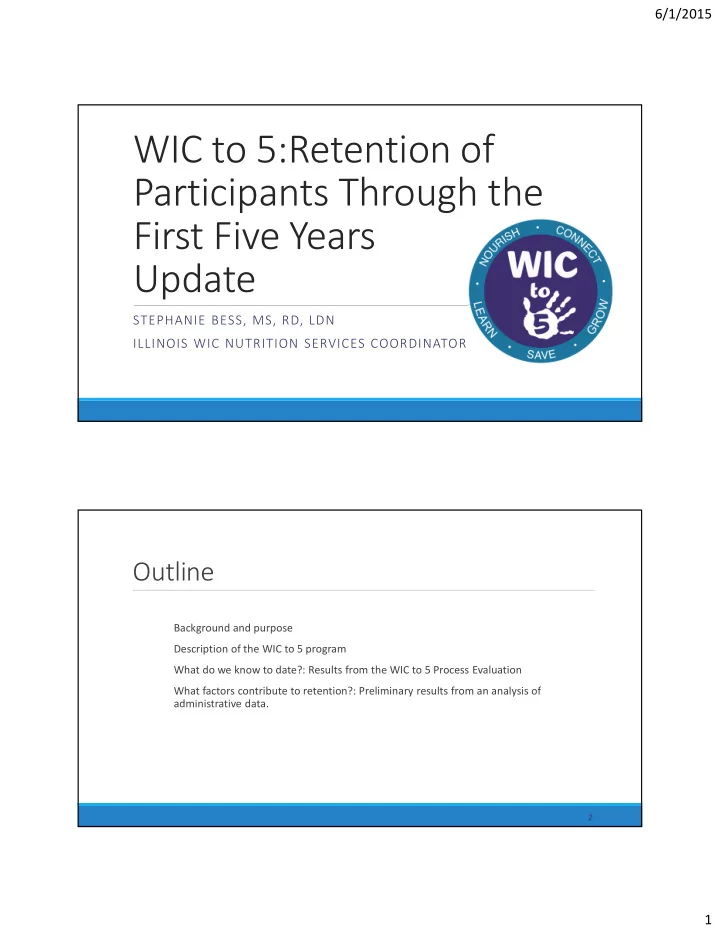
WIC to 5:Retention of Participants Through the First Five Years Update

STEPHANIE BESS, MS, RD, LDN ILLINOIS WIC NUTRITION SERVICES COORDINATOR

Outline

Background and purpose Description of the WIC to 5 program What do we know to date?: Results from the WIC to 5 Process Evaluation What factors contribute to retention?: Preliminary results from an analysis of administrative data.

2

slide-2
SLIDE 2

6/1/2015 2

Background and Purpose

3

WIC to 5 is a collaboration between the Illinois WIC program and researchers at the University of Illinois-Chicago, Department of Kinesiology and Nutrition to increase participation and retention of eligible children in WIC. Four intervention agencies (Roseland Hospital, McLean County WIC, Macon County WIC, and Vermilion County WIC). Four comparison agencies (Mt. Sinai Hospital WIC, Peoria County WIC, DeKalb County WIC, and Kankakee County WIC). Analysis of Illinois WIC administrative data of infants born in 2008 (Starting with infants born in September 2008)

  • !"

Overview of IL WIC Program

4

slide-3
SLIDE 3

6/1/2015 3

Illinois WIC Retention Project

5

2011-2012 Formative Research

  • Focus groups, interviews, surveys

2013 WIC to 5 Program Development 2014 Pilot Program Launch 2015 Pilot Program and Evaluation; Administrative Data Analysis 2016 Statewide Launch

Goals of WIC to 5

6

Raising Client Awareness of WIC Eligibility and Benefits Increase Staff Incentives and Promote Staff Wellness Increase Image/Understanding of WIC among Health Care and Child Care Providers Provide Outreach and Potentially Training for Vendors

slide-4
SLIDE 4

6/1/2015 4

WIC to 5 Model (Theory of Planned Behavior)

7

Attitude/Beliefs About Staying in WIC Intention to Stay in WIC Recertification Pick-Up Missed Appts. Redemption Social Support to Stay in WIC Facilitators/ Barriers to Stay in WIC

What is Included? (Theory of Planned Behavior)

8 *Targeted Communication to Clients

Intention to Stay in WIC Recertification Pick-Up Missed Appts. Redemption

*Community Outreach *Strategic Partnerships *Shopping Education Module *Vendor Outreach *Staff Incentives and Wellness

slide-5
SLIDE 5

6/1/2015 5

What is Included?

TARGETED COMMUNICATION COMMUNITY OUTREACH

9

Increase Perceived Value of the WIC Food Package. Increase Awareness about WIC Eligibility. Promote Trust and Reduce Perceived Judgment from WIC Staff. Increase Awareness About and Perceived Value of the WIC Program Among Family Members, Community Leaders, and Other Service Providers (In Process).

What is Included?

STRATEGIC PARTNERSHIPS SHOPPING EDUCATION MODULE

10

Increase Perceived Value of the WIC Program Among Physicians and Child Care Providers Reduce Barriers Associated with Shopping. Improve Recognition of WIC-eligible Foods and Package Sizes. Reduce Perceived Stigma Associated with Redeeming WIC Checks.

slide-6
SLIDE 6

6/1/2015 6

What is Included?

VENDOR OUTREACH STAFF INCENTIVES AND WELLNESS

11

Improve Relationships between WIC Clients, Cashiers, and Store Managers (In Process) Increase Perceived Value of Staff. Reduce Staff Stress. Improve Staff Perceived Efficacy to Retain Clients.

WIC to 5 Key Messages

12

Save

Helps our family save money.

Nourish

Provides nutritious foods kids need.

Grow

Supports healthy growth and development

Connect

Links families with other programs, providers, and resources.

Learn

Free advice and counseling from caring staff.

slide-7
SLIDE 7

6/1/2015 7

Targeted Communication to Clients about Retention

13

1 year 6 mo 15-18 mo Preg-5 mo 2 years 3 years 4 years 5 years

Poster in Clinic Assessment Q’s

Happy Birthday Card; Child’s Package Magnet; Board Book; 1 Yr Tips

WIC Retention Booster Card WIC to 5 Targeted Communications Tool; Brochure; Bag; Magnet WIC to 5 Shopping Ed WIC Preschool Brochure WIC Retention Booster Card; Piggy Bank Graduation Certificate

WIC to 5 Communication Timeline

slide-8
SLIDE 8

6/1/2015 8

6 month follow-up visit

15

#$% " &' #$% " #("))" #*+&$

6 month follow-up visit

16

,"#-. )" /("#"&(

slide-9
SLIDE 9

6/1/2015 9

1 Year of Age

17

&"'0

  • &&$1"

'2$(/(" #+ #("))" #*+&$ #+ &'

Shopping Education Module

18

Utilizes WIC Talk format and facilitated leadership principles Takes approximately 30 minutes Focuses on clients discussing shopping barriers and empowering them to come up with their own strategies

slide-10
SLIDE 10

6/1/2015 10

Community Outreach Toolkit

19

Target outreach sites: Community Family Resource Centers, churches, SNAP offices, food banks, other agencies and service providers 3"'-" 3"'2"

Strategic Partnerships

20

  • Pocket guidebook for physicians
  • Handbook for childcare providers
  • Online newsletter content
  • Continuing education credits via

webinar

  • Package for offices: posters, band

aids, outreach brochure

slide-11
SLIDE 11

6/1/2015 11

Health Care Provider Outreach Research

  • 1. Statewide online survey on knowledge and attitudes about WIC and benefits of WIC, n=26
  • 2. Intercept survey on WIC pocket guidebook at Illinois Chapter for the American Academy of

Pediatrics conference, n=16

  • 3. Focus group on WIC knowledge, attitudes, and feedback on outreach materials, n=2

Conclusions:

  • Difficult to engage/recruit physicians
  • Lack of knowledge on food package, training of WIC staff, education provided at WIC
  • Negative physician attitudes related to provision of formula, juice, excess of milk, low dollar

value for fruits and vegetables

  • Physician guidebook rated highly in intercept survey
  • Some would want shorter, 1-page pamphlet or info card
  • Some want more medically specific info (e.g. formula brands, medically complex children)

Where are we now?

Give update of how many people have received the intervention. Any staff feedback?

  • Feb 2014--6 month (WKI) intervention launched
  • Staff feedback positive: focus on 5 benefits is brief and feasible within visit, parents remark they were

unaware of eligibility to 5 years

  • Aug 2014—12 month (WCC1) intervention launched
  • Staff feedback mixed: parents like birthday card and board book, focus on clinic/shopping/food instrument

barriers too much information for 12 month certification visit

  • Dec 2014—Shopping education curriculum launched
  • Staff feedback positive: parents engaged in group discussion
  • As of Feb 2015
  • 1,954 infants have received 6 month (WKI) intervention
  • 669 children have received 12 month (WCC1) intervention
  • Physician pocket guidebook available for download from Illinois Chapter of the American Academy of

Pediatrics

slide-12
SLIDE 12

6/1/2015 12

What Factors Contribute to Retention?

Analyzing records of all children born in September 2008 & enrolled by 6 weeks of age for clinic, community, family & child level factors associated with continued program participation.

Demographic Characteristics of Children Born in September 2008

Total N=7414 Infant characteristics n % Birth weight (lb) 7.1±1.1 Weeks gestation at mom's first certification (week) 17.0±9.2 Gender Male 3681 49.6 Female 3733 50.4 Race NH White 2208 29.8 NH Black 2051 27.7 Hispanic 2894 39.0 Asian 142 1.9 Other 119 1.6 Total N=7414 Mother characteristics n % Pre-pregnancy weight (lb) 155.5±42.4 Pre-pregnancy BMI Underweight 238 3.2 Normal 2652 35.8 Overweight 1874 25.3 Obesity 1754 23.7 Unknown 896 12.1 Weight at delivery (lb) 184.3±42.0 Weight gain during pregancy (lb) 31.4±17.3 Breastfeeding Yes 4698 63.4 No 2689 36.3 Unknown 27 0.4 Length of breastfeeding (month) 4.4±5.5 Household size 3.8±1.5 Education Less than high school 747 10.1 High school or GED 4585 61.8 More than high school 1567 21.1 Unknown 515 6.9

slide-13
SLIDE 13

6/1/2015 13

Risk factors at the first assessment date

INFANT WIC MOTHER BF INF/MOTHER-PRI I ENVRNMT TOBC SMOKE… INAPPROPRIATE NUTR… AT RISK OF OVERWEIGHT INFANT NON-WIC HIGH-RISK… BF INF/MOTHER-PRI II OTHER BIRTH/INF CONDITIONS PREMATURITY LOW BIRTHWEIGHT SHORT STATURE FOR AGE AT RISK FOR SHORT STATURE UNDERWEIGHT AT RISK OF UNDERWEIGHT BF INF/MOTHER-PRI IV SMALL FOR GESTATIONAL AGE 0.0 20.0 40.0 60.0 80.0

Risk Factors

% of infant clients

Most Common Risk Factors at Enrollment*

*Can have more than one risk factor. Risk factors assigned to >1% of sample shown here.

Total N=7414 Risk assessment n % Number of risks 1 1784 24.1 2 2837 38.3 3 1797 24.2 4 692 9.3 5 196 2.6 6 or more 108 1.5

Summary of WIC participation/retention

0.0 5.0 10.0 15.0 20.0 25.0 1 2 3 4 5 6 7 8 9 Percent of Clients Number of Visits Attended

ATTENDANCE AT WIC VISITS, N=7414

Certification Visits Clinic Visits

Number of Certification Visits 1. Infant 2. 1 Year 3. 1.5 Years 4. 2 Years 5. 2.5 Years 6. 3 Years 7. 3.5 Years 8. 4 Years 9. 4.5 Years Number of Clinic Visits

  • 1. 3 months
  • 2. 6 months
  • 3. 9 months
  • 4. 1 year 3 months
  • 5. 1 year 9 months
  • 6. 2 years 3 months
  • 7. 2 years 9 months
  • 8. 3 years 3 months
  • 9. 3 years 9 months
  • 10. 4 years 3 months
  • 11. 4 years 9 months
slide-14
SLIDE 14
slide-15
SLIDE 15

6/1/2015 14

Predictors of Child Retention (number of certification visits)

Predictor Coefficient Estimate Standard Error p value Maternal pre-pregnancy BMI Underweight

  • 0.013

0.035 0.7078 Overweight 0.061 0.015 <.0001 Obesity 0.069 0.016 <.0001 Normal (ref) Infant Gender Female 0.003 0.012 0.8321 Male (ref) Infant Race NH Black

  • 0.138

0.017 <.0001 Hispanic 0.141 0.015 <.0001 Asian 0.046 0.044 0.2932 Other

  • 0.095

0.050 0.0584 NH White (ref) Breastfeeding No

  • 0.051

0.013 0.0001 Yes (ref) Mother Education High school

  • 0.158

0.018 <.0001 More than high school

  • 0.223

0.022 <.0001 Less than high school (ref) Household size 0.004 0.004 0.2793 Number of risk factors 0.028 0.005 <.0001 Birth weight 0.002 0.001 0.8308

Higher retention rates predicted by:

  • Overweight or obese pre-pregnancy

BMI

  • Infants having more risk factors at

enrollment Lower retention rates predicted by:

  • African American race
  • Higher education
  • Not breastfeeding

Next steps

  • Meet with pilot sites to discuss 2 year old intervention & fidelity
  • Analyze data on a full year’s births
  • This will include FI pick up and redemption data
  • Complete & distribute Community Outreach Kit