Gravitational Wave Afterglow of Stellar Collapse in Massive Scalar- - - PowerPoint PPT Presentation

gravitational wave afterglow of stellar collapse in
SMART_READER_LITE
LIVE PREVIEW

Gravitational Wave Afterglow of Stellar Collapse in Massive Scalar- - - PowerPoint PPT Presentation

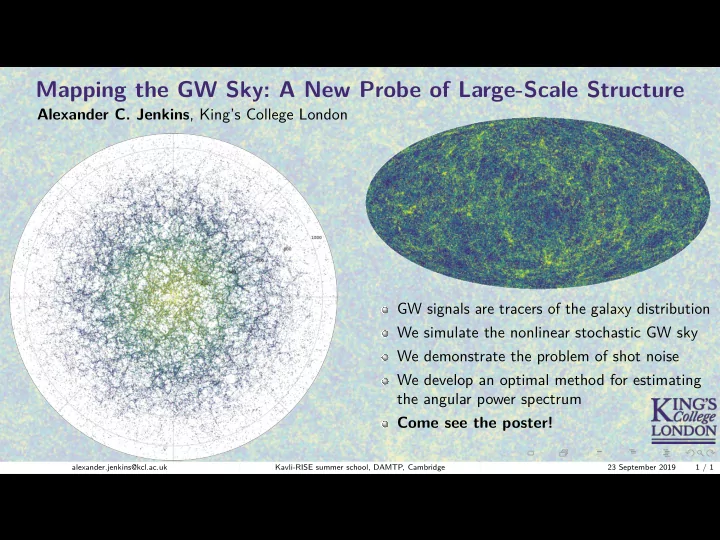
Mapping the GW Sky: A New Probe of Large-Scale Structure Alexander C. Jenkins , Kings College London Gravitational Wave Afterglow of Stellar Collapse in Massive Scalar- Tensor Gravity Ulrich Sperhake GW signals are tracers of the galaxy


slide-1
SLIDE 1

Gravitational Wave Afterglow of Stellar Collapse in Massive Scalar- Tensor Gravity

Ulrich Sperhake Mapping the GW Sky: A New Probe of Large-Scale Structure

Alexander C. Jenkins, King’s College London GW signals are tracers of the galaxy distribution We simulate the nonlinear stochastic GW sky We demonstrate the problem of shot noise We develop an optimal method for estimating the angular power spectrum Come see the poster!

alexander.jenkins@kcl.ac.uk Kavli-RISE summer school, DAMTP, Cambridge 23 September 2019 1 / 1

slide-2
SLIDE 2

Gravitational Wave Afterglow of Stellar Collapse in Massive Scalar- Tensor Gravity

Ulrich Sperhake

Moving black holes

energy extraction, absorption cross-section and the ring of fire

Rodrigo Vicente (CENTRA - IST) [in collaboration with Vítor Cardoso]

BH

Kavli-RISE Summer School on Gravitational Waves, Cambridge, UK arXiv:1906.10140 Accepted in PRD

slide-3
SLIDE 3

Gravitational Wave Afterglow of Stellar Collapse in Massive Scalar- Tensor Gravity

Ulrich Sperhake

Ashish Sharma!,#$%& '$% ($)*+!,# 1Gran Sasso Science Institute, L’Aquila, Italy 2INFN, Laboratori Nazionali del Gran Sasso, Assergi, Italy

Stochastic Cosmological Background Study with 3G Gravitational Wave Detectors : Probing the Very Early Universe

  • A GW stochastic background may

be next class signal detected.

  • It would be a statistical detection

whose confidence level will grow with the observation time.

  • To detect a primordial or early

universe GW signal, we have to reduce the foreground generated by 100 − 102 mergers (NS-NS, BH- BH, NS-BH) in the universe with 3G detectors.

  • Methods Required are :
  • Parameter Estimation of detected

binary signals

  • Reduce contributions from binary

signals as much as necessary (subtraction, projection)

  • Implementing methods for

stochastic signal search.

  • Even when foreground is resolved,

estimated signal waveform deviates from the true signal due to instrumental noise or confusion noise.

slide-4
SLIDE 4

Analytical template for gravitational-wave echoes from spinning remnants

Elisa Maggio

Gravitational-wave echoes in the postmerger signal of a binary coalescence can be a smoking gun

  • f near-horizon quantum

structures and of exotic ultracompact stars. We provide a physically motivated echo template that can be implemented for matched filter searches.

arXiv:1907.03091

PRD in press

slide-5
SLIDE 5

Gravitational Wave Afterglow of Stellar Collapse in Massive Scalar- Tensor Gravity

Ulrich Sperhake

Lorenzo Annulli, PhD @ CENTRA, IST

Poster about "scattering processes"

Motivated by: Environmental effects on GW propagation Population of astrophysical objects We wondered: Effect of a wave hitting on a binary system?

Incident Scattered

I will show you: Setup Method Results...

Kavli RISE Summer School on Gravitational Waves, Cambridge UK, 23/09 1