Graph Theoretical Approaches to the Small-World Phenomenon - - PowerPoint PPT Presentation

graph theoretical approaches to the small world phenomenon
SMART_READER_LITE
LIVE PREVIEW

Graph Theoretical Approaches to the Small-World Phenomenon - - PowerPoint PPT Presentation

Graph Theoretical Approaches to the Small-World Phenomenon Proseminar Analyse sozialer Netzwerke (eng.: Analysis of Social Networks ) Speaker: Felix Stahlberg Institute for Program Structures and Data Organization (IPD) SOFTWARE DESIGN AND


slide-1
SLIDE 1

KIT – The cooperation of Forschungszentrum Karlsruhe GmbH and Universität Karlsruhe (TH)

SOFTWARE DESIGN AND QUALITY GROUP

Source: pixelio.de
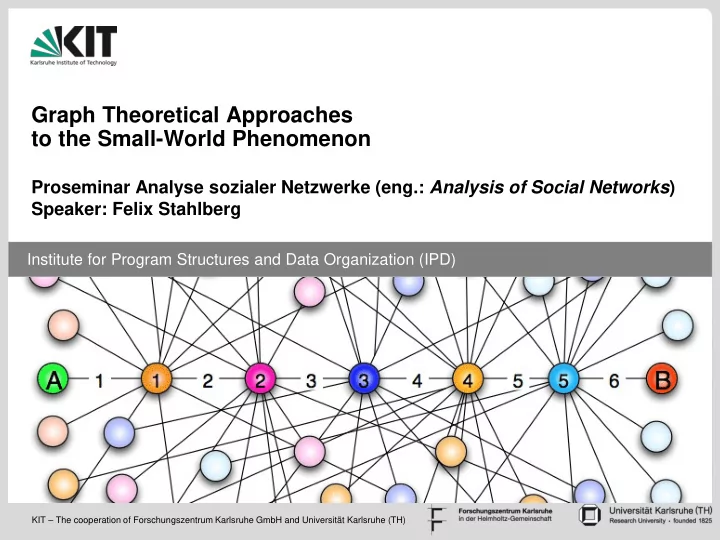
Graph Theoretical Approaches to the Small-World Phenomenon

Proseminar Analyse sozialer Netzwerke (eng.: Analysis of Social Networks) Speaker: Felix Stahlberg

Institute for Program Structures and Data Organization (IPD)

slide-2
SLIDE 2

Felix Stahlberg – Graph Theoretical Approaches to the Small-World Phenomenon 2 06.12.2010

Milgram’s Small-World Experiment [Mil67]

Boston Omaha

  • Mr. G.
  • n a first-name basis
  • Social and geographic

Separation between S and T

S T Name and selected information concerning T

slide-3
SLIDE 3

Felix Stahlberg – Graph Theoretical Approaches to the Small-World Phenomenon 3 06.12.2010

Scientific Interest (Examples)

Social Networks: Collaboration of actors Neuroscience: Neuronal network of Caenorhabditis elegans Medicine: Spread of infectious diseases Technology: Efficiency of power grids

slide-4
SLIDE 4

Felix Stahlberg – Graph Theoretical Approaches to the Small-World Phenomenon 4 06.12.2010

Modeling the Problem

?

Mathematical Model Phenomenon

slide-5
SLIDE 5

Felix Stahlberg – Graph Theoretical Approaches to the Small-World Phenomenon 5 06.12.2010

Mathematical Quantification (Path Length) [DW98]

A small-world network is a connected Graph 𝐻 = (𝑊, 𝐹) with A low characteristic path length 𝑀

Average length of shortest paths in 𝐻 In undirected graphs: 𝑀 ≔

𝑒𝑡(𝑤1,𝑤2)

𝑤1,𝑤2∈𝑊

|𝑊|( 𝑊 −1)

Where 𝑒𝑡(𝑤1, 𝑤2) is the length of the shortest path from 𝑤1 to 𝑤2.

A B C A G B C D E F L=1 L=72/42≈1.714

slide-6
SLIDE 6

Felix Stahlberg – Graph Theoretical Approaches to the Small-World Phenomenon 6 06.12.2010

Mathematical Quantification (Clustering) [DW98]

A small-world network is a connected Graph 𝐻 = (𝑊, 𝐹) with A high clustering coefficient 𝐷

How close neighbourhoods in 𝐻 are to being a clique 𝐷 ≔

𝐷𝑤

𝑤∈𝑊

|𝑊|

𝑥𝑗𝑢ℎ ∀𝑤 ∈ 𝑊: 𝐷𝑤 ≔

#𝐹𝑒𝑕𝑓𝑡 𝑗𝑜 𝑂𝑤 #𝐹𝑒𝑕𝑓𝑡 𝑗𝑜 𝑂𝑤 𝑞𝑝𝑡𝑡𝑗𝑐𝑚𝑓

Where 𝑂𝑤 is the subgraph induced by the neighbourhood of 𝑤.

A B C A G B C D E F C=1 C=(6+(2*6)/(7*6))/7≈0.898

slide-7
SLIDE 7

Felix Stahlberg – Graph Theoretical Approaches to the Small-World Phenomenon 7 06.12.2010

Mathematical Quantification (Wider Picture)

Global and local Efficiency [LM01]

Nonconnected, weighted (nonmetric) graphs Equivalents to 𝑀 and 𝐷. Measures parallel systems (not sequential like 𝑀)

Clustering coefficient 𝐷 controversial

slide-8
SLIDE 8

Felix Stahlberg – Graph Theoretical Approaches to the Small-World Phenomenon 8 06.12.2010

Cycle Plus A Random Matching

Let 𝐻 be a graph formed by adding a random matching to an 𝑜-cycle. Then with probability tending to 1 as 𝑜 goes to infinity, 𝐻 has diameter 𝐸(𝐻) satisfying log2 𝑜 − 𝑑 ≤ 𝐸 𝐻 ≤ log2 𝑜 + log2 log 𝑜 + 𝑑 𝑥𝑗𝑢ℎ 𝑑 ≤ 10. [BC88] 𝔽 𝐷 = 2 3 , 𝔽(𝑀) ∈ 𝑃(log 𝑜)

slide-9
SLIDE 9

Felix Stahlberg – Graph Theoretical Approaches to the Small-World Phenomenon 9 06.12.2010

Randomly Rewired Lattices (1)

𝑜 = 12, 𝑙 = 4, 𝑞 = 1 8 Starting from a ring lattice with 𝑜 vertices and 𝑙 edges per vertex, we rewire each edge at random with probability 𝑞. [DW98] 𝑜 = 12, 𝑙 = 4, 𝑞 = 0

slide-10
SLIDE 10

Felix Stahlberg – Graph Theoretical Approaches to the Small-World Phenomenon 10 06.12.2010

Randomly Rewired Lattices (2)

Starting from a ring lattice with 𝑜 vertices and 𝑙 edges per vertex, we rewire each edge at random with probability 𝑞. [DW98] 0,1 0,2 0,3 0,4 0,5 0,6 0,7 0,8 0,9 1 C(p)/C(0) L(p)/L(0) p 0,001 0,01 0,1 1

Small-World Networks Sketch: Small-World Networks in Strogatz-Watts model

slide-11
SLIDE 11

Felix Stahlberg – Graph Theoretical Approaches to the Small-World Phenomenon 11 06.12.2010

Algorithmic Aspects

Network

Invisible for S Visible for S

S T

slide-12
SLIDE 12

Felix Stahlberg – Graph Theoretical Approaches to the Small-World Phenomenon 12 06.12.2010

Kleinberg’s Model [Kle00] (1)

Parameter 𝑞 ≥ 1, 𝑟 ≥ 0, 𝑠 ≥ 0 Vertices are identified by tuples (i, j) in a 𝑜 × 𝑜 lattice Metric 𝑒( 𝑗, 𝑘 , 𝑙, 𝑚 ) = 𝑙 − 𝑗 + |𝑚 − 𝑘| A vertex 𝑤 has outgoing edges to

All vertices 𝑣 with 𝑒 𝑤, 𝑣 ≤ 𝑞 (local contacts) 𝑟 long-range contacts chosen by independent random trials

Probability for a vertex 𝑣 to be 𝑤’s long-range contact ~𝑒(𝑣, 𝑤)−𝑠

slide-13
SLIDE 13

Felix Stahlberg – Graph Theoretical Approaches to the Small-World Phenomenon 13 06.12.2010

Kleinberg’s Model [Kle00] (2) 𝑜 = 5 𝑞 = 1 𝑟 = 0

slide-14
SLIDE 14

Felix Stahlberg – Graph Theoretical Approaches to the Small-World Phenomenon 14 06.12.2010

Kleinberg’s Model [Kle00] (3)

v

𝑜 = 5 𝑞 = 2 𝑟 = 2

Outgoing edges of v

slide-15
SLIDE 15

Felix Stahlberg – Graph Theoretical Approaches to the Small-World Phenomenon 15 06.12.2010

Local Algorithms in Kleinberg’s Model 𝑠 = 2 is the only value for which there is a decentralized algorithm capable of producing chains whose length is polynomial in log n. [Kle00]

  • Cycles plus Random Matchings are inappropriate

to explain the small-world phenomenon

  • The Watts-Strogatz model may be inappropriate

to explain the small-world phenomenon

slide-16
SLIDE 16

Felix Stahlberg – Graph Theoretical Approaches to the Small-World Phenomenon 16 06.12.2010

Constructive Proof Idea for r=2

T S

𝑜 = 11 𝑞 = 1 𝑟 = 1

(Most of the unneccessary long-range contacts removed)

slide-17
SLIDE 17

Felix Stahlberg – Graph Theoretical Approaches to the Small-World Phenomenon 17 06.12.2010

Constructive Proof Idea for r=2 (Analysis)

T

Phase 1 Phase 0 Phase 2 Phase 3

S

  • #Phases in

𝑃(log 𝑜)

  • Expected

delivery time in each phase in 𝑃(log 𝑜)

  • Culmulative

delivery time in 𝑃(log2 𝑜)

slide-18
SLIDE 18

Felix Stahlberg – Graph Theoretical Approaches to the Small-World Phenomenon 18 06.12.2010

Conclusion

Still in focus of research Applicable to many fields of science Controversial modeling approaches Controversial experiment results

slide-19
SLIDE 19

Felix Stahlberg – Graph Theoretical Approaches to the Small-World Phenomenon 19 06.12.2010

References

[BC88] B. Bollobás and F. R. K. Chung. The diameter of a cycle plus a random matching. SIAM Journal on Discrete Mathematics, 1(3):328 333, 1988. [DW98] Steven Strogatz. Duncan Watts. Collective dynamics of small- world networks. Nature, 393, June 1998. [Kle00] John Kleinberg. The small-world phenomenon: an algorithm

  • perspective. In STOC ‘00: Proceedings of the thirty-second annual

ACM symposium on Theory of computing, pages 163-170, New York, NY, USA, 2000. ACM. [LM01] Vito Latora and Massimo Marchiori. Efiicient behavior of small- world networks. Phys. Rev. Lett., 87(19):198701, Oct 2001. [Mil67] Stanley Milgram. The small world problem. Psychology Today, 1967

slide-20
SLIDE 20

Felix Stahlberg – Graph Theoretical Approaches to the Small-World Phenomenon 20 06.12.2010

Questions