Ubiquity of the Stokes phenomenon 2 Various places where the Stokes - - PDF document

ubiquity of the stokes phenomenon
SMART_READER_LITE
LIVE PREVIEW

Ubiquity of the Stokes phenomenon 2 Various places where the Stokes - - PDF document

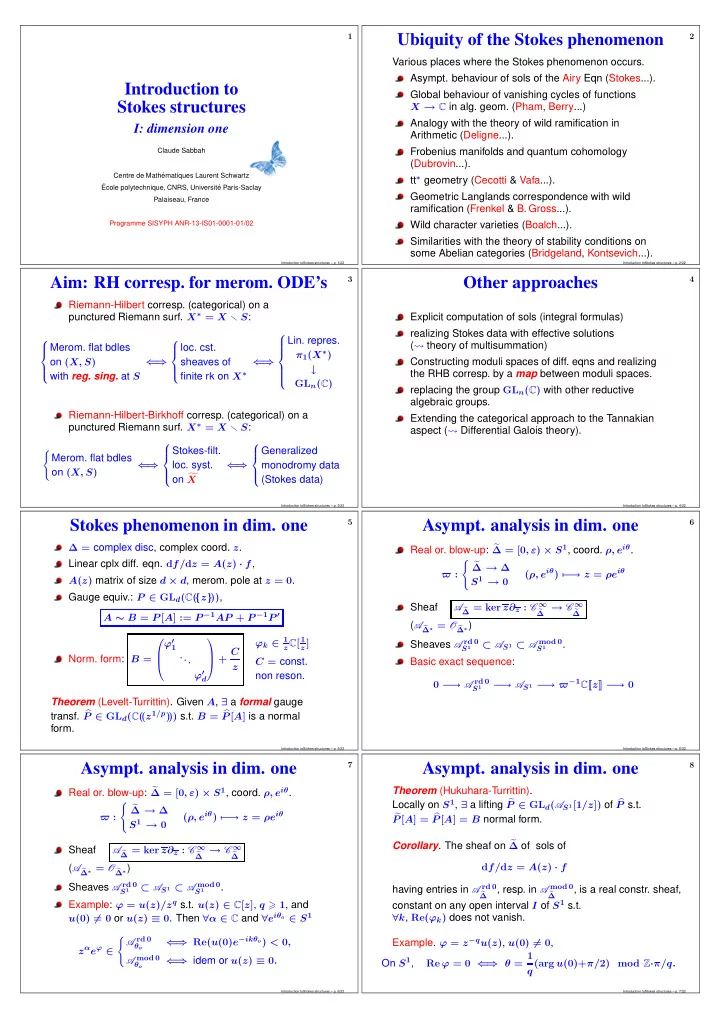
1 Ubiquity of the Stokes phenomenon 2 Various places where the Stokes phenomenon occurs. Asympt. behaviour of sols of the Airy Eqn (Stokes...). Introduction to Global behaviour of vanishing cycles of functions Stokes structures X C in


slide-1
SLIDE 1

Introduction to Stokes structures

I: dimension one

Claude Sabbah Centre de Math´ ematiques Laurent Schwartz ´ Ecole polytechnique, CNRS, Universit´ e Paris-Saclay Palaiseau, France Programme SISYPH ANR-13-IS01-0001-01/02

Introduction toStokes structures – p. 1/22

1

Ubiquity of the Stokes phenomenon

Various places where the Stokes phenomenon occurs.

  • Asympt. behaviour of sols of the Airy Eqn (Stokes...).

Global behaviour of vanishing cycles of functions X → C in alg. geom. (Pham, Berry...) Analogy with the theory of wild ramification in Arithmetic (Deligne...). Frobenius manifolds and quantum cohomology (Dubrovin...). tt∗ geometry (Cecotti & Vafa...). Geometric Langlands correspondence with wild ramification (Frenkel & B. Gross...). Wild character varieties (Boalch...). Similarities with the theory of stability conditions on some Abelian categories (Bridgeland, Kontsevich...).

Introduction toStokes structures – p. 2/22

2

Aim: RH corresp. for merom. ODE’s

Riemann-Hilbert corresp. (categorical) on a punctured Riemann surf. X∗ = X S:     

  • Merom. flat bdles
  • n (X, S)

with reg. sing. at S ⇐ ⇒     

  • loc. cst.

sheaves of finite rk on X∗ ⇐ ⇒         

  • Lin. repres.

π1(X∗) ↓ GLn(C) Riemann-Hilbert-Birkhoff corresp. (categorical) on a punctured Riemann surf. X∗ = X S:

  • Merom. flat bdles
  • n (X, S)

⇐ ⇒      Stokes-filt.

  • loc. syst.
  • n

X ⇐ ⇒      Generalized monodromy data (Stokes data)

Introduction toStokes structures – p. 3/22

3

Other approaches

Explicit computation of sols (integral formulas) realizing Stokes data with effective solutions ( theory of multisummation) Constructing moduli spaces of diff. eqns and realizing the RHB corresp. by a map between moduli spaces. replacing the group GLn(C) with other reductive algebraic groups. Extending the categorical approach to the Tannakian aspect ( Differential Galois theory).

Introduction toStokes structures – p. 4/22

4

Stokes phenomenon in dim. one

∆ = complex disc, complex coord. z. Linear cplx diff. eqn. df/dz = A(z) · f, A(z) matrix of size d × d, merom. pole at z = 0. Gauge equiv.: P ∈ GLd(C( {z} )), A ∼ B = P [A] := P −1AP + P −1P ′

  • Norm. form: B =

   ϕ′

1 ...

ϕ′

d

   + C z ϕk ∈ 1

zC[1 z]

C = const. non reson. Theorem (Levelt-Turrittin). Given A, ∃ a formal gauge transf. P ∈ GLd(C( (z1/p) )) s.t. B = P [A] is a normal form.

Introduction toStokes structures – p. 5/22

5

  • Asympt. analysis in dim. one

Real or. blow-up: ∆ = [0, ε) × S1, coord. ρ, eiθ. ̟ : ∆ → ∆ S1 → 0 (ρ, eiθ) − → z = ρeiθ Sheaf A e

∆ = ker z∂z : C ∞ e ∆ → C ∞ e ∆

(A e

∆∗ = O e ∆∗)

Sheaves A rd 0

S1

⊂ AS1 ⊂ A mod 0

S1

. Basic exact sequence: 0 − → A rd 0

S1

− → AS1 − → ̟−1C[ [z] ] − → 0

Introduction toStokes structures – p. 6/22

6

  • Asympt. analysis in dim. one

Real or. blow-up: ∆ = [0, ε) × S1, coord. ρ, eiθ. ̟ : ∆ → ∆ S1 → 0 (ρ, eiθ) − → z = ρeiθ Sheaf A e

∆ = ker z∂z : C ∞ e ∆ → C ∞ e ∆

(A e

∆∗ = O e ∆∗)

Sheaves A rd 0

S1

⊂ AS1 ⊂ A mod 0

S1

. Example: ϕ = u(z)/zq s.t. u(z) ∈ C[z], q 1, and u(0) = 0 or u(z) ≡ 0. Then ∀α ∈ C and ∀eiθo ∈ S1 zαeϕ ∈

  • A rd 0

θo

⇐ ⇒ Re(u(0)e−ikθo) < 0, A mod 0

θo

⇐ ⇒ idem or u(z) ≡ 0.

Introduction toStokes structures – p. 6/22

7

  • Asympt. analysis in dim. one

Theorem (Hukuhara-Turrittin). Locally on S1, ∃ a lifting P ∈ GLd(AS1[1/z]) of P s.t.

  • P [A] =

P [A] = B normal form.

  • Corollary. The sheaf on

∆ of sols of df/dz = A(z) · f having entries in A rd 0

e ∆

, resp. in A mod 0

e ∆

, is a real constr. sheaf, constant on any open interval I of S1 s.t. ∀k, Re(ϕk) does not vanish.

  • Example. ϕ = z−qu(z), u(0) = 0,

On S1, Re ϕ = 0 ⇐ ⇒ θ = 1 q(arg u(0)+π/2) mod Z·π/q.

Introduction toStokes structures – p. 7/22

8

slide-2
SLIDE 2

The Malgrange-Sibuya theorem

Fix a norm. form (irregular type), e.g. non-ramified: B = diag(ϕ′

1, . . . , ϕ′ d) + C

z . B-marked connections (∼: holom. gauge equiv.): Iso(B) =

  • (A,

P ) | B = P [A]

Stokes sheaf St(B) on S1: St(B)θ =

  • Id +Q | Q ∈ End(A rd 0

θ

), (Id +Q)[B] = B

  • Theorem (Malgrange-Sibuya).

Iso(B) ≃ H1(S1, St(B))

Introduction toStokes structures – p. 8/22

9

Stokes-filtered loc. syst. (non-ramif. case)

Aim: To specify the struct. of sol. space of a merom. ODE without making explicit the realization as functions, fixing the normal form. The local system L on S1: Sols of df/dz = A(z)f

  • n ∆∗, extended to

∆ = [0, ε) × S1 and restricted to {0} × S1. Hence L ⇐ ⇒ monodromy of sols. For every ϕ ∈ z−1C[z−1], a pair of nested subsheaves L<ϕ ⊂ Lϕ of L . Lϕ,θ = {fθ | e−ϕf(z) ∈ A mod 0

θ

} L<ϕ,θ = {fθ | e−ϕf(z) ∈ A rd 0

θ

} Hukuhara-Turrittin ⇒ L<ϕ = Lϕ except if ϕ = ϕk for some k = 1, . . . , d.

Introduction toStokes structures – p. 9/22

10

Stokes-filtered loc. syst. (non-ramif. case)

Aim: To give an intrinsic characterization of the category of Stokes-filtered local systems.

  • Definition. A (non-ramif.) Stokes-filt. loc. syst. on S1:

A loc. syst. L on S1, ∀ϕ ∈ z−1C[z−1], an R-const. subsheaf Lϕ ⊂ L s.t. ∀θ ∈ S1, Lψ,θ ⊂ Lϕ,θ ⇐ ⇒ ψ =ϕ, or Re(ψ − ϕ)<0 near θ , setting ∀θ, L<ϕ,θ =

ψ<θϕ Lψ,θ

  • L<ϕ

and grϕ L := Lϕ/L<ϕ

  • ne asks that ∀ϕ,

grϕ L is a local system on S1, ∀θ, dim Lϕ,θ =

ψθϕ rk grψ L .

Remark: can define (L , L•) over Z, Q, . . .

Introduction toStokes structures – p. 10/22

11

Stokes-filtered loc. syst. (non-ramif. case)

Let (L , L•) be a non-ramif. Stokes-filt. loc. syst. Φ := {ϕ | rk grϕ L = 0} is finite and

  • ϕ∈Φ rk grϕ L = rk L .

∀ϕ ∈ Φ, ∀θ, Lϕ,θ

(∗)

ψθϕ grψ Lθ.

Level structure Levels of B (hence A) : {q1 < · · · < qr} qi := pole ord. of some ψ − ϕ, ϕ = ψ ∈ Φ. #Levels(A) = 1. theory of summability. 2q Stokes directions for each (ϕ, ψ). #Levels(A) > 1. theory of multisummability. Principal and Secondary Stokes directions.

Introduction toStokes structures – p. 11/22

12

Stokes-filtered loc. syst. (non-ramif. case)

Theorem ∀ open I ⊂ S1 which ∋ at most one Stokes dir. ∀ pair in Φ, then (∗) holds on I (e.g. |I|π/qr+ε). Any morphism λ : (L , L•) → (L ′, L ′

  • ) graded on I

w.r.t. some iso (∗) and (∗)′, hence is strict, i.e., ∀ϕ, λ(Lϕ) = L ′

ϕ ∩ λ(L ).

Uniqueness of the splitting if #Level(A) = 1 and moreover |I| = π/q + ε. Duality. The exact sequences 0 − → Lϕ − → L − → L >ϕ − → 0 0 − → L<−ϕ − → L − → L −ϕ − → 0 are switched by duality HomC(•, C). ⇒ grϕ(L ∨) ≃ (gr−ϕ L )∨. Extk(•, C)=0 if k 1.

Introduction toStokes structures – p. 12/22

13

Deligne’s RH correspondence

Theorem (Deligne’s RH corresp.).

  • Merom. flat bdles
  • n (∆, 0)
  • norm. form

≀     

  • Merom. flat bdles
  • f norm. form
  • n (∆, 0)

≀      Stokes-filt.

  • loc. syst.
  • n S1

gr          graded Stokes-filt.

  • loc. syst.
  • n S1

Introduction toStokes structures – p. 13/22

14

Stokes data (non-ramif. case, pure level)

Case #Level(A) = 1 (level = q) Stokes data (Lℓ)ℓ∈Z/2qZ: C-vect. spaces, Isoms Sℓ+1

: Lℓ

− → Lℓ+1 Exhaustive filtrations

  • F•L2µ

ր F

  • L2µ+1 ց

Opposedness property: L2µ =

k FkL2µ ∩ S2µ 2µ−1(F kL2µ−1)

L2µ+1 =

k F kL2µ+1 ∩ S2µ+1 2µ

(FkL2µ)

Introduction toStokes structures – p. 14/22

15

Stokes data (non-ramif. case, pure level)

Case #Level(A) = 1 (level = q) Opposed filtrations ⇒ unique splittings τ2µ : L2µ

− → grF L2µ =

k grF k L2µ

τ2µ+1 : L2µ+1

− → grF L2µ+1 =

k grk F L2µ+1

Stokes multipliers Σℓ+1

:= τℓ+1 ◦ Sℓ+1

  • τ −1

: grF Lℓ − → grF Lℓ+1 Σℓ+1

block lower/upper triangular,

  • diag. blocks (Σℓ+1

)jj are isos.

Introduction toStokes structures – p. 15/22

16

slide-3
SLIDE 3

Stokes data (non-ramif. case, pure level)

(L , L•) Stokes-filt. loc. syst. pure level q

θ0

⇐ ⇒ Stokes data of pure level q. Fix θ0 ∈ S1 not a Stokes dir. ⇒ numbering of Φ s.t. ϕ1 <θ0 · · · <θ0 ϕr 2q Stokes dirs (θℓ := θ0 + ℓπ/q)ℓ∈Z/2qZ on S1. = ⇒    ϕ1 <θ2µ · · · <θ2µ ϕr ϕr <θ2µ+1 · · · <θ2µ+1 ϕ1 = ⇒ (Lϕj,θℓ)j:

  • filt. ր if ℓ = 2µ
  • filt. ց if ℓ = 2µ + 1

Introduction toStokes structures – p. 16/22

17

Stokes data (non-ramif. case, pure level)

(L , L•) Stokes-filt. loc. syst. pure level q (e.g. q = 2)

θ0

⇐ ⇒ Stokes data of pure level q. Li = Γ(Ii, L )

I1 I2 I3

I0 θ0 θ1 θ2 θ3 L1 b1 a1 Lθ2 Lθ1 L2 a2 b2 L0 b0 a0 Lθ3 Lθ0 L3 a3 b3

Introduction toStokes structures – p. 17/22

18

Stokes data (non-ramif. case, pure level)

(L , L•) Stokes-filt. loc. syst. pure level q (e.g. q = 2)

θ0

⇐ ⇒ Stokes data of pure level q. Li = Γ(Ii, L ) L1 F

  • S2

1

F • Lθ2 Lθ1 L2 F• S3

2

F• L0 F• S1 F• Lθ3 Lθ0 L3 F

  • S0

3

F •

Introduction toStokes structures – p. 17/22

19

Stokes data (non-ramif. case)

(L , L•) Stokes-filt. loc. syst. max level qr (e.g. q1 = 1, q2 = 2)

I1 I2 I3

I0 θ0 θ1 θ2 θ3 → more difficult to describe the char. properties of Stokes data (Lℓ, Sℓ+1

)

Introduction toStokes structures – p. 18/22

20

Examples

How to compute Stokes data? Use of the Fourier transf. (Marco’s talk): more complicated ⇐ = simpler. Explicit procedures (..., Mochizuki), but difficult to

  • btain closed formulas for Stokes data.

e.g. Airy diff. eq. (ramified) (∂2

y−y)u = 0

z = 1/y

  • A(z) = −
  • 0 0

1 0

  • z4

+

  • 0 −1

1

  • z

Unramified case, q = 1: Fourier transform of a

  • reg. sing. diff. eq. on P1.

Gaussian type: irreg. sing. at ∞, unramif., q = 2. FT of E ϕ: irreg. sing. at ∞, possibly ramif.

Introduction toStokes structures – p. 19/22

21

Dubrovin’s conjecture

X: smooth proj. Fano var. which admits a full exceptional collection: (E1, . . . , Em) ∈ Db(Coh(X)) generate as a

  • triang. category,

for i = j, Extk(Ei, Ej) = 0 except i < j and k = k(i, j), Extk(Ei, Ei) = 0 except k =

  • 0, Hom = C,

dim X SX = (Sij) ∈ Mm(Z), Sij = χ(Ei, Ej) :=

  • k

(−1)k dim Extk(Ei, Ej).

Introduction toStokes structures – p. 20/22

22

Dubrovin’s conjecture

f : U → C a tame reg. fnct. on a smooth affine var. finite # of crit. pts. GM syst.: GM :=

  • Ωmax(U)[z, z−1]

(zd + df)Ωmax −1(U)[z, z−1], z2∂z−f

  • GM at z = 0: one level, q = 1, Stokes matr. S±

f , can

be chosen with entries in Z.

  • Diag. blocks ↔ monodr. of vanishing cycles of f.

Introduction toStokes structures – p. 21/22

23

Dubrovin’s conjecture

Dubrovin’s conjecture. If f is the Landau-Ginzburg potential mirror to X good Fano, then ∃ choices a bases of vanishing cycles of f s.t. S+

f = SX

X = Pn (Dubrovin, Guzzetti) . . .

Introduction toStokes structures – p. 22/22

24