Grafting Fruit Trees Grafting Fruit Trees By Glossary of Grafting - - PDF document

grafting fruit trees grafting fruit trees
SMART_READER_LITE
LIVE PREVIEW

Grafting Fruit Trees Grafting Fruit Trees By Glossary of Grafting - - PDF document

Grafting Fruit Trees Grafting Fruit Trees By Glossary of Grafting Terms Scion Rootstock Grafting- the process of inserting a part of one plant into or on another in a way that they will unite and continue growth as a single unit. What


slide-1
SLIDE 1

1

Grafting Fruit Trees Grafting Fruit Trees

By

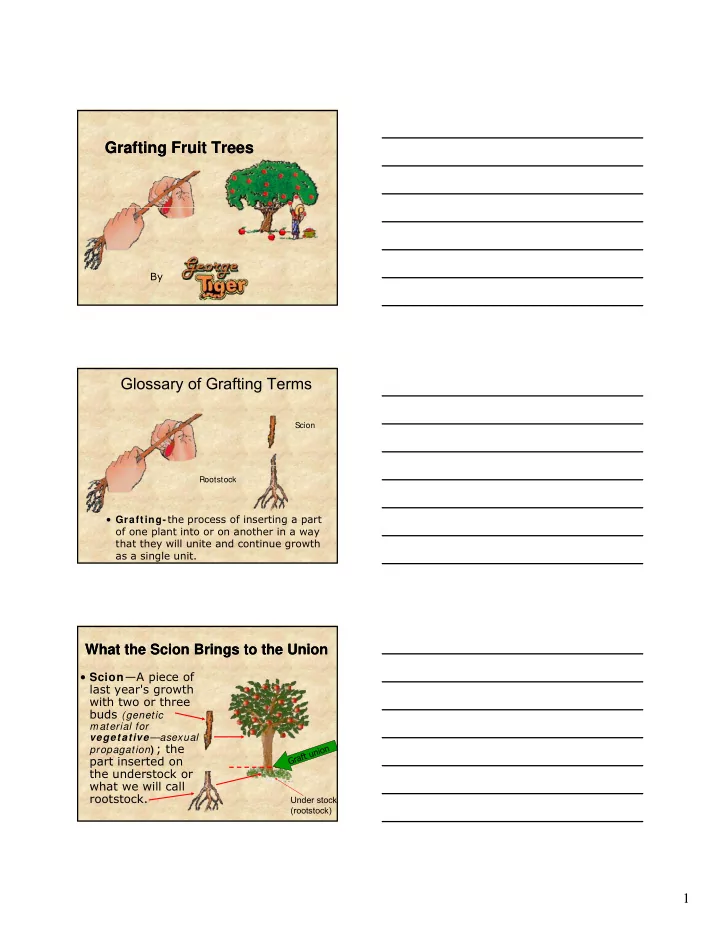
Glossary of Grafting Terms

Scion

  • Grafting-the process of inserting a part
  • f one plant into or on another in a way

that they will unite and continue growth as a single unit.

Rootstock

What the Scion Brings to the Union What the Scion Brings to the Union

  • Scion—A piece of

last year's growth with two or three buds (genetic

t i l f material for vegetative—asexual propagation) ; the

part inserted on the understock or what we will call rootstock.

Under stock (rootstock)

slide-2
SLIDE 2

2

  • Vegetative (Asexual) propagation maintains the

genetic identity of the offspring

Why is it necessary to vegetatively propagate most tree fruit and nut cultivars by grafting (or budding)?

  • Trees are grafted (or budded) because they are
  • ften difficult to root or
  • they benefit from characteristics of the

rootstock variety.

Scion: A detached shoot or twig containing buds from a woody plant, used in grafting. Alternate definition: A descendant; an heir; as, a scion of a royal stock.

Sexual propagation…(its all in the genes)

.. allows for genetic m ixing and recom bination that requires a number of steps for diploid parents. ..They must first form haploid gametocytes, and that means their diploid chromosomes must partition themselves into two

  • sets. ..This partitioning can be called genetic segregation.

Cultivar “A” Cultivar “B”

Dog

Only a few are selected

Either

Winner

It takes a tremendous amount

  • f time, effort, and screening

process to determine whether

  • ne of out of thousands or

more resultant prodigies is discarded (a dog) or of commercial value (a winner).

Either

  • r
slide-3
SLIDE 3

3 Honeycrisp Honeycrisp

Dog or winner

  • Honeycrisp (Malus domestica 'Honeycrisp') is an apple

cultivar developed at the Minnesota Agricultural Experiment Station's Horticultural Research Center.

  • Released in 1991, the Honeycrisp, once slated to be

, y p, discarded, has rapidly become a prized commercial commodity.

  • The Horticultural Research Center indicated that the

Honeycrisp was a hybrid of the apple cultivars Macoun and Honeygold.

  • However, genetic fingerprinting determined that neither
  • f these cultivars is a parent of the Honeycrisp, but that

the Keepsake is one of the parents. The other parent has not been identified, but it might be a numbered selection that could have been discarded since.

Cultivar—

  • Denotes a

cultivated type

  • f plant. (Now

used in place

  • f the term

variety.")

=

Cultivar is a label Cultivar is a label that denotes… that denotes…

expectation of:

  • Use & Flavor- sweet,

tart

  • Flowering and

pollination-

Pollination

Apple Scab

  • Disease resistance

–mildew, –apple scab

  • Fruiting- Annual vs

biennial

–early, –mid season, –late Season of harvest

  • August
  • September
  • October

Pollination

Apple Scab

slide-4
SLIDE 4

4

Crimson Crisp Dayton Early Fuji Elstar G l

Scion W ood for Klam ath Falls

Gala Golden Delicious Honeycrisp Rebella Royal Court Sansa

www.raintreenursery.com/ www.millernurseries.com/ www.starkbros.com/ www.sln.potsdam.ny.us/

  • Apple Cultivars for Puget Sound

( EB 1 4 3 6 ) Bloom and harvest dates, scab and mildew ratings, general descriptions and photographs.

http://cru84.cahe.wsu.edu/cgi-bin/pubs/EB1436.html

slide-5
SLIDE 5

5

An Inventory of Nursery Catalogs and Websites Listing Fruit Berry and Nut Listing Fruit, Berry and Nut Varieties by Mail Order in the United States

Kent Whealy (Author)

Warren Manhart’s Four Favorite Apples (from a list of 50 top cultivars)

  • Elstar:

All purpose apple

  • Spitzenberg: “Very good to best.”
  • Braeburn: Best of newer late apples.
  • New tow n: Rated the highest of all.
slide-6
SLIDE 6

6

Source of information on apples: local markets

The five most popular apples in the United States are

# 1 #2 #3

the United States are Red Delicious, Golden Delicious, Gala, Fuji and Granny Smith.

#4 #5

Apple Cultivars Moving Up Apple Cultivars Moving Up

Jonagold Jonagold Braeburn Braeburn Honeycrisp Honeycrisp Cameo Pink Lady

slide-7
SLIDE 7

7

Arkansas Black Jonathan Cox Orange Spitzenberg

Heirloom Varieties Heirloom Varieties

g Newtown Pippen Northern Spy

Disease Resistance and Good Quality

  • Cultivars that have shown good

resistance and good quality are: 'Akane’ 'Chehalis'

Akane Redfree Liberty Jonagold

are: 'Akane’, 'Chehalis', 'Liberty', ‘Dayton', and ‘Redfree'.

  • Intermediate resistance:

'Jonagold', 'Macoun', 'Melrose', 'Spartan', 'King'.

Dayton Chehalis

Cider Apples Cider Apples

Cid lit i it bl d d th t f l Cider quality inevitably depends on the type of apple

  • used. Cider is traditionally made with one third each of

sweet, bittersweet, and sharp apples.

Bittersweet Sharp Sweet Dabinette Duchess Cox’s Orange Pippin Kingston Black Melrose Gravenstein Michelin Rhode I. Greening Pitmaston Pineapple Yarlington Mill Newtown Pippin

slide-8
SLIDE 8

8

Apples & Their Use Fresh Salad Bake Cook Pie Dried Sauce Bloom Belle de Boskoop X X X X

Late-mid

Bramley's Seedling X X X X

Late

Cortland (Redcort) X X X X X X

Mid-season

Elstar X X X X X

Mid-season

Empire X X X X X X

Early

Fuji (Beni Shogun) X X X X X

Late-mid

Gala X X X X X X

Mid-season

Ginger Gold X X X X

Mid-season

Golden Delicious X X X X X X

Late-mid

Gravenstein X X X X X

Early

Haralred X X X X X X

Early-mid

Honeycrisp X X X X X X X

Late-mid

Jonagold, Jonagored X X X X X X

Mid-season

Jonamac X X X

Early

McIntosh X X X X X

Early

Melrose X X X X X

Early

Paula Red X X X X X X

Early-mid

Pristine X X X X

Early-mid

Queen's Cox X X X X X

Late-mid

Redfree X X X

Mid-season

Spartan X X X X X

Mid-season

Wealthy X X X X X

Early-mid

Wolf River X X X X X

Mid-season

Zestar X X X

Early-mid

Pome fruit

Pome: The fruit type derived from the fusion

  • f the ovaries, calyx cup, and floral tube,

produced by the apple, pear, quince, and

  • ther members of the subfamily Pomoideae.

Apple trees are monoecious--having male and female reproductive organs

  • n the same plant.

Seeds are Seeds are important important

June Drop: The more seeds in a particular apple, the more hormones produced on the

  • tree. By the end of June, the

tree reaches a tipping point, pp g p , where in the period of about ten days, it drops the smallest and weakest remaining fruits, which are the ones with the least number of seeds. Codling moth larvae burrows into the fruit, eats for around three weeks, then leaves the fruit to overwinter and pupate elsewhere. Most nourishment is obtained by feeding on the proteinacous seeds. When the seeds are destroyed the wormy apples drop early.

slide-9
SLIDE 9

9 Pollination

  • The apple, Malus domestica, is

id d t b lf f itf l considered to be self-unfruitful.

  • All apple cultivars (varieties) require

the pollen of a different cultivar to set a crop of fruit.

  • A pollen source and transfer must

be provided for these cultivars.

Pollination

Pollinator Compatible pollen source Cultivar A Cultivar B Self incompatible verses self pollination Pollen sterile: Triploid will not fertilize diploid cultivars—Diploids (normal) will fertilize triploids. Triploid = three sets of chromosomes Diploid = two sets of chromosomes Cultivar B

Other Pollinators or Transfer Agents Other Pollinators or Transfer Agents

Blue Orchard bee (Mason bee) Bumble bee Hover fly

slide-10
SLIDE 10

10

Gravenstein Zestar Roxbury Russet Akane Pristine Silken Paulared Chehalis Red Wealthy Discovery Jonagold Rebella Resi Red Boskoop Shizuka Ginger Gold Greensleeves Dayton Rajka Rleika September Wonder Red Cort Tydeman's Early Sansa Gala Honeycrisp Golden Delicious Queen's Cox Gold Star King Bramley's Gravenstein Zestar Roxbury Russet Akane Pristine Silken Paulared Chehalis Red Wealthy Discovery Jonagold Rebella

Late bloom bloom Early bloom Early bloom Mid-season bloom

Apple Apple Bloom & Bloom & Pollination Pollination

Variety Pollinated

Pollen source

Rebella Resi Red Boskoop Shizuka Ginger Gold Greensleeves Dayton Rajka Releika September Wonder Red Cort Tydeman's Early Sansa Gala Honeycrisp Golden Delicious Queen Cox Gold Star King Bramley's

Late Mid-season b

Ginger Gold Zestar Dutchess Regal Gala Sansa Red Gravenstein Paulared Red Wealthy Pristine BC 11W-19-18 Akane Discovery

25 1

August Septem ber

20 5 10

July

5 10 15 15 20 25 1 25 1

Average Season Average Season

  • f Harvest
  • f Harvest

Fall Apples

Valstar Honeycrisp Redcort Brooksfield Gala Fiesta Rebella Releika Resi Redmax Mollie's Delicious Silken Greensleeves Queen's Cox ega Ga a

Apple of Sum m er

1 2 3 4 5 6 7 8 9 10 11 12

Septem ber October

15 20 25 25 1 5

Thome Empire

10 1 5 10 15 20

Chehalis Dayton Golden Delicious Haralred Morren's Jonagored Autumn Gala

1

Rajka Early Fuji Sports

5

Nov

Royal Empire Roxbury Russet Shamrock

Fall Apples Winter Apples

13 14 15 16 17 18 19 20 21 22 23 24 25

Karmijn de Sonnaville Belmac Goldstar Shizuka Melrose Spur Belle de Boskoop Cameo Rubinstar Jonagold Bramley's Seedling Granny Smith Hillwell Braeburn Hudson's Golden G Spartan

Average Season Average Season

  • f Harvest
  • f Harvest
slide-11
SLIDE 11

11 Picking and Storing Apples

FS 147

Early Early--

  • -Jackson

Jackson County, County, Milton Milton-

  • Freew ater, and

Freew ater, and W asco W asco Midseason Midseason--

  • -Low er

Low er Hood River, Malheur, Hood River, Malheur, Douglas County, and Douglas County, and Josephine County Josephine County Mid Mid t l t t l t W ill tt W ill tt Mid Mid- to late to late--

  • -W illam ette

W illam ette Valley Valley Late Late--

  • -high m ountains

high m ountains and plateaus and the and plateaus and the coast. coast. Early districts often Early districts often begin harvest about 1 0 begin harvest about 1 0 days earlier than days earlier than m idseason districts, m idseason districts, and late and late-

  • season

season districts about 1 0 days districts about 1 0 days later. later.

Cultivars Selected on Tree Growth & Structure

Spur-type strains

  • Spur-type strains of

certain varieties such as Delicious, Golden Delicious, and others are available.

  • Spur types are smaller,

especially on dwarfing root stocks, and they're

  • ften more productive

than nonspur types.

slide-12
SLIDE 12

12

Semi Semi-

  • dwarf and Dwarf Trees

dwarf and Dwarf Trees

  • Dwarf trees have the additional

advantage of being easier to prune, spray, thin, and harvest.

Scion Wood Selection & Storage

  • Collect scions of one-year-old wood in

the fall, winter or early spring.

  • They may come from trees whose fruit

you desire -- perhaps those of neighbors you desire perhaps those of neighbors

  • r friends. Scion wood is also available

from nurseries or experiment stations.

  • Scion wood should be placed in closed

plastic bags and stored under refrigeration (32 to 40°F) until used.

  • The grafting is done in early spring,

usually before growth starts.

Scion wood collected from

  • ne year old
  • ne year old

wood or last year’s growth

Suckers from rootstock Water sprouts

slide-13
SLIDE 13

13

Scion Wood Source Scion Wood Source

Nick Botner 4015 Eagle Valley Rd. Yoncalla, OR 97499 (541) 849-2781

Neighbor Local Nursery Home Orchardist

WASHINGTON STATE UNIVERSITY Mount Vernon Research & Extension Unit 16650 State Route 536 Mount Vernon, WA 98273-9761 360-848-6132 FAX: 360-848-6159 E-mail kingjack@wsu.edu http://mountvernon.wsu.edu/FruitHorticulture/ScionwoodVarieties.html

Graft Compatibility

Sufficiently close genetic relationship for the form ation of a successful graft union

  • Limits of Compatibility

Limits of Compatibility

– Clone Species Genus Family Difficulty S S S S No sweat D S S S Easy D D S S Moderate D D D S Unlikely D D D D Nill

Apple Rootstock listed by size class Size

Class 1 P 22 Size Class 3 Size Class 5 Size Class 7 Size Class 9

  • Rootstocks are listed by size class from smallest (1) to largest (10).
  • Size class 1 represents a rootstock that produces a tree 10-20% of full

sized tree.

  • The size class of a rootstock is the primary characteristic of importance.

P.22 M 2 7 G.65 3 M.9 Bud.9

  • P. 2

G.16 5

  • G. 30

7

  • MM. 1 0 6
  • Bud. 490

9

  • Bud. 118
  • P. 18

Size Class 2 Bud 146 Bud 491 P.16 Mark Size Class 4

  • G. 11
  • M. 2 6

Size Class 6

  • M. 7

Size Class 8

  • MM. 1 1 1

Size Class 10 Seedling

slide-14
SLIDE 14

14

Columnar Apple Trees

Mini Mini-

  • dwarf

dwarf apple trees apple trees

Mi i d f l t

  • Mini-dwarf apple trees are grown on our

very dwarfing EMLA 27 rootstock.

  • They are easily maintained at only four to

six feet tall.

  • These highly productive, compact trees,

grown in large pots on patios or….

  • …are perfect to grow in a small backyard.

Rootstock Comparison & Scion Vigor

Tree and Rootstock vigor Scion wood Rootstock

slide-15
SLIDE 15

15

Rootstock Selection

Selection on basis of : Dwarfing Precocious Disease & Insect resistance Soil type Early fruiting Woolly apple aphid Fire Blight Soil site conditions Scab fungi

Propagating Rootstock Propagating Rootstock

Stoolbed

Rootstock also selected for: Ease of propagation Cut after 1 year growth Harvest rooted whips

Stoolbed

Under cut 2nd summer’s growth Mounded sawdust Backyard Ready to be grafted Dormant season harvest of rooted whip

Commercial Propagation

Rooted whips are planted at a 45o angle and once they are established… …they are pinned to the horizontal where buds produce water-sprouts.

slide-16
SLIDE 16

16 Rootstock Propagation

Horizontal whips produce water-sprouts at each bud. Sawdust is mounded at the base of the upright sprouts which encourage roots to develop in the moist media. Sawdust Soil

In dormant season, rooted whips are under cut and bundled

Sawdust Soil

www.amleo.com

www.raintreenursery.com

R100 EMLA 7 Apple rootstock (5+3.00/10+2.50/25+1.75ea) Price:$3.50 Qty 5+ $3.00 each Qty 10+ $2.50 each Qty 25+ $1.75 each

Grafting Bands 10 for $1.50

slide-17
SLIDE 17

17

Review: Four Criterion for Successful

Graft Union Formation

1 . 1 . Cam bial contact Cam bial contact 2 . 2 . Avoidance of Avoidance of

Scion wood

desiccation desiccation 3 . 3 . Com patibility Com patibility 4 . 4 . Pressure Pressure

Rootstock

Cambium—

  • The growing part of the tree; located

between the wood and bark. At the season when bark separates freely, cambium will be both on the wood surface and on the inner bark.

Cambial Contact

  • In the first days or weeks

after the two parts to be grafted are cut, cells proliferate at the site of the p

  • cut. This tissue is called

"callus".

slide-18
SLIDE 18

18

If the two parts are in contact with pressure between the parts these two callus layers will begin to grow together, creating a "callus bridge."

Callus Bridge Differentiation of new cambium.

  • Parenchyma cells

differentiate into cambium cells, thus uniting the cambium

  • f the stock with the

cambium of the cambium of the scion.

  • Formation of

secondary xylem and phloem from new cambium allows translocation between the stock and scion.

New Xylem New Phloem

Avoidance of desiccation Avoidance of desiccation

1.) Management during cuts. Keep cut edges moist. 2.) Use budding & grafting tape---or 3.) Use budding & grafting bands. 4.) Use tree seal

slide-19
SLIDE 19

19

Wrap the splice cuts…

…firmly to create pressure and stability Apply tree seal

Cleft Graft Cleft Graft

slide-20
SLIDE 20

20

Cleft Graft

Right Wrong

Topworking

  • When a desired variety is grafted
  • nto the limbs of a hardy tree it is

called "topworking."

  • The operation of cutting back the

branches and top of an established tree and budding or grafting part

  • f another tree on it.

Growing Multi Growing Multi-

  • grafted Trees

grafted Trees

  • Sometimes, more than one

apple variety is grafted on the same tree.

  • This is reasonably satisfactory,

but

  • varieties have different growth
  • varieties have different growth

rates and maturity dates,

  • so it's more difficult to prune

and spray such trees.

  • You can avoid these problems

by planting several dwarf trees of different varieties.

Open Center Leader Multi-graft apple tree

slide-21
SLIDE 21

21

Bud Graft

Leaf axel bud

  • Many of the apple trees and all of the

stone fruit trees (plum relatives) sold in the area’s nursery trade are propagated by a type of graft called budding.

Chip Budding

Chip budding is a technique that may be used whenever mature buds are

  • available. Because the bark does not have to "slip," the chip-budding

season is longer than the T-budding season.

Propagation Propagation

First summer’s growth-select one shoot. Dormant whip after leaf fall

slide-22
SLIDE 22

22

Whip-and-tongue graft (Whip graft)

Scion

Two buds

Rootstock

Second Cut

Scion Buds point up Second Cut on i d Rootstock scion and rootstock.

Putting it together

slide-23
SLIDE 23

23

Using a Grafting Tool

Rootstock Omega cut Grafting Tool Slip the scion on to th

Using a Grafting Tool

Scion the rootstock from the side. Rootstock Cut both scion and rootstock with same tool. Scion Slope cut Rootstock

Root stock should be (preferably) equal or greater in size than the scion.

slide-24
SLIDE 24

24

Scion Scion

Rootstock

However, the scion is often smaller When this is the case, align the cambial layers

  • n one side

Cleft graft Omega grafting tool Whip & Tongue graft

Anchor the aligned pieces by wrapping the elastic rubber

  • ver the ‘shoulder’
  • f the rootstock.

Continue wrapping around rootstock until covered.

slide-25
SLIDE 25

25

Securing the end of the wrap

Swing the loop around and

  • ver the end.

Grab the end and pull snug. Holding the end down with one finger--create a loop with extra stretch

Apply tree seal to cover entire bud rubber area. Care of Your New Tree

We will be here at the end of class.

First summer’s growth-select one shoot. Dormant whip after leaf fall

slide-26
SLIDE 26

26

One year’s growth 1 yr’s growth Rimnant of scion Rootstock Onset of growth Scion Rootstock

Training and Pruning

Choose 4 to 5 branches Choose 4 to 5 branches evenly distributed around the evenly distributed around the tree, hopefully about 90 tree, hopefully about 90 degrees apart. When there degrees apart. When there are five, look for a starfish are five, look for a starfish configuration. configuration.

slide-27
SLIDE 27

27 Using spreaders

Training and Pruning Training and Pruning

slide-28
SLIDE 28

28

Review: Four Criterion for Successful

Graft Union Formation

1 . 1 . Cam bial contact Cam bial contact 2 Avoidance of desiccation Avoidance of desiccation 2 . 2 . Avoidance of desiccation Avoidance of desiccation 3 . 3 . Com patibility Com patibility 4 . 4 . Pressure Pressure

McIntosh X Ben Davis. Widely grown all purpose McIntosh

  • type. One of the standards. Larger fruit with dark red skin

underlaid with stripes. Crisp pure white flesh resists browning when cut. Tart tangy flavor. Dessert quality. Excellent for eating out of hand, cooking, and cider. Vigorous long lived tree is annually productive and starts bearing early. Excellent

  • pollinator. Developed by New York Agricultural Experiment

Station in 1898. Ripens 2-3 weeks before McIntosh. Does not drop as readily as McIntosh. Ripens mid September to early October Redcort Royal Court

Cortland

  • October. Redcort, Royal Court

Crimson Crisp

An exciting new disease resistant variety being offered for the first time in the spring of 2006. The fruit is medium in size with a very attractive crimson red color over 95% of the surface. Crimson Crisp has a very firm, crisp texture with a tart, complex flavor. The tree is very grower friendly with a spreading habit, fruiting throughout the tree on two and three year old branches. The fruit matures mid-season and will keep in cold storage for six months.

Dayton

was released in 1988. Its fruit ripens about 4 weeks before Delicious. Fruits are large with a glossy red color. Reports indicate that maximum storage may only be one month. The tree is vigorous, with strong, upright- growing branches. It has good resistance to mildew and cedar apple rust and moderate resistance to fire blight.

Fuji j

Ralls Janet X Delicious. High quality apple with fairly poor appearance. Tall, rectangular, medium size fruit. Yellowish green skin with an

  • rangish red flush and darker stripes. Darker

blush on sun side. Crisp, juicy slightly subacid white flesh with outstanding texture. Good

  • keeper. Vigorous, productive, somewhat bushy
  • tree. Needs annual detailed pruning. Developed

in Japan and introduced in 1962. Ripens very

  • late. Very long storage life.

Auvil Early Fuji:

slide-29
SLIDE 29

29

Golden Delicious

Originated in West Virginia. Thin skinned that ranges from pale green to medium yellow. The yellowier the skin, the sweeter and softer the flesh. Good baking apple if you choose the greenish ones. Particularly suited to

  • pen tarts (since it retains its shape through cooking). Resists browning

after being cut. Needs very little sugar in cooking. Sweet eating and baking apple. Thin delicate peel. Bakes firm and makes a chunky sauce. Holds it's shape. Excellent pie apple. Sports of Golden Delicious listed below. Golden Delicious (Mullins cv ) Golden Delicious (Mullins cv.) Golden Supreme Golden Delicious (Carnefix cv.) Goldspur Golden Delicious (Sundale cv.), spur Nugget Spur Golden Delicious, spur Smoothee Improved Golden Delicious (Gibson cv.) Starkspur Golden Delicious, spur Yelo Spur Golden Delicious, spur The first Gala apple tree was one of many seedlings resulting from a cross between a Golden Delicious and a Kidd's Orange Red planted in New Zealand in the 1930s by orchardist J.H. Kidd. Donald W. McKenzie, an employee of Stark Bros Nursery, obtained a US plant patent for the cultivar on October 15, 1974. Terrific for eating out-of-hand, Gala is at its very best when purchased locally, in season. Autumn Gala, Brookfield Gala, Royal Gala.

Gala i Honeycrisp is an apple cultivar developed at the

Minnesota Agricultural Experiment Station's Horticultural Research Center at the University of Minnesota, Twin Cities. Designated in 1974 as the MN 1711, and released in 1991, the Honeycrisp, once slated to be discarded, has rapidly become a prized commercial commodity, as its sweetness, firmness, and tartness make it an ideal apple for eating raw. The Honeycrisp also retains its pigment well and boasts a relatively long shelf life when stored in cool, dry conditions

Rebella

A large elongated red apple with a delightful combination of sweet and tart flavors. Fruit ripens in late September and trees resist scab, mildew, fireblight, cedar apple rust, and red mite.

Elstar

Originated in the Netherlands from a cross between 'Golden Delicious' x 'Ingrid Marie'. Fruits ripen on early to mid September. The Elstar is a medium-sized apple whose skin is mostly red with yellow showing. The

Sansa

Sansa’ originated from a cross between ‘Gala’ and ‘Akane’ made in 1969. Sansa is attractive, crisp, aromatic, medium-sized, and sweet-flavored. It may be stored for up to 2 months. One report says that Sansa is resistant to apple scab. The fruit matures about 2 weeks before Gala. Good- quality fruit for its season. flesh is white, and has a soft, crispy texture. It may be used for cooking and is especially good for making apple sauce. In general, however, it is used in desserts due to its sweet flavor. Valstar:
slide-30
SLIDE 30

30

Okay! Let’s graft some apple trees.