Govender, N, Smit, I, Pienaar, D, Dold, J, English, D & - - PowerPoint PPT Presentation

govender n smit i pienaar d dold j english d thompson r
SMART_READER_LITE
LIVE PREVIEW

Govender, N, Smit, I, Pienaar, D, Dold, J, English, D & - - PowerPoint PPT Presentation

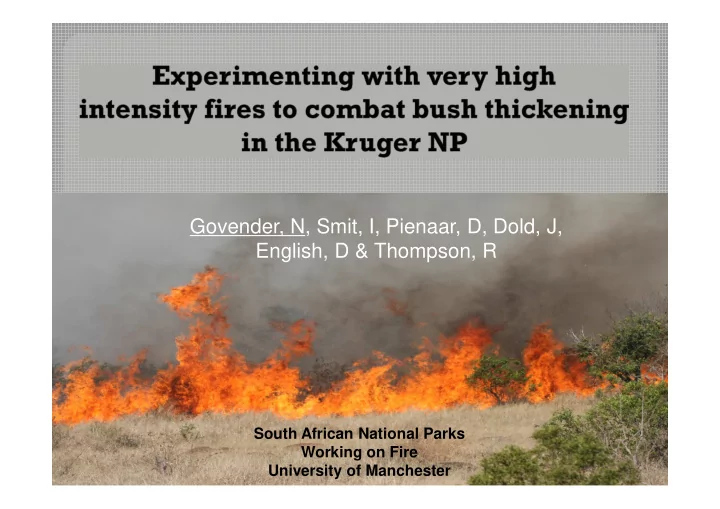
Govender, N, Smit, I, Pienaar, D, Dold, J, English, D & Thompson, R South African National Parks Working on Fire University of Manchester

slide-1
SLIDE 1

Govender, N, Smit, I, Pienaar, D, Dold, J, English, D & Thompson, R

South African National Parks Working on Fire University of Manchester

slide-2
SLIDE 2
slide-3
SLIDE 3
  • ! "#

! ! "$

%

! & ! ' ! ( ! )*)

slide-4
SLIDE 4

1937 image Savanna park with patches

  • f forest/thicket

2004 image Not a savanna landscape any more? Wigley, 2007

slide-5
SLIDE 5

&

  • High rainfall,

granitic areas of KNP

slide-6
SLIDE 6

1944 image Red – woody Green - grasses 2003 image Increase in the red patches more woody vegetation Reduction in green – decrease in grasses

Images courtesy of SandraMacFadyen

slide-7
SLIDE 7

%+

% ,- # "

.+

! / !

  • ! 01

+

slide-8
SLIDE 8

$2'0

3,

4 * 5 6/ 78

slide-9
SLIDE 9

/9 ,

  • .

2*:;

Coppicing 57% Shooting 39% Dead 4%

Trollope, et al Shooting 39% Dead 4% Coppicing 56%

slide-10
SLIDE 10

7<=<=<8

! 6 ! > ! 3

. %

*

slide-11
SLIDE 11

The experiment aims to investigate the desirability and feasibility of using very hot fires (fire storms) to address bush thickening in selected areas in KNP

slide-12
SLIDE 12

Objectives

  • 1. To determine the effect of high intensity fire on the

density (visibility), tree height classes and re-growth responses of woody vegetation.

  • 2. To determine the effect of a high intensity fires on

large trees with and without elephant impact (bark stripping).

slide-13
SLIDE 13

6- 0&9

  • 2$1

2:9?9$2 .>- %> =@< 6=A<B 3=2:

slide-14
SLIDE 14

C7(%"&228 =D$ 7<?92 8 6=- EBD2= 3=E- 2 ,F=?G

slide-15
SLIDE 15

H91

  • G

9

slide-16
SLIDE 16

.

$

  • '

9 $oC

.

Analysis courtesy of John Dold

slide-17
SLIDE 17

=

F:C<F

1%9&9%

F

22<

F

9

#F

slide-18
SLIDE 18

/

  • ,
  • I>

$2

/

slide-19
SLIDE 19

<9 $J$ 6.9 $ I.9 2 7F11F1F 8 /-

$< - <2 0 $22

7F11F9 1 8

HI LI HI

slide-20
SLIDE 20
  • 9:2B
slide-21
SLIDE 21

<< 76=$$- I=228 H*0 76=22*2CI=:?*<C8 &F11F

1

  • HI

HI LI

slide-22
SLIDE 22

$< E $:

  • 0 %

1 - 10 % 11 - 50 % 51 - 100 %

Pre fire distribution of trees within each impact class Impact class

% % %

slide-23
SLIDE 23

$< E $:

  • $
  • C

E 2

  • $
  • C

E 2

  • $
  • C

E 2

  • $
  • C

E 2

0 % 1 - 10 % 11 - 50 % 51 - 100 % Additional Impact Original Impact

slide-24
SLIDE 24

',7>'#,8 K9 I01%"29

I2

  • =

) 7 4 ( ) 7 4 ( band band band band NBR + − =

slide-25
SLIDE 25

Image prior to treatment application

Image courtesy of Izak Smit

slide-26
SLIDE 26

Image courtesy of Izak Smit

Image post treatment application

slide-27
SLIDE 27

Note the higher fire severity on the gabbro lower FS medium FS higher FS NW

Image courtesy of Izak Smit

slide-28
SLIDE 28
  • 0.2
  • 0.18
  • 0.16
  • 0.14
  • 0.12
  • 0.1
  • 0.08
  • 0.06
  • 0.04
  • 0.02

2000 4000 6000 8000 10000 12000 14000 Herbaceous biomass (kg/ha) Normalised Burn Ratio Difference

Analysis courtesy of Izak Smit

slide-29
SLIDE 29
  • 0.16
  • 0.14
  • 0.12
  • 0.1
  • 0.08
  • 0.06
  • 0.04
  • 0.02

0.02 1 2 3 4 5 6 7 8 9 10

Normalised Burn Ratio Difference

Average Normalised Burn Ratio (Prefire - Postfire) at different char heights

Analysis courtesy of Izak Smit

Char height (m)

Relationship between FS and FI

slide-30
SLIDE 30

>*

  • Anderson, Cook, Williams. Fires in Tropical Savannas

y = 3.7(1-e -0.19x), r2 = 0.91

slide-31
SLIDE 31

9

L

,L /I> 11

  • .>-

4.5- $2$2<

slide-32
SLIDE 32
slide-33
SLIDE 33

H'/0 3. 0*& &&

! #& ! &0. ! M

3,- 45 M> "&