Good Morning. My name is Perry Crozier and I am President of the - - PDF document

good morning my name is perry crozier and i am president
SMART_READER_LITE
LIVE PREVIEW

Good Morning. My name is Perry Crozier and I am President of the - - PDF document

Good Morning. My name is Perry Crozier and I am President of the National Capital Heavy Construction Association. I am accompanied today by our Executive Advisor, Dale Harley We are here today to talk to you about the 2016


slide-1
SLIDE 1
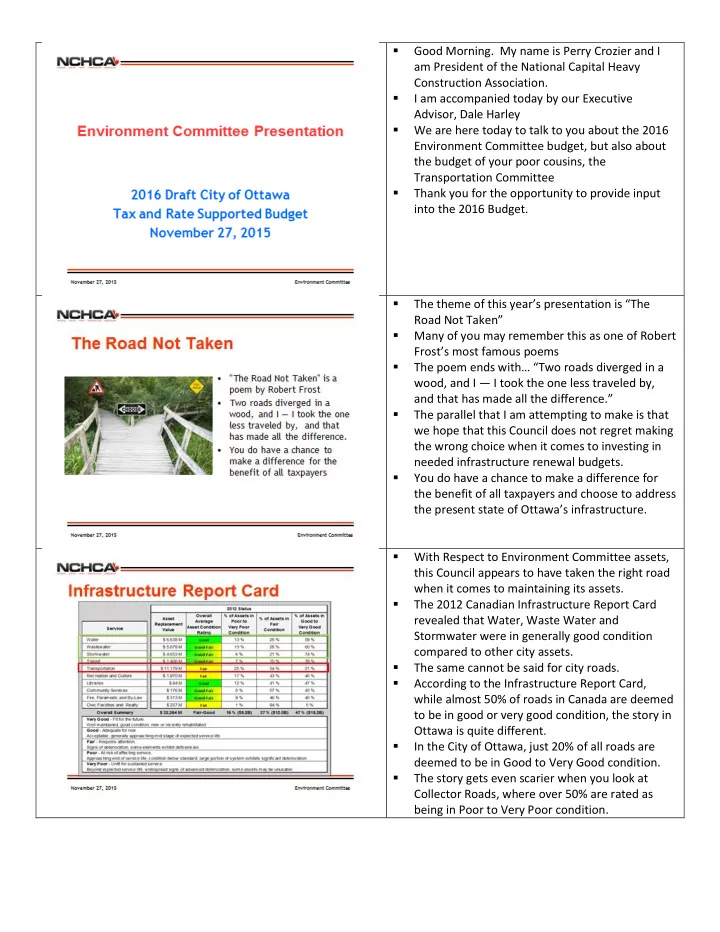
  • Good Morning. My name is Perry Crozier and I

am President of the National Capital Heavy Construction Association.

  • I am accompanied today by our Executive

Advisor, Dale Harley

  • We are here today to talk to you about the 2016

Environment Committee budget, but also about the budget of your poor cousins, the Transportation Committee

  • Thank you for the opportunity to provide input

into the 2016 Budget.

  • The theme of this year’s presentation is “The

Road Not Taken”

  • Many of you may remember this as one of Robert

Frost’s most famous poems

  • The poem ends with… “Two roads diverged in a

wood, and I — I took the one less traveled by, and that has made all the difference.”

  • The parallel that I am attempting to make is that

we hope that this Council does not regret making the wrong choice when it comes to investing in needed infrastructure renewal budgets.

  • You do have a chance to make a difference for

the benefit of all taxpayers and choose to address the present state of Ottawa’s infrastructure.

  • With Respect to Environment Committee assets,

this Council appears to have taken the right road when it comes to maintaining its assets.

  • The 2012 Canadian Infrastructure Report Card

revealed that Water, Waste Water and Stormwater were in generally good condition compared to other city assets.

  • The same cannot be said for city roads.
  • According to the Infrastructure Report Card,

while almost 50% of roads in Canada are deemed to be in good or very good condition, the story in Ottawa is quite different.

  • In the City of Ottawa, just 20% of all roads are

deemed to be in Good to Very Good condition.

  • The story gets even scarier when you look at

Collector Roads, where over 50% are rated as being in Poor to Very Poor condition.

slide-2
SLIDE 2
  • The 2014 Ontario Municipal Benchmarking

Initiative report would seem to confirm the results of the Infrastructure Report Card.

  • Ottawa wastewater and water pipes are on

average about 30 years old. This is on par with the other cities participating in the study.

  • The average number of wastewater main backups

and watermain breaks in Ottawa are also on par.

  • The same cannot be said about Ottawa Roads
  • The 2014 OMBI report revealed that Ottawa had

the worst roads of the major cities participating in the benchmarking study.

  • Only 19% of paved roads in Ottawa were rated as

being in good or very good condition. This compares to a mean of 54%.

  • Clearly, road infrastructure in Ottawa needs

attention.

  • It is safe to say that the city has chosen the

correct road when it comes properly maintaining its Environmental Services Infrastructure.

  • This has been made possible by the city as a

result of:

  • adopting realistic increases for rate supported

infrastructure; and

  • Investing the vast majority of its infrastructure

dollars on the renewal of these valuable assets.

slide-3
SLIDE 3
  • While the City has reduced its capital investment

this year, and the percentage of renewal investment has also declined, the planned future investments appear to be improving.

  • The Long Range Financial Plan 4 was adopted in

the last term of Council.

  • This plan identifies a need to increase the tax

supported funding for renewal of City assets to a level of $165 million per year to maintain a state

  • f good repair versus the average historical

expenditure on the renewal of roads, bridges, buildings and parks of only approximately $80 million per year.

  • Unfortunately, tax supported funding for city

assets is a long way behind rate supported assets.

  • The good news is, is that as a Council, you appear

to be getting it when it comes to infrastructure investment.

  • Matthew Pearson of the Ottawa Citizen reported
  • n November 11, 2015, the results of a survey

about the upcoming budget.

  • 96% of you noted infrastructure or roads in your

responses

  • 78% of you noted infrastructure renewal as a

priority

  • 70% specifically commented on the condition of

roads.

  • Here is what a few of you had to say:
slide-4
SLIDE 4

In Conclusion:

  • Maintaining a 2% tax increase is arguably the

right road to take in terms of providing reliable and affordable City services.

  • It would appear that Council has taken the right

road when it comes to maintaining Environmental assets, but appears to have reached a fork in the road when it comes to Transportation assets.

  • Evidence is mounting that the City must take “the

road less traveled” in order to make a difference.

  • This new road could include reallocating funding

from across all budget envelops to help pay for needed infrastructure renewal.

  • The City could also choose to increase debt to pay

for these repairs before they cost even more in the future. This would be consistent with what the City is already doing.

  • Investing more this year would also send a strong

message to your provincial and federal partners that the City is prepared to step up to the plate

  • n infrastructure project funding.
  • Thank you for the opportunity to address the
  • committee. I would be pleased to answer any

questions you might have. For more information please contact Dale Harley, 613-882-5684