Goals of Routing Protocols Find the optimal route 10: Rapid - - PDF document

goals of routing protocols
SMART_READER_LITE
LIVE PREVIEW

Goals of Routing Protocols Find the optimal route 10: Rapid - - PDF document

Goals of Routing Protocols Find the optimal route 10: Rapid Convergence Inter and intra AS, RIP, OSPF, Robustness BGP, Router Architecture Configurable to respond to changes in many variables (changes in bandwidth, delay,


slide-1
SLIDE 1

4: Network Layer 4a-1

10: Inter and intra AS, RIP, OSPF, BGP, Router Architecture

Last Modified: 3/24/2003 2:39:16 PM

4: Network Layer 4a-2

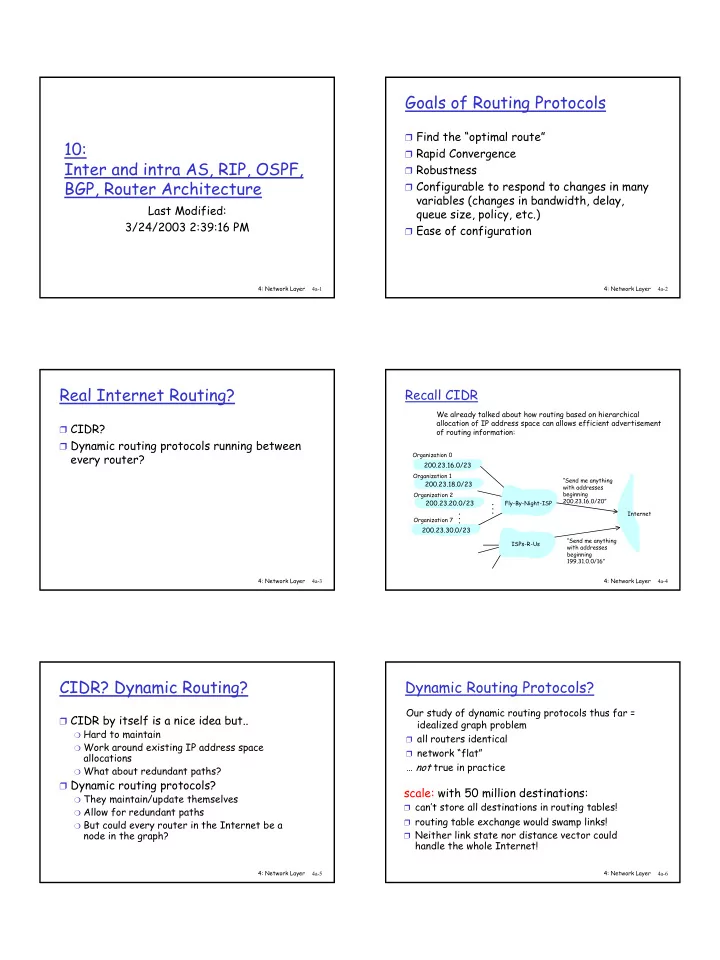
Goals of Routing Protocols

❒ Find the “optimal route” ❒ Rapid Convergence ❒ Robustness ❒ Configurable to respond to changes in many

variables (changes in bandwidth, delay, queue size, policy, etc.)

❒ Ease of configuration

4: Network Layer 4a-3

Real Internet Routing?

❒ CIDR? ❒ Dynamic routing protocols running between

every router?

4: Network Layer 4a-4

Recall CIDR

“Send me anything with addresses beginning 200.23.16.0/20”

200.23.16.0/23 200.23.18.0/23 200.23.30.0/23

Fly-By-Night-ISP Organization 0 Organization 7 Internet Organization 1 ISPs-R-Us “Send me anything with addresses beginning 199.31.0.0/16”

200.23.20.0/23

Organization 2

. . . . . .

We already talked about how routing based on hierarchical allocation of IP address space can allows efficient advertisement

  • f routing information:

4: Network Layer 4a-5

CIDR? Dynamic Routing?

❒ CIDR by itself is a nice idea but..

❍ Hard to maintain ❍ Work around existing IP address space

allocations

❍ What about redundant paths?

❒ Dynamic routing protocols?

❍ They maintain/update themselves ❍ Allow for redundant paths ❍ But could every router in the Internet be a

node in the graph?

4: Network Layer 4a-6

Dynamic Routing Protocols?

scale: with 50 million destinations:

❒ can’t store all destinations in routing tables! ❒ routing table exchange would swamp links! ❒ Neither link state nor distance vector could

handle the whole Internet! Our study of dynamic routing protocols thus far = idealized graph problem

❒ all routers identical ❒ network “flat”

… not true in practice

slide-2
SLIDE 2

4: Network Layer 4a-7

Routing in the Internet

❒ Administrative Autonomy

❍ Internet = network of networks ❍ Each network controls routing in its own network ❍ Global routing system to route between Autonomous Systems

(AS) ❒ Two-level routing:

❍ Intra-AS: administrator is responsible for choice ❍ Inter-AS: unique standard 4: Network Layer 4a-8

Hierarchical Routing

Routers in same AS run routing protocol chosen by administrators of that domain

❍ “intra-AS” routing

protocol

❍ routers in different AS

can run different intra- AS routing protocol

❒ special routers in AS ❒ run intra-AS routing

protocol with all other routers in AS

❒ also responsible for

routing to destinations

  • utside AS

❍ run inter-AS routing

protocol with other gateway routers

gateway routers

4: Network Layer 4a-9

Internet AS Hierarchy

Intra-AS border (exterior gateway) routers Inter-AS interior (gateway) routers

4: Network Layer 4a-10

Intra-AS and Inter-AS routing

Gateways:

  • perform inter-AS

routing amongst themselves

  • perform intra-AS

routers with other routers in their AS

inter-AS, intra-AS routing in gateway A.c network layer link layer physical layer

a b b a a C A B d A.a A.c C.b B.a c b c

4: Network Layer 4a-11

Intra-AS and Inter-AS routing

Host h2 a b b a a C A B d c A.a A.c C.b B.a c b Host h1 Intra-AS routing within AS A Inter-AS routing between A and B Intra-AS routing within AS B ❒ Single datagram is often routed over many hops

via routes established by several intra-AS routing protocols and an inter-AS routing protocol

4: Network Layer 4a-12

Intra vs Inter AS Routing protcols

❒ For Intra AS routing protocols: many choices; For

Inter AS routing protocols: standard

❍ Why does this make sense?

❒ Intra AS routing protocols focus on performance

  • ptimization; Inter AS routing protocols focus on

administrative issues

❍ Why does this make sense?

❒ Choice in Intra-AS

❍ Intra-AS often static routing based on CIDR, can also be

dynamic (usually RIP or OSPF) ❒ Standard Inter-AS BGP is dynamic

slide-3
SLIDE 3

4: Network Layer 4a-13

Intra-AS Routing

❒ Also known as Interior Gateway Protocols (IGP) ❒ Most common IGPs:

❍ RIP: Routing Information Protocol ❍ OSPF: Open Shortest Path First ❍ IGRP: Interior Gateway Routing Protocol (Cisco

proprietary)

❍ Can also be static (via CIDR) but that is not

called an IGP

4: Network Layer 4a-14

RIP ( Routing Information Protocol)

❒ Distance vector algorithm ❒ Included in BSD-UNIX Distribution in 1982 ❒ Single Distance metric: # of hops (max = 15 hops)

❍ Can you guess why? ❍ Count to infinity less painful if infinity = 16 ☺ ❍ But limits RIP to networks with a diameter of 15 hops

❒ Distance vectors: exchanged every 30 sec via

Response Message (also called advertisement)

❒ Each advertisement: route to up to 25 destination

nets

4: Network Layer 4a-15

RIP: Link Failure and Recovery

If no advertisement heard after 180 sec --> neighbor/link declared dead

❍ routes via neighbor invalidated ❍ new advertisements sent to neighbors ❍ neighbors in turn send out new advertisements (if

tables changed)

❍ link failure info quickly propagates to entire net ❍ poison reverse used to prevent small loops ❍ infinite distance = 16 hops to make make problem

with larger loops less painful

4: Network Layer 4a-16

RIP Table processing

❒ RIP routing tables managed by application-level

process called route-d (daemon)

❒ advertisements sent in UDP packets, periodically

repeated

❒ Periodically inform kernel of routing table to use

4: Network Layer 4a-17

RIP Table example: netstat -rn

❒ Three attached class C networks (LANs) ❒ Router only knows routes to attached LANs ❒ Default router used to “go up” ❒ Route multicast address: 224.0.0.0 ❒ Loopback interface (for debugging)

Destination Gateway Flags Ref Use Interface

  • ------------------- -------------------- ----- ----- ------ ---------

127.0.0.1 127.0.0.1 UH 0 26492 lo0 192.168.2. 192.168.2.5 U 2 13 fa0 193.55.114. 193.55.114.6 U 3 58503 le0 192.168.3. 192.168.3.5 U 2 25 qaa0 224.0.0.0 193.55.114.6 U 3 0 le0 default 193.55.114.129 UG 0 143454 4: Network Layer 4a-18

OSPF (Open Shortest Path First)

❒ “open”: publicly available ❒ Uses Link State algorithm

❍ LS packet dissemination ❍ Topology map at each node ❍ Route computation using Dijkstra’s algorithm

❒ OSPF advertisement carries one entry per neighbor

router (i.e. cost to each neighbor)

❒ Advertisements disseminated to entire AS (via

flooding)

slide-4
SLIDE 4

4: Network Layer 4a-19

OSPF “advanced” features (not in RIP)

❒ Many have nothing to do with link-state vs distance

vector!!

❒ Security: all OSPF messages authenticated (to

prevent malicious intrusion); TCP connections used

❒ Multiple same-cost paths can be used at once (single

path need not be chosen as in RIP)

❒ For each link, multiple cost metrics for different

TOS (eg, high BW, high delay satellite link cost may set “low” for best effort; high for real time)

❒ Integrated uni- and multicast support:

❍ Multicast OSPF (MOSPF) uses same topology data base as

OSPF ❒ Hierarchical OSPF in large domains

❍ Full broadcast in each sub domain only 4: Network Layer 4a-20

Hierarchical OSPF: Mini Internet

Within each area, border router responsible for routing outside the area Exactly one area is backbone area Backbone area contains all area border routers and possibly others

4: Network Layer 4a-21

Hierarchical OSPF

❒ Two-level hierarchy: local area, backbone.

❍ Link-state advertisements only in area ❍ each nodes has detailed area topology; only know

direction (shortest path) to nets in other areas.

❒ Area border routers: “summarize” distances to nets

in own area, advertise to other Area Border routers.

❒ Backbone routers: run OSPF routing limited to

backbone.

❒ Boundary routers: connect to other ASs.

4: Network Layer 4a-22

IGRP (Interior Gateway Routing Protocol)

❒ CISCO proprietary; successor of RIP (mid 80s) ❒ Distance Vector, like RIP but with advanced

features like OSPF

❒ several cost metrics (delay, bandwidth, reliability,

load etc); administer decides which cost metrics to use

❒ uses TCP to exchange routing updates ❒ Loop-free routing via Distributed Updating Alg.

(DUAL) based on diffused computation

4: Network Layer 4a-23

Now on to Inter-AS routing

4: Network Layer 4a-24

Autonomous systems

❒ The Global Internet consists of Autonomous

Systems (AS) interconnected with each other:

❍ Stub AS: small corporation ❍ Multihomed AS: large corporation (no transit traffic) ❍ Transit AS: provider (carries transit traffic)

❒ Major goal of Inter-AS routing protocol is to

reduce transit traffic

slide-5
SLIDE 5

4: Network Layer 4a-25

Internet inter-AS routing: BGP

❒ BGP (Border Gateway Protocol): the de facto

standard

❒ Path Vector protocol:

❍ similar to Distance Vector protocol ❍ Avoids count-to-infinity problem by identifying

yourself in a path advertised to you

❍ each Border Gateway broadcast to neighbors

(peers) entire path (I.e, sequence of ASs) to destination

❍ E.g., Gateway X may send its path to dest. Z:

Path (X,Z) = X,Y1,Y2,Y3,…,Z

4: Network Layer 4a-26

Internet inter-AS routing: BGP

Suppose: gateway X send its path to peer gateway W

❒ W may or may not select path offered by X

❍ cost, policy (don’t route via competitors AS!), loop

prevention reasons.

❒ If W selects path advertised by X, then:

Path (W,Z) = w, Path (X,Z)

❒ Note: X can control incoming traffic by controlling its

route advertisements to peers:

❍ e.g., don’t want to route traffic to Z -> don’t

advertise any routes to Z

4: Network Layer 4a-27

Internet inter-AS routing: BGP

❒ BGP messages exchanged using TCP. ❒ BGP messages:

❍ OPEN: opens TCP connection to peer and

authenticates sender

❍ UPDATE: advertises new path (or withdraws old) ❍ KEEPALIVE keeps connection alive in absence of

UPDATES; also ACKs OPEN request

❍ NOTIFICATION: reports errors in previous msg;

also used to close connec tion

4: Network Layer 4a-28

Internet Map

❒ Now that we know about autonomous

systems and intra and inter AS routing protocols

❒ What does the Internet really look like?

❍ That is a actually a hard question to answer ❍ Internet Atlas Project

  • http://www.caida.org/projects/internetatlas/
  • Techniques, software, and protocols for mapping the

Internet, focusing on Internet topology, performance, workload, and routing data

4: Network Layer 4a-29

The Internet around 1990

4: Network Layer 4a-30

CAIDA: NSFNET growth until 1995

Backbone nodes elevated Low Traffic Volume High

slide-6
SLIDE 6

4: Network Layer 4a-31

NSF Networking Architecture

  • f Late 1990s

❒ NSFNET Backbone Project successfully

transitioned to a new networking architecture in 1995.

❍ vBNS ( very high speed Backbone Network

Services) - NSF funded, provided by MCI

❍ 4 original Network Access Points (NSF

awarded)

❍ NSF funded Routing Arbiter project ❍ Network Service Providers (not NSF funded)

4: Network Layer 4a-32

Network Access Point

❒ Allows Internet Service Providers (ISPs),

government, research, and educational

  • rganizations to interconnect and exchange

information

❒ ISPs connect their networks to the NAP

for the purpose of exchanging traffic with

  • ther ISPs

❒ Such exchange of Internet traffic is often

referred to as "peering"

4: Network Layer 4a-33

The Internet in 1997

4: Network Layer 4a-34

CAIDA’s skitter plot

Highly connected Few connections Location (longitude)

Skitter data 16 monitors probing approximately 400,000 destinations 626,773 IP addresses 1,007.723 IP links 48,302 (52%) of globally routable network prefixes

Europe North America Asia Top 15 ASes are in North America (14 in US, 1 in Canada) Many links US to Asia and Europe; few direct Asia/Europe Links

4: Network Layer 4a-35

Economics of Internet Connectivity

❒ Upstream ISPs charge downstream ISPs

for connectivity (transit traffic)

❒ Downstream ISPs change customers ❒ Upper level ISPs exchange traffic at NAPs

for mutual convenience

4: Network Layer 4a-36

Roadmap

❒ Mechanics of Routing

❍ Sending datagram to destination on same

network

❍ Sending datagram to destination on a different

network ❒ Router Architecture ❒ Router Configuration Demo

slide-7
SLIDE 7

4: Network Layer 4a-37

Getting a datagram from source to dest.

IP datagram:

223.1.1.1 223.1.1.2 223.1.1.3 223.1.1.4 223.1.2.9 223.1.2.2 223.1.2.1 223.1.3.2 223.1.3.1 223.1.3.27

A B E

misc fields source IP addr dest IP addr data ❒ datagram remains

unchanged, as it travels source to destination

❒ addr fields of interest

here

  • Dest. Net. next router Nhops

223.1.1 1 223.1.2 223.1.1.4 2 223.1.3 223.1.1.4 2

routing table in A

4: Network Layer 4a-38

Destination on same network as source

223.1.1.1 223.1.1.2 223.1.1.3 223.1.1.4 223.1.2.9 223.1.2.2 223.1.2.1 223.1.3.2 223.1.3.1 223.1.3.27

A B E

Starting at A, given IP datagram addressed to B:

❒ look up net. address of B ❒ find B is on same net. as A ❒ link layer will send datagram

directly to B inside link-layer frame

❍ B and A are directly

connected

  • Dest. Net. next router Nhops

223.1.1 1 223.1.2 223.1.1.4 2 223.1.3 223.1.1.4 2

misc fields 223.1.1.1 223.1.1.3 data

4: Network Layer 4a-39

Destination on different network than source, Step 1

223.1.1.1 223.1.1.2 223.1.1.3 223.1.1.4 223.1.2.9 223.1.2.2 223.1.2.1 223.1.3.2 223.1.3.1 223.1.3.27

A B E

  • Dest. Net. next router Nhops

223.1.1 1 223.1.2 223.1.1.4 2 223.1.3 223.1.1.4 2

Starting at A, dest. E:

❒ look up network address of E ❒ E on different network

❍ A, E not directly attached

❒ routing table: next hop

router to E is 223.1.1.4

❒ link layer sends datagram to

router 223.1.1.4 inside link- layer frame

❒ datagram arrives at 223.1.1.4 ❒ continued….. misc fields 223.1.1.1 223.1.2.3 data

4: Network Layer 4a-40

Destination on different network than source, Step 2

223.1.1.1 223.1.1.2 223.1.1.3 223.1.1.4 223.1.2.9 223.1.2.2 223.1.2.1 223.1.3.2 223.1.3.1 223.1.3.27

A B E

Arriving at 223.1.4, destined for 223.1.2.2

❒ look up network address of E ❒ E on same network as router’s

interface 223.1.2.9

❍ router, E directly attached

❒ link layer sends datagram to

223.1.2.2 inside link-layer frame via interface 223.1.2.9

❒ datagram arrives at

223.1.2.2!!! (hooray!)

misc fields 223.1.1.1 223.1.2.3 data

network router Nhops interface 223.1.1

  • 1 223.1.1.4

223.1.2

  • 1 223.1.2.9

223.1.3

  • 1

223.1.3.27

  • Dest. next

4: Network Layer 4a-41

Router Architecture Overview

Two key router functions:

❒ run routing algorithms/protocol (RIP, OSPF, BGP) ❒ switching datagrams from incoming to outgoing link

4: Network Layer 4a-42

Input Port Functions

Decentralized switching:

❒ given datagram dest., lookup output port

using routing table in input port memory

❒ goal: complete input port processing at

‘line speed’

❒ queuing: if datagrams arrive faster than

forwarding rate into switch fabric Physical layer: bit-level reception Data link layer: e.g., Ethernet

slide-8
SLIDE 8

4: Network Layer 4a-43

Input Port Queuing

❒ Fabric slower that input ports combined -> queueing

may occur at input queues

❒ Head-of-the-Line (HOL) blocking: queued datagram

at front of queue prevents others in queue from moving forward

❒ queueing delay and loss due to input buffer overflow!

4: Network Layer 4a-44

Three types of switching fabrics

4: Network Layer 4a-45

Switching Via Memory

First generation routers:

❒ packet copied by system’s (single) CPU ❒ speed limited by memory bandwidth (2 bus

crossings per datagram)

Input Port Output Port Memory System Bus

Modern routers:

❒ input port processor performs lookup, copy into

memory

❒ Example: Cisco Catalyst 8500

4: Network Layer 4a-46

Switching Via Bus

❒ datagram from input port memory

to output port memory via a shared bus

❒ bus contention: switching speed

limited by bus bandwidth

❒ 1 Gbps bus (Example: Cisco 1900):

sufficient speed for access and enterprise routers (not regional or backbone)

4: Network Layer 4a-47

Switching Via An Interconnection Network

❒ overcome bus bandwidth limitations ❒ Banyan networks, other interconnection nets

initially developed to connect processors in multiprocessor

❍ Consider things like cross sectional BW

❒ Used as interconnection network in the router

instead of simple crossbar

❒ Advanced design: fragmenting datagram into fixed

length cells, switch cells through the fabric.

❒ Example: Cisco 12000 switches Gbps through the

interconnection network

4: Network Layer 4a-48

Output Ports

❒ Buffering required when datagrams arrive from

fabric faster than the transmission rate

❒ Scheduling discipline chooses among queued

datagrams for transmission

slide-9
SLIDE 9

4: Network Layer 4a-49

Output port queueing

❒ buffering when arrival rate via switch exceeds

  • uput line speed

❒ queueing (delay) and loss due to output port

buffer overflow!

4: Network Layer 4a-50

Router Hardware

4: Network Layer 4a-51

Router Configuration

❒ Router Software: operating system with

built in applications (command line interpreters, web servers)

❒ Configure Each Interface ❒ Configure Routing Protocol

4: Network Layer 4a-52

Outtakes

4: Network Layer 4a-53

A typical Network Access Point (NAP)

ADSU = ATM Data Service Unit IDSU = Intelligent Data Service Unit 4: Network Layer 4a-54

A small Internet

ethernet link host router FDDI Division A Division B Pac.Bell MCI aol.com

slide-10
SLIDE 10

10

4: Network Layer 4a-55

Why different Intra- and Inter-AS routing ? Policy:

❒ Inter-AS: admin wants control over how its traffic

routed, who routes through its net.

❒ Intra-AS: single admin, so no policy decisions needed

Scale:

❒ hierarchical routing saves table size, reduced update

traffic Performance:

❒ Intra-AS: can focus on performance ❒ Inter-AS: policy may dominate over performance

4: Network Layer 4a-56

CAIDA: Layout showing Major ISPs