Goals and Challenges for Hospital Stay - Define our Primary Goal - - PDF document

goals and challenges for hospital stay define our primary
SMART_READER_LITE
LIVE PREVIEW

Goals and Challenges for Hospital Stay - Define our Primary Goal - - PDF document

10/10/2016 Goals and Challenges for Hospital Stay - Define our Primary Goal Neonatal Abstinence Syndrome Shorten length of stay Rethinking Our Approach versus Decrease treatment rate Mark S Brown MD MSPH October 15, 2016 Maine AAP Fall


slide-1
SLIDE 1

10/10/2016 1

Mark S Brown MD MSPH October 15, 2016 Maine AAP Fall Conference

Neonatal Abstinence Syndrome

Rethinking Our Approach

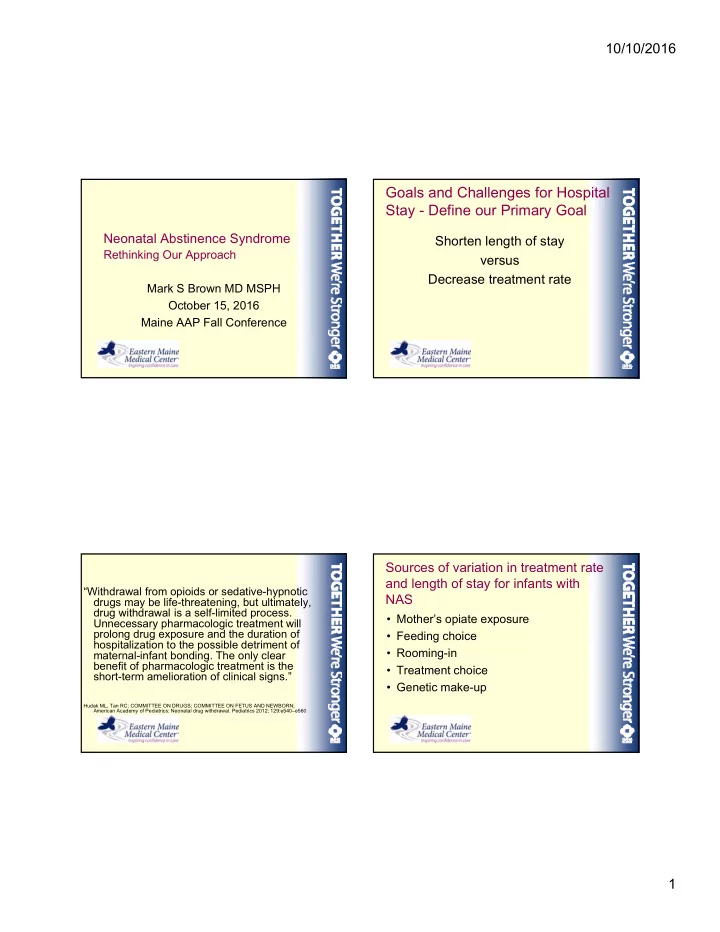
Goals and Challenges for Hospital Stay - Define our Primary Goal

Shorten length of stay versus Decrease treatment rate

“Withdrawal from opioids or sedative-hypnotic drugs may be life-threatening, but ultimately, drug withdrawal is a self-limited process. Unnecessary pharmacologic treatment will prolong drug exposure and the duration of hospitalization to the possible detriment of maternal-infant bonding. The only clear benefit of pharmacologic treatment is the short-term amelioration of clinical signs.”

Hudak ML, Tan RC; COMMITTEE ON DRUGS; COMMITTEE ON FETUS AND NEWBORN; American Academy of Pediatrics: Neonatal drug withdrawal. Pediatrics 2012; 129:e540–e560

Sources of variation in treatment rate and length of stay for infants with NAS

  • Mother’s opiate exposure
  • Feeding choice
  • Rooming-in
  • Treatment choice
  • Genetic make-up
slide-2
SLIDE 2

10/10/2016 2

Engaging the Families During Inpatient Stay What are the main challenges to families?

  • Medical environment and model – not prepared for
  • bservation period or medical treatment
  • Provider inconsistency – lack of trust
  • Competing demands – families, children, medication

appointments, transportation, housing, dysfunctional relationships

  • Treatment means a 3 to 4 weeks length of stay
  • Parents are challenged by competing family
  • bligations, appointments, judgment
  • Leaves baby unattended by parent for periods of time

each day

  • Babies can have attachment and state disorders that

are confused with withdrawal signs prolonging treatment

Goals and Challenges for Hospital Stay - Define our Primary Goal

6

  • Decreasing length of hospital stay during

treatment unfortunately forces us to find the edge of tolerable withdrawal as we decrease doses.

  • This reinforces poor state control in these

high-risk infants.

  • Can’t be good for the developing brain
  • Moves us toward using 2nd drugs since we

use these as a crutch to support inpatient weaning

SO, LET’S TALK ABOUT SCORING SOME MORE

slide-3
SLIDE 3

10/10/2016 3

NAS Scoring to Evaluate Signals for Treatment

  • Baby born to a mother on methadone maintenance

(65 mg daily)

  • Observed for 6 days without treatment

NAS Scoring to Evaluate Signals for Treatment

  • Baby born to a mother on methadone maintenance

(33 mg daily)

  • Observed for 6 days without treatment

NAS Scoring to Evaluate Signals for Treatment

  • Baby exposed to Subutex, observed for 5 days
  • Mother exclusively breast-feeding

NAS Scoring to Evaluate Signals for Treatment

  • Consider Finnegan Scoring as a tool
  • Understand the elements of the tool
  • Use it as a signal and consider

adapting a more functional scoring approach

slide-4
SLIDE 4

10/10/2016 4

What signs of withdrawal do we really care about?

13

Define our Primary Goal

  • Can the baby eat?
  • Is there significant vomiting, poor

coordination of suck, diarrhea?

  • Can the baby sleep?
  • Can the baby be consoled?

Goals and Challenges for Hospital Stay

14

  • Focus on non-pharmacologic care –

Hugs not Drugs

– Enlist parents – These infants have a disorder of their pain system and an inability to have normal state control – Anticipate and treat any discomfort – hunger, diaper rash, GERD – Minimize challenges to their inability to cope with state control – e.g., Feed first then change diaper

Abraham, et al. J Obstet Gynaecol Can 2010;32(9):866–871

What are parents worried about?

  • That they will be judged – “methadone mother”

– By Providers – By their own family

  • Lack of understanding by those in charge of services they need

– WIC – Shelters – Transportation often based on NTP and are not available to EMMC – Barriers to frequent hospital visitations

  • Babies will be stigmatized – “methadone baby”
  • Birth defects during pregnancy
  • Is my baby going to be normal?
  • Terrified of losing baby to DHHS even though they have done the

“right things”

  • Knowing how to do the NAS scoring “right’”
  • Feeling that they can never do enough according to some nursing

staff

slide-5
SLIDE 5

10/10/2016 5

What works well for parents?

  • Prenatal groups at replacement Centers
  • Participation in research about infant

development

  • Public Health Nursing in the home
  • Advanced notice of DHHS involvement
  • Maine Families
  • Gas cards, taxi vouchers, housing
  • Some providers are very respectful –

being listened to and concerns validated

“His nurse was like ‘his muscles are locking up because of his junkie mom’. I didn’t want to visit, I would call before and if that nurse was there, I wouldn’t even go.” “…because we’re gonna leave and he’s gonna cry and they’re gonna leave him crying because they’re gonna be like, ‘you know what? His parents are jerks!’”

“Post-NAS Syndrome”

  • After withdrawal, the pain system has

to recover

  • The pain and discomfort behaviors

need time to remodel

  • Environment still needs to be

modified

  • The emergence of the quiet alert

state takes time and needs to be reinforced to support development of state control

slide-6
SLIDE 6

10/10/2016 6

The Biggest Lesson Learned? The Window of the “Learning Moment” for the Mother is the Cornerstone for Attachment and a Stepping Stone in Mother’s Recovery