EVOCATION: FINDING THE CREATIVITY WITHIN THE CLIENT TO HAVE THEM - - PowerPoint PPT Presentation

evocation
SMART_READER_LITE
LIVE PREVIEW

EVOCATION: FINDING THE CREATIVITY WITHIN THE CLIENT TO HAVE THEM - - PowerPoint PPT Presentation

EVOCATION: FINDING THE CREATIVITY WITHIN THE CLIENT TO HAVE THEM SOLVE THEIR OWN PROBLEMS BILL OHANLON FOR A COPY OF THESE SLIDES, VISIT BILLOHANLON.COM GO TO THE BOTTOM OF THE WEBSITE GIVE ME A FEW DAYS TO POST THE SLIDES THEY WILL BE


slide-1
SLIDE 1

> <

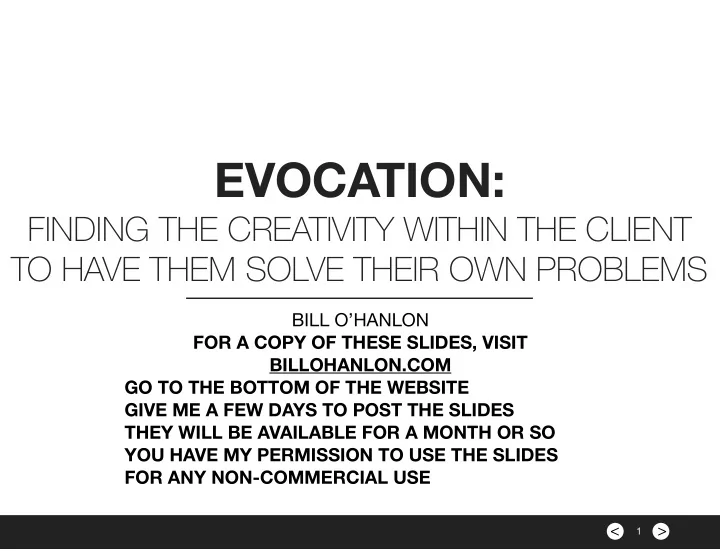
EVOCATION:

FINDING THE CREATIVITY WITHIN THE CLIENT TO HAVE THEM SOLVE THEIR OWN PROBLEMS

BILL O’HANLON FOR A COPY OF THESE SLIDES, VISIT BILLOHANLON.COM GO TO THE BOTTOM OF THE WEBSITE GIVE ME A FEW DAYS TO POST THE SLIDES THEY WILL BE AVAILABLE FOR A MONTH OR SO YOU HAVE MY PERMISSION TO USE THE SLIDES FOR ANY NON-COMMERCIAL USE

1
slide-2
SLIDE 2

> <

2
slide-3
SLIDE 3

> <

MY PREMISE: HYPNOSIS IS NOT ABOUT SUGGESTION, BUT RATHER, EVOCATION

3
slide-4
SLIDE 4

> <

MA LEARNS TO READ

4
slide-5
SLIDE 5

> <

0.1

The Difference Between Traditional and Evocative Therapies

Traditional: Deficit assumption

5

Clients are:

Damaged (genetically, neurologically, d e v e l o p m e n t a l l y, e m o t i o n a l l y, relationally) Missing skills Missing information Missing insight Missing motivation

slide-6
SLIDE 6

> <

0.2

The Difference Between Traditional and Evocative Therapies

Evocative: Resource assumption

6

Clients have:

Resources Abilities Skills Strengths Solutions Knowledge Motivation

slide-7
SLIDE 7

> <

0.3

The Difference Between Traditional and Evocative Therapies

Traditional: Role of the Therapist

7

Therapist is:

Expert in what is wrong Knows what is normal and what is not Has a model of mental health that explains what’s wrong and how to correct it Adding information or new beliefs

slide-8
SLIDE 8

> <

0.4

The Difference Between Traditional and Evocative Therapies

Evocative: Role of the Therapist

8

Therapist is expert in:

Change process helping access client’s abilities, resources, skills, strengths, solutions knowledge and motivation

Client is expert in:

His or her complaints, suffering, longings, and perceptions of and responses to therapy H i s o r h e r o w n l i f e / v a l u e s , preferences, longings What works and doesn’t

slide-9
SLIDE 9

> <

THE HORSE KNOWS THE WAY

9
slide-10
SLIDE 10

> <

1.1

How to Use Evocative Methods

Evocative Method 1

10

Find an ability, value or some knowledge: At work In hobbies or interests In the past In the present

slide-11
SLIDE 11

> <

ERICKSON LEARNS TO PRONOUNCE GOVERNMENT

11
slide-12
SLIDE 12

> <

1.2

How to Use Evocative Methods

Evocative Method 1

12

Evoke that ability through: Questions Therapist response Noticing and highlighting it Storytelling In-session or between- session task Hypnotic phenomena

slide-13
SLIDE 13

> <

1.3

How to Use Evocative Methods

Evocative Method 1

13

Link/help transfer that ability through: Questions Linking words (when, the next time, if, then) C h a n g e v e r b t e n s e s (problem in past; solution in present or future) Task assignment Presupposition Post-hypnotic suggestion

slide-14
SLIDE 14

> <

THE AFRICAN VIOLET QUEEN

14
slide-15
SLIDE 15

> <

2.1

How to Use Evocative Methods

Evocative Method 2

15

Tr a n s f o r m a l i a b i l i t y / problem into a resource/ solution: Value that experience, trait, problem Think of a context in which it could lead the client toward their longings and goals

slide-16
SLIDE 16

> <

I UNDERSTAND YOU HAVE EXPERIENCE AS A CARPENTER

16
slide-17
SLIDE 17

> <

THE GAP IN THE TEETH

17
slide-18
SLIDE 18

> <

3.1

How to Use Evocative Methods

Evocative Method 3

18

Notice and highlight what works E v o k e c o n t e x t s o f competence Evoke contexts for helpful experiences

slide-19
SLIDE 19

> <

A BOY IMPROVES HIS WRITING

19
slide-20
SLIDE 20

> <

4.1

How to Use Evocative Methods

Evocative Method 4

20

Tell a story/use metaphor Use art (music, poetry, visual arts, dance, film, novels, plays, etc.)

slide-21
SLIDE 21

> <

21

Ken Robinson - Gillian Lynne story

slide-22
SLIDE 22

> <

5.1

How to Use Evocative Methods

Evocative Method 5

22

Presuppose

slide-23
SLIDE 23

> <

“I DON’T KNOW HOW YOU WILL CHANGE”

23
slide-24
SLIDE 24

> <

6.1

How to Use Evocative Methods

Evocative Method 6

24

Give the client something ambiguous on which to p r o j e c t m e a n i n g a n d positive change A m b i g u o u s t a s k assignments Empty words and phrases

slide-25
SLIDE 25

> <

BOTANICAL GARDEN

25
slide-26
SLIDE 26

> <

DRIVEWAY THERAPY

26
slide-27
SLIDE 27

> <

7.1

How to Use Evocative Methods

Evocative Method 7

27

Give the client something to resist that can lead in a positive direction Noxious tasks Insults

slide-28
SLIDE 28

> <

“MAY HE DROWN IN HIS OWN SPIT”

28
slide-29
SLIDE 29

> <

A UNIQUE APPROACH TO INSOMNIA

29
slide-30
SLIDE 30

> <

FOR ME, SHIFTING TO THE EVOCATION ORIENTATION WAS A REVOLUTION

LESS WORK LESS DEEP DIVING/SPECULATING TO FIND THE “TRUE CAUSES” OR “ISSUES” MORE CONFIDENCE LESS WORRY ABOUT IMPOSING MY VALUES OR IDEAS MORE PARTNERSHIP AND EMPOWERMENT

30
slide-31
SLIDE 31

> <

31 


PLENARY #2: EVOCATION: FINDING THE CREATIVITY WITHIN THE CLIENT TO HAVE THEM SOLVE THEIR OWN PROBLEMS 
 BILL O’HANLON, MS, LMFT 


VERIFICATION CODE: 82614

slide-32
SLIDE 32

> <

EVOCATION:

FINDING THE CREATIVITY WITHIN THE CLIENT TO HAVE THEM SOLVE THEIR OWN PROBLEMS

BILL O’HANLON FOR A COPY OF THESE SLIDES, VISIT BILLOHANLON.COM GO TO THE BOTTOM OF THE WEBSITE GIVE ME A FEW DAYS TO POST THE SLIDES THEY WILL BE AVAILABLE FOR A MONTH OR SO YOU HAVE MY PERMISSION TO USE THE SLIDES FOR ANY NON-COMMERCIAL USE

32