SLIDE 1
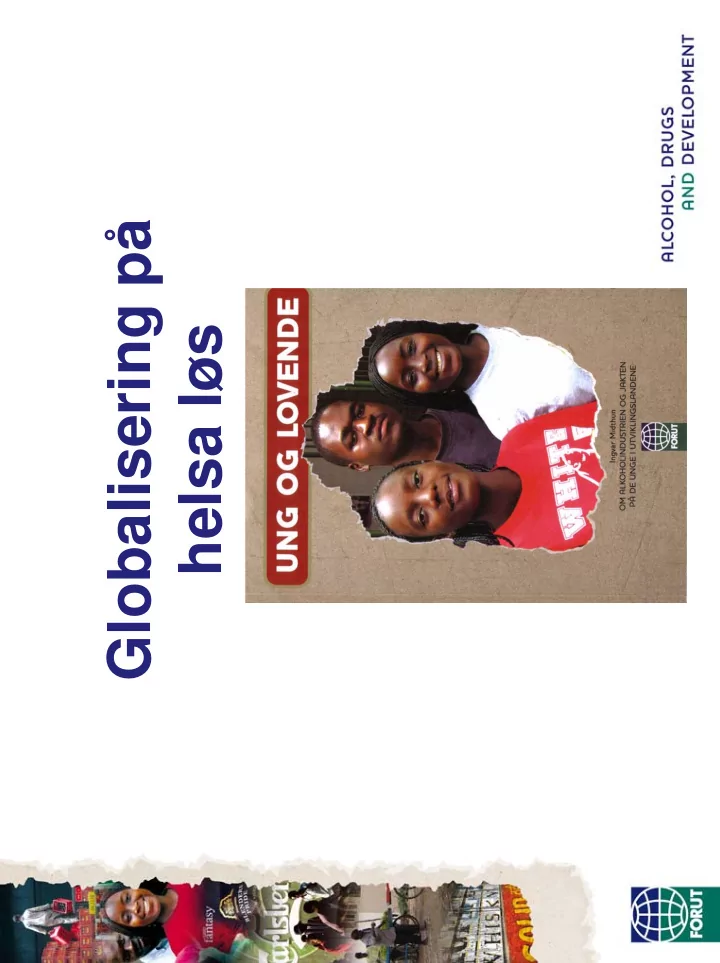
Globalisering på helsa løs
SLIDE 2
Jakten på unge forbrukere i utviklingsland – og hele verden
Global ekspansjon, politiske strategier, lobby-virksomhet og markedsføring i regi av alkohol-, tobakk- og næringsindustrien
SLIDE 3 …på helsa løs
- Alkohol, tobakk
- g feilernæring
har stor andel av helsebyrden
– Global Burden
Ranking of estimated attributable and avoidable burdens of 10 leading selected risk factors
Other diet-related risks and physical inactivity
Til sammen 17,6% av DALYs
SLIDE 4
Increased globalisation and concentration of ownership ”Emerging markets” in Africa, Asia and Latin-America
SLIDE 5 “Major trends”
- The other major trend to be seen in beer in 2005
was continued extensive investment in emerging markets.
– […] emerging beer markets [… has] become critical to the long-term growth prospects of multinational brewers – favourable demographics.
- populations are growing faster,
- more consumers are coming into legal drinking age,
- greater purchasing power.
- In contrast, the beer markets of the West are
stagnant,
– ageing populations, health concerns among consumers that are hurting drinking patterns, rising demand for premium wine and spirits and fierce competition on
- price. (Just-Drinks 17 Jan 2006)
SLIDE 6
SLIDE 7
SLIDE 8
India is probably second (in terms of emerging markets that are making the biggest contribution to BATs sales) after Brazil. It is a hundred billion sticks’ market and we have a 70% share. India represents our second market in volum terms. As living standards rise and people trade up from beedis the market could be enormous
BAT Chairman, Martin Broughton
SLIDE 9
India, a market shaping up to be one of the most attractive for multinational brewers.
Just-Drinks 17 Jan 2006
SLIDE 10 Why China and India?
world’s biggest beer market
USA: USA: 83 litre 83 litre China: China: 18 litre 18 litre
The five biggest beer markets in the world
China USA Germany Brazil Russia
consumption 2004:
India: India: 1 litre 1 litre
SLIDE 11 Politiske strategier
– Forsøker å gjøre problemet til et spørsmål om “personlig ansvar” i stedet for et folkehelse-perspektiv – Social Aspect Organisation – Smokers’ Rights Organisations – Finansierer forskning – Aktiv lobbyvirksomhet – Ekspansjon i nye markeder (Sør)
SLIDE 12 Politiske strategier
- Forskning/forskere for å tilsløre:
– Alkohol for hjertet – Sukker viktig kilde til energi – Tilbakeviser sammenhengen mellom sukker og fedme – Avviser sammenhengen mellom reklame og forbruk
- Alkohol og ernæringsindustrien redd
for å gå i samme fella som tobakk
SLIDE 13 “The Technical Report 916 has been widely criticised by many
- rganisations and individuals fo
standards for a scientific review and for ignoring the findings of a number of recent international consensus reports on diet and health.” r not meeting expected modern
SLIDE 14
“The Beverage Institute is responsible for evaluating emerging wellness trends and ingredients on behalf of The Coca-Cola Company, conducting clinical research in support of Company brands… “
SLIDE 15
SLIDE 16
- Asahi Breweries, LTD.
- Bacardi-Martini
- Beam Global Spirits & Wine
- Brown-Forman Corporation
- Diageo PLC
- Heineken N.V.
- InBev
- Molson Coors
- Pernod Ricard
- SABMiller PLC
- Scottish & Newcastle
SLIDE 17 Politiske strategier
- “Kjøper seg innflytelse”?
– Både sukker-, tobakks- og alkohol- industrien er store bidragsytere til amerikansk valgkamp – For å unngå restriksjoner, beholde fordeler (f.eks. subsidier), støtte i inter- nasjonale fora (handelsforhandlinger, WTO, WHO etc).
- Deltakere i “public-private
partnership” i WHO
SLIDE 18 Amerikanske valgkampbidrag
Kilde:
SLIDE 19 Amerikanske valgkampbidrag
Kilde:
SLIDE 20 WHO Framework Convention
- n Tobacco Control
- Idea initiated May 1995 – 48th WHA
- Resolution WHA49.17 – 1996
- “But it wasn’t until 1999, a year after
the then WHO Director-General, Dr Gro Harlem Brundtland, made global tobacco control a priority of WHO, that work on the WHO Framework Convention on Tobacco Control began.”
SLIDE 21 WHO – 916-saken
- WHO Technical Report Series 916 -
Diet, nutrition and the prevention of chronic diseases
– Gro Harlem Brundtland tok et initiativ mot fedme og sukker – Prosess med ekspertgruppe fram mot Utforming av en ”Global strategi” på Verdens helseforsamling 2004 (med blant andre Kaare Norum) – Amerikansk press vannet ut resultatet
SLIDE 22 WHO – US interest in alcohol
- … a source of pressure on WHO on behalf
- f alcohol industry interests
- 1983: a study on the public health
implications of alcohol production and trade was stopped by the DG to “reassure the Reagan Administration that WHO’s global health programs are in line with the principles of private enterprise”
- Later published without note of its WHO
connection (Cavanaugh & Clairmonte 1985: Alcoholic Beverages: Dimensions of Corporate Power).
SLIDE 23 Industry interest in WHO
- … alcohol industry watches over WHO’s
activities with care and concern
- … considerable effort by industry firms or
“social aspects” organizations […] to influence WHO’s alcohol programme
- A special case of an alcohol industry
player is the International Center for Alcohol Policies (ICAP), set up in 1995 by 11 multinational alcohol producers.
SLIDE 24 WHO and Alcohol
- WHA58.26 – Public Health Problems
Caused by Harmful Use of Alcohol
- To draw up recommendations and report
to the 60th World Health Assembly in 2007
– Follow up the present resolution. – Secure a further strong WHO mandate for alcohol policy and strategy after 2007 – Global Strategy?
- Consultations held both with industry and
NGOs
SLIDE 25
Trade treaties
Alcohol policy/WHO: Use regulations for public health World Trade Organization (WTO): Remove trade regulations purpose
SLIDE 26 Trade Creep – ”Disciplining Domestic Regulation”
- Negotiating chair’s draft July 2006
- Impose a GATS "necessity test" on domestic
regulation
- Impact? Everything related to qualifications,
licensing, and standards would have to be "no more trade restrictive than necessary"
- If challenged under a necessity test,
governments would have to prove that their alcohol regulations:
– Serve legitimate objectives – Are effective. – Are "proportional" in their restriction on trade
SLIDE 27 “The industry firmly believes that distribution rights and advertising freedoms are essential components of market access and should benefit from the broadest possible liberalisation within the Doha Round services negotiations” World Spirits Alliance “I want my negotiators – I say my negotiators because I think they negotiate for us – to try to do the utmost to open up the services trade market all
Pascal Kerneis, Managing Director, European Services Forum
Objectives of the international spirits industry
SLIDE 28
EU threatens India with WTO action
Nyhetene 15. november 2006: “The European Union has threatened to take India to the World Trade Organisation over the country’s taxes on wines and spirits… The Scotch whisky industry, for example, has been a fierce critic of India’s duty system, where a tax of up to 550% can be levied on a bottle of Scotch.”
SLIDE 29 Drinks industry
“Every action taken by management is guided by one
embracing shareholder value” Anheuser Busch Annual Report 1997
SLIDE 30 Aspects of advertising
budgets
campaigns and/or break codes
– 17 floors of Bangkok’s tallest building: Johnny Walker logo and the message:
Drink Don’t Drive
SLIDE 31
SLIDE 32
- “Our advertising and promotional
materials will not imply that alcohol has the ability to prevent, treat or cure any human disease. Nor will they create the impression that alcohol consumption enhances mental ability or physical performance, e.g. when engaging in
- sports. We will not promote our
brands as ‘energy drinks’.”
SLIDE 33
SLIDE 34
Sports sponsorhip
SLIDE 35 Malawi:
Carlsberg announcing the winner
Private Jet Trip 2005
SLIDE 36
SLIDE 37
SLIDE 38