Global Surgery: Assuring an Adequate Surgical Workforce Florida - - PDF document

global surgery assuring an adequate surgical workforce
SMART_READER_LITE
LIVE PREVIEW

Global Surgery: Assuring an Adequate Surgical Workforce Florida - - PDF document

Global Surgery: Assuring an Adequate Surgical Workforce Florida Chapter, American College of Surgeons April 7,2018 Patricia J Numann MD, FACS Lloyd S Rodgers Professor of Surgery Emerita Syracuse NY Disclosures No financial disclosures Why


slide-1
SLIDE 1

1

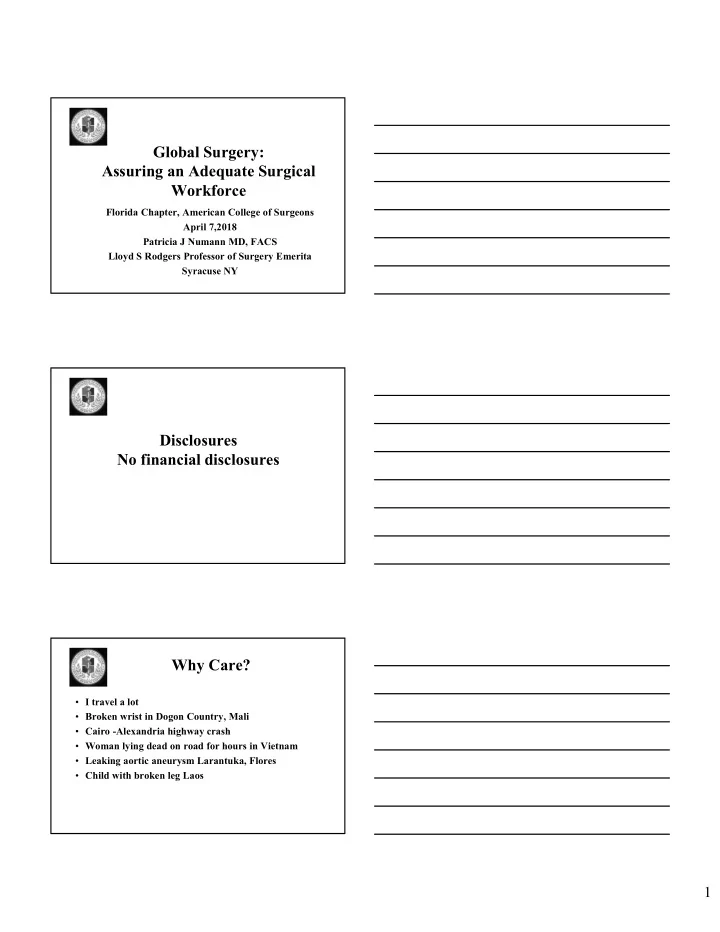
Global Surgery: Assuring an Adequate Surgical Workforce

Florida Chapter, American College of Surgeons April 7,2018 Patricia J Numann MD, FACS Lloyd S Rodgers Professor of Surgery Emerita Syracuse NY

Disclosures No financial disclosures Why Care?

  • I travel a lot
  • Broken wrist in Dogon Country, Mali
  • Cairo -Alexandria highway crash
  • Woman lying dead on road for hours in Vietnam
  • Leaking aortic aneurysm Larantuka, Flores
  • Child with broken leg Laos
slide-2
SLIDE 2

2

I could be involved

  • Association of Women Surgeons
  • International Society of Surgery
  • ACS Operation Giving Back
  • ACS International Relations Committee
  • ACS International Chapters
  • ACS International ATLS
  • International Presidents

Access to care and workforce are a major issue

  • 5 billion without access up from 2 billion in 2000
  • 11% of total loss of life per year is due to surgical

problems –WHO 2002

  • 6% of surgical procedures in 1/3 of world population
  • Africa only 7% surgeons are women
  • Trauma kills more people than HIV, Malaria, and TB
  • 2 million children awaiting surgery for congenital

heart disease

  • 38 million people are blind 48% from cataracts
  • And then there is war and natural disasters
  • The Copenhagen Conference in 2008 [3] stated that

provision of surgical care was one of the 25 most cost effective investments for low income countries.

  • Dr Jim Yong Kim, President of the World Bank, [4]

has stated his goal is to eliminate extreme poverty by 2030 and eliminate poverty worldwide by 2050, support smart business models, reduce inequality and focus on the lowest 40%.

  • Providing surgical care will increase the work force

and improve the economic status of low income countries.

Economic Data Supporting Benefit of Surgery

slide-3
SLIDE 3

3

WHO 2011

  • Surgical care not part of its public health mission
  • 4% budget for surgical issues
  • More people in LMIC die of trauma than HIV,TB,

and Malaria combined

  • US delegate to WHA did not vote in favor of

including surgery in the public health mission of WHO

WHO Endorsement Matters!

  • Increasing funding: World Bank support
  • Development of national policies, training and

facilities

  • The young and women disproportionately affected:

Childbirth, accidents, burns, congenital anomalies

  • Funding and expansion of WHO Global Initiative for

Essential and Emergency Surgical Care GIEESC

We can make a Difference

  • Unified to get WHO Resolution passed in 2015
  • World Health Assembly Resolution (WHA68.15):

“Strengthening emergency and essential surgical care and anaesthesia as a component of universal health coverage.”

  • Lancet Commission on Global Surgery
  • World Bank’s Disease Control Priorities Project
slide-4
SLIDE 4

4

The Lancet Global Health

Surgeons / 100,000 population

  • Low Income: 0.7
  • Lower Middle Income: 5.5
  • Upper Middle income: 22.6
  • High income: 56.9
  • Homer et al: Global distribution of surgeons, anesthesiologists, and Obstetricians The Lancet Global Health

April 2015

Statistics for LIC

MD/20,000 Mat Mort Births Poverty Somalia 4 1/14 6 not avail Congo 2 1/24 6 59% Uganda 1 1/35 6.69 35% Senegal 1 1/46 5 34% Chad 1 1/15 1100/100,00 6 62% Tanzania 1 1/23 5 89% US 40 21/100,000

WHO Birth Data 2010

Birth Attended by Professional C Section Rate as percent of births Low Income Country-$1035/yr 46.9% 5.8 Low Middle Income countries 60% 8.8 High Middle Income countries 97% 30.6 High Income Countries 99% 29.6

slide-5
SLIDE 5

5

Complications of Pregnancy

  • Ethiopia-18,000 women have obstructed labor each

year.

  • 1/2 die the other half lose a baby and gain a fistula
  • C section available to small percent of low income

world then 25% have no anesthesia available

  • A fistula means the woman will be ostracized and die

Millennium Development Goals United Nations by 2030

  • 17 Goals
  • Ensure Healthy Lives and promote well-being for all
  • Achieve gender equity and empower all women
  • Develop a global Partnership for development

How do we achieve Global Access?

What is our role?

slide-6
SLIDE 6

6

Complex Issue

  • Lack of Basic education
  • Poverty
  • Social customs
  • Gender bias
  • Population density
  • Corruption

Global Commitment

  • Achieve the Millennial Goals
  • Establish guidelines for engagement
  • Promote meaningful cultural change to prevent

discrimination and violence

  • Empower women
  • Commit personally to help create the change

World Health Organization November 2001 Core Domains of Good Stewardship

Generation of intelligence Formalizing strategic policy direction Ensuring tools for implementation Coalition building Ensuring a fit between policy objectives and organizational structure and culture Ensuring accountability

slide-7
SLIDE 7

7

Standards for Programs

  • Equitable exchange- give as much as you get
  • Do not diminish experience of in country trainee
  • Build Capacity
  • Be Sustainable
  • Build on existing facilities
  • Guidelines for Surgeons on Establishing Projects in

Low-Income Countries. Grimes C. World J Surg 2013; 37:1203-1207

Understanding who does surgery

  • Very variable from country to country
  • Individual preceptor
  • Religious figure
  • 1 year training
  • Board Certified/Fellowship trained
  • Determined by the Government/ Surgical College/

Board/Licensure or maybe by the individual

Circumcision cave -Mali

slide-8
SLIDE 8

8

“Surgeon”-preparing knife Role of Women “Women hold up half the sky”

Nicholas Kristof and Sheryl WuDong

  • Girls less likely to be educated
  • Must follow traditional cultural roles
  • Prevalent violence : Rape

Honor crimes Female circumcision

  • In Subsaharan Africa only 7% surgeons women

Ghana

  • Percent women in medical school 35%
  • Surgeons and related disciplines include ob-gyn,

anesthesia, radiology [2007] Total 281 Women 20 [7.1%]

  • Prof. E.D. Yeboah, Past President

West African College of Surgeons

slide-9
SLIDE 9

9

Lest We Forget

The basic infrastructure of hospitals and the country affect the ability to provide surgical care:

  • Impassable roads with no alternative

transportation

  • Unsafe or unavailable water
  • Unreliable electrical power

ACS Survey

  • 92% residents
  • 50%Fellows more are older male general surgeons

but 18% under 40

  • ACS is committed to be part of solution

“Mission” work

  • Approximately 40% of all surgery in Kenya in

performed at such faith-based hospitals

  • 22% of all surgery in Ghana, but 35% of all surgery

done at rural hospitals, is done at faith-based hospitals

  • ACS Operation Giving Back
  • Pan African Academy of Christian Surgeons[PAACS]
slide-10
SLIDE 10

10

Give what is desired

  • Laparoscopic Cholecystectomy Surgery Program in Mongolia
  • Organized by Dr Ray Price-Utah
  • Now in All Mongolian Hospitals
  • Instituted Check list usage in all Mongolian Hospitals

Laparoscopic Surgery Program in Mongolia

  • Established by Ray Price

MD FACS from Utah

  • His Mormon Mission
  • Brought Laparoscopic

surgery to Mongolia

  • More valuable to a laborer

in Mongolia than an American

  • Educated and disseminated

the technique to all Mongolian Hospitals

ACS Global Initiatives

International Relations Committee Develop an International Strategy ACS International Chapters ACS Board of Governors and Regents International Presidents Meeting Address Issues of Mutual concern ACS International Fellowships International ATLS Participate in International Cancer programs

slide-11
SLIDE 11

11

Founded in 2004

  • Humanitarian Aide
  • Disaster Relief

Simulation Center in Ghana and East Africa Scholarships Exchange opportunities Recruits examiners for exams in COSECSA Global Health Competency for Surgeons Course

ACS OGB CONSORTIUM OF ACADEMIC GLOBAL SURGERY

  • VISION STATEMENT
  • We envision unifying academic programs to discover

solutions for safe, effective and affordable surgical care worldwide.

  • MISSION STATEMENT
  • To reduce the burden of untreated surgical disease in

resource-limited areas, we collaborate to cultivate the next generation of compassionate, capable global surgery leaders, experienced in education, research, policy, and advocacy.

Global commitment to Cancer Prevention and treatment

  • Smoking is increasing in the world
  • Reverse smoking causes Chutta cancer in India
  • Lack of awareness results in average presenting size
  • f Breast cancer in LIC of 6.5cm
  • Need for liver transplant high in LMIC due to

Hepatitis C

  • Slow to understand the increased risk of Gastric

cancer in Japan and Esophageal in China

slide-12
SLIDE 12

12

Global Plan

  • Increasing number of global initiative
  • Institutional Twining
  • Academic exchanges
  • Collaborative research
  • Building Sustainable Systems
  • Local solutions for local problems
  • Cost effective strategy for incremental improvement

Funding Needs

  • Women Surgical Scholars

Program in Sub-Saharan Africa

Funding Goal: $25,000 annually

  • ACS Training Hub in

Sub-Saharan Africa

Funding Goal: TBD

  • Tumor Board Education Series

Funding Goal: $81,000

Opportunities for Involvement

  • Alliance for Surgery and Anesthesia Presence
  • World Health Congress
  • International Studies programs: Duke, UNC, UCSF, U of Utah
  • Surgical Residencies with International rotations; 39
  • MPH programs
  • Fellowships and Scholarships ACS Sponsors many
  • ACS committees-RAS, YSA, Trauma Committee
  • Doctors without Borders, Partners in Health, Local Missions
  • Keep informed-World Journal of Surgery
  • Personal volunteerism and philanthropy
slide-13
SLIDE 13

13

What Can We Do?

  • Have a strategic plan for your organizations International

efforts

  • Include Global Health, health disparity, and public health

information in training

  • Encourage your medical school and residency to have a global

health program

  • Support charitable organizations that fund medical programs

that are capacity building and sustainable

  • Support Charities that provide economic development for

women- Charity Navigator

“When we know better, we do better”

Maya Angelou Thank you