1987 1 Scarless Surgery: The Thyroidectomy Evolution the - - PowerPoint PPT Presentation

1987
SMART_READER_LITE
LIVE PREVIEW

1987 1 Scarless Surgery: The Thyroidectomy Evolution the - - PowerPoint PPT Presentation

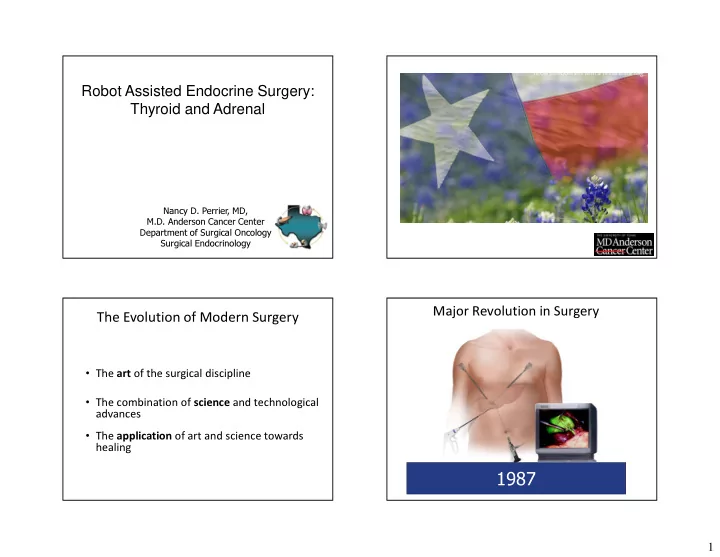
Robot Assisted Endocrine Surgery: Thyroid and Adrenal Nancy D. Perrier, MD, M.D. Anderson Cancer Center Department of Surgical Oncology Surgical Endocrinology Major Revolution in Surgery The Evolution of Modern Surgery The art of the


slide-1
SLIDE 1

1

Robot Assisted Endocrine Surgery: Thyroid and Adrenal

Nancy D. Perrier, MD, M.D. Anderson Cancer Center Department of Surgical Oncology Surgical Endocrinology

The Evolution of Modern Surgery

  • The art of the surgical discipline
  • The combination of science and technological

advances

  • The application of art and science towards

healing

Major Revolution in Surgery

1987

slide-2
SLIDE 2

2

Scarless Surgery: the Millenium Thyroidectomy The Thyroidectomy Evolution

Trans cervical Endo scopic Gagner

1996

Trans axillar y Insuffl ation Ikeda, Taka miSas aki JACS

2000

Scarles s Endosc

  • pic

Breast Ohgami , Ishi Surg Lap Endo Percut Tech 2000 Trans axillar y Insuffl ating Ikeda, Taka mi, Niimi Surg Endo 2001 Ant Chest Wall Takami, Ikeda, Current Opin Oncol

2006

Lap Axillary and Percuta neous Yoon, Park, Chung Surg Lap Endo Per Tech

2006

Trans axillary Robotic Love, Wright, Irish J Lapar Adv Surg Tech

2005

Laparos copic Breast Sasaki, Najami ma, Ikeda World J

  • f Surg

2008

Bilatera l Axillary Breast App BABA Koh YW, Kim, Lee Surg Endosc

2008

BABA Insuff End Shima z, Shiba, Tamak i Surg Endos c

2008

Trans Oral Richm

  • n,

Pattani Tufano Head and Neck

2009

Post Auri & Axil App Lee, Kim, Park WJS

2009

Bil Robot Ass Thyroid Sx BRATS Landry, Grubbs, Perrier Arch Surg

2010

Thyroidectomy Options

Approach

  • Open
  • Endoscopic

– Direct – Indirect

  • Transcervical
  • Transaxillary (30/00)
  • Anterior Chest Wall
  • Peri Areolar Breast
  • Trans-oral

Techniques

  • Exposure

– Insufflation vs Gasless

  • Instrumentation

– Robotic vs not

  • Remote access

Kang et al. J Am Coll Surg Aug 2009

Transaxillary Approach
slide-3
SLIDE 3

3

Transaxillary Pectoralis Exposure Right Side Transaxillary Dissection

Space between the SCM branches

Sternal Head of SCM Elevation Surgical Dissection

slide-4
SLIDE 4

4

Korean Experience

  • Multicenter study
  • 1043 consecutive cases

Lee, Han, Chung Surg Endo 2010)

Korean Experience

  • Differences in outcome
  • Prospective study

–Preop, 1, 12 weeks post op –OR time longer –No difference in pain, LOS, voice –Less discomfort and swallowing disturbances than open –Cosmetic satisfaction higher in robot

Lee, Han, Chung Surg Endo 2010)

Cadaveric Dissections

slide-5
SLIDE 5

5

Port Placement- Axillary Space

C

1

3

R

2

s

12mm 30° Dual Endoscope at 40° angle 5mm Maryland Dissector 8 mm Pro Grasp Retractor

Chung Retractor

8 mm Curved Harmonic Scalpel Laparoscopic Suction

Head

Foot

Robotic Positioning

‘ Chung Retractor

Commercially Available 2010

Transaxillary Thyroidectomy

Chung JACS 2009

Mean tumor size: 1.0 cm Complications:

Major- 1% Minor 6.3%

slide-6
SLIDE 6

6

Evidence Based Principles

–Define the question & problem –Search for evidence –Evaluate literature –Apply results –Audit outcome

Operative Times for RATS

Total Thyroidectomy

Single Incision Bilateral Transaxillary Thyroidectomy

Expense of Robotic Thyroidectomy: A Cost Analysis at a Single Institution . Arch Surg. 2012;147(12):1102-1106.

Single Institution Cost of Robotic Thyroidectomy

slide-7
SLIDE 7

7

s/p Thyroidectomy

Robotic Thyroidectomy Complications

  • Massive emphysema and hypercarbia

(Gottlieb, Anes Analgesia 1997)

  • Effect on intracranial pressure

(Rubino, Gagner Surgery 2000)

  • Brachial Plexopathy
  • Tracheal Injury
  • Chest Wall Numbness

Why I have abandoned RATS

  • Main benefit- translocation of the surgical

incision to the axilla

  • Requires 2X resources (personnel,

sterilization, scheduling)

  • Unable to justify the expense in a time of

cost effectiveness and when demands

  • utweigh resources
  • Outcome not superior
  • Not likely a bridge to telesurgery

Perrier, N. Stang, M. Surgery Dec 2012

Summary: Robotic Thyroidectomy

  • More Expensive

–Higher equipment depreciation costs –Substantially longer operating room time –Flat reimbursement schedule which is a disincentive to implementation –Cost prohibitive

  • Niche Operation

Sturgeon, Clin Thyroidol (2013)

slide-8
SLIDE 8

8

Reserved……

Robotic Assisted Adrenalectomy

Cushing’s Syndrome

Robotic Technology

  • Potential Benefits

– Increased articulation of instruments: provides a flexible approach to dissection, – Magnified, 3 D optics: better visualization – Motion Scaling – Ergonomic advantages

  • Disadvantages

– Cost (non reusables, staff, maintenance, sterilization) – Time – Complexity

Dickson, P Am Surg (2013) Vol 79

slide-9
SLIDE 9

9

Patient Positioning

Retroperitoneoscopic Adrenalectomy Laparoscopic Operative Technique

slide-10
SLIDE 10

10

Robotic Docking

8mm cannula 8mm cannula

Left Sided Port Placement

Prograsp Camera Harmonic

1 Camera

Robot Docked Here

5mm trocar for suction, irrigation, clip applier 12mm port balloon trocar

Suction

1

Left Sided Set Up

Camera 2

Ideal Instrument Articulation

slide-11
SLIDE 11

11

Situations that Beckon Robotic Instrumentation

  • 1. Cushing’s disease with prolonged

preoperative medical (ketaconazole) therapy

  • 2. Cortex preservation critical- may optimize the

ability to maintain a vascularized remnant

  • 3. Adrenal metastatic disease s/p neoadjuvant

chemotherapy dense adherence to IVC

  • 4. Adrenal vein anterior aspect of renal hilum
  • 5. Morbid Obesity

Case 1

39 y/o F with C618S MEN IIA RET mutation Biochemical evidence of pheochromocytoma Bilateral lesions > 4 cm Cortical preservation critical 4 of 4 young children + RET

Cortical-Sparing Strategy

  • Preservation of adrenal vein
  • Minimal peripheral dissection of spared remnant

Case 2

  • 49 y/o F dx with small cell lung cancer
  • Treated with XRT and whole brain

radiation

  • New isolated left adrenal metastasis
  • Received systemic Cytoxan, Taxotere,

Adriamycin

slide-12
SLIDE 12

12

Systemic Treatment of Isolated Adrenal Metastasis

  • Decreased from 5.6 to 3.1 cm

Case 3

41 y/o M with severe HTN Right adrenal mass Elevated aldosterone with right sided lateralization Weight 152 Kg (334 lbs)

Robotic Adrenalectomy

  • Robotic assistance is complimentary to PRA and

may provide advantage in complex procedures

  • Angled articulation appears to be beneficial in

select PRA dissection

  • The technology continues to evolve and further

refinements are necessary

  • Theoretic advantages should be rigorously

validated in the clinical arena

Limitations

  • Available Instruments

– Robotic Clip Appliers – Articulating electrothermy instrumentation

  • Hardware is bulky
  • Access to robotic devices requires

intermediate scheduling

  • Requires experienced bedside assistant
  • Dependent on multiple vendors
slide-13
SLIDE 13

13

Summary: Robotics in Endocrine Surgery

Thyroid

  • Twice the time
  • >Twice the

expense

  • Not superior
  • Translocation of

incision

  • Different

Complications

Adrenal

  • Select cases
  • Articulation and

view beneficial

  • Further instrument

improvement

  • Bulky hardware

Principles of Safe Introduction of New Technology

  • Broad diseased based knowledge
  • Skill set for the operation; not technology
  • Comprehensive educational experience
  • Skill acquisition by a team rather than
  • nly a primary surgeon

Sachdeva AK: Acquiring skills in new procedures and technology: the challenge and the opportunity. Arch Surg 2005; 140: 387.

Endocrine Surgery: Robotics Implementation

  • Establish research aims
  • Design data acquisition forms with

definite endpoints

  • Employ a consistent technique
  • Develop and refine
  • Objective review of outcomes

“…surgeons as fiduciaries must balance technologic advancement and ethical responsibilities, a subject rarely broached in our data-driven surgical publications.”

  • -James W. Jones, M.D.

Ethics of Rapid Surgical Technological Advances Ann Thorax Surg 2000;69:676-677