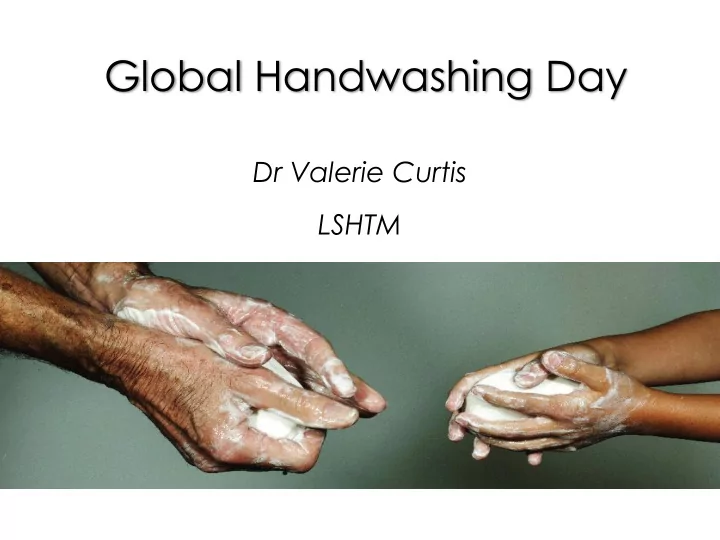
Global Handwashing Day Dr Valerie Curtis LSHTM Why HWWS? Some - - PowerPoint PPT Presentation

global handwashing day
SMART_READER_LITE
LIVE PREVIEW

Global Handwashing Day Dr Valerie Curtis LSHTM Why HWWS? Some - - PowerPoint PPT Presentation

Global Handwashing Day Dr Valerie Curtis LSHTM Why HWWS? Some 23-40% reduction in diarrhoea risk (Freeman et al 2014) Global disease burden 300 000-600 000 lives p.a. China: not HWWS costs $10bn, 10x ROI India: not HWWS costs


slide-1
SLIDE 1

Global Handwashing Day

Dr Valerie Curtis LSHTM

slide-2
SLIDE 2

Why HWWS?

  • Some 23-40% reduction in diarrhoea risk

(Freeman et al 2014)

  • Global disease burden 300 000-600 000

lives p.a.

  • China: not HWWS costs $10bn, 10x ROI
  • India: not HWWS costs $30bn, 20x ROI
  • Prevention of pandemics and AMR
slide-3
SLIDE 3

The Parable

  • No messaging – no words!
  • No knowledge – about emotion, reward
  • Universal
  • No death, disease or doctors
  • Strong levers to unlock a routine
  • Surprise, Revaluation, Performance
slide-4
SLIDE 4
slide-5
SLIDE 5

1 3 5 5 24 3 1 43 55 67 67 88 86 77 10 20 30 40 50 60 70 80 90 100 % of mother practicing targeted behaviour Before (n=120) After (119)

Source: Om Gautam, 2014

Change in safe food behaviour

slide-6
SLIDE 6
slide-7
SLIDE 7

Behaviour Setting Intervention Environment

Behaviour Centred Design

Behaviour Brain Health

Assess + Build Create Deliver Evaluate

slide-8
SLIDE 8

A

Assess

B

Build

Behaviour

C

Create

Centred

D

Deliver

Design

E

Evaluate

slide-9
SLIDE 9

www.superamma.org

slide-10
SLIDE 10

2% 4% 6% 29% 1% 19% 37% 29% 0% 5% 10% 15% 20% 25% 30% 35% 40% baseline 1st follow up 2nd follow up 3rd follow up

handwashing at target events

intervention in first half of villages intervention in control villages

SuperAmma Results

Source: Biran et al Lancet GH 2013

slide-11
SLIDE 11

View Intervention Control HWWs is good manners 84% 21% HWWS protects children 63% 2% HWWS leads to success in life 30% 0% Everybody around here WHWS 35% 8%

Source: Greenland et al 2015

slide-12
SLIDE 12

2% 4% 6% 29% 1% 19% 37% 29% 0% 5% 10% 15% 20% 25% 30% 35% 40% baseline 1st follow up 2nd follow up 3rd follow up

handwashing at target events

intervention in first half of villages intervention in control villages

(6 weeks) (6 months) (12 months)

slide-13
SLIDE 13

Behaviour Setting Intervention Environment

Behaviour Centred Design

Behaviour Brain Health

Assess + Build Create Deliver Evaluate Surprise Revaluation Performance

slide-14
SLIDE 14

Takeaways

  • Surprise, revaluation performance
  • 10% of effort and investment on design
  • f intervention
  • Private sector lessons: scale, cost, refresh
  • Use professionals
  • Long term policy and capacity
slide-15
SLIDE 15

Thanks

  • Hygiene Centre @ LSHTM: Bob Aunger,

Adam Biran, Val Curtis, Katie Greenland, Jessie deWitt Huberts, Wolf Schmidt, Sian White, Om Gautam, Gaby Judah

  • Funders: Wellcome, ESRC, DFID, SHARE,

World Bank, Unicef, Gates, GAIN, WaterAid, WSSCC, Unilever, KCC, GoJo

slide-16
SLIDE 16

BCD Materials

  • 1. WWW.EHG/BehaviourCentredDesign for manual and papers : Aunger and Curtis, Kinds of

Behavior, Aunger and Curtis The Anatomy of Motivation

  • 2. Ghana handwashing ad (1990s)

https://www.youtube.com/watch?v=w2qRcMTstzc

  • 3. Rural Indian handwashing campaign (2013)

http://www.superamma.org

  • 4. Zambian multiple behaviour change campaign (2014)

EBF: https://www.youtube.com/watch?v=zHTwlhQdjiw ORS: https://www.youtube.com/watch?v=w45PtrHUEdg Handwashing: https://www.youtube.com/watch?v=l3jcDuU_5sc