Monday, October 10 2:30-3:30pm Latrines Handwashing WaSH in - - PDF document

monday october 10 2 30 3 30pm
SMART_READER_LITE
LIVE PREVIEW

Monday, October 10 2:30-3:30pm Latrines Handwashing WaSH in - - PDF document

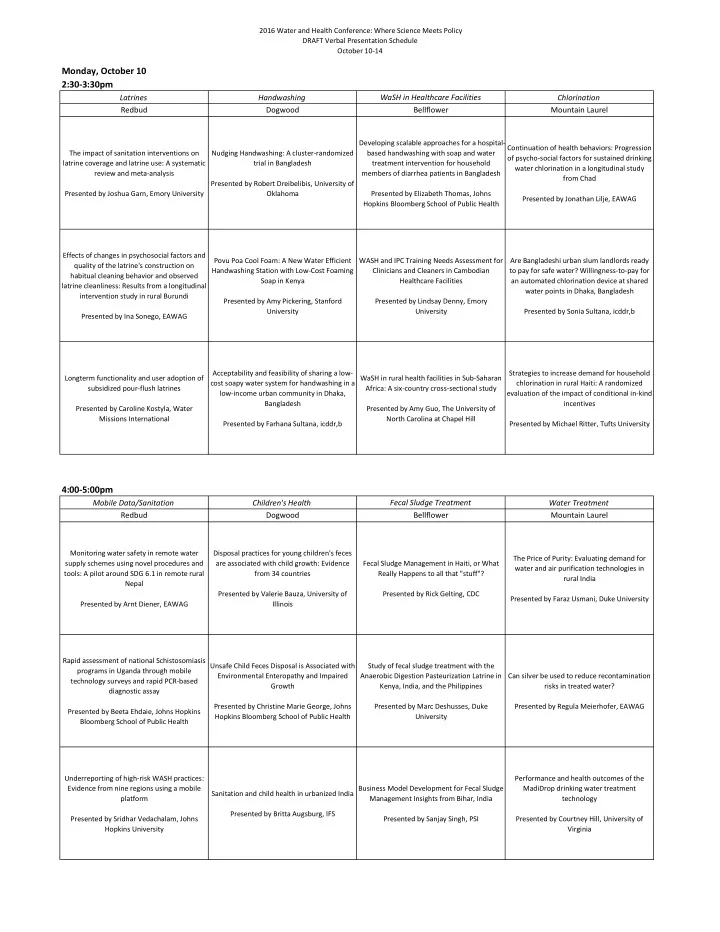
2016 Water and Health Conference: Where Science Meets Policy DRAFT Verbal Presentation Schedule October 10-14 Monday, October 10 2:30-3:30pm Latrines Handwashing WaSH in Healthcare Facilities Chlorination Redbud Dogwood Bellflower


slide-1
SLIDE 1

2016 Water and Health Conference: Where Science Meets Policy DRAFT Verbal Presentation Schedule October 10-14

Monday, October 10 2:30-3:30pm

Latrines Handwashing WaSH in Healthcare Facilities Chlorination Redbud Dogwood Bellflower Mountain Laurel

The impact of sanitation interventions on latrine coverage and latrine use: A systematic review and meta-analysis Presented by Joshua Garn, Emory University Nudging Handwashing: A cluster-randomized trial in Bangladesh Presented by Robert Dreibelibis, University of Oklahoma Developing scalable approaches for a hospital- based handwashing with soap and water treatment intervention for household members of diarrhea patients in Bangladesh Presented by Elizabeth Thomas, Johns Hopkins Bloomberg School of Public Health Continuation of health behaviors: Progression

  • f psycho-social factors for sustained drinking

water chlorination in a longitudinal study from Chad Presented by Jonathan Lilje, EAWAG Effects of changes in psychosocial factors and quality of the latrine's construction on habitual cleaning behavior and observed latrine cleanliness: Results from a longitudinal intervention study in rural Burundi Presented by Ina Sonego, EAWAG Povu Poa Cool Foam: A New Water Efficient Handwashing Station with Low-Cost Foaming Soap in Kenya Presented by Amy Pickering, Stanford University WASH and IPC Training Needs Assessment for Clinicians and Cleaners in Cambodian Healthcare Facilities Presented by Lindsay Denny, Emory University Are Bangladeshi urban slum landlords ready to pay for safe water? Willingness-to-pay for an automated chlorination device at shared water points in Dhaka, Bangladesh Presented by Sonia Sultana, icddr,b Longterm functionality and user adoption of subsidized pour-flush latrines Presented by Caroline Kostyla, Water Missions International Acceptability and feasibility of sharing a low- cost soapy water system for handwashing in a low-income urban community in Dhaka, Bangladesh Presented by Farhana Sultana, icddr,b WaSH in rural health facilities in Sub-Saharan Africa: A six-country cross-sectional study Presented by Amy Guo, The University of North Carolina at Chapel Hill Strategies to increase demand for household chlorination in rural Haiti: A randomized evaluation of the impact of conditional in-kind incentives Presented by Michael Ritter, Tufts University

4:00-5:00pm

Mobile Data/Sanitation Children's Health Fecal Sludge Treatment Water Treatment Redbud Dogwood Bellflower Mountain Laurel

Monitoring water safety in remote water supply schemes using novel procedures and tools: A pilot around SDG 6.1 in remote rural Nepal Presented by Arnt Diener, EAWAG Disposal practices for young children's feces are associated with child growth: Evidence from 34 countries Presented by Valerie Bauza, University of Illinois Fecal Sludge Management in Haiti, or What Really Happens to all that "stuff"? Presented by Rick Gelting, CDC The Price of Purity: Evaluating demand for water and air purification technologies in rural India Presented by Faraz Usmani, Duke University Rapid assessment of national Schistosomiasis programs in Uganda through mobile technology surveys and rapid PCR-based diagnostic assay Presented by Beeta Ehdaie, Johns Hopkins Bloomberg School of Public Health Unsafe Child Feces Disposal is Associated with Environmental Enteropathy and Impaired Growth Presented by Christine Marie George, Johns Hopkins Bloomberg School of Public Health Study of fecal sludge treatment with the Anaerobic Digestion Pasteurization Latrine in Kenya, India, and the Philippines Presented by Marc Deshusses, Duke University Can silver be used to reduce recontamination risks in treated water? Presented by Regula Meierhofer, EAWAG Underreporting of high-risk WASH practices: Evidence from nine regions using a mobile platform Presented by Sridhar Vedachalam, Johns Hopkins University Sanitation and child health in urbanized India Presented by Britta Augsburg, IFS Business Model Development for Fecal Sludge Management Insights from Bihar, India Presented by Sanjay Singh, PSI Performance and health outcomes of the MadiDrop drinking water treatment technology Presented by Courtney Hill, University of Virginia

slide-2
SLIDE 2

2016 Water and Health Conference: Where Science Meets Policy DRAFT Verbal Presentation Schedule October 10-14

Tuesday, October 11 2:30-3:30pm

Open Defecation/CLTS WaSH Finance Menstrual Hygiene Management Disease Exposure Redbud Dogwood Bellflower Mountain Laurel

Achieving and Sustaining of Open Defection Free villages in remote areas of Lao PDR Presented by George Josephs, World Bank Bringing WaSH to the last-mile: IndiaPost and Water.org Presented by Lesley Pories, Water.org Investigating Fear, Shyness, and Discomfort Related to Menstrual Hygiene Management in Rural Cambodia: Intersections between Women's Health and WaSH Presented by Gabrielle Daniels, Yale University Fecal Fingerprints: The Landscape of Enteropathogen Contamination in low- income, urban neighborhoods of Kisumu, Kenya Presented by Kelly Baker, University of Iowa Inclusive Sanitation in Rural Kenya: Can CLTS Reach the Elderly, the Chronically Ill and the Socio-Economically Disadvantaged? Presented by Orlando Hernandez, FHI360 Evaluating the financial and economic of performance of alternative water tariffs in Nairobi, Kenya. Presented by David Fuente, The Water Institute at UNC Women's sanitation experiences are associated with mental health: A mixed methods study in rural Odisha India Presented by Bethany Caruso, Emory University Network Informatics for Strategic Infectious Disease Exposure Assessment Studies on Water-borne Fecal Pathogens Presented by Ananya Sen Gupta, University of Iowa Demand Creation and Supply Chain Development for Scaling Up Rural Sanitation in Hoa Binh Province (Vietnam) Post- Intervention Rapid Assessment Presented by Claire Chase, World Bank Resource mobilization mechanisms for community-managed rural water systems: Alternatives to water fees Presented by Nikki Behnke, The Water Institute at UNC Inequities in access to menstrual hygiene management facilities and materials in Nairobi slum schools Presented by Candace Girod, Emory University Sanitation, water supply, and facial cleanliness coverage threshold levels, and protection against trachoma using Global Trachoma Mapping Project Data Presented by Matthew Freeman, Emory University

4:00-5:00PM

Community Sanitation WaSH in the U.S. Emergency WaSH Drinking Water Safety Redbud Dogwood Bellflower Mountain Laurel

Community Priorities for Sanitation and Energy Systems in Resource-Limited Communities Presented by Allison Davis, University of Colorado, Boulder Impact of In-home Water Service on the Rates

  • f Infectious Diseases: Results from Four

Communities in Western Alaska Presented by Timothy Thomas, Alaska Native Tribal Health Consortium Chlorination of Drinking Water in Emergencies: Systematic Review of Knowledge, Recommendations for Implementation, and Research Needed Presented by Daniele Lantagne, Tufts University Water Safety Planning: Measuring gains and implementing effective practices Presented by Karen Setty, The University of North Carolina at Chapel Hill Effect of community sanitation coverage on faecal contamination of the household environment in rural Bangladesh Presented by Tarique Huda, icddr,b Findings from Project Coyote Water: An Assessment of Unregulated Drinking Water

  • n Tribal Lands within the United States

Presented by George Goodwin, Alaska Native Tribal Health Consortium Disinfection of human excreta in emergency settings: Assessing the efficiency of chemical (super-chlorination) and physiochemical (hydrated lime) protocols Presented by Diogo Trajano, University of Brighton Impact Assessment of Water Safety Plans in the Asia Pacific Region Presented by Ranjiv Khush, Aquaya Community-level sanitation coverage is associated with child growth and household drinking water quality in rural Mali Presented by Michael Harris, Stanford University Prevalence and Impacts of Failing Septic Systems and Straight Pipes in Rural Alabama Presented by Mark Elliott, University of Alabama Community resilience to climate change - Modifying use of water sources to enhance human health outcomes in climate-vulnerable Pacific Island Countries (PICs). Presented by Wade Hadwen, Griffith University Predicting drinking water advisories in small community water systems Presented by Heather Murphy, Temple University

slide-3
SLIDE 3

2016 Water and Health Conference: Where Science Meets Policy DRAFT Verbal Presentation Schedule October 10-14

Wednesday, October 12 2:30-3:30pm

System Strengthening Water Collection/Delivery Reaching Unserved Enteric Infection Redbud Dogwood Bellflower Mountain Laurel

Optimizing the Learning Process in WASH: Best practices for civil society organizations, intermediary organizations, and funders Presented by Emily Endres, Results for Development Institute The economics of water collection times in rural Kenya Presented by Joe Cook, University of Washington Reaching Lebanon's urban refugee populations Presented by David Rodgers, World Vision Lebanon Evaluating the Impact of School WASH Improvements Using the Presence of Serum Antibodies for Enteric and Neglected Tropical Diseases among School Children in Mali Presented by Anna Chard, Emory University Measuring Progress: How Alternative Measures to the JMP Estimates Change Perspectives on WaSH Progress Presented by Jami Nunez, University of New Mexico Understanding water service levels in the context of multiple water source use: Nationally representative data from four low income countries Presented by Peter Burr, Oxford Policy Management Delivering a Human Right to Drinking Water at the Sub-National Scale: Evidence from California on Policy Successes, Challenges and Tradeoffs Presented by Gregory Pierce, University of California, Los Angeles Prevalence of enteric infections among children sharing sanitation in low-income, informal neighborhoods of Maputo, Mozambique: Baseline data from the MapSan Trial Presented by Jacqueline Knee, Georgia Tech Institutional Analyses: An examination of 12 years of external support Presented by Clarissa Brocklehurst, Sanitation and Water for All Measuring the impact of multiple-use water services in Tanzania and Burkina Faso: Water service quality, nutrition, and health Presented by Ariane Schertenleib, EAWAG WASH in Wetlands. Where do we stand? Presented by Carmen Anthonj, University of Bonn Risk Factors for Pediatric Enteric Infection in a Low-Income Urban Neighborhood: Examining the Contributions of the Household Environment, Neighborhood Geography, and Exposure Behaviors in Vellore, India Presented by David Berendes, Emory University

4:00-5:00PM

Water System Functionality Urban Sanitation Disease Burden WaSH Redbud Dogwood Bellflower Mountain Laurel

Getting functionality monitoring right can help ensure rural water supply sustainability Presented by Jeffrey Goldberg, USAID Are we doing the right thing? Is city sanitation planning contributing to system strengthening? Presented by Antoinette Kome, SNV Estimating the global burden of disease attributable to intermittent water supplies using quantitative microbial risk assessment Presented by Aaron Bivins, Georgia Tech Group led Self-supply as alternative model Presented by Bethel Gebremedhi, IRC Handwashing with Soap Practices Among Cholera Patients and their Accompanying Family Members in a Hospital Setting: An Observational Study Presented by Fatema Zohura, icddr,b Assessment of Exposure to Fecal Contamination in a Low-Income Neighborhood before and after a Shared Latrine Intervention Presented by Suraja Raj, Emory University Climate Effects on Waterborne Disease Transmission: A Mechanistic Modeling Framework Presented by Alicia Mullis, University of Michigan Social impact of being a Community Health Promoters in the WASH-Benefits Trial Presented by Farzana Begum, icddr,b A behavior change intervention to improve shared toilet maintenance and cleanliness in urban slums of Dhaka: A randomized control trial Presented by Mahbub-Ul Alam, icddr,b Investigating spatial variation and determinants of childhood diarrhea in Ethiopia: A spatial and multilevel study Presented by Demewoz Haile, College of Health Sciences Impact of community health clubs on diarrhea, anthropometry, and water quality in western Rwanda Presented by Sheela Sinharoy, Emory University

slide-4
SLIDE 4

2016 Water and Health Conference: Where Science Meets Policy DRAFT Verbal Presentation Schedule October 10-14

Thursday, October 13 2:30-3:30PM

Demand Water Quality WaSH and Ebola Diarrheal Disease Redbud Dogwood Bellflower Mountain Laurel

Why is drinking water not being tested? Evaluating the drivers for institutional water quality testing performance in sub-Saharan Africa Presented by Rachel Peletz, Aquaya Water quality in Ethiopia: learning from data Presented by Katie Shields, The Water Institute at UNC Handwashing for Ebola Outbreak Contexts: Comparison of the Safety and Efficacy of Soap, Hand Sanitizer, and 0.05% NaDCC, HTH, and NaOCl Chlorine Solutions Presented by Marlene Wolfe, Tufts University Effectiveness of the H2S test as a water quality indicator for diarrhea risk in rural Bangladesh Presented by Mahfuza Islam, icddr,b Sustainability of Demand Responsive Approaches to Rural Water Supply: The Case

  • f Kerala

Presented by Luis Andres, World Bank Correlations between self-reported and measured water quality in boreholes in Eastern Region, Ghana and implications on water use patterns and health Presented by Alexandra Kulinkina, Tufts University Small and Large Scale Disinfection of Ebola Virus Surrogates in a Matrix of Hospital Sewage and Human Fecal Samples Presented by Emanuele Sozzi, The University

  • f North Carolina at Chapel Hill

Enterococci but not E. coli counts in drinking water are positively associated with gastrointestinal disease risk in urban Zambia Presented by Michelo Simuyandi, London School of Hygiene & Tropical Medicine Water System Breakdown Typology: Evidence From Liberia, Nigeria, Tanzania, and Uganda Presented by Ryan Cronk, The University of North Carolina at Chapel Hill Does arsenic contamination in drinking water limit early childhood development in Bangladesh? Presented by Sabrina Haque, World Bank Selection of a biosafety level 1 surrogate for the Ebola virus: comparison of bacteriophages MS2, M13, Phi6 and PR772 Presented by Karin Gallandat, Tufts University Effects of functional latrine density on drinking water contamination, soil- transmitted helminth infection, and diarrhea: A spatial analysis Presented by Heather Amato, Emory University

4:00-5PM

Sanitation Filtration Water Quality WaSH and healthcare Redbud Dogwood Bellflower Mountain Laurel

Sustaining Sanitation: Evidence from Odisha, India on the long-term effectiveness of the shame and subsidy approach Presented by Jennifer Orgill, Duke University Revitalization of Abandoned Biosand Filters Presented by Kristen Jellison, Lehigh University On-site Water Reuse Systems - Innovation & Demonstration Presented by Aaron Dotson, University of Alaska Anchorage Predictors of water and sanitation service levels in health care facilities in Haiti Presented by Vidya Venkataraman, The Water Institute at UNC From political will to delivering sanitation: Incentives for prioritisation and course correction in India, Indonesia and Ethiopia Presented by Andres Hueso, WaterAid Evaluation of Fired-in Copper, Silver, and Iron Additives for Reduction of MS2 Virus and E. coli Bacteria by Amended Ceramic Water Filters with Filtered Water Storage Presented by Katie Friedman, The University

  • f North Carolina at Chapel Hill

Evaluation of sustained effectiveness of three centralized water treatment projects in Haiti Presented by Justine Rayner, Tufts University Water-borne infections from health care facility water systems: A systematic review Presented by Lydia Adebe, The Water Institute at UNC An approach to measurement of the sustainability of sanitation marketing programs Presented by Yi Wei, iDE Acceptability and microbiological effectiveness of a combined ceramic filter and brominator in Kenya and Haiti: A pilot study

  • f a new household water treatment

technology Presented by Anna Murray, Tufts University A Field Evaluation of E. coli Quantification in Compartment Bag Tests (CBT) Incubated at Ambient Temperatures Presented by Patricia Akers, CDC Prevalence and direct costs of emergency department visits for selected diseases transmitted primarily and partially through water, United States Presented by Elizabeth Adam, CDC