
SLIDE 1
Masahiro Machida (Kyoto Univ.), Tomoaki Matsumoto (Hosei Univ.)
Giant Planet Formation in Magnetized Disk
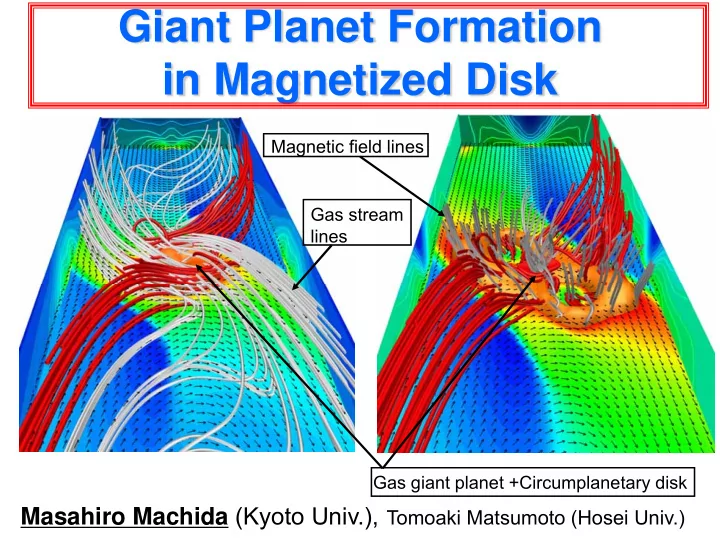
Magnetic field lines Gas stream lines Gas giant planet +Circumplanetary disk
Giant Planet Formation in Magnetized Disk Magnetic field lines Gas - - PowerPoint PPT Presentation
Giant Planet Formation in Magnetized Disk Magnetic field lines Gas stream lines Gas giant planet +Circumplanetary disk Masahiro Machida (Kyoto Univ.), Tomoaki Matsumoto (Hosei Univ.) Motivation 350 exoplanets almost all planets are Gas
Magnetic field lines Gas stream lines Gas giant planet +Circumplanetary disk
350 exoplanets ⇒ almost all planets are Gas Giant Planets The formation process of gas giant planets is important for understanding the theoretical planet formation Gas giant planets are formed in the protoplanetary disk Recent Studies: 3D simulations Not resolve (proto) planet (i.e., radius of gas planet) Not include the magnetic effect This study resolve the gas giant planet with ∆x < rJup (present Jovian radius) include the magnetic effect (planet formation in protoplanetary disk with MRI turbulence)
Local Simulation around Protoplanet
■ Boundary Condition
・ x- fixed boundary ・ y- periodic boundary ・ z- fixed boundary
■ Basic equations ( Resistive MHD eq.)
) ( ) v ( ) v ( 2 ) v ( 4 1 1 v ) (v v ) v (
eff
ρ η ϕ π ρ ρ ρ P P B B t B z B P t t
p
= Δ + × × ∇ = ∂ ∂ × Ω − ∇ − × × ∇ − ∇ − = ∇ ⋅ + ∂ ∂ = ⋅ ∇ + ∂ ∂
central star
Protoplanetary Disk
r=5.2 AU
x
y azimuthal
z
Protoplanet velocity shear
radial vertical
x: radial direction y: azimuthal direction z: vertical direction
(x, y, z) = (12h, 12h, 6h)
Density Distribution Magnetic Field (perpendicular to the disk) Shear Velocity Gravitational Potential
Central star Protoplanet β=100 plasma beta (equatorial plane)
Shear velocity
x=12h y=12h z=6h x y z
Protoplanet
B field (perpendicular)
Mp = 0.6 MJup@5.2AU
Parameters
B a r
r
i c E O S ( M i z u n
9 7 8 , M a c h i d a 2 9 ) T h e r m a l e v
u t i
a r
n d t h e p r
l a n e t
Thermal evolution Magnetic resistivity
This study (fiducial) This study
η i n t h e c
l a p s i n g m
e c u l a r c l
d c
e ( N a k a n
t a l . 2 2 , M a c h i d a e t a l . 2 6 )
isothermal far from the protoplanet adiabatic near the protoplanet depends on the dust opacity |x|<7h ⇒ η=0 to mimic dead zone (protoplanet exists in the active zone which is enclosed by the dead zone) |x|>7h ⇒ η=ηfiducial
L=2 L=4 L=8 L=6 x=6h x=3h x=0.75h x=0.19h Hill Radius Same time, different level of grid (resolution)
L=1,2,・ ・ ・ 8 Grid size: 128 x 128 x 16 Grid level: Lmax=8 (L: Grid Level) Total grid number: 128 x128 x 16 x 8 Scale range: L=12h – 0.008h, ∆x (L=8) ~0.5 RJupiter @5.2 AU
L=1 L=2 L=3
Spiral arms & Gap formation Circum-planetary disk Protoplanet system acquires the angular momentum from shearing motion in the protoplanetary disk Large scale (l=1) Small scale
(Machida et al. 2008, Machida 2009)
(Machida et al. 2006) β=1, Ideal MHD, MRI stable Protoplanet + Circumplanetary disk Magnetic field lines Outflow
Outflow driven by the proto planet embedded in the protoplanetary disk
Toroidal dominated field lines
l=2, Lbox=6h l=4, Lbox=1.5h l=6, Lbox=0.38h Protoplanet is located at the center of the simulation box Circumplanetary disk formation in the MRI turbulent disk with low β (β~1) The magnetic field significantly affects the circumplanetary disk formation x x x x x x z y radial azimuthal
circumplanetary disk
Hill sphere
Circumplanetary disk acquires the angular momentum from MRI turbulence Toroidal dominated field ⇒ Gas flows into the Hill sphere along field lines ⇒ Inclined disk formation ⇒ Rotation axis of planetary system (planet and disk) is perpendicular to the protoplanetary disk normal
l=6, Lbox=0.38h, Resistive Model
Ordered & vertical fields Strong B ⇒ MRI stable
Circumplanetary disk has
protoplanetary disk protoplanet + disk
B in disk
No B Model Low-β Model High-β Model MRI No No Yes Structure Spiral Spiral Turbulence Outflow No Yes ??? Gap Deep Deep More deep MP/(MP/dt)*1 ~104 yr ~105 yr ~106 yr? Satellite disk
(acquisition process)
Large
(shearing motion)
Compact
(transfer by outflow)
Compact
(turbulent flow)
B in satellite disk No Strong Strong
Gas-planet and satellite formation under unmagnetized or magnetized disk
*1: MP/(MP/dt) is the growth timescale of the protoplanet (gas accretion timescale of the protoplanet)
Giant planet formation in magnetized disks was investigated
using 3D simulations with higher-spatial resolution including the thermal and magnetic effects
MRI in the active zone
Turbulence and low-β gas near the Hill sphere of protoplanet Deeper gap appears in the active zone
The protoplanet formation under low-β (β~1) environment
Due to the deeper gap and turbulence, the growth timescale of the protoplanet becomes long (~106 yr) Inclined circumplanetary disk along toroidal field
Satellite formation
The circumplanetary disk (i.e., the site of the satellite formation) is stable against MRI, because of low-β (β∼0.1) The circumplanetary disk has a strong, ordered, poloidal field ⇒ Type I migration of satellites may be suppressed by Muto mechanism
(Muto et al. 2008)