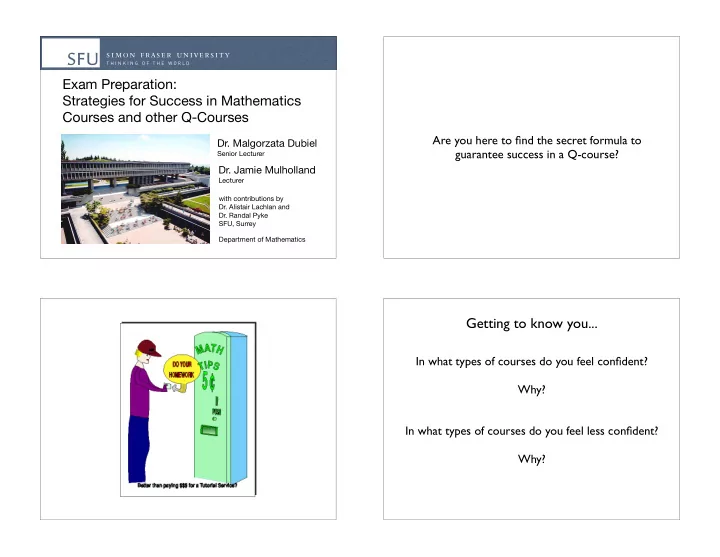
Getting to know you... In what types of courses do you feel - - PowerPoint PPT Presentation

getting to know you
SMART_READER_LITE
LIVE PREVIEW

Getting to know you... In what types of courses do you feel - - PowerPoint PPT Presentation

Exam Preparation: Strategies for Success in Mathematics Courses and other Q-Courses Are you here to find the secret formula to Dr. Malgorzata Dubiel guarantee success in a Q-course? Senior Lecturer Dr. Jamie Mulholland Lecturer with


slide-1
SLIDE 1

Exam Preparation: Strategies for Success in Mathematics Courses and other Q-Courses

  • Dr. Malgorzata Dubiel

Senior Lecturer

  • Dr. Jamie Mulholland

Lecturer Department of Mathematics with contributions by

  • Dr. Alistair Lachlan and
  • Dr. Randal Pyke

SFU, Surrey

Are you here to find the secret formula to guarantee success in a Q-course? In what types of courses do you feel confident? Why? In what types of courses do you feel less confident? Why?

Getting to know you...

slide-2
SLIDE 2

Mathematics is not a spectators sport.

George Polya (1887-1985 )

Thought:

Difference between Q-courses and other courses:

New topics are built on older topics - solid foundation of prerequisite material is essential. Math is learned by doing problems. Do the homework. You are expected to read the text, work through examples, practice more than just the assigned homework questions. 1 hour of lecture 3 hours of study Cramming for exams will not work!

Once upon a time...

What concerns do you have about writing a mathematics (or other science) exam?

slide-3
SLIDE 3

Have you thought about:

How many days do you plan to study for final exams? When do you plan to start studying? Will you study in a group, by yourself, or a bit of both? Have you picked up your marked homework assignments and exams? Have you checked your homework solutions for ALL questions? Did you revise your midterm tests? Will you try enough of the HARD problems in the text?

If you keep doing what you’ve always done, you’ll keep getting what you’ve always got.

Zig Zigler

Thought:

What can I do now to prepare for Exams?

Attend classes! Learn from past mistakes

  • reflect on homework and midterms

Regular review - review wisely! Use the text; examples, exercises, review questions Optimize your learning style; manage your time! (eg. don’t just work on easy problems) Develop your own practice questions and exams! Develop and follow a study schedule Prepare you own “cheat sheet” (study sheet)

Regular Review:

  • Review lecture notes
  • Within 24 hours
  • Weekly
  • 1 - 3 weeks pre-exam

Curve of Forgetting

http://www.adm.uwaterloo.ca/infocs/study/curve.html

slide-4
SLIDE 4

Reviewing Effectively:

review material frequently during the term

Preparing for Exams

Start well in advance and review often. Identify your weaknesses (in understanding) Study “from the top down” (big concepts to specific examples) Study by stimulating your memory. (what examples are illustrating this concept? Definitions?) End each study session with 15 minutes of reflection Practice writing exams Take in no new material the night before an exam Expect the unexpected! (eg. new questions, “What if...”)

What Should You Try:

Pre-Exam Plans:

  • nutrition (food, fluids)
  • rest (relaxation & sleep)
  • wake-up routines
  • transportation; Don’t be late!
  • date, time, and location of exam (know where to find

it!)

  • review study sheet; overview of course
  • isolation (reduce distractions; focus)
  • equipment (pens/pencils, eraser, ruler, calculator, ...)
  • game plans: exam rituals & strategies

Ritual: Strategy:

A plan of action designed to achieve a particular goal. A set of actions thought to have symbolic value. Purpose:

  • to calm, relax, focus, provide a centered state of mind
  • to put you more in control of the situation

Purpose:

  • to maximize results (grades/performance)
slide-5
SLIDE 5

Some examples of rituals/strategies:

  • positive affirmations (“I will do well on this exam.”)
  • using same pen/pencil/eraser/ruler
  • rubbing earlobes, clapping hands (best done

discretely)

  • read ALL exam questions before beginning - choose

to begin with the easiest question

  • have a plan if you begin to panic - close eyes, breath

What are your rituals and/or strategies?

Three Weeks Before the Exam

E X A M I R

1 day 1 week 3 weeks

Long Review Identify Knowledge Gaps Review Knowledge Gaps

IR = Intense Review

How do you organize information?

Structural hierarchy “Dumpster” Approach

concepts key equations definitions worked out examples your own explanation

Study Skills videos by Richard Zachowski at http://maclife.mcmaster.ca/academicskills/online_resources.cfm

slide-6
SLIDE 6

Concept Summary

Heading or Title of Concept Key Equations/Formulas/Facts Definition of Each Term Additional Information Your Own Example or Explanation

Focus on working on problems

What fraction of the exam corresponds to material

  • n first midterm?

What fraction of the exam correspond to material

  • n second midterm?

What fraction of the exam corresponds to material covered since the second midterm? STEP 1. From the instructor gather information about what to expect. Will definitions and theorems be asked for? Is any kind of calculator permitted? Is there a specific practice exam or exams supplied by the instructor? Possible sources: recent final exams recent midterm exams problems worked by the instructor in lecture notes problems supplied by the instructor for purposes

  • f review

Which sources are best depends on the particular

  • instructor. Working on recent final exams almost

always pays dividends. STEP 2. Gather a large collection of problems and exercises, and solve them

slide-7
SLIDE 7

Finding limits Using rules of differentiation Continuity Related rates Interpreting graphs Curve sketching Exponential growth and decay Max/Min problems

STEP 3. Classify the problems

Example: Some categories for calculus are

Organize course material into categories. Identify key concepts and techniques covered in each category List the methods and tricks which are useful in each category Determine to which category the problem belongs and the concepts/techniques used to solve the problem

Example: Identifying problems that are related

Problem 1:

  • Ms. Jones has chickens and horses on her farm.

Altogether there are 50 heads and 140 legs. How many horses are there. Problem 2: Jenna has $5.40 in nickels and dimes. How many nickels does she have if she has a total of 75 nickels and dimes. category: systems of linear equations method: elimination or substitution The height of an arrow t seconds after it is fired is given by Determine the maximum height of the arrow and the time t it reaches this maximum height. category: Quadratic functions method: find the vertex

Example: a question from Precalculus or Physics

h(t) = −8t2 + 48t + 128

Put aside the answers to the problems Practice actually writing out the solutions Check that you have obtained the right answer and that your solution is enough for full marks Step 4. Practice, practice, practice

slide-8
SLIDE 8

The same kinds of problems recur again and again on exams Learn to see connections between the problems and the concepts covered in the course. Learn to recognize at once common types of problems and have at your fingertips the methods and tricks that go with them The only way to get the facility you need is to have practiced each category enough Do not throw away easy points on offer for knowing definitions and theorems

Summary:

I hear, and I forget I see, and I remember, I do, and I understand, I reflect, and I improve. (Chinese Proverb)

Magic Key

  • 1. Start studying from the first day of the semester, and have a plan.
  • 2. Read the textbook, and other required or recommended material.
  • 3. Do your homework!
  • 4. Treat your homework and midterms as learning opportunities: pick up and

revise your papers, make sure you understand your mistakes.

  • 5. Organize a study group. Learn to ask questions!
  • 6. Review periodically - don’t wait until the end of the semester!
  • 7. Develop your own exam rituals and strategies, and mentally rehearse them

in days prior to the exam.

  • 8. Don’t cram!
  • 9. Plan last days before your exams wisely, making sure that you have enough

sleep and eat properly.

  • 10. Exercise helps. So does music (listening to Mozart is supposed to help with

math and logical thinking).