Gestational Trophoblastic Disease I. Discuss clinical pearls for - - PowerPoint PPT Presentation

gestational trophoblastic disease
SMART_READER_LITE
LIVE PREVIEW

Gestational Trophoblastic Disease I. Discuss clinical pearls for - - PowerPoint PPT Presentation

10/20/2017 Objectives I. Epidemiology, definitions and terminology I. Review the clinical entity of gestational trophoblastic neoplasia and discuss the spectrum of presentation Gestational Trophoblastic Disease I. Discuss clinical pearls


slide-1
SLIDE 1

10/20/2017 1

Gestational Trophoblastic Disease

UCSF Obstetrics & Gynecology Update: What does the evidence tell us?

Jocelyn S. Chapman, MD Assistant Professor Gynecologic Oncology

Obstetrics, Gynecology & Reproductive Sciences October 20, 2017

No financial disclosures

Objectives

I. Epidemiology, definitions and terminology I. Review the clinical entity of gestational trophoblastic neoplasia and discuss the spectrum of presentation I. Discuss clinical pearls for work-up and evaluation I. Review the pitfalls in staging and management

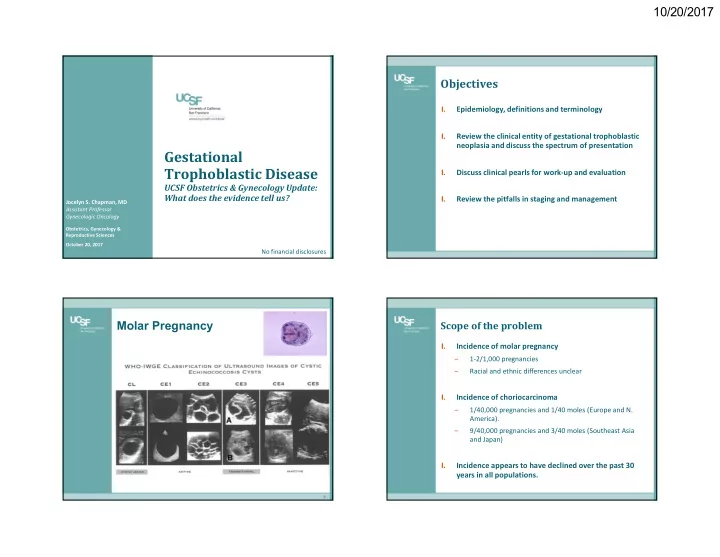
Molar Pregnancy

3

Scope of the problem

I. Incidence of molar pregnancy

– 1-2/1,000 pregnancies – Racial and ethnic differences unclear

I. Incidence of choriocarcinoma

– 1/40,000 pregnancies and 1/40 moles (Europe and N. America). – 9/40,000 pregnancies and 3/40 moles (Southeast Asia and Japan)

I. Incidence appears to have declined over the past 30 years in all populations.

slide-2
SLIDE 2

10/20/2017 2

Risk Factors for Complete Hydatidiform Mole

I. Extremes of maternal age (1.9 times higher than reference) I. Prior molar pregnancy (10-20 times higher than reference) I. History of SAB (2-3 fold higher than reference)

Risk Factors for Choriocarcinoma

I. Prior complete hydatidiform mole (1,000 times more likely than reference) II. Asian, American Indian and African American ethnicities (?)

Where does this disease start?

4 GTDs and 3 GTNs

  • Hydatiform mole

– Complete (15-20% risk of GTN) – Partial (1-5% risk of GTN)

  • Invasive mole
  • Choriocarcinoma
  • Placental site trophoblastic tumor (PSTT)
slide-3
SLIDE 3

10/20/2017 3

Clinical & pathologic features of GTD Partial versus complete moles

Human chorionic gonadotropin (HCG) 6 Types of hCG in serum

slide-4
SLIDE 4

10/20/2017 4

The problem of phantom hCG Three ways to rule out phantom HCG

I. Run the serum HCG assay on a urine specimen.

– Antibodies are filtered out in urine

I. Request serial dilution.

– If there is TRUE GTN then serial dilution should result in a parallel DECREASE in HCG. – If the HCG result is a false positive, serial dilution should NOT show a parallel decrease with dilution.

I. Send urine and blood to the USA hCG Reference laboratory (hcglab.com).

How to diagnose post-molar GTN?

15

I. hCG plateau for 4 consecutive values over 3 weeks II. hCG rise of >/= 10% for 3 values over 2 weeks

  • III. hCG persistence 6 months after molar evacuation
  • IV. Histopathologic diagnosis of choriocarcinoma

V. Presence of metastatic disease

Include the following in your work-up for GTN

I. Complete history and examination I. CBC, coags, chemistries, LFTs, TFTs, blood type, Rh status, quantitative hCG

– Rhogam?

II. Imaging: CXR and ultrasound

– CT abdomen and pelvis – CT chest if CXR negative – Brain imaging if there are chest mets

slide-5
SLIDE 5

10/20/2017 5

Don’t forget these things when taking a suspected GTN case to the OR.

I. Uterotonics II. 12-14mm canula

– Start at the internal cervix – Ultrasound guidance

  • III. Type and Cross
  • IV. Can consider hysterectomy

– Completed childbearing – Decreases risk for local persistent disease – Treatment of choice for PSTT. – Risk of post-molar GTN 3-5% so must have surveillance.

Should hysterotomy or IOL ever be considered?

18

Hysterotomy & IOL

Staging GTN Treatment of Choriocarcinoma

  • Low-risk: prognostic score <7

– Methotrexate (MTX) +/- leucovorin rescue

  • Weekly IM MTX (30-50mg/m2) easiest dosing

and lowest side effects but higher failure rates.

  • MTX 0.4mg/m2 IM/IV daily for 5 days every 2

weeks is most effective. – Actinomycin-D (ACT-D)

  • High-risk: prognostic score ≥7

– EMA/CO: etoposide, MTX, ACT-D, cyclophosphamide, vincristine – MAC: MTX, ACT-D, cyclophosphamide

  • These tumors are VERY chemosensitive!
slide-6
SLIDE 6

10/20/2017 6

Chemotherapy works! Follow-up

22

  • Check hCG monthly x 12 months

– Risk of relapse in the first year is 3% – Risk of relapse after the first year is exceedingly low

  • Oral contraceptives

– Suppresses LH

  • Subsequent pregnancy

– 1-2% risk of 2nd GTN event – Pelvic U/S in 1st trimester – Placenta goes to pathology – Check bHCG 6 weeks after delivery

Subsequent Pregnancy Outcome

Prior Molar pregnancy Complete Partial Total pregnancies 1254 218 Total deliveries 962 167 Term 68.7% 74.3% Preterm 7.4% 1.8% Stillbirth 0.6% 0.5% Spontaneous abortion 17.8% 16.1% Elective abortion 3.2% 5.0% Ectopic 0.9% 0.5% Repeat Mole 1.4% 1.8%

Garner, Contemp Obstet Gynecol 2001

A Case

24

  • 16 wks GA
  • Presents with: abdominal

pain, n/v, headache

  • U/S consistent with molar

pregnancy

  • bHCG 400,000
slide-7
SLIDE 7

10/20/2017 7

A Case (cont.)

25

Conclusions

  • GTN is curable
  • Think about the possibility of phantom hCG
  • Don’t forget your OR checklist
  • Call your friendly Gyn-Oncologist to help with

management and treatment

  • Remember the principles of follow-up &

counseling for future conceptions.

Question #1

TRUE OR FALSE: Partial moles are more likely than complete moles to progress to GTN.

  • A. True
  • B. False

FALSE

T r u e F a l s e

88% 13%

Question #2

Which of the following is TRUE when taking a patient with a suspected molar pregnancy for D&C?

A. A type and screen is sufficient for pre-op laboratory evaluation. B. Sharp curettage is better than suction curettage.

  • C. Uterotonics should be available.

A type and screen is suffi... Sharp curettage is better... Uterotonics should be av...

4% 90% 6%

slide-8
SLIDE 8

10/20/2017 8

Question #3

TRUE OR FALSE: A patient with a persistent bHCG between 40 - 60 IUs/L, normal menses and no evidence of GTD on imaging should be given methotrexate.

  • A. True
  • B. False

FALSE

T r u e F a l s e

74% 26%

Questions?