Alaska Disrupting Chemicals in Two Alaska Native Arctic - - PowerPoint PPT Presentation

alaska
SMART_READER_LITE
LIVE PREVIEW

Alaska Disrupting Chemicals in Two Alaska Native Arctic - - PowerPoint PPT Presentation

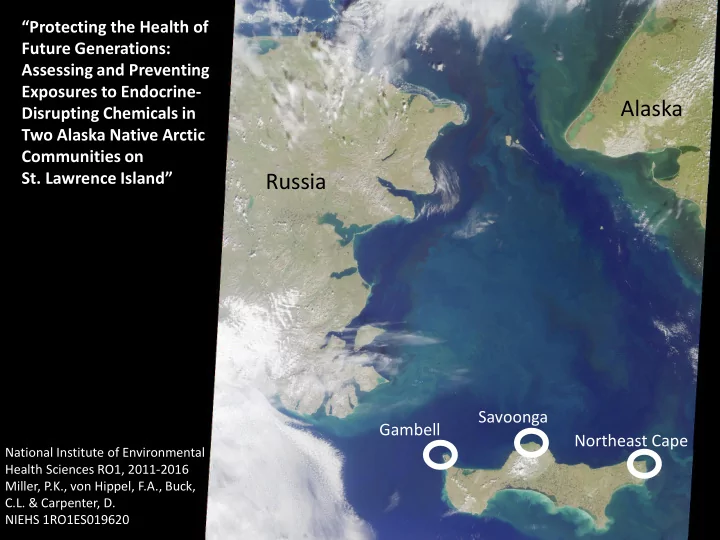
Protecting the Health of Future Generations: Assessing and Preventing Exposures to Endocrine- Alaska Disrupting Chemicals in Two Alaska Native Arctic Communities on St. Lawrence Island Russia Savoonga Gambell Northeast Cape


slide-1
SLIDE 1

Gambell Savoonga Northeast Cape

National Institute of Environmental Health Sciences RO1, 2011-2016 Miller, P.K., von Hippel, F.A., Buck, C.L. & Carpenter, D. NIEHS 1RO1ES019620

“Protecting the Health of Future Generations: Assessing and Preventing Exposures to Endocrine- Disrupting Chemicals in Two Alaska Native Arctic Communities on

  • St. Lawrence Island”

Alaska Russia

slide-2
SLIDE 2

1) At the conclusion of site remediation, is remaining PCB contamination due primarily to the formerly used defense site or to atmospheric deposition? 2) Is the remaining PCB contamination biologically relevant for resident freshwater fishes? 3) Do contaminant levels have implications for the health of people on St. Lawrence Island?

slide-3
SLIDE 3
slide-4
SLIDE 4

DNA for sex genotyping thyroid RNA & histology gonads, liver & kidney split samples RNA and histology brain RNA

Funding: Alaska INBRE & NIEHS

+ contaminant chemistry

slide-5
SLIDE 5
slide-6
SLIDE 6

Alaska blackfish

ninespine stickleback

slide-7
SLIDE 7
slide-8
SLIDE 8

Levels of PCBs in the Suqi River fish are still high, even though clean-up is considered complete… and contaminant chemistry reveals a mostly local source (FUDS), but are these PCB concentrations biologically meaningful?

slide-9
SLIDE 9

Is the hormone system of the fish disrupted?

slide-10
SLIDE 10

Ninespine stickleback Vtg assay development funded by: Alaska INBRE, CAS, ENRI; in collaboration with Ioanna Katsiadaki.

Sites downstream of FUDS “Control” sites

slide-11
SLIDE 11

“Control” sites Sites downstream of FUDS

slide-12
SLIDE 12

Site 5 male: abnormal liver, abnormal testes Site 13 male: normal liver, normal testes

slide-13
SLIDE 13

Is gene expression of the fish disrupted?

slide-14
SLIDE 14

Expression of genes associated with DNA repair and replication, proteases, metal ion binding, symporters…

slide-15
SLIDE 15

1) At the conclusion of site remediation, is remaining PCB contamination due primarily to the formerly used defense site or to atmospheric deposition? Most PCB contamination in the Suqi River originated at the FUDS. 2) Is the remaining PCB contamination biologically relevant for resident freshwater fishes? Sentinel fish in the Suqi River show estrogenic effects, thyroid disruption, and altered gene expression. 3) Do contaminant levels have implications for the health of people on St. Lawrence Island? Fish and humans share the same hormone systems and most of the genes underlying diseases in humans are the same genes underlying those diseases in fish. Estrogenic effects are associated with abnormal development and certain cancers. Altered gene expression results are also consistent with higher cancer risk. The fish results, therefore, indicate that PCB levels in the Suqi River are still high enough to cause health problems in people exposed to those PCBs, through, for example, eating Suqi River fish.