Amman 1 September 14, 2006
Germanium-based detectors for gamma-ray imaging and spectroscopy - - PowerPoint PPT Presentation
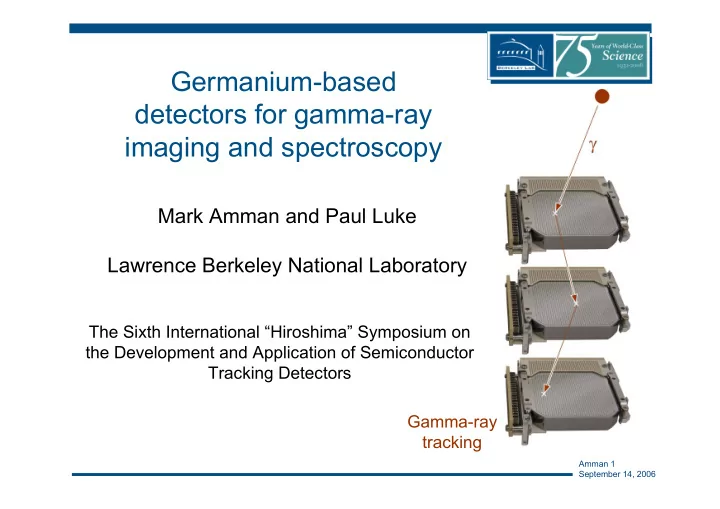
Germanium-based detectors for gamma-ray imaging and spectroscopy Mark Amman and Paul Luke Lawrence Berkeley National Laboratory The Sixth International Hiroshima Symposium on the Development and Application of Semiconductor Tracking
Amman 2 September 14, 2006
Outline
- Ge detectors and Gamma-ray imaging
- Detector fabrication technologies
- Amorphous-semiconductor contacts
- Bipolar blocking and barrier heights
- 3-d position detection
- Fine electrode segmentation
- Issues: charge sharing, temperature cycling
Amman 3 September 14, 2006
Detector material: Why Ge?
- High Z
- Large commercially available crystals
10 cm diameter boules
- Large depletion lengths
> 2 cm
- Near perfect charge collection
µτe, µτh >10 cm2/V → L > 104 cm
- Favorable charge generation statistics
High efficiency Excellent energy resolution
< 0.2%FWHM @ 1.3MeV
However, cooling to near LN temperatures required because
- f small band gap
( )
eV 97 . 2 energy creation pair h
- e
e G eV 08 . factor Fano Ge F , E F 35 . 2 E
2 / 1 Statistics
= ≡ ε = ≡ ε = Δ
γ
Amman 4 September 14, 2006
Multi-hole collimator 2-d position sensitive detector Pin-hole aperture Coded aperture 2-d position sensitive detector #1 2-d position sensitive detector #2
Gamma-ray imaging
Need position as well as spectroscopic information
Amman 5 September 14, 2006
Standard Ge technology
Implanted n+ contacts do not withstand high fields and are not reproducible Metal surface barrier contacts are not rugged and are p-type
Amman 6 September 14, 2006
Segmented electrical contacts
Problems:
- Thick Li and post fabrication
diffusion limit pitch to ~ 1 mm
- Interstrip surfaces lack
passivation Fine pitches possible on B- implanted contact
Amman 7 September 14, 2006
Amorphous semiconductor contacts
Advantages:
- Bipolar blocking contacts
- Self passivating
- Simple fabrication process
- Thin contact dead layer
- Fine pitches achievable
- W. Hansen and E. Haller, IEEE TNS 24, 61 (1977).
P.N. Luke, et al., IEEE TNS 39, 590 (1992).
Amman 8 September 14, 2006
Bipolar blocking behavior
Full depletion Full depletion
Amman 9 September 14, 2006
Barrier heights
n+ / p-type Ge / a-Ge device Fit to ΔI = AT2 e-φ/kT
Amman 10 September 14, 2006
Barrier heights
~1011 ~106-108 ρ [Ω-cm] φe +φh [eV] φh [eV] φe [eV] 0.67 0.28 0.39 a-Si (Ar) 0.68 0.39 0.29 a-Ge (Ar+17.5% H2) 0.70 0.34 0.36 a-Ge (Ar) Contact
Barrier heights depend on material and deposition parameters Higher film resistivity of a-Ge (Ar+17.5% H2) over that of a-Ge (Ar) typically desired to obtain high inter-electrode impedance
Amman 11 September 14, 2006
Barrier heights
~1011 ~106-108 ρ [Ω-cm] φe +φh [eV] φh [eV] φe [eV] 0.67 0.28 0.39 a-Si (Ar) 0.68 0.39 0.29 a-Ge (Ar+17.5% H2) 0.70 0.34 0.36 a-Ge (Ar) Contact
Choose this combination to minimize leakage current
Amman 12 September 14, 2006
Barrier heights
Amman 13 September 14, 2006
3-d position detection
- M. Momayezi, et al., SPIE 3768, 530 (1999).
- M. Amman and P.N. Luke, NIM A 452, 155 (2000).
Amman 14 September 14, 2006
Detector example
Orthogonal-strip detectors produced for the Nuclear Compton Telescope (Steve Boggs at UC Berkeley Space Sciences Laboratory) 37 strips each side, 2 mm strip pitch, a-Ge (Ar, 17.5% H2) contacts 6 detectors produced to date (12 ultimately required) 8 cm 1.5 cm
Amman 15 September 14, 2006
Detector example
NCT Prototype
60Co (1.173 MeV) source
(50 µCi, 5 m, ~2 hrs.) Compton circle projection Maximum likelihood Courtesy: Steve Boggs, SSL
Amman 16 September 14, 2006
Fine-pitched segmentation
Strip detector produced for synchrotron x-ray applications (Daresbury Laboratory) 1024 strips, 50 µm strip pitch, 1 mm thick
Amman 17 September 14, 2006
Issue: Charge sharing
Amman 18 September 14, 2006
Issue: Charge sharing
Amman 19 September 14, 2006
Other solutions:
- Smaller gaps
- Field shaping electrodes: M. Amman and
P.N. Luke, NIM A 452, 155 (2000).
- Etch away amorphous layer between
electrodes: D. Protic and T. Krings, IEEE TNS 50, 998 (2003). More work to be done …
Amman 20 September 14, 2006
Improvements needed
- Temperature cycling stability
- Optimization of a-Ge/Ge/a-Si configuration
- Charge sharing reduction
- Side surface state control?