Geovisualization Challenges of Seascape Genetics Geovisualization - - PowerPoint PPT Presentation

geovisualization challenges of seascape genetics
SMART_READER_LITE
LIVE PREVIEW

Geovisualization Challenges of Seascape Genetics Geovisualization - - PowerPoint PPT Presentation

Geovisualization Challenges of Seascape Genetics Geovisualization Challenges of Seascape Genetics - GeoViz 2011 Consider Genetic characteristics of fish in relation to their environment Why? Traceability of fish and fish products,


slide-1
SLIDE 1

Geovisualization Challenges of Seascape Genetics - GeoViz 2011
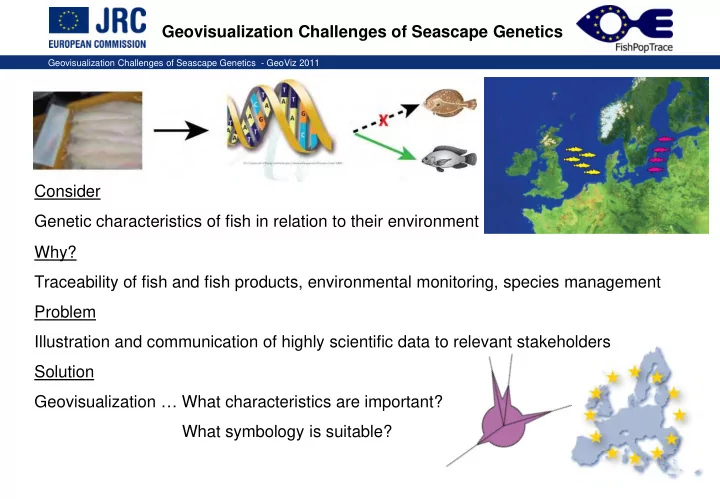
Why? Traceability of fish and fish products, environmental monitoring, species management Problem Illustration and communication of highly scientific data to relevant stakeholders Solution Geovisualization … What characteristics are important? What symbology is suitable? Geovisualization Challenges of Seascape Genetics Consider Genetic characteristics of fish in relation to their environment

slide-2
SLIDE 2

Geovisualization Challenges of Seascape Genetics - GeoViz 2011

Geovisualization Challenges

  • f Seascape Genetics

Eoin Mac Aoidh & Jann Martinsohn

European Commission Joint Research Centre Maritime Affairs Unit, Ispra, Italy

slide-3
SLIDE 3

Geovisualization Challenges of Seascape Genetics - GeoViz 2011

  • Context: Seascape genetics
  • Case study description & geoviz objectives
  • Existing seascape genetics geoviz solutions
  • Proposed symbology
  • Conclusion

Geovisualization Challenges of Seascape Genetics

slide-4
SLIDE 4

Geovisualization Challenges of Seascape Genetics - GeoViz 2011

Context: Seascape Genetics

WHAT (Species identification)

? Wild or Cultured? ?

(Origin assignment)

? Where From? What?

slide-5
SLIDE 5

Geovisualization Challenges of Seascape Genetics - GeoViz 2011

Context: Seascape Genetics

  • Genetic characteristics-environment relationship
  • Genetic differences in fish from region A to region B
  • Visualize the genetic characteristics in relation to:

Land mass, currents, temperature, salinity, chlorophyll, etc.

slide-6
SLIDE 6

Geovisualization Challenges of Seascape Genetics - GeoViz 2011

Context: Seascape Genetics

  • Consumer protection

– Food traceability & labelling schemes

  • Legal & economic

– Control & Enforcement to combat Illegal fishing (€10-20bn p.a.)

  • Wildlife preservation & sustainable fishing

– Endangered species management

  • Scientific research

– Spatio-temporal environmental analysis

Cross-domain applications Requires effective transfer of genetic structure information from the scientific domain Geovisualization

slide-7
SLIDE 7

Geovisualization Challenges of Seascape Genetics - GeoViz 2011

FishPopTrace Case Study

  • Over 7,500 fish specimen collected

– Cod, hake, herring, and sole. – Locations all around Europe

  • Analysed using SNPs

– Sites in the genome where individuals can carry different nucleotide variants (A, C, G or T)

Image: www.bioinsights.com

slide-8
SLIDE 8

Geovisualization Challenges of Seascape Genetics - GeoViz 2011

FishPopTrace Case Study

  • Specimen are clustered according to frequencies of

specific SNPs identified in their genome

  • Plotting the geographic locations at which specimen

in the same cluster of frequencies were sampled can reveal strong geographic correlations

Cod in the Baltic Sea have similar frequencies of specific SNPs to each other, but different frequencies to cod in the North Sea.

slide-9
SLIDE 9

Geovisualization Challenges of Seascape Genetics - GeoViz 2011

Case Study Geovisualization Objectives

  • Geovisualize:
  • 1. Cluster membership of sampled specimen

To which genetic cluster does a specimen sampled at location X belong? What other sampled locations show fish with similar characteristics?

  • 2. Probability of misassignment to a cluster

What is the probability that the specimen could be incorrectly assigned to a cluster? Which cluster is the misassignment likely to have come from?

slide-10
SLIDE 10

Geovisualization Challenges of Seascape Genetics - GeoViz 2011

Case Study Geovisualization Objectives

  • Web-based geovisualization for communication and

analysis (OpenGeo Stack)

  • Symbology should be suitable, simple, yet expressive

– Suitable for available data – Simple to understand – Simple to render

Why not use existing symbologies?

slide-11
SLIDE 11

Geovisualization Challenges of Seascape Genetics - GeoViz 2011

Seascape Genetic Symbologies

  • Continuous surface maps are unsuitable

– Data is not continuous – Too many unknown areas we cannot accurately interpolate – Maps could be misleading causing problems – E.g. for control and enforcement use – Complex clipping, interpolating and rendering around land boundaries

  • Point based representation is more appropriate
slide-12
SLIDE 12

Geovisualization Challenges of Seascape Genetics - GeoViz 2011

Existing Seascape Genetic Symbologies

  • Frequencies of genetic characteristics often visualized as

geolocated pie charts (point based)

Same concept applies for visualizing ratios of cluster membership Assume 4 genetically different clusters

  • f the same species

Haplotypes present at sampled locations Specimen at location (x,y) have genetic material

  • riginating from the

Green (60%), Black (25%), Red (10%), and Blue (5%) clusters

slide-13
SLIDE 13

Geovisualization Challenges of Seascape Genetics - GeoViz 2011

Existing Seascape Genetic Symbologies

  • Population cluster membership of common sole

plotted using pie charts

(FishPopTrace analysis slightly falsified)

  • Small ratios sometimes

////occluded by other pies

  • Pie charts must be
.

regularly shaped

  • Variables Restricted to:

slice size, colour, pie //radius

slide-14
SLIDE 14

Geovisualization Challenges of Seascape Genetics - GeoViz 2011

Existing Seascape Genetic Symbologies

  • Generalisation of

misassignment trends by grouping similar specimen

  • What about automated

maps for a Web-based interface: Clusters cannot be grouped, arrowed and labelled by hand

slide-15
SLIDE 15

Geovisualization Challenges of Seascape Genetics - GeoViz 2011

Existing Seascape Genetic Symbologies

Remember:

Seascape genetics must also show elements of the seascape

Problems:

– Small segment occlusions – Grouping / simplifying arrows – Map occlusion – Arrows and pies are separate objects

Solution:

Simplify and visualize as a . . . single layer

slide-16
SLIDE 16

Geovisualization Challenges of Seascape Genetics - GeoViz 2011

Proposed Symbology Exploration

  • Ratio of cluster characteristics

generates a fill colour

  • Each cluster assigned to a colour
  • f the CMYK model. Ratio = Hex
  • Notion of cluster membership

retained

  • Occlusion no longer a problem
  • Container shape no longer

restricted

  • How about misassignment

probabilities?

slide-17
SLIDE 17

Geovisualization Challenges of Seascape Genetics - GeoViz 2011

Proposed Symbology Exploration

  • Popular multivariate representation techniques
  • N equally spaced axes

Star Plot

Image from www.nasa.gov

RadVIZ method (Ankerst et. al.)

Image from Brundsdon et. al.

slide-18
SLIDE 18

Geovisualization Challenges of Seascape Genetics - GeoViz 2011

Proposed Symbology Exploration

  • Rotate the axes to point in the direction of cluster

misassignment, plot probability on each axis

Cluster 5

slide-19
SLIDE 19

Geovisualization Challenges of Seascape Genetics - GeoViz 2011

Some Examples

  • Difficult to compare (non-uniform shape)
  • Size of fill area is misleading
  • Direction and probability difficult to discern
slide-20
SLIDE 20

Geovisualization Challenges of Seascape Genetics - GeoViz 2011

Updated Symbol

slide-21
SLIDE 21

Geovisualization Challenges of Seascape Genetics - GeoViz 2011

Comparison of Symbology

  • Uniform shape
  • Uniform fill area
  • Directionality and

Misassignment probability easier to identify

slide-22
SLIDE 22

Geovisualization Challenges of Seascape Genetics - GeoViz 2011

Conclusion

  • Replacement for pie charts and misassignment

arrows

  • Information incorporated into a single symbol type
  • A single point-based map layer
  • Grouping and drawing of arrows unnecessary
  • Automated symbol generation
  • Overhead on system and user reduced
  • Background space available for seascape variables
  • How will it look on a map?
slide-23
SLIDE 23

Geovisualization Challenges of Seascape Genetics - GeoViz 2011

Symbology on a Map

slide-24
SLIDE 24

Geovisualization Challenges of Seascape Genetics - GeoViz 2011

What next?

  • Implement auto-symbol generation technique
  • Incorporate it into the existing Web-based platform
  • Evaluate