Geovisualization and synergies with InfoVis and Visual Analytics - - PDF document

geovisualization and synergies with infovis and visual
SMART_READER_LITE
LIVE PREVIEW

Geovisualization and synergies with InfoVis and Visual Analytics - - PDF document

Geovisualization and synergies with InfoVis and Visual Analytics Panel position statement Gennady Andrienko Fraunhofer Institute IAIS Sankt Augustin Germany http://www.ais.fraunhofer.de/and What is geovisualization research? fundamental


slide-1
SLIDE 1

1

Geovisualization and synergies with InfoVis and Visual Analytics

Panel position statement Gennady Andrienko Fraunhofer Institute IAIS Sankt Augustin Germany http://www.ais.fraunhofer.de/and

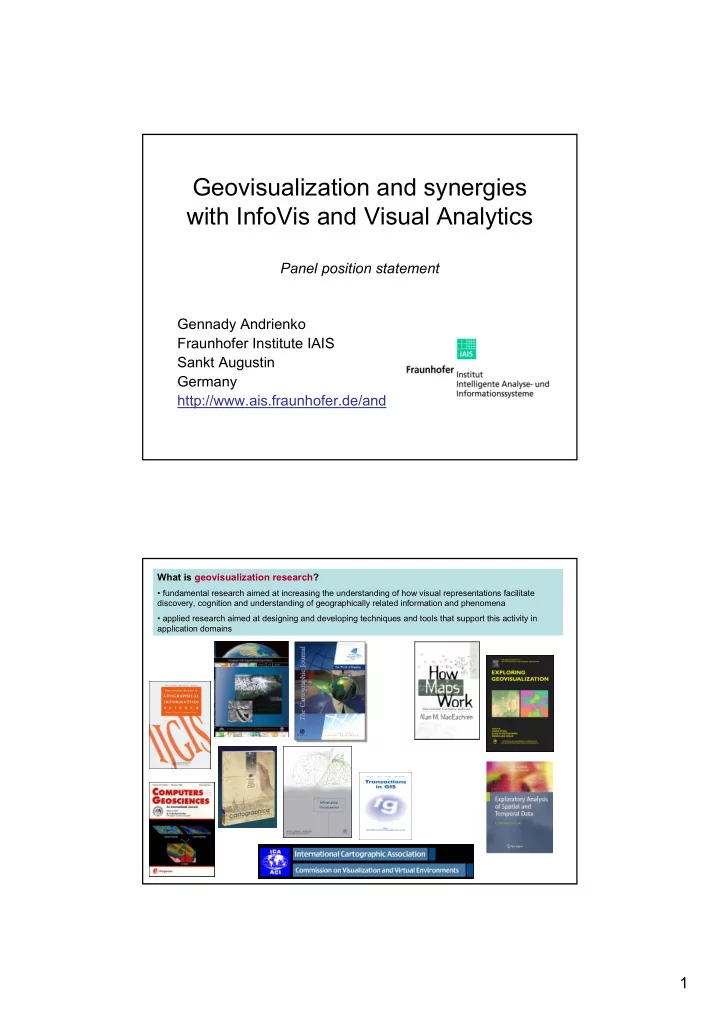
What is geovisualization research?

  • fundamental research aimed at increasing the understanding of how visual representations facilitate

discovery, cognition and understanding of geographically related information and phenomena

  • applied research aimed at designing and developing techniques and tools that support this activity in

application domains

slide-2
SLIDE 2

2

GeoVis users

  • perception of space and maps
  • spatial cognition and reasoning
  • mental maps
  • metaphors
  • trends (wide use of online maps, navigation

tools, geobrowsers, geo-wikis, …)

GeoVis of

  • dynamic phenomena and processes
  • movement and mobility
  • complex spatio-temporal structures

(plans,scenarios, effects and actions…)

  • imagery
  • terrain
  • non-geographic data

GeoVis for

  • exploration and analysis
  • knowledge building and integration
  • decision making
  • education and instruction
  • presentation and communication
  • collaboration

GeoVis plus

  • InfoVis, SciVis, statistical graphics, …
  • multimedia
  • computational analysis
  • databases and data warehouses
  • modelling
  • spatio-temporal reasoning

GeoVis

  • Geographic representations
  • Geographic interfaces
  • Geographic interactions
  • GeoVisual Analytics
  • GeoCollaboration

Example: Analysing Movements

slide-3
SLIDE 3

3

Example: Assessing a Schedule GeoVis @ Visualisation Summit

Workshop of 17 scientists working on GeoVis, InfoVis, and Visual Analytics All answered 3 questions in advance:

  • 1. What topics of GeoVis you are working on

now?

  • 2. What are, in your opinion, the major

difficulties that prevent wide usage of geovisualizations?

  • 3. In which areas of GeoVis you expect the

major progress in next years?

slide-4
SLIDE 4

4

Data:

  • dynamic processes
  • movement
  • complex structures

(plans, scenarios,…)

  • imagery
  • terrain

– huge – multivariate – uncertain

Tasks/Purposes:

  • exploration & analysis
  • knowledge building
  • decision making
  • collaboration
  • presentation & communication
  • education & instruction

Technology:

  • mobile devices
  • multimedia
  • multimodal HCI
  • augmented reality

– Web – GoogleEarth, GoogleMaps,… – SDI – Wiki…

Users:

  • perception & cognition
  • mental maps
  • metaphors
  • differences (professional,

educational, cultural,…)

General

Empirics Practice

Specific Data Tasks/ Purposes Technology:

  • requirements &

limitations

  • opportunities

Users:

  • requirements
  • abilities
  • preferences,

habits

Experimental studies Design principles

Cartography Psychology InfoVis, SciVis …

HCI

Statistics Data Mining DB & DW Geocomputations Artificial Intelligence

Data Typologies & Models Patterns & knowledge

  • typology
  • representation

GeoVis

  • perators

Instructional sciences (?)

Task Typologies & Models Inventories

  • f

techniques Models of GeoVis use Design of generic toolkits & infrastructures User/task-centred design

Methodology Theory

  • Customisation
  • Interoperability
  • Usability
  • Evaluation
  • Geographic interfaces
  • Geographic interactions
  • Collaborative GeoVis
  • 3D & perspective views
  • Stereoscopic views
  • Legend design
  • GeoVis + multimedia
  • Visual Analytics
  • InfoVis interfaces
  • GeoVis of non-geo data
  • Scalability

abc abc abc

– much work done and/or many people working – some work done; few people working – nothing or very little done; none or very few people working

Legend:

Use of GeoVis

Problems

  • Undeveloped terminology (e.g. how does GeoVis differ from

cartography?)

  • Low understanding of additional value of interactivity
  • Focus on exploration limits users to experts
  • Tools are designed for expert users → too complex!
  • Poor design and low usability of tools; poor documentation
  • Tools do not exactly address users’ needs
  • Ignorance of potential users about the strength of GeoVis
  • No success stories of solving real-world problems
  • Lack of education and training in using GeoVis
  • Low trust of domain specialists in visual approaches;

bias towards numbers, formulas, and texts

  • Lack of support for documenting insights and knowledge

gained → no material results!

  • Lack of support for spatial and spatio-temporal reasoning
  • Lack of ready-to-use software
  • Lack of advanced GeoVis functions in GIS
  • Limited functionality of non-commercial tools (focus on particular

techniques and data types)

  • Limited infrastructural (data model) basis
  • Lack of interoperability of data, systems, and tools/methods
  • Lack of scalability w.r.t. data size, device characteristics, …
  • Gap between existing theory and technological opportunities

Widely used:

  • Open online mapping tools
  • GoogleEarth, GoogleMaps, …
  • Weather forecasts
  • Navigation and routing tools
  • GeoVis in geoscientific

community

Not (widely) used:

  • Collaborative GeoVis
  • GeoVis of multivariate data
  • GeoVis of temporal data
  • Visual data mining
  • GeoVis of non-geographic data
  • Generally, advanced GeoVis

tools produced by academics
slide-5
SLIDE 5

5

Challenges

  • Handle huge volumes of data
  • Handle complex and heterogeneous information
  • Handle dynamic phenomena and processes
  • Support time-critical analysis and decision

making

  • Support externalisation of insights and synthesis
  • f knowledge
  • Embrace new hardware and technologies
  • Increase the use of GeoVis tools, broaden the

user community and application scope

  • Develop adequate theory and methodology

InfoVis faces the same challenges !

Common opinion

We need research in multidisciplinary teams (including cartography & GeoVis, InfoVis, data mining, databases, HCI, cognitive sciences) for solving real-life spatio-temporal problems (characterized by huge volumes

  • f complex data)

in tight cooperation with domain experts

slide-6
SLIDE 6

6

Where to learn more?

Special issue on “GeoVisual Analytics for Spatial Decision Support”, edited by G.Andrienko, N.Andrienko, P.Jankowski, and A.MacEachren Int.J.GIScience, 2007, v.21(8)

http://kartoweb.itc.nl/icavis/index.html Next workshop: Helsinki, August 2-3, 2007