SLIDE 2 Slide 7 / 185
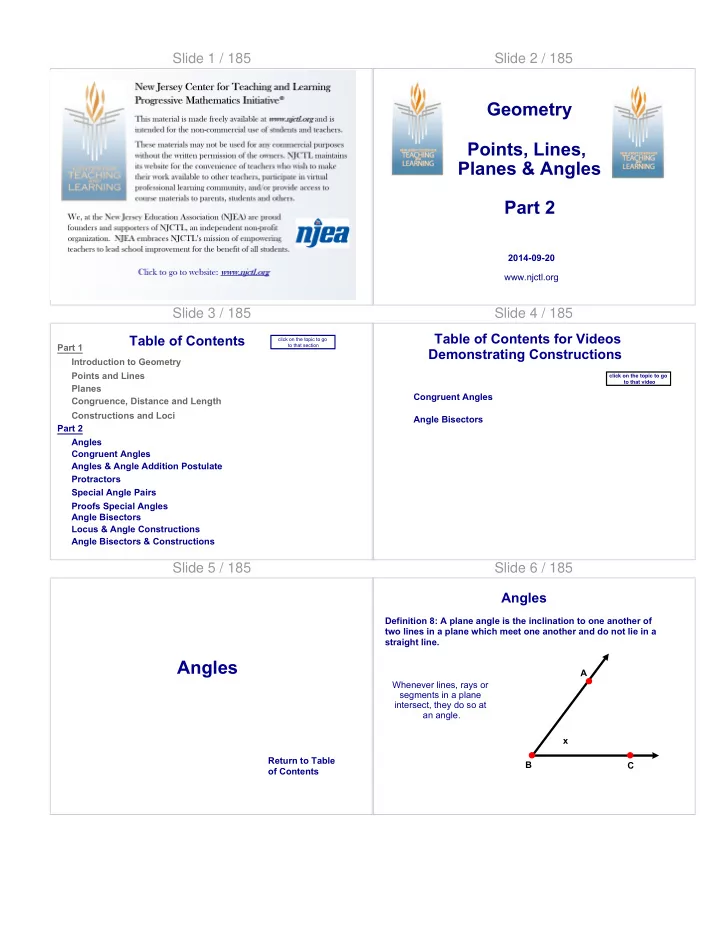
A B C x
Angles
The measure of angle is the amount that one line, one ray or segment would need to rotate in order to overlap the other. In this case, Ray BA would have to rotate through an angle of x in order to overlap Ray BC.
Slide 8 / 185
A B C x
Angles
In this course, angles will be measured with degrees, which have the symbol 0. For a ray to rotate all the way around from BC, as shown, back to BC would represent a 3600 angle.
Slide 9 / 185 Measuring angles in degrees
The use of 360 degrees to represent a full rotation back to the
- riginal position is arbitrary.
3600
Any number could have been used, but 360 degrees for a full rotation has become a standard.
Slide 10 / 185 Measuring angles in degrees
The use of 360 for a full rotation is thought that it come from ancient Babylonia, which used a number system based on 60. Their number system may also be linked to the fact that there are 365 days in a year, which is pretty close to 360. 360 is a much easier number to work with than 365 since it is divided evenly by many numbers. These include 2, 3, 4, 5, 6, 8, 9, 10 and 12.
Slide 11 / 185
Definition 10: When a straight line standing on a straight line makes the adjacent angles equal to one another, each of the equal angles is right, and the straight line standing on the
- ther is called a perpendicular to that on which it stands.
Right Angles
A B x x C D The only way that two lines can intersect as shown and form adjacent equal angles, such as shown here where Angle ABC = Angle ABD, is if there are right angles, 900.
Slide 12 / 185
Fourth Postulate: That all right angles are equal to one another.
Right Angles
A B x x C D Not only are adjacent right angles equal to each other as shown below, all right angles are equal, even if they are not adjacent, for instance, all three of the below right angles are equal to one another. A B C 900