Geometry Progressive Mathematics Initiative This material is made - - PDF document

geometry
SMART_READER_LITE
LIVE PREVIEW

Geometry Progressive Mathematics Initiative This material is made - - PDF document

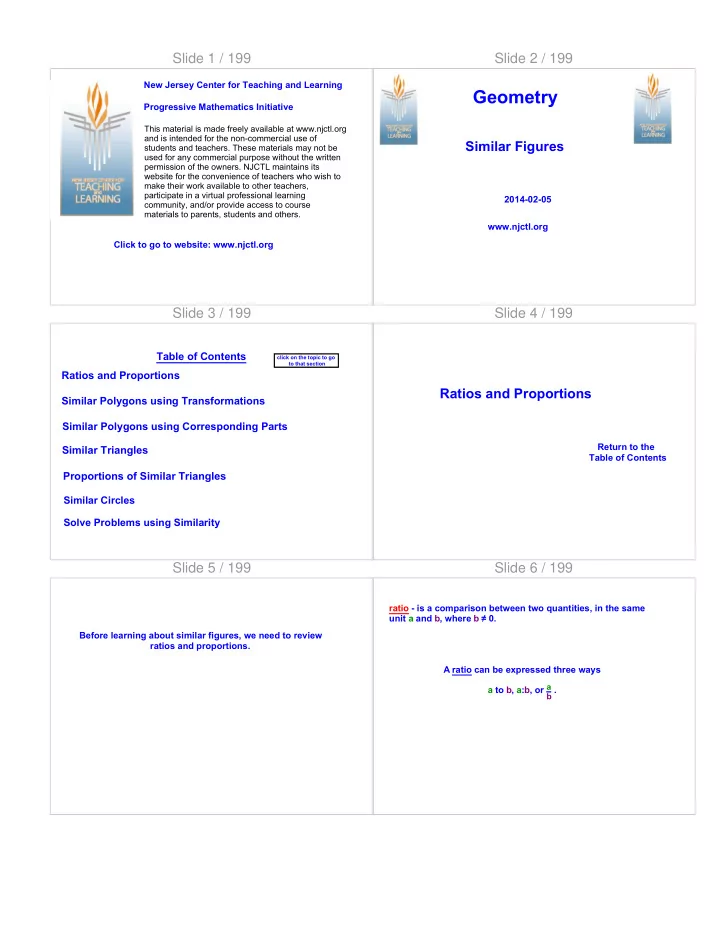
Slide 1 / 199 Slide 2 / 199 New Jersey Center for Teaching and Learning Geometry Progressive Mathematics Initiative This material is made freely available at www.njctl.org and is intended for the non-commercial use of Similar Figures


slide-1
SLIDE 1

Slide 1 / 199

This material is made freely available at www.njctl.org and is intended for the non-commercial use of students and teachers. These materials may not be used for any commercial purpose without the written permission of the owners. NJCTL maintains its website for the convenience of teachers who wish to make their work available to other teachers, participate in a virtual professional learning community, and/or provide access to course materials to parents, students and others.

Click to go to website: www.njctl.org New Jersey Center for Teaching and Learning Progressive Mathematics Initiative

Slide 2 / 199

Geometry

Similar Figures

www.njctl.org 2014-02-05

Slide 3 / 199

Table of Contents Ratios and Proportions Similar Polygons using Corresponding Parts Similar Triangles Proportions of Similar Triangles

click on the topic to go to that section

Similar Polygons using Transformations Similar Circles Solve Problems using Similarity

Slide 4 / 199 Ratios and Proportions

Return to the Table of Contents

Slide 5 / 199

Before learning about similar figures, we need to review ratios and proportions.

Slide 6 / 199

ratio - is a comparison between two quantities, in the same unit a and b, where b ≠ 0. A ratio can be expressed three ways a to b, a:b, or .

a b

slide-2
SLIDE 2

Slide 7 / 199

Example Simplify the ratio. 16 meters to 40 meters

click

Slide 8 / 199

Example Simplify the ratio. The length of a rectangle is 9 inches. The width of a rectangle is 2

  • feet. Write the ratio of the rectangle's width to length.

Remember a ratio must be written in the same unit How many inches in a foot?

click

Slide 9 / 199

1 Simplify the ratio.

A 4:3 B

12/16

C

3 to 4

D

6:8 12 boys to 16 girls

Answer

Slide 10 / 199

2 Simplify the ratio. 10 days to 5 weeks A 2 to 1 B 2/7 C 2:5 D 10/35

Answer

Slide 11 / 199

3 Simplify the ratio. 300 feet to 1 mile

(Hint: 1 mile = 5,280 feet)

Answer

Slide 12 / 199

proportion - is a statement that two ratios are equal. To solve a proportion, use the cross-product property. If , then ad = bc a c b d =

slide-3
SLIDE 3

Slide 13 / 199

Example Solve for y. Use the cross-product property. 36 = 4y 9 = y

CHECK

Slide 14 / 199

Example Solve for y. Use the cross-product property. 8(y+2) = 12y 8y+16 = 12y

  • 8y
  • 8y

16 = 4y 4 = y

CHECK

Slide 15 / 199

Try this... Solve for y. Answer

Slide 16 / 199

4 Solve for x.

A 3 B

4

C

5

D

6

Answer

Slide 17 / 199

5 Solve for x.

A 3 B

4

C

5

D

6

Answer

Slide 18 / 199

6 Solve for y.

A 3 B

4

C

5

D

6

Answer

slide-4
SLIDE 4

Slide 19 / 199

More Proportion Properties If , then If , then If , then

a c b d = a c b d = a c b d = b d a c = a b c d = a+b c+d b d =

click click click

Slide 20 / 199

Example Tell whether the statement is True or False. If , then TRUE If , then simplify

Slide 21 / 199

Example Tell whether the statement is True or False. If , then Answer

Slide 22 / 199

Example Tell whether the statement is True or False. If , then

Answer

Slide 23 / 199

  • 1. If

, then ?

  • 2. If

, then ?

  • 3. If

, then ? Try this... Complete. Answer

Slide 24 / 199

7 If , then

True False Answer

slide-5
SLIDE 5

Slide 25 / 199

8 If , then

True False Answer

Slide 26 / 199

9 If , then

A B C Answer

Slide 27 / 199

10 If , then

A B C Answer

Slide 28 / 199

James, Michelle and Angela have $50 in a ratio of 2:5:3,

  • respectively. How much money do they each have?

James' amount + Michelle's amount + Angela's amount = $50 2x + 5x + 3x = 50 10x = 50 x = 5 James' amount = 2x = 2(5) = $10 Michelle's amount = 5x = 5(5) = $25 Angela's amount = 3x = 3(5) = $15 $10 + $25 + $15 = $50

Slide 29 / 199

The scale on a map of the East Coast US is 1 inch = 200 miles On the map, the distance between Trenton, NJ and Washington, DC is 0.76 inches. What is the actual distance between Trenton and Washington, DC? x = 152 The distance between Trenton and Washington DC is 152 miles.

Slide 30 / 199

Try this... Maria and Omar have $75 in a ratio of 9 to 6. How much do they each have? Answer

slide-6
SLIDE 6

Slide 31 / 199

11 Students at the John F. Kennedy Middle School built a 11-foot model of the Space Needle, using a scale of 1:55. What is the actual height of the Space Needle?

Answer

Slide 32 / 199

12 Three candidates in a recent election split the vote in a ratio of 2 to 5 to 6. There were 260,000 votes

  • cast. How many votes did the winner receive?

A 20,000 B

40,000

C

100,000

D

120,000

Answer

Slide 33 / 199

13 The perimeter of a bedroom is 54 ft. The ratio of the length to the width is 5:4. What is the width of the bedroom?

Students type their answers here

Answer

Slide 34 / 199 Similar Polygons using Transformations

Return to the Table of Contents

Slide 35 / 199

What does it mean for two figures to be similar? Congruent figures have exactly the same shape and size. When two figures are congruent you can translate (slide), reflect (flip) or rotate (turn) one so that it fits exactly on the other one. Similar figures have the same shape but may NOT be the same size. The turtle on the right is an enlargement of the turtle on the left. These turtles are similar figures. Can you identify any real life examples that use similar figures?

Slide 36 / 199

When two figures are congruent, you can map one figure onto the other by translating (sliding), reflecting (flipping), and rotating (turning). If two figures are similar, what transformations can you do to map one figure onto the other? Answer

slide-7
SLIDE 7

Slide 37 / 199

A transformation is a function that changes the position, shape, and/or size of a figure. The input is the pre-image. The output is the image. Translations, reflections and rotations are rigid motions. A rigid motion transformation changes the position of a

  • figure. The shape and size are not changed.

Dilations do not change the shape of the figure. The size is changed. Therefore, dilations preserve angle measure. Coordinate notation - Review: Dilation (x, y) (2x, 2y) Translation (x, y) (x, y-7)

Slide 38 / 199

Review Transformation Notation And Vector Notation Translation of ABC to A'B'C' was made by moving right 8 units and up 3 units, we use the following notation: (x, y) (x+8, y+3) The translation vector used to translate ABC to A'B'C' is written as: AA'=<8,3>

Slide 39 / 199

Review Transformation Notation A reflection over the y-axis uses the following notation: (x,y) (-x,y) A reflection over the x-axis uses the following notation: (x, y) (x, -y)

Slide 40 / 199

Review Notation 90 counter-clockwise rotation about the

  • rigin:

(x, y) (-y, x) 180 rotation about the origin: (x, y) (-x, -y) 270 counter- clockwise or 90 clockwise rotation about the origin: (x, y) (y, -x)

A B C A' B' C' A B C A' B' C' A B C A' B' C'

Slide 41 / 199

Review Notation Dilation ABC is mapped to A'B'C' with center of dilation at the

  • rigin by:

(x, y) (2x, 2y)

Slide 42 / 199

Describe the composition of similarity transformations needed to map ABCD to A'B'C'D' to A''B''C''D''. ABCD~A'B'C'D'~A''B''C''D''

A B C D A' B' C' D' A" B" C" D"

Answer

slide-8
SLIDE 8

Slide 43 / 199

Does the order in which you perform the similarity transformations matter?

  • Yes. In this case, if you first perform the translation and

then the dilation, the image is not the same.

ABCD A'B'C'D', by a dilation A'B'C'D' A''B''C''D'' by a translation ABCD A'B'C'D' by a translation A'B'C'D' A''B''C''D'' by a dilation

ABCD~A'B'C'D'~A''B''C''D''

A B C D A' B' C' D' A" B" C" D"

2 10 2 10

  • 2
  • 10
  • 2
  • 10

A B C D A' B' C' D' A" B" C" D"

Slide 44 / 199

ABCD A''B''C''D'' by a dilation and a translation. Dilation (x, y) (2x, 2y) Translation (x', y') (x', y'-7) What is the scale factor k of the dilation?

Answer

ABCD~A'B'C'D'~A''B''C''D''

A B C D A' B' C' D' A" B" C" D"

Slide 45 / 199

What is the translation vector PP' used to translate PQR to P'Q'R'? Answer

P Q R P' Q' R'

Slide 46 / 199

14 Which similarity transformations can map RST to YZX? A Rotation, dilation, translation B Translation, dilation, translation C Reflection, dilation, translation D All of the above

52o

1 2 3 R S T

52o 2 4 6 X

Y Z Figures not drawn to scale

Answer

Slide 47 / 199

15 Find the scale factor for the dilation that maps RST to YZX. A 1/2 B 2 C 4 D None of the above

52o

1 2 3 R S T

52o 2 4 6 X

Y Z Figures not drawn to scale

Answer

Slide 48 / 199

16 If the scale factor of the dilation in the sequence of similarity transformations that map RST to YZX is 3 and RS=6 mm. Find the length of YZ. A 2 B 3 C 9 D 18

52o

6 R S T

52o ? X

Y Z Figures not drawn to scale

Answer

slide-9
SLIDE 9

Slide 49 / 199

17 Use the definition of similarity in terms of similarity transformations to determine if the two figures are similar. A B C

Similar, the dilation (x, y) (3x,3y) and translation (x', y') (x'+6,y'+2) map ABC to A'B'C'.

D

Similar, the translation (x, y) (x+6,y+2) maps ABC to A'B'C'. Similar, the dilation (x, y) (3x,3y) maps ABC to A'B'C'. Not similar, there are no similarity transformations that can map ABC to A'B'C'. Answer

A B C A' B' C'

Slide 50 / 199

18 Use the definition of similarity in terms of similarity transformations to determine if the two figures are similar. A B C D

Similar, the translation (x, y) (x+5,y)maps ABC to DEF. Not similar, there are no similarity transformations that can map ABC to DEF. Similar, the dilation (x, y) (1/3x,1/3y) and translation (x', y') (x'+5,y') map ABC to DEF. Similar, the dilation (x, y) (1/3x,1/3y)maps ABC to DEF. Answer

A B C D E F

Slide 51 / 199

19 Use the definition of similarity in terms of similarity transformations to determine if the two figures are similar. A B C D

Similar, the reflection (x, y) (x,-y) maps ABC to ADE. Not similar, there are no similarity transformations that can map ABC to ADE. Similar, the dilation (x, y) (2x,2y) and reflection (x', y') (x',-y') map ABC to ADE. Similar, the dilation (x, y) (2x,2y) maps ABC to ADE. Answer

A B C D E

Slide 52 / 199

Using the definition of similarity in terms of similarity transformations, what do you have to do to show that two figures are similar? Wrap Up: Answer

Slide 53 / 199 Similar Polygons using Corresponding Parts

Return to the Table of Contents

Slide 54 / 199

Measurement Polygon 1 Polygon 2 Ratio

When a figure is enlarged, how are corresponding angles related? How are corresponding side lengths related? Complete the conjecture - If two figures are similar then corresponding angles are congruent and the lengths of corresponding sides are proportional. Corresponding sides are proportional if the ratios

  • f their lengths are equal.

click click click click

Click to complete Lab 1 - Similar Polygons Teacher Notes

slide-10
SLIDE 10

Slide 55 / 199

Measurement Polygon 1 Polygon 2 Ratio

When a figure is enlarged, how are corresponding angles related? How are corresponding side lengths related? Complete the conjecture - If two figures are similar then corresponding angles are congruent and the lengths of corresponding sides are proportional. Corresponding sides are proportional if the ratios

  • f their lengths are equal.

click click click click

Similar Polygons Lab Solutions click

Slide 56 / 199

Click for interactive website to investigate. When a figure is enlarged, how are corresponding angles related? How are corresponding side lengths related?

Slide 57 / 199

What does "lengths of corresponding sides are proportional" mean?

If you start with a triangle with side lengths 6 cm, 8 cm and 10 cm and angle measures a, b, and c. Can I create a triangle that is similar if I ....

  • 1. Add 2 to each side? The new triangle has sides 8 cm, 10 cm and 12 cm.
  • 2. Subtract 2 from each side? The new triangle has sides 4 cm, 6 cm, and 8 cm.
  • 3. Multiply each side by 2? The new triangle has sides 12 cm, 16 cm, and 20 cm.
  • 4. Divide each side by 2? The new triangle has sides 3 cm, 4 cm, and 5 cm.

What conclusions can you make about side lengths and similar triangles? What operations provide triangles that are similar to the original?

Click to complete Lab 2 - What does "lengths of corresponding sides are proportional" mean? Teacher Notes

Slide 58 / 199

20 ABC has side lengths 7, 9 and 11. Which triangle has corresponding side lengths that are proportional? A 10, 12, 14 B 4, 6, 8 C 21, 27, 33 D All of the above

Answer

Slide 59 / 199

21 XYZ has side lengths 18, 45, and 60. Which triangle has corresponding side lengths that are proportional? A 21, 48, 63 B 6, 15, 20 C 15, 42, 57 D All of the above

Answer

Slide 60 / 199

Sketch two nonsimilar polygons whose corresponding angles are congruent.

Answer

slide-11
SLIDE 11

Slide 61 / 199

Sketch two nonsimilar polygons whose corresponding sides are proportional but whose corresponding angles are not congruent.

Answer

Slide 62 / 199

Answer ABCD A'B'C'D'

A D B D' A' C' B' C

  • 1. List all pairs of congruent angles
  • 2. Write the ratio of corresponding sides in a statement of

proportionality

When 3 or more ratios are equal, you can write an extended proportion .

Slide 63 / 199

Can you write another similarity statement? ABCD A'B'C'D'

A D B D' A' C' B' C

Answer

Slide 64 / 199

The ratio of the lengths of corresponding sides is the similarity ratio.

  • 1. Find the similarity ratio r from

A'B'C'D' to ABCD, reduced to lowest terms.

A D B D' A' C' B' C

ABCD A'B'C'D'

  • 2. Find the similarity ratio r from ABCD to A'B'C'D',

reduced to lowest terms.

Answer

Slide 65 / 199

What is the relationship between the scale factor k and the similarity ratio r for ABCD ~ A'B'C'D'?

A D B D' A' C' B' C

ABCD A'B'C'D' Answer

Slide 66 / 199

22 Decide whether the polygons are similar. If so, write a similarity statement. A RST ~ XYZ B STR ~ YXZ C RST ~ YZX D None of the above

52o

1 2 3 R S T

52o 2 4 6 X

Y Z Figures not drawn to scale

Answer

slide-12
SLIDE 12

Slide 67 / 199

23 Write another similarity statement for RST~ YZX A TSR~ XZY B SRT~ ZYX C All of the above D None of the above

52o

1 2 3 R S T

52o 2 4 6 X

Y Z Figures not drawn to scale

Answer

Slide 68 / 199

24 List all pairs of congruent angles for the similarity statement RST ~ YZX. A B C D None of the above

Answer

Slide 69 / 199

25 Write the statement of proportionality for the similarity statement RST ~ YZX. A B C D None of the above

Answer

Slide 70 / 199

26 Find the similarity ratio from RST to YZX. A B C D

52o

1 2 3 R S T

52o 2 4 6 X

Y Z Figures not drawn to scale

Answer

Slide 71 / 199

27 Decide whether the polygons are similar. If so, write a similarity statement. A ABCD~EFGH B ABCD~FEHG C ABCD~FGHE D None of the above

A B C D

74

  • 122o

1.5 2 2.5 1

E F G H

74o 122o

4.5 6 7 3 Figures not drawn to scale

Answer

Slide 72 / 199

28 Find the similarity ratio from SPQR to LMNO A B C D None of the above

P Q R S 6

45o 120o

5.4 3 2.7 L O M N 120o 45o 4 8 3.6 7.2 Figures not drawn to scale

Answer

slide-13
SLIDE 13

Slide 73 / 199

29 Decide whether the figures are similar.

Yes No

A B C D 2 2.4 4 5 3 5

  • 37o

124o 164o

L M N P 3 3.6 6 7.5 35o 37o 1 2 4

  • 164o

Figures not drawn to scale

Answer

Slide 74 / 199

30 Given RST~ UVW, a student explained that and are a pair of corresponding sides and and are a pair of corresponding sides. The student wrote the proportion . Is this correct? If not, rewrite the proportion. Yes No

Answer

Slide 75 / 199

A B C

D E F

Explain why congruence is a special case of similarity. Answer

Slide 76 / 199

Reflexive Property of Congruent Triangles Every triangle is congruent to itself

A B C A B C

Do the properties of congruence apply to similarity?

Slide 77 / 199

Symmetric Properties of Congruent Triangles

A B C D E F A B C D E

F

Do the properties of congruence apply to similarity?

Slide 78 / 199

Do the properties of congruence apply to similarity? Transitive Property of Congruent Triangles

A B C D E F D E F J K L A B C J K L

slide-14
SLIDE 14

Slide 79 / 199

Hint: Corresponding angles are congruent

4 6 3 5y 92o D E F G H

2 z w 125o xo L M N P Q

Example DEFGH NPQLM. Solve for the variables. Answer

Slide 80 / 199

4 6 3 5y 92o D E F G H

2 z w 125o xo L M N P Q

Answer

Hint: Corresponding angles are congruent

DEFGH NPQLM. Solve for the variables.

Slide 81 / 199

Try this... PQRS KJML. Solve for the variables.

10 y 5 4xo P Q R S z 2.4

6wo

J K L M 2

112o

Answer

Slide 82 / 199

31 What is the value of x? (ABCD~HEFG)

A 32 B

29

C

31

D

30

A B C D w 2 4

87o 123o

E F G H 3 y 6 4 x + 3 3zo

Answer

Slide 83 / 199

32 What is the value of w? (ABCD~HEFG)

A 1 B

2

C

3

D

4

A B C D w 2 4

87o 123o

E F G H 3 y 6 4 x + 3 3zo

Answer

Slide 84 / 199

33 What is the value of y? (ABCD~HEFG)

A B C D w 2 4

87o 123o

E F G H 3 y 6 4 x + 3 3zo

Answer

slide-15
SLIDE 15

Slide 85 / 199

34 What is the value of z? (ABCD~HEFG)

A B C D w 2 4

87o 123o

E F G H 3 y 6 4 x + 3 3zo

Answer

Slide 86 / 199

Using the definition of similarity in terms of corresponding parts, what do you have to do to show that two figures are similar? Wrap Up: Answer

Slide 87 / 199 Similar Triangles

Return to the Table of Contents

Slide 88 / 199

To show that two figures are similar: · Show that all corresponding angles are congruent and corresponding sides are proportional. · Show that there is a sequence of similarity transformations that map one figure to the other. · The shortcuts for triangles are: AA,SSS, SAS In this unit, you will learn 3 shortcuts to prove that two triangles are similar.

Slide 89 / 199

#1 Angle-Angle Similarity (AA ~ ) Postulate If two angles of one triangle are congruent to two angles

  • f another triangle, then the triangles are similar.

If <A # <F and <C # <D, then ABC FED.

A B C

D E F

Slide 90 / 199

To prove this,

Measurement Triangle ABC Triangle A'B'C' Ratio AB BC CA

Therefore, If two angles of one triangle are congruent to two angles

  • f another triangle, then the triangles are

similar.

click

A B C

A' C'

B'

click for Lab 3 - Angle Angle Similarity (AA ~ ) Teacher Notes

slide-16
SLIDE 16

Slide 91 / 199

Let's also prove this using similarity transformations. To prove the triangles are similar, find a sequence of similarity transformations that map ABC to XYZ. Statements Reasons

Given: Prove: ABZ ~ XYZ

Dilate ABZ with scale factor k =

ABZ ~ XYZ

Definition of scale factor Transitive Property of ~ Given

ABZ ~ A'B'Z

Definition of dilation corresponding angles of ~ triangles are congruent Transitive Property of simplify

A'B'Z XYZ

ASA

A'B'Z~ XYZ

Definition of

Slide 92 / 199

Example Determine whether the triangles are similar. If they are similar write a similarity statement. If they are not similar, explain why.

K L M P N

Answer

Slide 93 / 199

Example Determine whether the triangles are similar. If they are similar, write a similarity statement. If they are not similar, explain why.

55o 46o R S T

82o 55o X Y Z

Answer

Slide 94 / 199

Try this... Decide whether the triangles are similar. If they are similar, write a similarity statement. If they are not similar, explain why.

D E

F

G H

58o 58o

Answer

Slide 95 / 199

35 Are the triangles similar?

Yes No

32o 48o

Answer

Slide 96 / 199

36 Are the triangles similar?

Yes No

28o 124o

Answer

slide-17
SLIDE 17

Slide 97 / 199

#2 Side-Side-Side Similarity (SSS ) Theorem If the corresponding sides of two triangles are proportional, then the triangles are similar.

A B C D

E F

If , then the triangles are similar.

Slide 98 / 199

To prove this,

Measurement Triangle ABC Triangle A'B'C' Ratio AB 7cm 14cm BC 9cm 18cm CA 11cm 22cm

Therefore, If the corresponding sides of two triangles are proportional, then the triangles are similar.

click

B C A 9 7 11

B' C' A' 18 14 22

click for Lab #4 - Side-Side-Side Similarity (SSS ~ ). Teacher Notes

Slide 99 / 199

Let's also prove this using similarity transformations. To prove the triangles are similar, find a sequence of similarity transformations that map ABZ to XYZ. Statements Reasons

Dilate ABZ with scale factor k =

ABZ ~ XYZ

Definition of scale factor Transitive Property of ~ Given Definition of dilation simplify

A'B'Z XYZ

SSS

Given: Prove: ABZ ~ XYZ

simplify simplify

A'B'Z~ XYZ

Definition of

ABZ ~ A'B'Z

Slide 100 / 199

Let's prove the triangles are similar another way.

Given: Prove: ABC ~ XYZ

B C A

Y Z X P Q

Statements Reasons

Choose P on so that AB=PY Draw PYQ~ XYZ Given Corresponding sides of ~ triangles are proportional If AB=PY then BC=YQ and AC=PQ Property of = ABC PYQ ABC ~ PYQ SSS ABC ~ XYZ Ruler Postulate Parallel Postulate Corresponding angles Postulate Reflexive Property of AA~ Property of Transitive Property of ~

Slide 101 / 199

D P K 12 9 18

R L B 6 12 10

Example Determine whether the triangles are similar. If they are similar write a similarity statement. If they are not similar, explain why.

To identify corresponding sides, list the sides from smallest to greatest. Write the statement of proportionality.

Answer

Slide 102 / 199

P R S 3 4.2 6

B C D 2 2.8 4

Example Determine whether the triangles are similar. If they are similar write a similarity statement. If they are not similar, explain why. Answer

slide-18
SLIDE 18

Slide 103 / 199

#3 Side-Angle-Side Similarity (SAS ) Theorem If two sides of one triangle are proportional to two sides of another triangle and their included angles are congruent, then the triangles are similar. If and <B ≅ <E, then the 's are similar.

A B C D

E F

Slide 104 / 199

Let's prove the triangles are similar another way.

Y Z X P Q

Statements Reasons

Choose P on so that AB=PY Draw PYQ~ XYZ Given Corresponding sides of ~ triangles are proportional If AB=PY then BC=YQ Property of = ABC PYQ ABC ~ PYQ SAS ABC ~ XYZ Ruler Postulate Parallel Postulate Corresponding angles Postulate Reflexive Property of AA~ Property of Transitive Property of ~

Given: Prove: ABC ~ XYZ

B C A

Given

Slide 105 / 199

To prove this,

Measurement Triangle ABC Triangle A'B'C' Ratio

1000

AB 7cm 14cm BC 9cm 18cm CA

B C A 9 7 11

B' C' A' 18 14 22

Therefore, If two sides of one triangle are proportional to two sides of another triangle and their included angles are congruent, then the triangles are similar.

click

100

click for Lab #5 - Side-Angle-Side Similarity (SAS ~ )

Slide 106 / 199

Let's also prove this using similarity transformations. To prove the triangles are similar, find a sequence of similarity transformations that map ABC to XYZ. Statements Reasons

Dilate ABZ with scale factor k =

ABZ ~ XYZ

Definition of scale factor Transitive Property of ~ Given

ABZ ~ A'B'Z

Definition of dilation corresponding angles of ~ triangles are congruent Transitive Property of simplify

A'B'Z XYZ

SAS

Given: Prove: ABZ ~ XYZ

simplify

A'B'Z~ XYZ

Definition of

Slide 107 / 199

L M N P O 4 6 15 10

Example Determine whether the triangles are similar. If they are similar write a similarity statement. If they are not similar, explain why. Answer

Slide 108 / 199

Try this... Determine whether the triangles are similar. If they are similar write a similarity statement. If they are not similar, explain why.

D E

F

G H 20 25 30 25

Answer

slide-19
SLIDE 19

Slide 109 / 199

37 Are the triangles similar?

Yes No

3 4 5 5 12 13

Answer

Slide 110 / 199

38 Are the triangles similar?

Yes No

S T U V W 2 3 9 6

Answer

Slide 111 / 199

39 Are the triangles similar?

Yes No Answer

Slide 112 / 199

40 Which is not a method to prove triangles are congruent?

A SSS B

SAS

C

HL

D

AA

Answer

Slide 113 / 199

41 Which is not a method to prove triangles are similar?

A SSS B

SAS

C

HL

D

AA

Answer

Slide 114 / 199

Example Given CEG DEF. Find CG.

D E F C G 6 9 x 7

Answer

slide-20
SLIDE 20

Slide 115 / 199

42 The triangles are similar therefore

True False

J K L 10 12 14 M N P

5 6 7

Answer

Slide 116 / 199

43 AKP ~ RZE. Find RZ.

A K P 6 4.8 65o E Z 8 x R

Answer

Slide 117 / 199

44 AKP ~ RZE. Find KP.

A K P 6 4.8 65o E R Z 8 15 73o

Answer

x

Slide 118 / 199

45 AKP ~ RZE. Find m E.

A 65o B

42o

C

32o

D

73o

A K P 6 4.8 65o E R Z 8 15 73o

Answer

Slide 119 / 199

46 All equilateral triangles are similar. True False

Answer

Slide 120 / 199

How do you prove that two triangles are similar? Is Angle-Angle-Side (AAS) a shortcut to prove that two triangles are similar? Wrap Up: Answer

slide-21
SLIDE 21

Slide 121 / 199 Proportions of Similar Triangles

Return to the Table of Contents

Slide 122 / 199

Do you remember this question from the last section? Decide whether the triangles are similar. If they are similar write a similarity statement. If they are not similar, explain why.

D E

F

G H

58o 58o

Write the ratio of corresponding sides in a statement of proportionality.

Answer

click

Slide 123 / 199

Since , what can we say about and ?

D E

F

G H

58o 58o

Using the statement of proportionality show that .

by the Converse of Corresponding Angles Postulate If two lines are cut by a transversal and the corresponding angles are congruent, then the lines are parallel.

Answer

Slide 124 / 199

Side Splitter Theorem If a line parallel to one side of a triangle intersects the other two sides, then it divides the sides proportionally. If , then .

A B C D E

Slide 125 / 199

Statements Reasons

FEG~ FDH Corresponding sides of ~ triangles are proportional Corresponding angles Postulate Reflexive Property of AA~

Given: Prove:

D E

F

G H

Prove the Side Splitter Theorem. If a line parallel to one of a triangle intersects the other two sides, then it divides the sides proportionally.

Given Segment Addition Postulate FE+ED=FD FG+GH=FH Substitution Simplify Simplify Subtraction Property

  • f =

Property of proportions

Slide 126 / 199

J K L H I 12 4 9

Example Find JK.

Answer

slide-22
SLIDE 22

Slide 127 / 199

H J L K I 12 8 24

Example Find x.

x

Answer

Slide 128 / 199

Try this... Find x.

10 14

x

21

Answer

Slide 129 / 199

Converse to the Side Splitter Theorem If a line divides two sides of a triangle proportionally, then the line is parallel to the third side. If , then

A B C D E

Slide 130 / 199

Statements Reasons

FEG~ FDH Corresponding angles

  • f ~ triangles are

congruent Corresponding angles Converse Reflexive Property of SAS~ Given Segment Addition Postulate FE+ED=FD FG+GH=FH Substitution Simplify

Given: Prove:

Prove the Converse to the Side Splitter Theorem. If a line divides two sides of a triangle proportionally, then the line is parallel to the third side.

D E

F

G H Addition Property of =

Slide 131 / 199

Example Can you prove if ?

27 18 18 12 R E A B D

Answer

Slide 132 / 199

J I N C F 3 9 6 8

Example Can you prove if ? Answer

slide-23
SLIDE 23

Slide 133 / 199

Try this... Can you prove if PQ // ST?

P Q R S T 6 12 5 10

Try this... Can you prove if PQ // ST? Answer

Slide 134 / 199

47 Is DE // BC?

Yes No

C E A B D 6 4 5 3

Answer

Slide 135 / 199

48 Is DE || BC?

Yes No

C E A B D

18 15 24 20

Answer

Slide 136 / 199

49 Find y.

6 10 12 y

Answer

Slide 137 / 199

50 Find y.

4 14 12 y

Answer

Slide 138 / 199

51 Find y.

6 24 15 y

Answer

slide-24
SLIDE 24

Slide 139 / 199

Constructing Similar Triangles using the Converse to the Side Splitter Theorem Step 1 Draw a triangle ABC. Use a ruler to ensure that at least 2 sides of the triangle are whole numbers.

2 inches 3.5 inches 3 inches

A B C

Slide 140 / 199

2 inches 3.5 inches 3 inches 2 inches 3 inches

A B C

Step 2 Extend 2 of the sides of the triangle by doubling the lengths.

Slide 141 / 199

2 inches 3.5 inches 3 inches 2 inches 3 inches

A B C D E

Step 3 Connect the extended sides. Label the new segment DE.

Slide 142 / 199

By SAS , the small triangle is similar to the large triangle.

2 inches 3.5 inches 3 inches 2 inches 3 inches

A B C D E

Slide 143 / 199

Triangle Angle Bisector Theorem If a ray bisects an angle of a triangle and intersects the

  • pposite side of the triangle, then the ray divides the
  • pposite sides into segments that are proportional to the
  • ther two sides of the original triangle.

A B C D

If bisects then

Slide 144 / 199

Given: Prove:

ABC, bisects Prove the Triangle Angle Bisector Theorem. If a ray bisects an angle of a triangle and intersects the opposite side of the triangle, then the ray divides the

  • pposite sides into segments that

are proportional to the other two sides of the original triangle.

1 3 4 A C D E F 2 B Statements Reasons Parallel Postulate Definition of intersect Side Splitter Theorem Corresponding Angles Postulate Given Definition of angle bisector Alternate Interior Angles Theorem Transitive Property of Congruence Transitive Property of Congruence AF=AB Converse of the Base Angles Theorem Substitution

slide-25
SLIDE 25

Slide 145 / 199

Example Find x.

E F G H 10 4 6 x

Answer

Slide 146 / 199

P A R K 16 14 x 15-x

Example Find KR.

Answer

Slide 147 / 199

R P G O 5 15 y 25-y

Try this... Find the length of PO. Answer

Slide 148 / 199

52 Complete the proportion.

A B C D

I K J H

Answer

Slide 149 / 199

53 Find y.

I K J H

8 4 12 y

Answer

Slide 150 / 199

54 Find the length of HK.

A 10 B

20

C

5

D

15

I K J H

y 10 5 30-y

Answer

slide-26
SLIDE 26

Slide 151 / 199

55 Find the length of JK.

I K J H

18 20 12-x x

Answer

Slide 152 / 199

56 Decide whether ST || PR.

Yes No

P Q R S T 18 24 15 21

Answer

Slide 153 / 199

57 Find the length of TR.

45-x 16 20 x

R T S U V

Answer

Slide 154 / 199

Discuss the difference between dividing segments proportionally and dividing segments equally. Wrap Up:

Answer

Slide 155 / 199 Similar Circles

Return to the Table of Contents

Slide 156 / 199

Are all circles similar? How can you prove this? · Show that there is a set of similarity transformations that map one figure to the other. · Show that all corresponding angles are congruent and corresponding sides are proportional. However, circles do not have angles or sides. What can you do? · Circles have a radius, diameter and circumference.

slide-27
SLIDE 27

Slide 157 / 199

Describe the composition of similarity transformations needed to map circle A to circle A' to circle A". (Note: the origin is the center

  • f the dilation)

circle A ~ circle A' ~ circle A" Answer

A A' A"

Slide 158 / 199

Describe the composition of similarity transformations needed to map circle A to circle A' to circle A". (Note: A is the center

  • f the dilation)

circle A with radius AB ~ circle A with radius AB' ~ circle A" with radius A"B" Answer

A B B' A" B"

Slide 159 / 199

Does the order in which you perform the similarity transformations matter?

circle A circle A' by a translation circle A' circle A'' by a dilation circle B circle B' by a dilation circle B' circle B" by a translation

· The order matters ONLY IF the center of the circle is the

  • rigin. The center of the circle will move TWICE in each

case, but in different directions.

  • b. If the translation is done

first, followed by a dilation, the center of the circle follows the translation directions, and then the new center moves

  • ut on a line from the origin.
  • a. If the dilation is done first,

followed by a translation, the center of the circle moves out

  • n a line from the origin, and

then follows the translation directions.

Slide 160 / 199

· If the center of the circle is point A, the center only moves ONCE, for the translation. The center A stays in the same place for the dilation. That is why it does not matter whether the translation or dilation is done first. Does the order in which you perform the similarity transformations matter?

Slide 161 / 199

circle A circle A'' by a translation and a dilation. Translation (x, y) (x+4, y-2) Dilation (x', y') (2x', 2y') What is the scale factor k of the dilation?

A B A' B' A" B"

Answer

Slide 162 / 199

58 Which similarity transformations can map circle A to circle A"? Origin is the center of the dilation.

Dilation (x, y) (0.5x, 0.5y) and translation (x', y') (x'+3,y'+4). Translation (x, y) (x+3,y+4) and dilation (x', y') (0.5x', 0.5y').

A B

C All of the above D None of the above

A A' A"

Answer

slide-28
SLIDE 28

Slide 163 / 199

59 Which similarity transformations can map circle A (large

circle) to circle A"? Point A is the center of dilation.

A Dilation with scale factor of 2,

translation AA"=<1,4>

B Dilation with scale factor of 1/2

translation AA"=<1,4>

C Dilation with scale factor of 2,

translation AA"=<4,1>

D Dilation with scale factor of 1/2,

translation AA"=<4,1>

A B B' A" B"

Answer

Slide 164 / 199

60 Which similarity transformations can map circle A with center (-1,2) and radius 3 to circle B with center (3,4) and radius 5? Point A is the center of the dilation. A B

C All of the above D None of the above Dilation circle A to circle A' by scale factor of 5/3 and translation (x,y) (x+4,y+2) Translation (x, y) (x+4,y+2) and dilation of circle A to circle A' by a scale factor of 5/3. Answer

Slide 165 / 199

61 Which similarity transformations can map circle A with center (0,2) and radius 6 to circle B with center (0,-6) and radius 2? Point A is the center of the dilation. A B C D

Dilation circle A to circle A' by a scale factor of 1/3 and translation (x, y) (x, y-8). Translation (x, y) (x,y-8) and dilation of circle A to circle A' by a scale factor of 3. Dilation circle A to circle A' by a scale factor of 3 and translation (x, y) (x, y-8). Translation (x, y) (x,y+8) and dilation of cirle A to circle A' by a scale factor of 1/3. Answer

Slide 166 / 199

62 Find the scale factor for the dilation that maps the small circle to the large circle. A B C D 2 3

Answer

Slide 167 / 199

63 Find the scale factor for the dilation that maps the large circle to the small circle. A B C D 2 3

Answer

Slide 168 / 199

64 Find the scale factor for the dilation that maps circle A to circle A'. A B C D 2.5 Cannot be determined

Answer

slide-29
SLIDE 29

Slide 169 / 199

65 If the scale factor of the dilation in the sequence of similarity transformations that map circle A to circle B is 3 and the radius of circle A is 5, find the radius of circle B. A B C D 15 8

Answer

Slide 170 / 199

66 Choose the vector that describes the translation. A B C D

A A"

Answer

Slide 171 / 199

For all circles the ratio of the circumference to the diameter is always the same, regardless of the dimensions of the circle. That ratio is always equal to 3.14159265... or, more easily, what we call . Since this ratio never changes, we can say that all circles are similar. When a circle is enlarged or reduced, what changes? radius, diameter, circumference

Slide 172 / 199

Given: Prove:

Prove all circles are similar.

circle A with radius r circle B with radius s circle A is similar to circle B Statements Reasons definition of translation definition of translation the center of circle A' is B definition of translation definition of dilation definition of dilation transitive property of ~ r s

Slide 173 / 199

Explain how to use a reflection and a dilation to prove circle A is similar to circle A'. Wrap Up:

A A"

Answer

Slide 174 / 199 Solve Problems using Similarity

Return to the Table of Contents

slide-30
SLIDE 30

Slide 175 / 199

How can you use similar figures to solve real-life problems? Using similar triangles and indirect measurement, you will find large distances and the heights of trees, flagpoles, and buildings. What is the difference between direct measurement and indirect measurement? Answer

Slide 176 / 199

How can we find the distance across the Grand Canyon?

Grand Canyon National Park, AZ

Slide 177 / 199

How can you prove that ABC ~ EDC? How can you find the distance across the Grand Canyon? Then, construct right triangle EDC.

  • 1. Walk to point D, place a marker and

measure the distance of CD.

  • 2. Walk to point E, place a marker and

measure the distance of DE. First, construct right triangle ABC.

  • 1. Identify a landmark at point A.
  • 2. Place a marker at point B directly

across from point A.

  • 3. Walk to point C, place a marker and

measure the distance of BC.

Slide 178 / 199

ABC~ EDC Why? Why? Why? How do you find d? Write a statement of proportionality that uses d. The distance across the Grand Canyon is 200 ft. Answer

Slide 179 / 199

How can we find the height of the Washington Monument?

Washington Monument and Reflecting Pool, Washington D.C.

Slide 180 / 199

We are going to use shadows to find the height of the Washington Monument. This is another method of indirect measurement.

slide-31
SLIDE 31

Slide 181 / 199

How can you prove that ABC ~ DEF? How can you find the height of the Washington Monument? On a sunny day, the sun's rays cast a shadow on a vertical

  • bject. There are two similar right triangles.
  • 1. The right triangle formed by the

Washington Monument and its shadow.

  • 2. The right triangle formed by

you and your shadow. Measure the lengths of the shadows.

Slide 182 / 199

ABC~ DEF Why? Why? Why? How do you find h? Write a statement of proportionality that uses h. The height of the Washington Monument is 555 ft. Answer

Slide 183 / 199

How can we find the height of the Washington Monument when there are no shadows?

Slide 184 / 199

We are going to use a mirror trick to find the height of the Washington Monument. This is another method of indirect measurement. Place a mirror with cross hairs (an X) drawn on it flat on the ground between yourself and the Washington Monument. Look into the mirror and walk to a point at which you see the top of the Washington Monument lining up with the mirror's cross hairs. The light rays from the top of the Washington Monument to the mirror and back up to your eye form equal angles.

Slide 185 / 199

In Physics,

Slide 186 / 199

Measure the distance from you to the mirror and the Washington Monument to the mirror. How can you prove that ABC ~ DEF? How can you find the height of the Washington Monument?

slide-32
SLIDE 32

Slide 187 / 199

Why? Why? Why? How do you find h? Write a statement of proportionality that uses h. The height of the Washington Monument is 555 ft. ABC~ ADE

Answer

Slide 188 / 199

67 A lamppost casts a 9 ft shadow at the same time a person 6 ft tall casts a 4 ft shadow. Find the height of the lamppost. A 6 ft B 2.7 ft C 13.5 ft D 15 ft

Answer

Slide 189 / 199

68 Your little sister wants to know the height of the

  • giraffe. You place a mirror on the ground and stand

where you can see the top of the giraffe as shown. How tall is the giraffe? A 189 in B 21 ft C 15.75 ft D 18.9 ft

You 5 ft 3 in g 15 ft 5 ft Answer

Slide 190 / 199

69 To find the width of a river, you use a surveying technique as shown. Setup the proportion to find the distance across the river. A B C D

Answer

Slide 191 / 199

Solve a problem using similar rectangles. Rectangle ABCD is 8 inches by 11 inches Rectangle EFGH is x inches by 6 inches There is a margin of 1 inch along all of the edges. Find x so that ABCD ~ EFGH If x = 4.4 inches, then ABCD~EFGH

Slide 192 / 199

Or Rectangle ABCD is 8 inches by 11 inches Rectangle EFGH is 6 inches by x inches There is a margin of 1 inch along all of the edges. Find x so that ABCD ~ EFGH If x = 8.25 inches, then ABCD~EFGH

slide-33
SLIDE 33

Slide 193 / 199

A typographic grid system is a set of horizontal and vertical lines that determine the placement of type on a page. The lines create rows and columns of identical rectangles. A graphic designer wants to design a new grid system for a poster. The poster is 24 inches by 36 inches. The grid must have margins of 1 inch along all edges. There must be 5 rows of rectangles. The rectangles must be similar in size to the poster.

  • 1. What should be the length x of the small rectangle?
  • 2. What should be the width y of the small rectangle?
  • 3. How many columns of small rectangles can there be?

Slide 194 / 199

The length has 34 inches = 36 - 2 (for the margin) and requires 5 rows of rectangles The rectangle needs to be similar to the poster. The width has 22 inches = (24-2) How many columns of rectangles will fit? Should there be 4 or 5 columns of rectangles? If there are 5 columns of rectangles, you will not have a 1 inch

  • border. Therefore, 4 columns of rectangles.

Slide 195 / 199

The length has 22 inches = 24 - 2 (for the margin) and requires 5 rows of rectangles The rectangle needs to be similar to the poster. The width has 34 inches = (36-2) How many columns of rectangles will fit? 5 columns of rectangles. What is the other solution?

Slide 196 / 199

70 A graphic designer wants to design a new grid system for a poster. The poster is 54 cm by 72 cm. The grid must have margins of 2 cm along all edges. There must be 5 rows of rectangles. The rectangles must be similar in size to the poster. What should be the length x of the rectangles? A B C D

13.6 cm 13.3 cm 10.2 cm 10 cm

Answer

Slide 197 / 199

71 A graphic designer wants to design a new grid system for a poster. The poster is 54 cm by 72 cm. The grid must have margins of 2 cm along all edges. There must be 5 rows of rectangles. The rectangles must be similar in size to the poster. What should be the width y of the rectangles? A 10 cm B 10.2 cm C 13.3 cm D 13.6 cm

Answer

Slide 198 / 199

72 A graphic designer wants to design a new grid system for a poster. The poster is 54 cm by 72 cm. The grid must have margins of 2 cm along all edges. There must be 5 rows of rectangles. The rectangles must be similar in size to the poster. How many columns of rectangles can there be? A 3 B 4 C 5 D 6

Answer

slide-34
SLIDE 34

Slide 199 / 199

Explain the similarities and differences between direct measurement and indirect measurement. Wrap Up:

Answer