
SLIDE 1
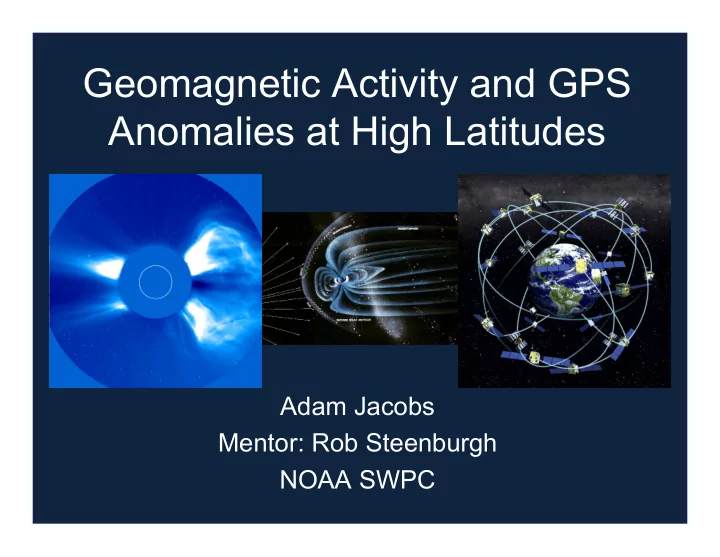
Geomagnetic Activity and GPS Anomalies at High Latitudes Adam - - PowerPoint PPT Presentation
Geomagnetic Activity and GPS Anomalies at High Latitudes Adam Jacobs Mentor: Rob Steenburgh NOAA SWPC OUTLINE Motivation Motivation Background Data Details Alaskas citizens use GPS for many daily activities Data Processing
OUTLINE Motivation Background Data Details Data Processing Results/Plots Conclusions Future Work Comments or Questions Jacobs· Steenburgh Colorado REU Presentation · slide 2
many daily activities
effect the accuracy of GPS
they can and can’t rely on GPS positioning (some situations are life threatening)
predictable relationship?
able to forecast GPS disruption (timing/magnitude) given certain levels of geomagnetic activity
OUTLINE Motivation Background
Scintillation Cycle Slips Positioning Error
Data Details Data Processing Results/Plots Conclusions Future Work Comments or Questions Jacobs· Steenburgh Colorado REU Presentation · slide 3
OUTLINE Motivation Background
Scintillation Cycle Slips Positioning Error
Data Details Data Processing Results/Plots Conclusions Future Work Comments or Questions Jacobs· Steenburgh Colorado REU Presentation · slide 4
perturbations in the Earth’s magnetic field
particle precipitation and complex structure to develop in the ionosphere—especially at high latitudes (top pic)
blobs—disrupt GPS signals (bottom pic)
refraction of the GPS signal which in turn cause phase shifts and amplitude variability respectively
changes amplitude and phase
cause unpredictable variations in Total Electron Content
complex signal group (pseudorange) delay
distance between the reference station and a satellite using the time for the signal to get there
are used to get the distance OUTLINE Motivation Background
Scintillation Cycle Slips Positioning Error
Data Details Data Processing Results/Plots Conclusions Future Work Questions Jacobs· Steenburgh Colorado REU Presentation · slide 5
the bandwidth of a receiver’s phase lock loop (PLL) the receiver loses lock
determines the number of cycles that will slip by unrecorded(hence cycle-slips)
successful correction methods for cycle slips including polynomial fitting OUTLINE Motivation Background
Scintillation Cycle Slips Positioning Error
Data Details Data Processing Results/Plots Conclusions Future Work Comments or Questions Jacobs· Steenburgh Colorado REU Presentation · slide 6
Numerous cycle slips in the GPS observations create jumps in the time series. (Banville et. al. 2010—Radio Science)
OUTLINE Motivation Background Data Details
GPS data Geomagnetic data
Data Processing Results/Plots Conclusions Future Work Questions Jacobs· Steenburgh Colorado REU Presentation · slide 7
reference stations
check for latitude dependence in GPS errors
Nation Geodetic Survey (NGS) Continuously Operating Reference Stations (CORS) network
OUTLINE Motivation Background Data Details
GPS data Geomagnetic data
Data Processing Results/Plots Conclusions Future Work Questions Jacobs· Steenburgh Colorado REU Presentation · slide 8
hourly K-index data from College, AK
maximum fluctuations in the horizontal mag. Field components relative to a quiet day, during a three hour interval
eight “equivalent three hourly” (a-index) values which have been converted nonlinearly from the K-index values
OUTLINE Motivation Background Data Details
GPS data Geomagnetic data
Data Processing Results/Plots Conclusions Future Work Questions Jacobs· Steenburgh Colorado REU Presentation · slide 9
stations and the A-index at College for 2003 and 2008 (quiet and active years)
data sets and calculated correlation coefficients
compared these data sets to the A-index
College K-index and three hourly medians for GPS positioning errors
distributions, and seasonal variability (looked at specific events)
OUTLINE Motivation Background Data Details Data Processing Results/Plots Conclusions Future Work Questions Jacobs· Steenburgh Colorado REU Presentation · slide 10
OUTLINE Motivation Background Data Details Data Processing Results/Plots
Cycle Slips Position Error
Conclusions Future Work Questions Jacobs· Steenburgh Colorado REU Presentation · slide 11
OUTLINE Motivation Background Data Details Data Processing Results/Plots
Cycle Slips Daily Corr. 1 Daily Corr. 2 Daily Corr. 3 Position Error
Conclusions Future Work Questions Jacobs· Steenburgh Colorado REU Presentation · slide 12
OUTLINE Motivation Background Data Details Data Processing Results/Plots
Cycle Slips Daily Corr. 1 Daily Corr. 2 Daily Corr. 3 Position Error
Conclusions Future Work Questions Jacobs· Steenburgh Colorado REU Presentation · slide 13
OUTLINE Motivation Background Data Details Data Processing Results/Plots Cycle Slips
Daily Corr. 1 Daily Corr. 2 Daily Corr. 3 Position Error
Conclusions Future Work Questions Jacobs· Steenburgh Colorado REU Presentation · slide 14
stronger cases
OUTLINE Motivation Background Data Details Data Processing Results/Plots Cycle Slips Position Error Fair TS 2003 2003 Zoom Fair TS 2008 2008 Zoom Fair Corr. 1 Fair Corr. 2 Fair Corr.
Jacobs· Steenburgh Colorado REU Presentation · slide 15
OUTLINE Motivation Background Data Details Data Processing Results/Plots Cycle Slips Position Error Fair TS 2003 2003 Zoom Fair TS 2008 2008 Zoom Fair Corr. 1 Fair Corr. 2 Fair Corr.
Jacobs· Steenburgh Colorado REU Presentation · slide 16
OUTLINE Motivation Background Data Details Data Processing Results/Plots Cycle Slips Position Error Fair TS 2003 2003 Zoom Fair TS 2008 2008 Zoom Fair Corr. 1 Fair Corr. 2 Fair Corr.
Jacobs· Steenburgh Colorado REU Presentation · slide 17
OUTLINE Motivation Background Data Details Data Processing Results/Plots Cycle Slips Position Error Fair TS 2003 2003 Zoom Fair TS 2008 2008 Zoom Fair Corr. 1 Fair Corr. 2 Fair Corr.
Jacobs· Steenburgh Colorado REU Presentation · slide 18
2008
errors though
OUTLINE Motivation Background Data Details Data Processing Results/Plots Cycle Slips Position Error Fair TS 2003 2003 Zoom Fair TS 2008 2008 Zoom Fair Corr. 1 Fair Corr. 2 Fair Corr.
Jacobs· Steenburgh Colorado REU Presentation · slide 19
OUTLINE Motivation Background Data Details Data Processing Results/Plots Cycle Slips Position Error Fair TS 2003 2003 Zoom Fair TS 2008 2008 Zoom Fair Corr. 1 Fair Corr. 2 Fair Corr.
Jacobs· Steenburgh Colorado REU Presentation · slide 20
OUTLINE Motivation Background Data Details Data Processing Results/Plots Cycle Slips Position Error Fair TS 2003 2003 Zoom Fair TS 2008 2008 Zoom Fair Corr. 1 Fair Corr. 2 Fair Corr.
Jacobs· Steenburgh Colorado REU Presentation · slide 21
OUTLINE Motivation Background Data Details Data Processing Results/Plots Cycle Slips Position Error Fair TS 2003 2003 Zoom Fair TS 2008 2008 Zoom Fair Corr. 1 Fair Corr. 2 Fair Corr. 3
Jacobs· Steenburgh Colorado REU Presentation · slide 22
and outer ring to subtract out noise
OUTLINE
Motivation Background Data Details Data Processing Results/Plots Conclusions Future Work Questions Jacobs· Steenburgh Colorado REU Presentation · slide 23
interpolation
Location/Intensity data (POES data)
to eliminate multipath
data — when GPS really went haywire
OUTLINE
Motivation Background Data Details Data Processing Results/Plots Conclusions Future Work Questions Jacobs· Steenburgh Colorado REU Presentation · slide 24
OUTLINE Motivation Background Data Details Data Processing Results/Plots Conclusions Future Work Questions Jacobs· Steenburgh Colorado REU Presentation · slide 25
SWPC Project Help
Internship Experience
OUTLINE
Motivation Background Data Details Data Processing Results/Plots Conclusions Future Work Questions Jacobs· Steenburgh Colorado REU Presentation · slide 26
Daily Lags 3-hourly Lags