GEOGRAPHY AT CAMBRIDGE 100 years of the Geography degree You can - - PowerPoint PPT Presentation
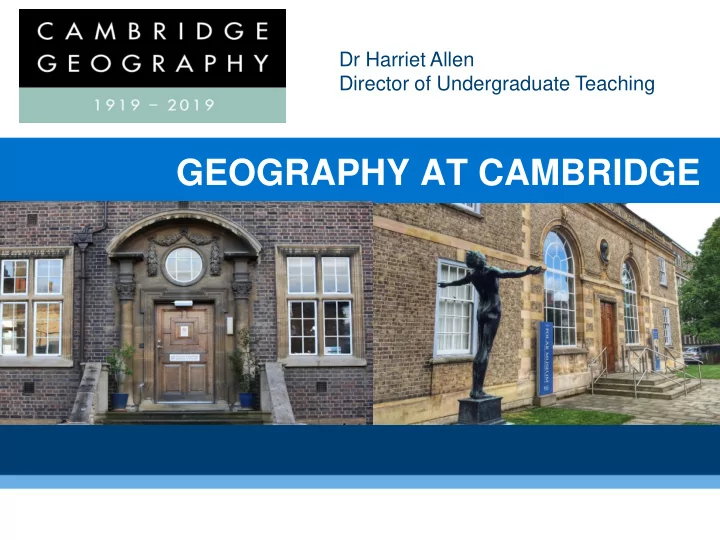
Dr Harriet Allen Director of Undergraduate Teaching GEOGRAPHY AT CAMBRIDGE 100 years of the Geography degree You can find out more about our celebrations, including films of events, on our public website under alumni events
100 years of the Geography degree
You can find out more about our celebrations, including films
- f events, on our public website under alumni events
https://www.geog.cam.ac.uk/alumni/events/centenary2019.html. An
entertaining history of teaching and the degree is published in Landmark, available online on the alumni webpage.
WHY GEOGRAPHY?
- You enjoy learning about
environments, landscapes and peoples: their societies, economies and cultures
- You are keen to learn and develop a
wide range of skills
- You are seeking a broad-based
academic degree, offering above average graduate employability
- And: you have a sense of wonder,
curiosity and concern.
WHY GEOGRAPHY AT CAMBRIDGE?
- Study in one of the World’s leading departments:
- Consistently ranked amongst the best geography degrees
in the UK: retained our ranking of 1st in the Complete University Guide (2016, 2017, 2018, 2019, 2020)
- Ranked second in the 2014 Research Excellence
Framework
- Study in both departmental and college environments
- Wealth of relevant resources and support through the
Collegiate system
CAMBRIDGE UNIVERSITY GEOGRAPHICAL SOCIETY
CUGS is organised and run entirely by undergraduates. In the past year CUGS has invited speakers from other geography departments as well as civil servants and policy makers. It organises lectures and social events throughout the year. www.cugs.co.uk
Like them!
THE TRIPOS (the word for a degree at Cambridge)
All first degrees awarded by Cambridge are Bachelor of Arts (BA) degrees. We do not make you choose between human and physical geography. The course is broad enough to include those whose primary interests are in natural sciences, social sciences, humanities; or all three.
TEACHING AND LEARNING
- Teaching divided into ‘papers’, there are no restrictions on paper
choice from year to year and you can only take papers within the Geography Tripos. Unique teaching environment:
- Lectures
- Supervisions
- Practical classes / fieldwork
- Dissertation
Written exams + coursework Examined coursework
FIRST YEAR (PART IA)
- 2 compulsory papers and in 2019-20 these are:
- People, Place and the Politics of Difference
- Environmental Processes and Change
- Practical classes for Geographical Skills and Methods
- ASSESSMENT: 5 practical assessments (skills and methods)
and two exams, one for each paper
SECOND YEAR (PART IB)
A) Compulsory paper: Living with Global Change i. Cultures of Risk (how people live in an uncertain world); ii. Making Geographical Knowledges (how different societies make sense of environmental change); iii. Geographies of Environmental Hazard (e.g. Climate Change, Volcanic Hazards, Sea Level Rise) B) Choose 3 other papers from a choice of 6 (all of which include a coursework exercise): C) Classes/practicals in skills and research design in geography
- ASSESSMENT: four written exams and coursework
- 1. Economic Geography
- 2. Development Theories, Policies and
Practice
- 3. Citizenship, Cities and Civil Society
4. Quaternary Climates & Environments 5. Glacial Processes 6. Biogeography Papers in 2019-20:
SECOND YEAR FIELDTRIP (in vacations)
- Switzerland
- Berlin
- Dublin
- Tenerife
- Morocco
- Mallorca
- Copenhagen
THIRD YEAR (PART II)
- Free choice of 4 papers from a list
- f 12 ; some include coursework
- Paper choices vary from year to
year
- 10,000 word dissertation
PAPERS IN 2019-20:
- 1. The Geographies of Global Urbanism
- 2. Geographies of the Arctic
- 3. Political Ecology in the Global South
- 4. Demographic Continuity and Change
- 5. Environmental Knowledges and the
Politics of Expertise
- 6. Geographies of Postcolonialism and
Decoloniality
- 7. Legal Geographies
- 8. From Earth Observation to the Climate
System
- 9. Glaciology
- 10. Volcanology
- 11. Seascapes
- 12. Biogeography
THIRD YEAR: DISSERTATION
- 10,000 word dissertation:
APPLICATIONS
- You apply to a college (unless making an open
application)
- It doesn’t matter which school subjects you are
studying (and you don’t even need Geography). Good examples:
- Economics, English literature, History,
Sociology
- Biology, Chemistry, Mathematics, Physics
- Every applicant sits the Cambridge Admissions
Assessment, see:
https://www.undergraduate.study.cam.ac.uk/courses/geography#entry-requirements
COLLEGES
- In terms of academic life it doesn’t matter which
college you choose - Directors of Studies are appointed to look after your academic welfare
- All colleges, except Peterhouse, admit geographers
- Size of college and Geography cohort
- Location/Setting
- Women only / mature students
GEOGRAPHY INTERVIEWS
- 20-25 minutes (usually 2 interviews, each with two
interviewers)
- Like a mini-supervision where we discuss a series of
key themes in geography
- May involve a piece of reading, either sent in advance
- r set on the day
- Exploring how you think through and construct an
argument
- Assessing your interest in the subject
- Videos of the interview process are on our website
SUGGESTED READING
- There is no set reading list for a subject as broad
as Geography. You should maintain a broad interest in those areas that interest you.
- You might try reading newspapers, current
affairs journals and magazines like New Scientist, The Economist, Geographical Magazine and Geography Review.
- Get involved with the RGS, even just by looking