
SLIDE 1
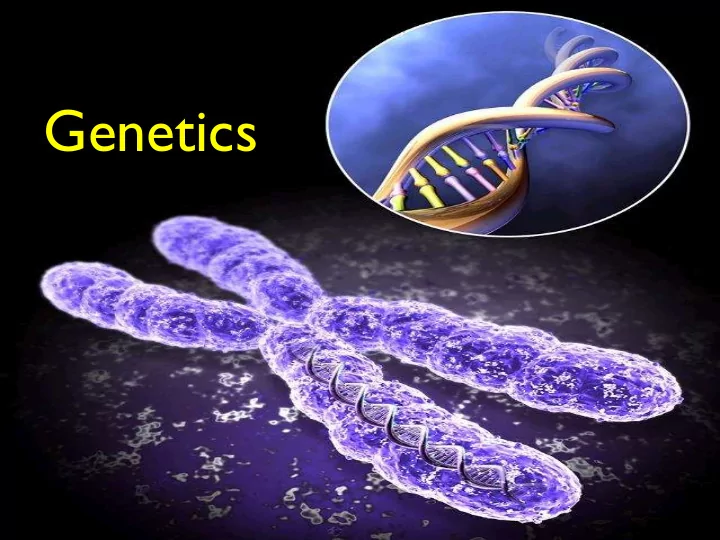
Genetics Core Concepts Mendels Law of Segregation states that there - - PowerPoint PPT Presentation
Genetics Core Concepts Mendels Law of Segregation states that there are two alleles for every gene determining a specific characteristic, and these alleles are segregated into separate gametes during reproduction. When the 2 different
for every gene determining a specific characteristic, and these alleles are segregated into separate gametes during reproduction.
(heterozygote), the dominant allele will be the one that is expressed in the phenotype of the individual.
more different genes, if found on separate chromosomes, are determined independently of each other.
there are 2 or more ways to arrive at a given outcome.
inheritance that are modifications of Mendel’s rules.
generation)
generation)
generation)
genetics: blending theory
science teacher
– Pea plants available in many varieties
– Perfect flowers
pollination
– Short generation time – Many offspring
CHARACTERS TRAITS
P Generation (true-breeding parents)
Purple flowers White flowers
x
F1 Generation (hybrids)
All plants had purple flowers
F2 Generation
705 plants 224 plants
self-pollination
MONOHYBRID CROSS
inheritance of a single trait Cross- fertilization
– Dominant – Recessive
– Dominant is fully expressed – Recessive has no visible effect
Allele for purple flowers ( P )
Locus for flower-color gene Homologous pair of chromosomes
Allele for white flowers ( p p )
versions of genes exist (alleles)
inherits 2 alleles (genotype)
fully expressed
no visible effect PP PP pp pp Pp PP PP or Pp pp pp
alleles, true-breeding
alleles
appearance
Parental generation
different traits for flower color
gamete: purple parent (P), white parent (p) F1 generation
F2 generation
sperm with different kinds of gametes combine to form a specific ratio
An organism displays the dominant phenotype. It may be either homozygous
trait. How can its genotype be determined? Perform a test-cross: Dominant phenotype x recessive phenotype
Inheritance of two characters
four phenotypes in the F2 generation
Inheritance of two characters
NOT transmitted as a package (YR and yr only)
packaged into gametes in all possible combinations of alleles (YR, Yr, yR, yr)
Law of independent assortment
Allele pairs separate independently during the formation of gametes
Addition Rule combines probabilities for mutually exclusive events Multiplication Rule combines probabilities of 2 or more independent events that need to
Round seed shape is dominant
plants. What percentage of the F2 generation can be expected to: a. Be homozygous dominant for seed shape? b. Be heterozygous for seed shape? c. Have round seeds?
Addition Rule combines probabilities for mutually exclusive events Multiplication Rule combines probabilities of 2 or more independent events that need to
Round seed shape is dominant
dominant over yellow pods. What percentage of the F2 generation can be expected to: a. Be heterozygous for both characters? b. Have round seeds in green pods? c. Have wrinkled seeds in green pods?
Addition Rule combines probabilities for mutually exclusive events Multiplication Rule combines probabilities of 2 or more independent events that need to
Round seed shape is dominant
dominant over yellow pods. Tall plants are dominant over short ones. What percentage of the F2 generation can be expected to: a. Be heterozygous for all characters? b. Be tall plants with round seeds in yellow pods? c. Be short plants with round seeds in green pods?
inheritance; guide questions available online
2:30 PM on the day of the Bio Perio
www.youtube.com
Find the genotypic and phenotypic ratios of the offspring from the following crosses using the forked line method:
Codominance
alleles affect phenotype in separate ways
horses – both red and white
Incomplete dominance
phenotypes of two parents
parents give rise to pink offspring
Multiple alleles
than two alleles that control the phenotype
system has 3 alleles-- IA,IB,i. IA,IB are codominant, i is recessive to both
Alleles with different degrees of dominance and recessiveness
www.flickr.com
www.bio.georgiasouthern.edu
www.buzzle.com
http://nevinerk.weebly.c
9320/236178.png?402
silver blahblah birds. a) What are the genotypes of the parent blahblah birds in the original cross? b) What is the genotype of the silver offspring? c) What would be the phenotypic ratios of offspring produced by two silver blahblah birds?
plants with orange fruits are crossed the following phenotypic ratios are present in the offspring: 25% red fruit, 50% orange fruit, 25% yellow fruit. What are the genotypes of the parent orange-fruited plants?
crossed with a red roan bull.
wanted only cattle with red fur?
tan fur together). a) What pattern of inheritance does this illustrate? b) What percent of kittens would have tan fur if a tabby cat is crossed with a black cat?
heterozygous for "B" blood type?
having a child with Type O?
type of the offspring of a couple whose blood types are A and B. Both sets