
SLIDE 1
Generative Research
Teaching Communication Skills
Melody Ma | Devika Singh | Joseph Hines | Denise Nguyen | Scott Dombkowski
Team Ada
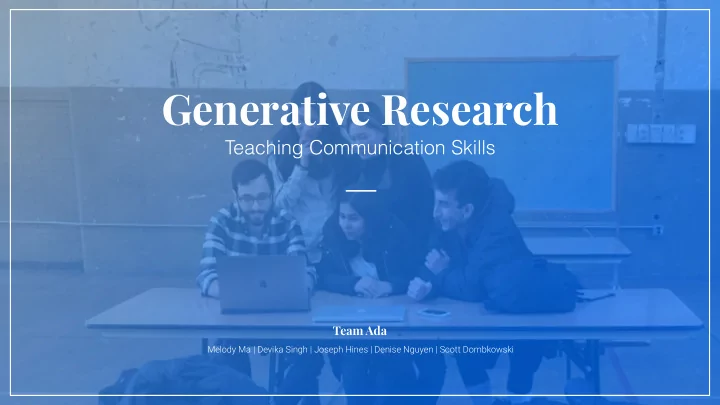
Generative Research Teaching Communication Skills Team Ada Melody - - PowerPoint PPT Presentation
Generative Research Teaching Communication Skills Team Ada Melody Ma | Devika Singh | Joseph Hines | Denise Nguyen | Scott Dombkowski 01 Our Scope Table of 02 Our Objective Contents 03 Initial and Current Stakeholders 04 Research
Teaching Communication Skills
Melody Ma | Devika Singh | Joseph Hines | Denise Nguyen | Scott Dombkowski
Team Ada
01 Our Scope 02 Our Objective 03 Initial and Current Stakeholders 04 Research Strategy 05 Research Methods 06 Research Insights 07 Design Principles 08 Concepts 09 Next Steps
Table of Contents
Our scope is to teach soft skills to students entering the workforce. We recognize that the future of work is evolving due to automation in different industries. However, what is not ambiguous is the need for soft
world of work” as they are extremely difficult to automate.
Our Scope
“As technology becomes more pervasive, the world of work becomes more collaborative, education is more about teaching them how to respond to a fast-paced world of relentless change.”
How might we leverage artificial intelligence to facilitate human to human interactions that promote the development of communication skills amongst students entering the workforce?
Our Objective
Initial Stakeholders
CMU Pitt CCAC Private University 14,000 Students Public University 35,000 Students Community College 43,000 Students
Types of Higher Education Institutions
Current Stakeholders
Creative Fields STEM Fields Business Fields
Types of Industry
Students New Grads Managers
Moments in Career
Research Methods
Creative Fields STEM Fields Business Fields Students Managers New Grads Students Generative Workshop & Survey Diary Study & Note to Past Self Interviews & Note to Future Employee Industry / Career
Research Scenarios
Networking & Interviewing
01
Difficult conversations with superiors
04
Collaboration between teams
02
Presenting work
03
networking in the professional setting
people with similar expertise
multidisciplinary team
group of audiences
Research Overview Stats
Generative Workshop 13 Attendees Diary Study 6 Participants Interview 6 Participants Note to Past Self 6 Notes Note to Future Employee 6 Notes Survey 50 Respondents
Generative Workshop
with Students
Generative Workshop Journey Map
Journey Map
Students
Generative Workshop Sticky Scenario
Sticky Scenario
Students
Sticky Scenario
Students
Generative Workshop Role-Playing
Role Playing
Students
Generative Workshop Communication Tool
Communication Tool
Students
Diary Studies & Note to Past Self
with New Grads
Diary Studies
New Grads
Q: What adjustments did you make to overcome those obstacles? A: “A sense of competition and discord when assigned to do a task in a team. Difgerent results due to difgerence in style and speed of working that might put one ahead of the other.”
Notes to Past Self
New Grads
“…Flexibility will be key as you learn to speak with persons of a wide range of communication styles, personalities, backgrounds, and experiences. I hope you remember that as long as you put yourself out there consistently, you have everything to be proud of and you will be paving a path to your ultimate career goals. So speak up and remember the strengths you bring to the
Interviews & Note to Future Employee
with Managers
Interviews
Managers
Q: Is there anything you’ve learned from communicating with your manager that you’ve carried forward while managing? A: “Always protecting someone from my department. If you want to teach your child you teach them inside. Protect them from outside departments, once they have learned, they will be able to go outside the
the department, you should take the responsibility.”
“As a new hire, I think it very important that when you communicate you clearly and concisely deliver your message, listen closely to the customer and their perspective while staying compassionate and empathetic to the their position… Be open and seek guidance from the experienced members of our team especially with the diffjcult and high pressure sales situations we face regularly.”
Notes to Future Employee
Managers
Research Insights
Research Insights
General
Communication strategies and pain points are similar across industries.
INSIGHT #01
“Communication and collaboration are essential in the 21st century skills; so much
require things to be done across boundaries."
Research Insights
General
Consistent preparation and practice is essential for being a confident communicator.
INSIGHT #02
“Practice makes perfect!”
Research Insights
General
Constructive feedback with context and reflection helps to improve communication skills
INSIGHT #03
“It is hard to understand feedback that is not direct to an example. Hard to ask specific questions if there is not something there that they can draw from.”
Research Insights
On Students
Both written and verbal skills are necessary for effective professional communication.
INSIGHT #04
“Communication tends to mean oral communication, but then you have employers complaining that people can’t write a coherent sentence,”
Research Insights
On Students
A positive setting can increase confidence and help facilitate difficult conversations.
INSIGHT #05
“My approach is to not change them. I center towards what their talents are and how they can use them to
diffjculty.”
Research Insights
On Students
There is a need to develop communication skills to become better presenters, networkers and teammates.
INSIGHT #06
“Since I have an introverted personality, I would say networking because it can be diffjcult for me to do, especially in scenarios with lots of people.”
Research Insights
On Students
Preparation for different audiences and contexts is important.
INSIGHT #07
“I ensured that I had researched and was prepared for not only past steps but also future consequences.”
Research Insights
On Students
Familiarization with professional situations and scenarios can help students better prepare for entering the workforce.
INSIGHT #08
“Learning what kinds of situations to expect and what to say or do during specific situations will make you more prepared and confident."
Design Principles
Create more transparency between schools and industry
Design Principles & Implications
Learning should be engaging and interactive Promote continuous learning
Research Insight:
Increased efforts in teaching soft skills, but current applications are not engaging. Group settings are ideal for practicing and interacting.
Research Insight:
Learning models should be oriented around continuous learning. Feedback should happen as often as possible and at multiple levels.
Research Insight:
There is a misalignment between what industry expects and what schools provide in terms of soft skills. Familiarization with professional situations and scenarios can help students better prepare for entering the workforce.
01 02 03
Consistent preparation and practice is essential for being a confident communicator.
Cater to Individuals
Design Principles & Implications
Research Insight:
Feedback loops are essential Constructive feedback with context and reflection helps to improve communication skills
Research Insight:
Learners have different motivations and goals. Personalized learning is essential for identifying an user’s mental models and blind spots.
04
Research Insight:
Learning goals should be explicitly articulated at the outset. Mission goals and clear assessment rubrics at the beginning benefit student’ learning.
Follow the established learning model: Explicit
05
Foster a conducive learning environment
Design Principles & Implications
Prepare for a variety of contexts.
Research Insight:
Both written and verbal skills are necessary for effective professional communication. There is a need to develop communication skills to become better presenters, networkers and teammates. Preparation for different audiences and contexts is important.
Research Insight:
Environments significantly influence learning A positive setting can increase confidence and help facilitate difficult conversations.
06 07
Design Directions
Concept 01
PERSONAL COACH An eco-system of artifacts for students and young professional that helps them prepare for different professional settings through simulated practice and post performance analysis.
Concept 02
REAL-TIME LEARNING An assistive learning tool for students and young professionals that helps with in-situ learning.
Concept 03
GROUP FEEDBACK An environment or artifact for groups that analyzes communication and provides real time/post insights to facilitate better conversations in the future.
Personal Coach
Directions Summary
Real-time learning Group Feedback 01 02 03