Generative recursion Readings: Sections 25, 26, 27, 30, 31 Topics: - - PDF document

generative recursion
SMART_READER_LITE
LIVE PREVIEW

Generative recursion Readings: Sections 25, 26, 27, 30, 31 Topics: - - PDF document

Generative recursion Readings: Sections 25, 26, 27, 30, 31 Topics: What is generative recursion? Termination Hoares Quicksort Modifying the design recipe Example: breaking strings into lines Intro Termination Quicksort DRecipe Example


slide-1
SLIDE 1

Generative recursion

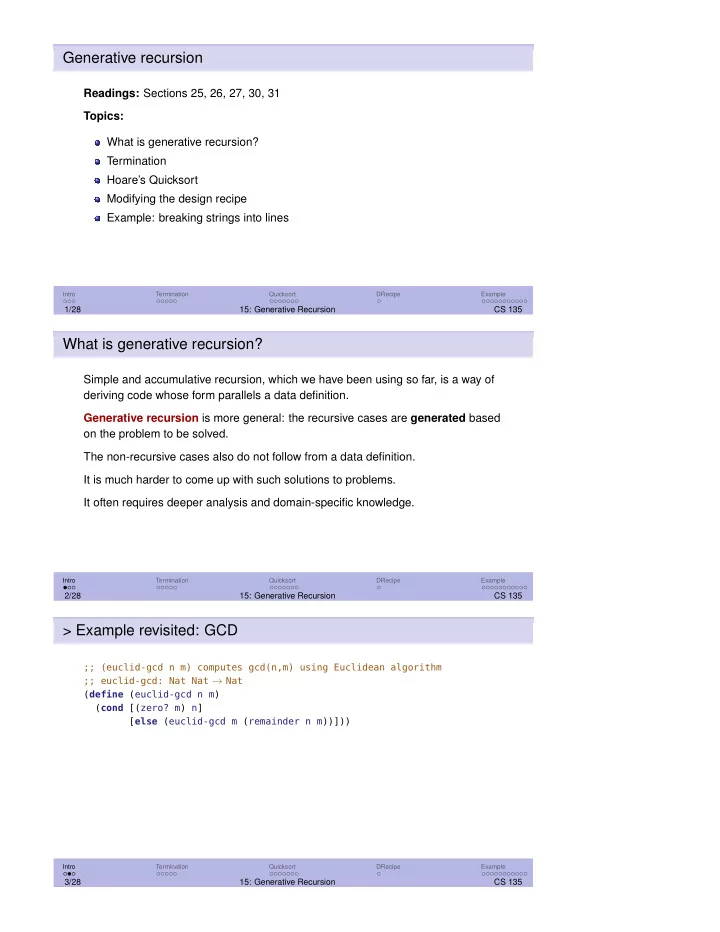
Readings: Sections 25, 26, 27, 30, 31 Topics: What is generative recursion? Termination Hoare’s Quicksort Modifying the design recipe Example: breaking strings into lines

Intro Termination Quicksort DRecipe Example

1/28 15: Generative Recursion CS 135

What is generative recursion?

Simple and accumulative recursion, which we have been using so far, is a way of deriving code whose form parallels a data definition. Generative recursion is more general: the recursive cases are generated based

  • n the problem to be solved.

The non-recursive cases also do not follow from a data definition. It is much harder to come up with such solutions to problems. It often requires deeper analysis and domain-specific knowledge.

Intro Termination Quicksort DRecipe Example

2/28 15: Generative Recursion CS 135

> Example revisited: GCD

;; (euclid-gcd n m) computes gcd(n,m) using Euclidean algorithm ;; euclid-gcd: Nat Nat → Nat (define (euclid-gcd n m) (cond [(zero? m) n] [else (euclid-gcd m (remainder n m))]))

Intro Termination Quicksort DRecipe Example

3/28 15: Generative Recursion CS 135

slide-2
SLIDE 2

> Why does this work?

Correctness: Follows from Math 135 proof of the identity. Termination: An application terminates if it can be reduced to a value in finite time. All of our functions so far have terminated. But why? For a non-recursive function, it is easy to argue that it terminates, assuming all applications inside it do. It is not clear what to do for recursive functions.

Intro Termination Quicksort DRecipe Example

4/28 15: Generative Recursion CS 135

Termination of recursive functions

Why did our functions using simple recursion terminate? A simple recursive function always makes recursive applications on smaller instances, whose size is bounded below by the base case (e.g. the empty list). We can thus bound the depth of recursion (the number of applications of the function before arriving at a base case). As a result, the evaluation cannot go on forever.

Intro Termination Quicksort DRecipe Example

5/28 15: Generative Recursion CS 135

> Depth of recursion example

(define (sum-list lst) (cond [(empty? lst) 0] [else (+ (first lst) (sum-list (rest lst)))])) (sum-list (list 3 6 5 4)) ;; 1

⇒ (+ 3 (sum-list (list 6 5 4)))

;; 2

⇒ (+ 3 (+ 6 (sum-list (list 5 4))))

;; 3

⇒ (+ 3 (+ 6 (+ 5 (sum-list (list 4)))))

;; 4

⇒ (+ 3 (+ 6 (+ 5 (+ 4 (sum-list (list ))))))

;; arrived at base case

⇒ (+ 3 (+ 6 (+ 5 (+ 4 0)))) ⇒ ... ⇒ 18

The depth of recursion of any application of sum-list is equal to the length of the list to which it is applied. For generatively recursive functions, we need to make a similar argument.

Intro Termination Quicksort DRecipe Example

6/28 15: Generative Recursion CS 135

slide-3
SLIDE 3

> Termination of euclid-gcd

In the case of euclid-gcd, our measure of progress is the size of the second argument. If the first argument is smaller than the second argument, the first recursive application switches them, which makes the second argument smaller. After that, the second argument always gets smaller in the recursive application (since m > n mod m), but it is bounded below by 0. Thus any application of euclid-gcd has a depth of recursion bounded by the second argument. In fact, it is always much faster than this.

Intro Termination Quicksort DRecipe Example

7/28 15: Generative Recursion CS 135

> Termination is sometimes hard

;; collatz: Nat → Nat (define (collatz n) (cond [(= n 1) 1] [(even? n) (collatz (/ n 2))] [ else (collatz (+ 1 (* 3 n)))]))

It is a decades-old open research problem to discover whether or not (collatz n) terminates for all values of n.

https://xkcd.com/710/

Intro Termination Quicksort DRecipe Example

8/28 15: Generative Recursion CS 135

> collatz-list

We can see better what collatz is doing by producing a list.

;; (collatz-list n) produces the list of the intermediate ;; results calculated by the collatz function. ;; collatz-list: Nat → (listof Nat) ;; requires: n >= 1 (check-expect (collatz-list 1) '(1)) (check-expect (collatz-list 5) '(5 16 8 4 2 1)) (define (collatz-list n) (cons n (cond [(= n 1) empty] [(even? n) (collatz-list (/ n 2))] [ else (collatz-list (+ 1 (* 3 n)))])))

Intro Termination Quicksort DRecipe Example

9/28 15: Generative Recursion CS 135

slide-4
SLIDE 4

Hoare’s Quicksort

The Quicksort algorithm is an example of divide and conquer: divide a problem into smaller subproblems; recursively solve each one; combine the solutions to solve the original problem. Quicksort sorts a list of numbers into non-decreasing order by first choosing a pivot element from the list. The subproblems consist of the elements less than the pivot, and those greater than the pivot.

Intro Termination Quicksort DRecipe Example

10/28 15: Generative Recursion CS 135

> Quicksort example

If the list is (list 9 4 15 2 12 20), and the pivot is 9, then the subproblems are

(list 4 2) and (list 15 12 20).

Recursively sorting the two subproblem lists gives

(list 2 4) and (list 12 15 20).

It is now simple to combine them with the pivot to give the answer.

(append (list 2 4) (list 9) (list 12 15 20)) ⇒ '(2 4 9 12 15 20)

Intro Termination Quicksort DRecipe Example

11/28 15: Generative Recursion CS 135

> Pivot and subproblems

The easiest pivot to select from a list lon is (first lon). A function which tests whether another item is less than the pivot is

(lambda (x) (< x (first lon))).

The first subproblem is then (filter (lambda (x) (< x (first lon))) lon) A similar expression will find the second subproblem (items greater than the pivot).

Intro Termination Quicksort DRecipe Example

12/28 15: Generative Recursion CS 135

slide-5
SLIDE 5

> my-quicksort

;; (my-quicksort lon) sorts lon in non-decreasing order ;; my-quicksort: (listof Num) → (listof Num) (define (my-quicksort lon) (cond [(empty? lon) empty] [else (local [(define pivot (first lon)) (define less (filter (lambda (x) (< x pivot)) (rest lon))) (define greater (filter (lambda (x) (>= x pivot)) (rest lon)))] (append (my-quicksort less) (list pivot) (my-quicksort greater)))])) (check-expect (my-quicksort '(5 3 9)) '(3 5 9))

Intro Termination Quicksort DRecipe Example

13/28 15: Generative Recursion CS 135

> Quicksort termination

Termination of quicksort follows from the fact that both subproblems have fewer elements than the original list (since neither contains the pivot). Thus the depth of recursion of an application of my-quicksort is bounded above by the number of elements in the argument list. This would not have been true if we had mistakenly written

(filter (lambda (x) (>= x pivot)) lon) instead of the correct (filter (lambda (x) (>= x pivot)) (rest lon)).

Intro Termination Quicksort DRecipe Example

14/28 15: Generative Recursion CS 135

> Built-in quicksort

In the teaching languages, the built-in function quicksort consumes two arguments, a list and a comparison function.

(quicksort '(1 5 2 4 3) <) ⇒ '(1 2 3 4 5) (quicksort '(1 5 2 4 3) >) ⇒ '(5 4 3 2 1) (quicksort '("chili powder" "anise" "bazil") string<?)

⇒ (list "anise" "bazil" "chili powder")

Intro Termination Quicksort DRecipe Example

15/28 15: Generative Recursion CS 135

slide-6
SLIDE 6

> Degenerative quicksort

Intuitively, quicksort works best when the two recursive function applications are

  • n arguments about the same size.

When one recursive function application is always on an empty list (as is the case when quicksort is applied to an already-sorted list), the pattern of recursion is similar to the worst case of insertion sort, and the number of steps is roughly proportional to the square of the length of the list. We will go into more detail on efficiency considerations in CS 136.

Intro Termination Quicksort DRecipe Example

16/28 15: Generative Recursion CS 135

Modifying the design recipe

The design recipe becomes much more vague when we move away from data-directed design. The purpose statement remains unchanged, but additional documentation is often required to describe how the function works. Examples need to illustrate the workings of the algorithm. We cannot apply a template, since there is no data definition. For divide and conquer algorithms, there are typically tests for the easy cases that don’t require recursion, followed by the formulation and recursive solution of subproblems, and then combination of the solutions.

Intro Termination Quicksort DRecipe Example

17/28 15: Generative Recursion CS 135

Example: breaking strings into lines

Traditionally, the character set used in computers has included not only alphanumeric characters and punctuation, but “control” characters as well. An example in Racket is #\newline, which signals the start of a new line of text. The characters ‘\’ and ‘n’ appearing consecutively in a string constant are interpreted as a single newline character. For example, the string "ab\ncd" is a five-character string with a newline as the third character. It would typically be printed as "ab" on one line and "cd" on the next line.

Intro Termination Quicksort DRecipe Example

18/28 15: Generative Recursion CS 135

slide-7
SLIDE 7

> Getting started

Consider converting a string such as "one\ntwo\nthree" into a list of strings,

(list "one" "two" "three"), one for each line.

The solution will start with an application of string

  • list. That’s the only way

we’ve studied of working with individual characters in a string. This problem can be solved using simple recursion on the resulting list of characters – but it’s hard. The “simple” recursion gets bogged down in a lot of little details. In this case a generative solution is easier.

Intro Termination Quicksort DRecipe Example

19/28 15: Generative Recursion CS 135

> The generative idea

Instead of thinking of the list of characters as a list of characters, think of it as a list

  • f lines:
  • n e \n t w o \n t h r e e
  • n e \n t w o \n t h r e e

A list of lines is either empty or a line followed by a list of lines. Start with helper functions that divide the list of characters into the first line and the rest of the lines.

Intro Termination Quicksort DRecipe Example

20/28 15: Generative Recursion CS 135

> Helper: first-line

;; (first-line loc) produces longest newline-free prefix of loc ;; first-line: (listof Char) → (listof Char) (define (first-line loc) (cond [(empty? loc) empty] [(char=? (first loc) #\newline) empty] [else (cons (first loc) (first-line (rest loc)))])) (check-expect (first-line empty) empty) (check-expect (first-line '(#\a #\newline)) '(#\a)) (check-expect (first-line (string

list "abc\ndef")) '(#\a #\b #\c))

Intro Termination Quicksort DRecipe Example

21/28 15: Generative Recursion CS 135

slide-8
SLIDE 8

> Helper: rest-of-lines

;; (rest-of-lines loc) produces loc with everything up to ;; and including the first newline removed ;; rest-of-lines: (listof Char) → (listof Char) (define (rest-of-lines loc) (cond [(empty? loc) empty] [(char=? (first loc) #\newline) (rest loc)] [else (rest-of-lines (rest loc))])) (check-expect (rest-of-lines empty) empty) (check-expect (rest-of-lines '(#\a #\newline)) empty) (check-expect (rest-of-lines '(#\a #\newline #\b)) '(#\b))

Intro Termination Quicksort DRecipe Example

22/28 15: Generative Recursion CS 135

> List of lines template

We can create a “list of lines template” using these helpers.

(define (loc

lol loc) (local [(define fline (first-line loc)) (define rlines (rest-of-lines loc))] (cond [(empty? loc) empty] [else ... fline ... (loc

lol rlines) ...]))

This looks a lot like the template for functions consuming a (listof X). That was simple recursion. This is not simple recursion. Why not?

Intro Termination Quicksort DRecipe Example

23/28 15: Generative Recursion CS 135

> loc

lol

;; loc

lol: (listof Char) → (listof Str) (check-expect (loc

lol (string

list "abc\ndef")) (list "abc" "def")) (check-expect (loc

lol (string

list "")) (list)) (check-expect (loc

lol (string

list "\ndef")) (list "" "def")) (define (loc

lol loc) (local [(define fline (first-line loc)) (define rlines (rest-of-lines loc))] (cond [(empty? loc) empty] [else (cons (list

string fline) (loc

lol rlines))])))

Intro Termination Quicksort DRecipe Example

24/28 15: Generative Recursion CS 135

slide-9
SLIDE 9

> Generative recursion (1/2)

Why is this generative recursion?

loc

lol can be rewritten as (define (loc

lol loc) (cond [(empty? loc) empty] [else (cons (list

string (first-line loc)) (loc

lol (rest-of-lines loc)))]))

The recursive call to loc

lol is not using the data definition for a list of characters.

It often gets many steps closer to the base case in one recursive application.

Intro Termination Quicksort DRecipe Example

25/28 15: Generative Recursion CS 135

> Generative recursion (2/2)

It is using a data definition of a “list of lines”, but that’s a higher-level abstraction that we imposed on top of the (listof Char), our actual argument. The key part of the generative recursion pattern is that the argument to loc

lol is

being generated by rest-of-lines. With generative recursion we needed that “aha” that transformed the problem into a list of lines. That “aha” is often difficult to see. Was it worth it? Consider the solution using “simple” recursion on the next slide.

Intro Termination Quicksort DRecipe Example

26/28 15: Generative Recursion CS 135

> Using simple recursion

(define (list

lines loc) (cond [(empty? loc) (list empty)] [(and (empty? (rest loc)) (char=? #\newline (first loc))) (list empty)] [else (local [(define r (list

lines (rest loc)))] (cond [(char=? #\newline (first loc)) (cons empty r)] [else (cons (cons (first loc) (first r)) (rest r))]))])) ;; string

strlines: string → (listof string) ;; converts string to list of lines (strings) based on newlines (define (string

strlines str) (map list

string (list

lines (string

list str))))

Intro Termination Quicksort DRecipe Example

27/28 15: Generative Recursion CS 135

slide-10
SLIDE 10

Goals of this module

You should understand the idea of generative recursion, why termination is not assured, and how a quantitative notion of a measure of progress towards a solution can be used to justify that such a function will return a result. You should understand the examples given.

Intro Termination Quicksort DRecipe Example

28/28 15: Generative Recursion CS 135