General PsychologyPSY 110 Hybrid SUNY Broome Community College - - PDF document

general psychology psy 110 hybrid suny broome community
SMART_READER_LITE
LIVE PREVIEW

General PsychologyPSY 110 Hybrid SUNY Broome Community College - - PDF document

General PsychologyPSY 110 Hybrid SUNY Broome Community College Instructor: Dr. Bill Altman Office: 011A Titchener Hall E-mail: altmanws@sunybroome.edu Phone: 607-778-5216 Website : http://williamaltman.info Fax: 607-778-5394 Mailbox: In 210


slide-1
SLIDE 1

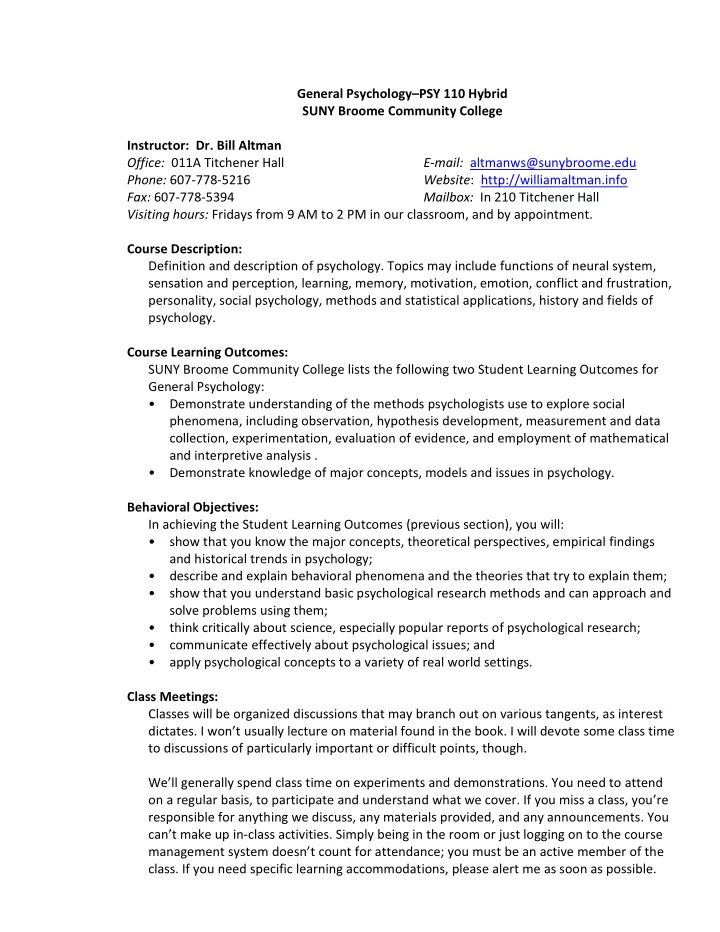
General Psychology–PSY 110 Hybrid SUNY Broome Community College Instructor: Dr. Bill Altman Office: 011A Titchener Hall E-mail: altmanws@sunybroome.edu Phone: 607-778-5216 Website: http://williamaltman.info Fax: 607-778-5394 Mailbox: In 210 Titchener Hall Visiting hours: Fridays from 9 AM to 2 PM in our classroom, and by appointment. Course Description: Definition and description of psychology. Topics may include functions of neural system, sensation and perception, learning, memory, motivation, emotion, conflict and frustration, personality, social psychology, methods and statistical applications, history and fields of psychology. Course Learning Outcomes: SUNY Broome Community College lists the following two Student Learning Outcomes for General Psychology:

  • Demonstrate understanding of the methods psychologists use to explore social

phenomena, including observation, hypothesis development, measurement and data collection, experimentation, evaluation of evidence, and employment of mathematical and interpretive analysis .

  • Demonstrate knowledge of major concepts, models and issues in psychology.

Behavioral Objectives: In achieving the Student Learning Outcomes (previous section), you will:

  • show that you know the major concepts, theoretical perspectives, empirical findings

and historical trends in psychology;

  • describe and explain behavioral phenomena and the theories that try to explain them;
  • show that you understand basic psychological research methods and can approach and

solve problems using them;

  • think critically about science, especially popular reports of psychological research;
  • communicate effectively about psychological issues; and
  • apply psychological concepts to a variety of real world settings.

Class Meetings: Classes will be organized discussions that may branch out on various tangents, as interest

  • dictates. I won’t usually lecture on material found in the book. I will devote some class time

to discussions of particularly important or difficult points, though. We’ll generally spend class time on experiments and demonstrations. You need to attend

  • n a regular basis, to participate and understand what we cover. If you miss a class, you’re

responsible for anything we discuss, any materials provided, and any announcements. You can’t make up in-class activities. Simply being in the room or just logging on to the course management system doesn’t count for attendance; you must be an active member of the

  • class. If you need specific learning accommodations, please alert me as soon as possible.
slide-2
SLIDE 2

Textbook and other readings: Our textbook is Psychological Science (6 edition) by Michael S. Gazzaniga, ISBN:

th

9780393671667, published by W. W. Norton & Company in 2018. I may recommend other readings during the course of the semester. Copies of the book are on reserve at the College Library. Read the assigned work for a chapter before that unit is discussed in class. Formal writing in this class will conform to the style set forth in the Publication Manual of the American Psychological Association. This is available for your use at the SUNY Broome Community College Writing Center. If you plan a career in psychology you may wish to purchase a copy, but this isn’t required. A shorter, less expensive but useful reference is the Pocket Guide to APA Style, by Robert Perrin. Classroom Etiquette: Please observe these rules, so everyone will have the best chance to participate and excel:

  • You may bring food or drinks to class, but don’t bring anything that will be

distracting, such as strong-smelling cheeses or foods that create a lot of noise.

  • Electronic communications devices (e.g., cell phones or tablets) must be turned
  • ff. The only exception is if you must monitor a child care or medical situation.

In such cases, please let me know at the beginning of class, set your phone to vibrate rather than ring, and sit near the door so that you can leave to receive your call without disturbing other students.

  • Video and audio recording of the class are not permitted without prior

permission from the instructor. SUNY Broome Community College is committed to creating a civil learning environment. Find more information at https://www.sunybroome.edu/c/document_library/get_file?uuid=32369ca4-996f-45ab-ae 14-b37fc7dc5d16&groupId=39972. Assignments: Examinations: There will be four unit exams, covering material from the textbook and class meetings, delivered through the online Course Management System (BlackBoard). All exams will be open-book and open-note tests. They’ll become available as we complete each unit, according to the class schedule, and will remain accessible for one week. You may take each exam up to 3 times, to improve your learning and your score. I’ll count your FINAL ATTEMPT as the grade for your test. I’ll only count the scores of your three best unit exams in your final grade (see below). If you need specific testing accommodations, please alert me as soon as possible. Research Assignments: This class incorporates experiments in psychophysiology (the interaction of the mind and body). You’ll design, carry out, and report on the results of one in-class experiment. This will take the form of two of group papers and a conference poster presentation based on your experiment. These are described in detail on the class website.

slide-3
SLIDE 3

In Class Writing Exercises (ICWE): At the beginning of each classroom meeting, you’ll respond to either a short quiz or a

  • quotation. This advance organizer helps center your thoughts on the topics of the day.

At the end of class you’ll write a short reaction to the day’s work. You may also use this as an opportunity to write any questions about the topic, or to comment on the class. This end-of-class ICWE helps to solidify your learning, helps me evaluate how well you’re getting the course material, and indicates how I might improve my teaching. Supplemental Instruction (SI) Participation: SI sessions are designed to help clarify course material, provide information and assistance with your assignments, and help you to develop the skills you need to succeed. They’re

  • ffered several times during the week, and you may attend as often as you wish.

Evaluation: Grades in this course are based on your accomplishments. There is no curve. Common expectations of collegiate level work will be applied to all evaluations. Final grades will be computed as follows: Three Unit Examinations (3 at 20 % each) 60% Thesis Statement and Hypothesis 5% Formal Research Proposal 10% Final Research Poster Presentation 20% In-Class Writing Exercises (ICWE) 5% Plagiarism, cheating, or any other violations of academic integrity will not be tolerated, and will be treated harshly. One of the most difficult topics for many students to understand is that of plagiarism. You can learn more about plagiarism and how to avoid it at https://owl.english.purdue.edu/owl/resource/589/01/. There’s quick quiz, so you can be sure that you understand the concepts involved. SUNY Broome Community College’s Academic Honesty Policy is at https://www.sunybroome.edu/c/document_library/get_file?p_l_id=142779&folderId=1429 06&name=DLFE-762.pdf If you have any questions about your progress in the course, your grade, course concepts,

  • r any other concerns, I’ll be happy to meet with you during visiting hours, or by
  • appointment. You can get more information about your rights as a student at

https://www.sunybroome.edu/student-academic-appeals-procedure

slide-4
SLIDE 4

Extra Credit: There are several ways in which you can earn extra credit toward your final grade:

  • write an analysis of a film with regard to specific psychological issues or concepts;
  • write a critique of an article from a current issue of a refereed psychology journal (get

the format on my website); or

  • other possibilities may be announced in class or via email.

You may do as many as three extra credit projects. If you choose to do more than one, you must pick at least two different kinds. Each extra credit project will raise your final course grade by 1 point on a scale of 100. Thus, if you do three projects, your final grade rises by 3

  • points. For example, if you do three projects, your final course grade might rise from 88 to

91, translating into a rise from B+ to A-. Extra credit is only available if you already have a passing grade in the course. If you are failing, no extra credit will be counted. Other Resources: Make the most of the college’s wide range of resources to enhance your understanding of the course material, time management abilities, study skills, and writing skills. For example, you may work with tutors at the Learning Assistance Center to improve your understanding of course concepts, or hone your test-taking skills. The staff at the Writing Center can help you formulate ideas for your papers, and may provide guidance for subsequent drafts. Meeting with them before you begin your projects can save you a lot of time and effort at later stages, and help you produce better papers. The Writing Tools and the Research Projects sections of my website provide examples of good and bad papers, tools to help organize your thoughts, and links to other resources. I invite you to see me during office hours for help with the course, writing, or other things. You may form your own study groups, to provide peer review and study support on a more frequent basis. A major advantage of such a group is that by having a set meeting time every week you encourage each other to complete your work in a timely fashion and to higher standards of quality. You may use the class mailing list to organize study groups. I’ve provided a private wiki (http://bccgeneralpsych.pbworks.com) with lots of information about the concepts in the course, including videos to illustrate particular points. SUNY Broome Community College is committed to learning environments that are inclusive of and accessible to students with disabilities. If you require reasonable academic accommodations or use of auxiliary aids in class, contact the Accessibility Resources Office at ARO@sunybroome.edu or call 607-778-5150. Please note that in order to receive accommodations in this course, you must present a valid Campus Accessibility Plan and discuss individual needs with the instructor in a timely manner.

slide-5
SLIDE 5

In-Class Research Projects Using the Biopac MP40 1. Constitute your research teams, and select a topic area for your research project. 2. Thesis Statement and Hypothesis Paper Articulate a research question and a specific hypothesis. You’ll need to find 10 sources in the research literature to complete this paper. 3. Formal Research Proposal Write a formal proposal for your research project. Combine your first paper with a design for an experiment to test your hypothesis. 4. Use the Biopac MP40 to test your hypothesis. 5. Analyze your results. (No worries, I’ll help with this part.) 6. Final Report: write up your research poster. (A group assignment.) Be sure to use APA style for all papers. Karen Pitcher at the Library and I have provided a template to make this easier. You’ll find it on my website. In addition, I have provided a set of poster templates on the Research Projects page of my website. You may find that getting an advance critique is a tremendous help in writing and editing your papers, and in the past students have found that it can make a big difference with regard to the grades their papers earn. I’d be happy to do that for you, so if you’d like me to critique your papers or posters before their respective due dates, please bring hardcopy to my visiting hours. Many students have reported that using the grading rubrics available on my website to grade their own papers before turning them in helped them to improve their papers and posters a

  • lot. This resulted in better papers, and of course, in higher grades. Based on their experience, I

recommend using this strategy. It’s important to hand in your work on time. Papers handed in after their due dates will lose 10 points per day (this INCLUDES weekend days). Papers over one week late will not be accepted and will earn zero (0) points. Nota bene: I reserve the right to modify this syllabus at any time. All changes will be announced in class or on the mailing list.