Psychology Research Capstone (Writing Emphasis) PSY 295 SUNY Broome - - PDF document

psychology research capstone writing emphasis psy 295
SMART_READER_LITE
LIVE PREVIEW

Psychology Research Capstone (Writing Emphasis) PSY 295 SUNY Broome - - PDF document

Psychology Research Capstone (Writing Emphasis) PSY 295 SUNY Broome Community College Instructor: Dr. Bill Altman Office: 011A Titchener Hall E-mail: altmanws@sunybroome.edu Phone: 607-778-5216 Website : http://williamaltman.info Fax:


slide-1
SLIDE 1

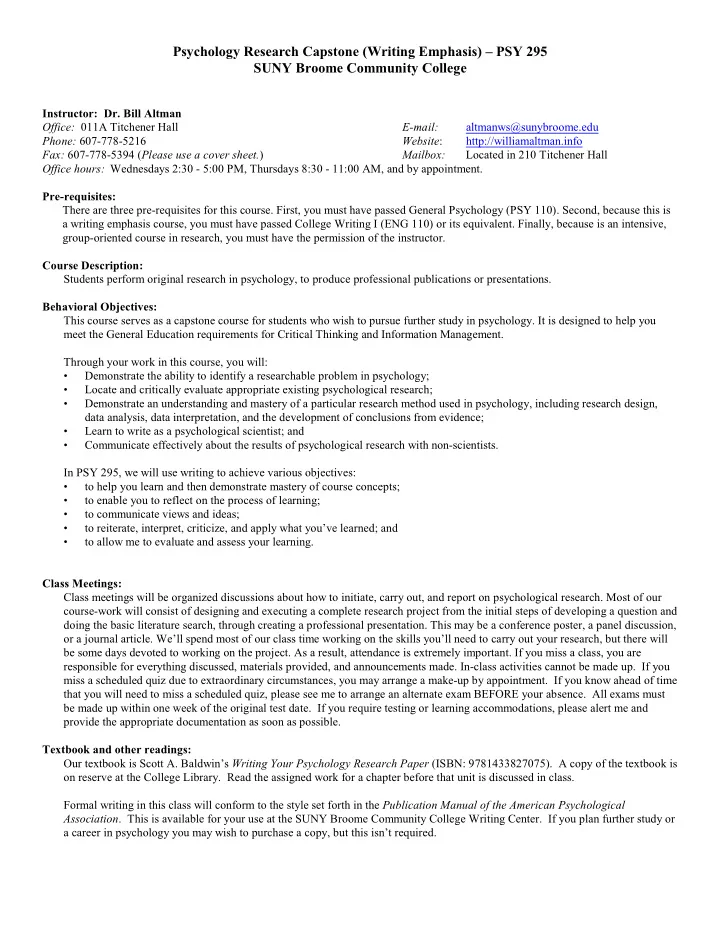
Psychology Research Capstone (Writing Emphasis) – PSY 295 SUNY Broome Community College

Instructor: Dr. Bill Altman Office: 011A Titchener Hall E-mail: altmanws@sunybroome.edu Phone: 607-778-5216 Website: http://williamaltman.info Fax: 607-778-5394 (Please use a cover sheet.) Mailbox: Located in 210 Titchener Hall Office hours: Wednesdays 2:30 - 5:00 PM, Thursdays 8:30 - 11:00 AM, and by appointment. Pre-requisites: There are three pre-requisites for this course. First, you must have passed General Psychology (PSY 110). Second, because this is a writing emphasis course, you must have passed College Writing I (ENG 110) or its equivalent. Finally, because is an intensive, group-oriented course in research, you must have the permission of the instructor. Course Description: Students perform original research in psychology, to produce professional publications or presentations. Behavioral Objectives: This course serves as a capstone course for students who wish to pursue further study in psychology. It is designed to help you meet the General Education requirements for Critical Thinking and Information Management. Through your work in this course, you will:

  • Demonstrate the ability to identify a researchable problem in psychology;
  • Locate and critically evaluate appropriate existing psychological research;
  • Demonstrate an understanding and mastery of a particular research method used in psychology, including research design,

data analysis, data interpretation, and the development of conclusions from evidence;

  • Learn to write as a psychological scientist; and
  • Communicate effectively about the results of psychological research with non-scientists.

In PSY 295, we will use writing to achieve various objectives:

  • to help you learn and then demonstrate mastery of course concepts;
  • to enable you to reflect on the process of learning;
  • to communicate views and ideas;
  • to reiterate, interpret, criticize, and apply what you’ve learned; and
  • to allow me to evaluate and assess your learning.

Class Meetings: Class meetings will be organized discussions about how to initiate, carry out, and report on psychological research. Most of our course-work will consist of designing and executing a complete research project from the initial steps of developing a question and doing the basic literature search, through creating a professional presentation. This may be a conference poster, a panel discussion,

  • r a journal article. We’ll spend most of our class time working on the skills you’ll need to carry out your research, but there will

be some days devoted to working on the project. As a result, attendance is extremely important. If you miss a class, you are responsible for everything discussed, materials provided, and announcements made. In-class activities cannot be made up. If you miss a scheduled quiz due to extraordinary circumstances, you may arrange a make-up by appointment. If you know ahead of time that you will need to miss a scheduled quiz, please see me to arrange an alternate exam BEFORE your absence. All exams must be made up within one week of the original test date. If you require testing or learning accommodations, please alert me and provide the appropriate documentation as soon as possible. Textbook and other readings: Our textbook is Scott A. Baldwin’s Writing Your Psychology Research Paper (ISBN: 9781433827075). A copy of the textbook is

  • n reserve at the College Library. Read the assigned work for a chapter before that unit is discussed in class.

Formal writing in this class will conform to the style set forth in the Publication Manual of the American Psychological

  • Association. This is available for your use at the SUNY Broome Community College Writing Center. If you plan further study or

a career in psychology you may wish to purchase a copy, but this isn’t required.

slide-2
SLIDE 2

Classroom Etiquette: Please observe the following, so everyone will have the best chance to participate and excel: 1. You are welcome to bring food or drinks to class, but please do not bring things that will cause distractions, such as strong-smelling cheeses or foods that create a lot of noise. 2. All electronic communications devices (e.g., cell phones) must be turned off. The only exception is when you must monitor a child or medical situation. In such cases, please let me know at the beginning of class, set your phone to vibrate rather than ring, and sit near the door so that you can leave to receive your call. 3. Video and audio recording of the class are not permitted. SUNY Broome Community College is committed to creating a civil learning environment. Find more information at

https://www.sunybroome.edu/c/document_library/get_file?uuid=32369ca4-996f-45ab-ae14-b37fc7dc5d16&groupId=39972.

Assignments: The Research Project This class is based on the completion of a psychological research project. You’ll design, carry out, and report on the results

  • f an experiment, observational research project, or correlational research project. Most of the formal writing for the course

will be a series of individual and group papers based on your project. I expect that this work will go through several drafts before achieving final form. More detailed information, including sample papers, is available on the class website. All projects will be submitted to appropriate journals for publication or conferences for presentation, by the end of the semester. Quizzes There will be four unit quizzes. These will cover material from the textbook and class discussions. Journal Article Critiques One way to learn a great deal about scientific writing is to read and critique published material. You are responsible for three article critiques during the semester. I’ll provide a format and guidance for these. In order to practice good scientific writing, I suggest that you turn these in for evaluation well before their final due dates. If you do, you’ll be able to rewrite them as often as needed before their final due dates. Building a professional online presence Each student will create a free Linkedin profile (or modify an existing profile), to establish a professional identity in the

  • nline community.

Required Optional Assignments You are required to choose and complete one of the following assignments. Any choice is acceptable, and I’ll provide appropriate guidance and assistance for whichever you choose.

  • Create and run an in-class presentation or activity based on an assigned reading;
  • Give a presentation based on historical research following the work on a particular theory or method;
  • Engage in an Association for Psychological Science Wikipedia Initiative Project; or
  • Create and post a YouTube video illustrating one of the basic concepts covered in class.

In Class Writing Exercises (ICWE) At the beginning of each class you will either take a short quiz or write a short response to a quotation or other information I

  • present. This advance organizer helps center your thoughts on the topics of the day. At the end of each class you’ll write a

short reaction to the day’s work. You can also use this as an opportunity to write directly to me with any questions about the topic, or to comment on the class. The ICWE at the end of class helps you to solidify your learning, gives me an opportunity to evaluate how well you’re getting the course material, and indicates how I might improve my teaching on particular topics to help students better understand them. Evaluation: Grades in this course are based on your accomplishments. There is no curve. Common expectations of collegiate level work will be applied to all evaluations. Final grades will be computed as follows: Group Research Project 40% Quizzes 20% (4 at 5% each) Journal Article Critiques 15% (3 at 5% each) Required Optional Assignment 15% Building Your Linkedin Profile 5% In-Class Writing Exercises (ICWE) 5% (Average of daily exercises)

slide-3
SLIDE 3

If you have any questions about your progress in the course, your grade, particular concepts, or any other concerns, I’ll be happy to meet with you during office hours, or by appointment. Plagiarism, cheating, or other violations of academic integrity will not be tolerated, and will be treated harshly. One of the most difficult topics for many students to understand is that of plagiarism. You can learn more about plagiarism and how to avoid it at https://owl.english.purdue.edu/owl/resource/589/01/. They even provide a quick quiz, so you can be sure you understand the concepts involved. You’ll find the SUNY Broome Community College Academic Honesty Policy at https://www.sunybroome.edu/c/document_library/get_file?p_l_id=142779&folderId=142906&name=DLFE-762.pdf You can get more information about your rights as a student at

http://www.sunybroome.edu/c/document_library/get_file?uuid=c6d24d1a-3cf0-4e3f-a891-ed0a4d7c2ab9&groupId=39972.

Extra Credit: There are several ways in which you can earn extra credit toward your final grade in this course:

  • write an analysis of a film with regard to specific psychological issues or concepts, and supporting references;
  • write an extra critique of an article from a current issue of a refereed psychology journal; or
  • ther possibilities may be announced in class or via email, so be sure to watch your email for special opportunities.

You may do as many as three extra credit projects. If you choose to do more than one, you must choose at least two different kinds of projects. Each project will raise your final course grade by 1 point on a scale of 100. Thus, if you do three projects, your final grade rises by 3 points. For example, if you do three projects, your final course grade might rise from 88 to 91, translating into a rise in the final course grade from B+ to A-. Extra credit is only available if you already have a passing grade in the course. If you are failing, no extra credit will count. Other Resources: I encourage you to make the most of the college’s wide range of resources to enhance your understanding of the course material, time management abilities, study skills, and writing skills. For example, you may work with tutors (some of whom have worked closely with me, and know how to succeed) at the Learning Assistance Center to improve your understanding of course concepts,

  • r hone your test-taking skills.

I highly recommend consulting with the staff at the Writing Center. These professionals can help you formulate ideas for your papers, and may provide guidance for subsequent drafts. Meeting with them as you start your projects (before you begin writing) can save you a lot of time and effort at later stages, and help you produce better papers in the end. Check out the Writing Tools and the Research Projects sections of my website. You’ll find examples of good and bad papers, tools to help you organize your thoughts, and links to other helpful resources. I invite you to see me during office hours for help with course work, writing, or other concerns. You may form your own study groups, to provide peer review and study support on a more frequent basis. A major advantage of such a group is that by having a set meeting time every week you encourage each other to complete your work in a timely fashion and to higher standards of quality. You may use the class mailing list to organize study groups. SUNY Broome Community College is committed to learning environments that are inclusive of and accessible to students with

  • disabilities. Any student who requires reasonable academic accommodations or use of auxiliary aids in class should contact the

Accessibility Resources Office at ARO@sunybroome.edu or call 607-778-5150. Please note that in order to receive accommodations in this course, a student must present a valid Campus Accessibility Plan and discuss individual needs with me in a timely manner. Nota bene: I reserve the right to modify this syllabus at any time. All changes will be announced in class or via the course mailing list.