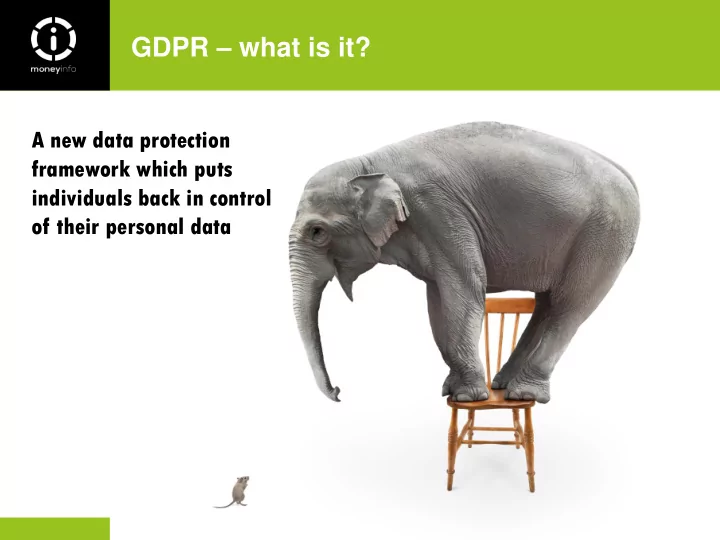
SLIDE 1 GDPR – what is it?
A new data protection framework which puts individuals back in control
SLIDE 2
- 1. Awareness
- 2. Document the personal data you hold
- 3. Communicating privacy information
- 4. Individuals rights
- 5. Subject access requests
- 6. Lawful process for processing personal data
- 7. Consent
- 8. Children
- 9. Data breaches
- 10. Data protection by design and default
- 11. Data Protection Officer
- 12. International
Watch the video here… www.moneyinfo.com/Videos/GDPR12Steps
ICO 12 steps to GDPR compliance
SLIDE 3
Make sure key people in your organisation are aware that the law is changing. Get a team together involving compliance, HR and key decision makers and look at what needs to be done for May 2018.
Step 1: Awareness
SLIDE 4
- What information do you hold?
- What is it’s purpose?
- Where is it stored?
- Where is it shared?
Step 2: Document the personal data you hold
SLIDE 5 Owner Who is responsible for this information asset? Name A way to identify the information asset. Description A description of what the information asset is and what It records. Specifically note if your information asset contains personal or sensitive information. Format e.g. SQL Database, Excel Spreadsheet Purpose Why do you hold this information and what it is used for. Location Where is the information stored? Security How is the information secured? E.g. password protected, encryption etc. Users Who has access to this information asset? Retention Period How long is the data kept for and why? Risks/Impacts What would be the impact of losing the information asset? Consider loss of confidentiality i.e. a data breach, loss of availability and loss of integrity. What would be the cost of replacing the information? External Sharing Is this information shared externally with any third parties? Legal basis What is your basis for processing this information? e.g. consent, legitimate interest
Information Asset Register
SLIDE 6
“a concise, transparent, intelligible and easily accessible form, using clear and plain language…”
ARTICLE 12
Step 3: Communicating privacy information
SLIDE 7
- the right to be informed
- the right of access
- the right to be forgotten
- the right to restrict processing
- the right to data portability
- the right to object
- The right not to be subject to
automated decision-making including profiling
Step 4: Individuals’ rights
SLIDE 8
“Where possible, the controller should be able to provide remote access to a secure system which would provide the data subject with direct access to his or her personal data.” RECITAL 63
Step 5: Subject access requests
SLIDE 9
- consent
- necessary for the performance of a contract
- compliance with a legal obligation
- to protect the vital interest of a data subject
- for tasks in the public interest
- legitimate interests
DETERMINE WHAT IT IS AND DOCUMENT IT
Step 6: Lawful basis for processing personal data
SLIDE 10 Step 7: Consent
When capturing consent “…include:
- the name of your organisation;
- the name of any third party controllers who will rely on
the consent;
- why you want the data;
- what you will do with it; and
- that individuals can withdraw consent at any time.”
INFORMATION COMMISSIONERS OFFICE
SLIDE 11
Gain consent from someone with parental responsibility Apply consent rules when capturing and recording consent
Step 8: Children
SLIDE 12
- lost?
- destroyed?
- corrupted?
- disclosed?
Step 9: Data breaches
SLIDE 13
RECOGNISE INVESTIGATE NOTIFY MITIGATE
Step 9: Data breaches
SLIDE 14
“In order to be able to demonstrate compliance with this regulation, the controller should adopt internal policies and implement measures which meet in particular the principles of data protection by design and data protection by default.” RECITAL 78
Step 10: Data Protection by Design and Data Protection Impact Assessments
SLIDE 15
“… description of the envisaged processing operations… …assessment of the necessity… … assessment of the risks to the rights and freedoms of subjects… …measures envisaged to address the risks…” ARTICLE 35
Step 10: Data Protection by Design and Data Protection Impact Assessments
SLIDE 16 You need to appoint someone in your
- rganisation, or an external adviser,
who has the knowledge, support and authority to take responsibility for your data protection compliance.
Step 11: Data Protection Officer
SLIDE 17 Determine your lead supervisory authority
.
Step 12: International
SLIDE 18
The do’s and don’ts for keeping data safe
SLIDE 19 Data Access Data Quality Data Privacy by Design Secure communications Subject Access Requests Data Portability
.
How can technology help?
SLIDE 20 .
How can technology help?
SLIDE 21 .
How can technology help?
SLIDE 22 .
How can technology help?
SLIDE 23 .
How can technology help?
SLIDE 24 .
How can technology help?
SLIDE 25 .
How can technology help?
SLIDE 26 .
How can technology help?
SLIDE 27 .
How can technology help?
SLIDE 28 . @moneyinfotech www.moneyinfo.com
How can technology help?