GCMRC Science Updates Part 3 Michael Moran Grand Canyon Monitoring - - PowerPoint PPT Presentation

gcmrc science updates part 3
SMART_READER_LITE
LIVE PREVIEW

GCMRC Science Updates Part 3 Michael Moran Grand Canyon Monitoring - - PowerPoint PPT Presentation

GCMRC Science Updates Part 3 Michael Moran Grand Canyon Monitoring and Research Center Southwest Biological Science Center Adaptive Management Working Group Meeting February 13, 2020 U.S. Department of the Interior U.S. Geological Survey


slide-1
SLIDE 1

U.S. Department of the Interior U.S. Geological Survey

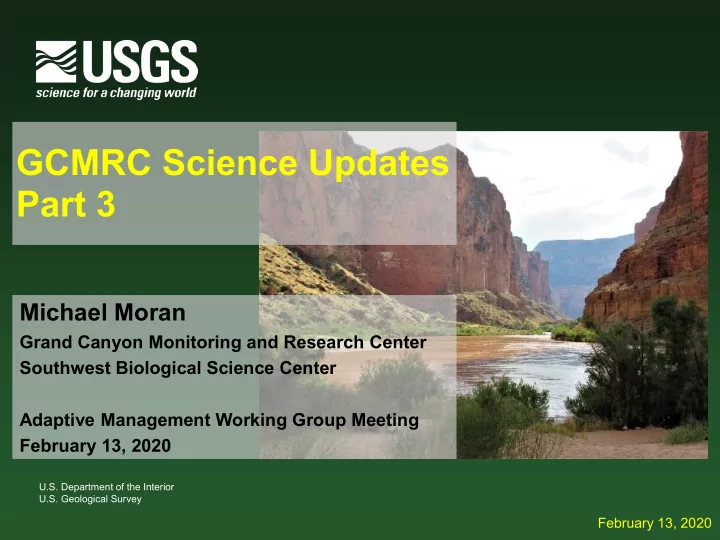
GCMRC Science Updates Part 3

Michael Moran

Grand Canyon Monitoring and Research Center Southwest Biological Science Center Adaptive Management Working Group Meeting February 13, 2020

February 13, 2020

slide-2
SLIDE 2

February 13, 2020

Outline

  • Part 1
  • Humpback Chub
  • Native and Nonnative Fishes
  • Bug Flows
  • Part 2
  • Nutrients and Temperature as Ecosystem Drivers and Lake Powell
  • Riparian Vegetation
  • Warm-Water Invasive Fishes
  • Trout
  • Part 3
  • Sediment
  • Archaeological Site Monitoring
  • Socioeconomics and Hydropower
slide-3
SLIDE 3

Project A – Streamflow, Sediment Transport, and Water Quality

PI – David Topping

  • GCMRC scientists and their

cooperators monitor changes in suspended sediment and in the amount of sand stored

  • n the bed of the river

February 13, 2020 Paria River gage at Lees Ferry, USGS

slide-4
SLIDE 4

Sediment Inputs – Fall 2019

Paria River Input

https://www.gcmrc.gov/discharge_qw_sediment/station/GCDAMP/09382000

July 1 through November 1, 2019

February 13, 2020

Preliminary data, do not cite Take Away: Only ~ 6,000 metric tons of sediment in fall accounting period

slide-5
SLIDE 5

Was There Enough Fine Sand for HFE?

Zero bias value July 1 – November 1, 2019 (metric tons)

  • 170,000

Upper Marble Canyon

February 13, 2020

  • 130,000

Lower Marble Canyon

Take Away: Not enough sand for fall HFE

www.gcmrc.gov/discharge_qw_sediment/reaches/GCDAMP

Preliminary data, do not cite

slide-6
SLIDE 6

Sediment Inputs – Spring 2020

Paria River Input

December 1 through February 12, 2020

February 13, 2020

Take Away: Only ~ 22,000 metric tons of sediment in spring accounting period

www.gcmrc.gov/discharge_qw_sediment/station/GCDAMP/09382000

Preliminary data, do not cite

slide-7
SLIDE 7

Is There Enough Fine Sand for HFE?

Zero bias value December 1, 2019 – January 7, 2020 (metric tons)

  • 32,000

Upper Marble Canyon 15,000 Lower Marble Canyon

https://www.gcmrc.gov/discharge_qw_sediment/reaches/GCDAMP

February 13, 2020

Take Away: Currently not enough sand for Spring HFE Preliminary data, do not cite

slide-8
SLIDE 8

Monthly Median and Maximum Sand Supply of the Paria River and Little Colorado River

February 13, 2020

Preliminary data, do not cite

slide-9
SLIDE 9

Long-Term Sand Management

February 13, 2020

  • Tributary sand supply is very

episodic

  • Long periods between sand

inputs when winnowing can

  • ccur

Take Away: Sand inputs are episodic and erosion

  • ccurs between events

Preliminary data, do not cite

slide-10
SLIDE 10

Sediment Monitoring Conclusions

February 13, 2020

  • Not enough sand for Fall 2019 HFE;

currently not enough sand for Spring HFE

  • Spring HFEs may rarely occur because

almost all large Paria floods happen from August through October

  • Multi-year sand accumulation is only

possible during years of above-average tributary sand supply and below- average dam releases

slide-11
SLIDE 11

Project B – Sandbar and Sediment Storage

PI – Paul Grams

  • GCMRC scientists and their

cooperators monitor changes in sandbars and changes in the amount of sand available for camping and other recreation

February 13, 2020

slide-12
SLIDE 12

Long-Term Sandbar Monitoring

Project Element B.1

February 13, 2020

  • Long-term, most bar types and in

both Marble and Grand Canyon show a slight upward trend in volume

  • Short-term increases in sandbar

volume are usually off-set by erosion that occurred between HFEs

Preliminary results, do not cite

slide-13
SLIDE 13

Campsite Areas in Marble and Grand Canyon

February 13, 2020

  • Campsite areas have

decreased since 1998 but HFEs help to stem the loss

  • Decreases in campsite area

are primarily due to vegetation expansion

Preliminary results, do not cite

slide-14
SLIDE 14

Channel Mapping of Sand

Project Element B.2

May 2016 May 2013 Difference

Blue = deposition Red = erosion

  • =

February 13, 2020

Preliminary data, do not cite

slide-15
SLIDE 15

Completed Channel Mapping

Segment Completed Maps Glen Canyon 2014 Upper Marble Canyon 2013, 2016 Lower Marble Canyon 2009, 2013, 2019 Eastern Grand Canyon 2011, 2014, 2019 East Central Grand Canyon * West Central Grand Canyon 2017 Western Grand Canyon *

Western Grand Canyon segment not yet

  • mapped. Proposed for next workplan.

East-Central Grand Canyon to be mapped in 2021

February 13, 2020

slide-16
SLIDE 16

Channel Mapping Results: Upper Marble Canyon, 2013-2016

50-km reach (0-50 km downstream from Paria River)

February 13, 2020

Upper Marble Canyon, 2013-2016

  • Includes 2 controlled floods
  • No summer high-volume flows

Take Away: More sand has been deposited than eroded from this reach during this time period

slide-17
SLIDE 17

Channel Mapping Results: Lower Marble Canyon, 2009-2013

50-km reach (50-100 km downstream from Paria River)

February 13, 2020

Lower Marble Canyon, 2009-2013

  • No controlled floods
  • Includes 2011 equalization flows

Take Away: More sand has been eroded than deposited from this reach during this time period

slide-18
SLIDE 18

Channel Mapping Results: Eastern Grand Canyon, 2011-2014

40-km reach (100-140 km downstream from Paria River)

February 13, 2020

Eastern Grand Canyon, 2011-2014

  • Includes 2 controlled floods
  • Includes 2011 equalization flows

Take Away: More sand has been eroded than deposited from this reach during this time period

slide-19
SLIDE 19

Sandbar Monitoring Conclusions

February 13, 2020

  • Most sandbar volumes have been

increasing through time

  • Use of controlled floods for rebuilding

sandbars may be sustainable if done when sufficient sand is available

  • Periods with high summer release

volumes will cause evacuation; periods with normal summer release volumes and strong tributary inputs result in accumulation

slide-20
SLIDE 20

Project D – Geomorphic Effects of Dam Operations and Vegetation Management for Archaeological Sites

February 13, 2020

LTEMP Resource and Goal

  • Archaeological and Cultural Resources
  • Maintain the integrity of potentially affected NRHP-eligible
  • r listed historic properties in place, where possible, with

preservation methods employed on a site-specific basis

Joel B. Sankey, US Geological Survey, SBSC, GCMRC, Flagstaff, AZ Joshua Caster, US Geological Survey, SBSC, GCMRC, Flagstaff, AZ Helen Fairley, US Geological Survey, SBSC, GCMRC, Flagstaff, AZ Jen Dierker, National Park Service, Grand Canyon, AZ Mike Kearsley, National Park Service, Grand Canyon, AZ
slide-21
SLIDE 21

Geomorphic Effects of Dam Operations and Vegetation Management for Archaeological Sites

February 13, 2020

  • The geomorphic condition of archaeological sites is affected

by how Colorado River sand is transferred among landforms in Grand Canyon

  • Many archaeological sites are degraded by gully erosion, but

river sand can provide a protective cover to preserve sites in place and thus help achieve the LTEMP goal for Archaeological and Cultural Resources

  • GCMRC quantitatively monitors the geomorphic condition of

archaeological sites relative to LTEMP flow (e.g., Fall HFEs) and non-flow actions (e.g., Vegetation Management)

Caster and others, in press: New report summarizes monitoring completed through 2018 at 23 sites using the GCMRC protocol

slide-22
SLIDE 22

Vegetation removal experiments

  • In April, 2019 the NPS implemented

experimental vegetation removal treatments on several sandbars in Grand Canyon to increase campsite area and to increase the supply of HFE sediment via aeolian processes to dunefields that host archaeological sites

  • GCMRC is monitoring the outcome
  • f the vegetation treatments relative

to future HFEs

February 13, 2020

slide-23
SLIDE 23

Vegetation removal experiments (2)

February 13, 2020

5 areas selected based on:

  • NPS management

priorities

  • Existing GCMRC

monitoring ⁻ Sandbars ⁻ Campsites ⁻

  • Arch. Sites

⁻ Riparian Vegetation

  • Observed changes in

geomorphic condition using established GCMRC protocols (e.g., lidar)

slide-24
SLIDE 24

Vegetation removal experiments (3)

February 13, 2020

slide-25
SLIDE 25

Implications and Future Work

February 13, 2020

  • In April, 2020 the NPS will revisit the sites and conduct maintenance and additional

experimental vegetation removal treatments to increase aeolian sediment supply to several dunefields that host archaeological sites

  • GCMRC will monitor the outcome of the treatments relative to future HFEs in ongoing

monitoring of the geomorphic condition of archaeological sites

slide-26
SLIDE 26

Project J – Socioeconomic Research

PI – Lucas Bair

  • GCMRC scientists identify

preferences and economic values of resources in the Colorado River Ecosystem

February 13, 2020

slide-27
SLIDE 27

Tribal Perspectives and Values of Resources Downstream of Glen Canyon Dam

February 13, 2020

Project Element J.1

  • Collaborative effort with Navajo Nation to recognize Navajo values for

downstream resources and support the prioritization of management goals

  • The majority of survey respondents

value resources in Glen and Grand Canyons and support implementation

  • f flow experiments to improve

downstream resources

slide-28
SLIDE 28

Project N – Hydropower Research

PI – Lucas Bair LTEMP EIS Hydropower Resource Goal

  • Maintain or increase Glen Canyon

Dam electric energy generation, load following capability, and ramp rate capability, and minimize emissions and costs to the greatest extent practicable, consistent with improvement and long-term sustainability of downstream resources.

February 13, 2020

slide-29
SLIDE 29

February 13, 2020

Project N Objective

Project N will identify, coordinate, and collaborate with external partners on monitoring and research opportunities associated with operational experiments at GCD designed to meet hydropower and energy resource objectives, as stated in the LTEMP ROD.

slide-30
SLIDE 30

February 13, 2020

Project N Hypothesis

  • Changes in the energy sector led us to the hypothesis that

using Glen Canyon Dam as baseload generation will reduce total economic costs associated with electricity generation in the Western Interconnect when considering generation mix and fuel and emissions costs.

  • Our implicit hypothesis is that Glen Canyon Dam baseload

generation would be ‘consistent with improvement and long-term sustainability of downstream resources.’

slide-31
SLIDE 31

February 13, 2020

Change in Operations and Emissions Costs with Flat Flows at Glen Canyon Dam (dollars in thousands)

  • In the ‘business as usual’

scenario, the increase in

  • perations costs are more

than offset by the decrease in emissions costs

  • In the other scenarios,

total operations and emissions costs increase

slide-32
SLIDE 32

February 13, 2020

Project N Conclusion

  • Structural changes in the electricity sector are altering the

role of hydropower and how costs associated with experimental flows might accrue.

  • Total economic costs of our proxy experimental flow are

significantly different when emissions costs are included.

  • Decisions we make today in electricity sector expansion

will impact the role hydropower plays in the sector and costs associated with environmental and adaptive management of rivers.

slide-33
SLIDE 33

Questions