Gauged SDFT and stable de Sitter in d = 7 Jose J. Fern - - PowerPoint PPT Presentation

gauged sdft and stable de sitter in d 7
SMART_READER_LITE
LIVE PREVIEW

Gauged SDFT and stable de Sitter in d = 7 Jose J. Fern - - PowerPoint PPT Presentation

Gauged SDFT and stable de Sitter in d = 7 Jose J. Fern andez-Melgarejo Harvard University Based on 1505.01301: W. Cho, J.J. FM, I. Jeon, J.-H. Park (JHEP 2015) 1506.01294: G. Dibitetto, J.J. FM, D. Marqu es (sub. JHEP 2015) Duality


slide-1
SLIDE 1

Gauged SDFT and stable de Sitter in d = 7

Jose J. Fern´ andez-Melgarejo

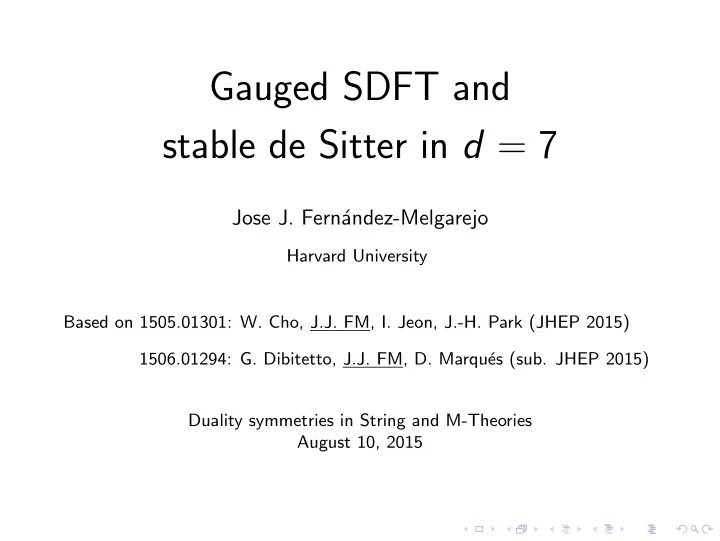
Harvard University Based on 1505.01301: W. Cho, J.J. FM, I. Jeon, J.-H. Park (JHEP 2015) 1506.01294: G. Dibitetto, J.J. FM, D. Marqu´ es (sub. JHEP 2015) Duality symmetries in String and M-Theories August 10, 2015

slide-2
SLIDE 2

Our goals

Goal 1: DFT from relaxed (SC) gauge principle. Uniqueness

  • f the action upon what symmetries?

Cho,FM,Jeon,Park’15

Generalised diffeomorphisms Double Lorentz transformations O(D,D) ... SUSY?

Goal 2: Half-maximal d = 7: natural continuation of previous results

Dibitetto,FM,Marqu´ es’15

Classification of deformations Vacua Mass spectrum

slide-3
SLIDE 3

Outline

1 Twisted supersymmetric DFT (SDFT)

[Cho,Jeon,FM,Park] Relaxation approaches Untwisted SDFT Twisting

2 Stable de Sitter in half-maximal d = 7 [Dibitetto,FM,Marqu´

es]

3 Conclusions

slide-4
SLIDE 4

Outline

1 Twisted supersymmetric DFT (SDFT)

[Cho,Jeon,FM,Park] Relaxation approaches Untwisted SDFT Twisting

2 Stable de Sitter in half-maximal d = 7 [Dibitetto,FM,Marqu´

es]

3 Conclusions

slide-5
SLIDE 5

Geometric formulation

Jeon...’11, Hohm...’11, Hohm...’12

SDFT(HAB, d) as a curvature: SABCD Non-vanishing scalar curvatures SABCD

  • HACHBD

, J ACJ BD Upon SC: SABCDJ ACJ BD = −SABCDHACHBD [DFT + SC] lacks some O(d, d) gaugings

  • Aldazabal. . . ’11,Geissb¨

uhler’11

Relaxation of the SC?

slide-6
SLIDE 6

Relaxation of the SC

  • Aldazabal. . . ’11, Geissb¨

uhler’11, Gra˜

  • na. . . ’12, Geissb¨
  • uhler. . . ’13, Berman. . . ’13

Lower-dim SC stronger than quadratic constraints in half-maximal SUGRA SDFT+SC-terms GABCD = [S + ∆]ABCD Geometric approaches ∆ = ∆(EAM)

Weitzenb¨

  • ck connection

Generalised flux formulation GABCD(αHACHBD + βJ ACJ BD) such that half-max SUGRA

DFT action fixed by first principles?

slide-7
SLIDE 7

Supersymmetric theories

N = 1 SDFT

Siegel’93, Hohm. . . ’12, Jeon. . . ’12, Berman. . . ’13

  • d ,

VAp , ¯ VA¯

p ,

ρα , ψα

¯ p

  • N = 2 SDFT
  • Jeon. . . ’12
  • d ,

VAp , ¯ VA¯

p ,

Cα ¯

α ,

ρα , ρ′ ¯

α ,

ψα

¯ p ,

ψ′

p ¯ α

  • Symmetries:

O(10,10) Generalised diffeo’s Spin(1,9)×Spin(9,1) SUSY

slide-8
SLIDE 8

SDFT - {V , ¯ V }

Double vielbein formalism

Siegel, Hohm. . . , Jeon. . .

VApV Aq = ηpq , ¯ VA¯

p ¯

V A¯

q = ¯

η¯

p¯ q ,

VAp ¯ V A¯

q = 0 ,

VApVBp + ¯ VA¯

p ¯

VB ¯

p = JAB .

Projectors PAB = VApVBp ¯ PAB = ¯ VA¯

p ¯

VB¯

p

D = ∂ + Γ + Φ + ¯ Φ D

  • VAp ,

¯ VA¯

p ,

d , JAB

  • = 0

Connections

ΓCAB(V , ¯ V , d) Christoffel ΦApq(V , ¯ V , d) Spin(1,9) ¯ ΦA¯

p¯ q(V , ¯

V , d) Spin(9,1)

slide-9
SLIDE 9

SDFT - {V , ¯ V }

Field strengths

SABCD = 1

2

  • RABCD + RCDAB − ΓE

ABΓECD

  • FABCD = 2∇[AΦB]CD − 2Φ[A|C

EΦ|B]ED

¯ FABCD = 2∇[A ¯ ΦB]CD − 2¯ Φ[A|C

E ¯

Φ|B]ED GABCD = 1

2

  • (F + ¯

F)ABCD + (F + ¯ F)CDAB + (Φ + ¯ Φ)E

AB(Φ + ¯

Φ)ECD

  • = SABCD + 1

2(VA p∂EVBp + ¯

VA

¯ p∂E ¯

VB¯

p)(VC q∂EVDq + ¯

VC

¯ q∂E ¯

VD¯

q)

(δX − LX)GABCD ∼ (δX − LX)SABCD ∼ 0 Non-vanishing Ricci Gpr¯

qr

Gp¯

r¯ q¯ r

Non-vanishing scalar curvatures Gpqpq G¯

p¯ q¯ p¯ q

slide-10
SLIDE 10

SDFT - RR sector

O(10,10) scalar bispinor Cα ¯

β

− → F := D+C ¯ F := ¯ C −1

+ (F)TC+

where D±T := γpDpT ± γ(11)D¯

pT ¯

γ¯

p

Gauge invariance upon nilpotency of D+ δC = D+Λ − → δF = (D+)2Λ ∼ 0 Nilpotency upon strong constraint (D±)2T ∼ 0

slide-11
SLIDE 11

Twisting

Twisted fields TA1···An(X, Y ) = e−2ωλ(Y )UA1

˙ A1(Y ) · · · UAn ˙ An(Y ) ˙

T ˙

A1··· ˙ An(X)

Twisting derivatives ∂CTA1···An = e−2ωλUC

˙ CUA1 ˙ A1 · · · UAn ˙ An ˙

D ˙

C ˙

T ˙

A1··· ˙ An

where

˙ D ˙

C ˙

T ˙

A1··· ˙ An := ˙

∂ ˙

C ˙

T ˙

A1··· ˙ An − 2ω ˙

∂ ˙

Cλ ˙

T ˙

A1··· ˙ An + n

  • i=1

Ω ˙

C ˙ Ai ˙ B ˙

T ˙

A1··· ˙ B··· ˙ An

˙ ∂ ˙

C : = (U−1) ˙ C C∂C

Ω ˙

C ˙ A ˙ B : =

  • U−1 ˙

∂ ˙

CU

  • ˙

A ˙ B

We define f ˙

A ˙ B ˙ C := 3Ω[ ˙ A ˙ B ˙ C]

f ˙

A := Ω ˙ B ˙ B ˙ A − 2 ˙

∂ ˙

slide-12
SLIDE 12

Consistency/twistability conditions

Twisted ˙ L ˙

X

˙ L ˙

X ˙

T ˙

A1··· ˙ An = e2ωλ(U−1) ˙ A1 A1 · · · (U−1) ˙ An An LXTA1···An

= ˙ X

˙ B ˙

D ˙

B ˙

T ˙

A1··· ˙ An + ω ˙

D ˙

B ˙

X

˙ B ˙

T ˙

A1··· ˙ An

+

n

  • i=1

( ˙ D ˙

Ai ˙

X ˙

B − ˙

D ˙

B ˙

X ˙

Ai) ˙

T ˙

A1··· ˙ Ai−1 ˙ B ˙ Ai+1··· ˙ An

Twisted C-bracket

[ ˙ X, ˙ Y ]

˙ A ˙ C = (U−1) ˙ A A[X, Y ]A C

= ˙ X

˙ B ˙

D ˙

B ˙

Y

˙ A − ˙

Y

˙ B ˙

D ˙

B ˙

X

˙ A + 1 2 ˙

Y

˙ B ˙

D

˙ A ˙

X ˙

B − 1 2 ˙

X

˙ B ˙

D

˙ A ˙

Y ˙

B

Closure of the algebra

  • [ ˙

L ˙

X, ˙

L ˙

Y ] − ˙

L[ ˙

X, ˙ Y ] ˙

C

  • ˙

T ˙

A1··· ˙ An = 0

slide-13
SLIDE 13

Closure conditions

Gra˜ na-Marqu´ es’12

SC for all the dotted twisted fields, ˙ ∂ ˙

M ˙

˙ M ≡ 0

Orthogonality between connection and derivatives Ω

˙ M ˙ F ˙ G ˙

∂ ˙

M ≡ 0

Constancy of f ˙

A ˙ B ˙ C

˙ ∂ ˙

Ef ˙ A ˙ B ˙ C ≡ 0

Jacobi identities f[ ˙

A ˙ B ˙ Ef ˙ C] ˙ D ˙ E ≡ 0

Triviality of f ˙

A

f ˙

A = Ω ˙ C ˙ C ˙ A − 2 ˙

∂ ˙

Aλ = ∂CUC ˙ A − 2 ˙

∂ ˙

Aλ ≡ 0

slide-14
SLIDE 14

Twisted connections and field strengths

Connections (∂ → D )

  • Γ, Φ, ¯

Φ

  • ˙

Γ, ˙ Φ, ˙ ¯ Φ

  • (Semi-)covariant generalised curvature

(δ ˙

X − ˆ

L ˙

X) ˙

G ˙

A ˙ B ˙ C ˙ D ≡ ˙

D[ ˙

A( ˙

P + ˙ ¯ P) ˙

B] ˙ C ˙ D + ˙

D[ ˙

C( ˙

P + ˙ ¯ P) ˙

D] ˙ A ˙ B

Natural curvature GABCD

1 2[ ˙

Dp, ˙ D¯

q]T p ≡ ˙

Gpr¯

qrT p 1 2[ ˙

Dp, ˙ D¯

q]T ¯ q ≡ − ˙

Gp¯

r¯ q¯ rT ¯ q

slide-15
SLIDE 15

N = 1 twisted SDFT

N = 1 ˙ LHalf−maximal

Twisted SDFT = e−2 ˙

d 1 4 ˙

Gpqpq + i 1

2 ¯

ργp ˙ Dpρ − i ¯ ψ¯

p ˙

pρ − i 1 2 ¯

ψ¯

pγq ˙

Dqψ¯

p

  • Twisted transformations for fermions

δερ = −γp ˙ Dpε , δεψ¯

p = ˙

pε .

f ˙

A ˙ B ˙ Cf ˙ A ˙ B ˙ C breaks Z2 symmetry

˙ Gpqpq + ˙ G¯

p¯ q¯ p¯ q = 1 6f ˙ A ˙ B ˙ Cf ˙ A ˙ B ˙ C

where

Aldazabal...’11, Dibitetto...’12

f ˙

A ˙ B ˙ Cf ˙ A ˙ B ˙ C = −3∂DUA ˙ A∂D

U−1

˙ A A − 24 ∂Dλ ∂Dλ

slide-16
SLIDE 16

N = 2 twisted SDFT

N = 2 ˙ LMaximal

Twisted SDFT = e−2 ˙

d 1 8( ˙

Gpqpq − ˙ G¯

p¯ q¯ p¯ q) + 1 2Tr( ˙

F ¯ ˙ F) + i 1

2 ¯

ργp ˙ Dpρ − i 1

2 ¯

ρ′¯ γ¯

p ˙

pρ′

− i 1

2 ¯

ψ¯

pγq ˙

Dqψ¯

p + i 1 2 ¯

ψ′p¯ γ¯

q ˙

qψ′ p

−i ¯ ρ ˙ Fρ′ + i ¯ ψ¯

pγq ˙

F¯ γ¯

pψ′q − i ¯

ψ¯

p ˙

pρ + i ¯

ψ′p ˙ Dpρ′ Twisted SUSY transformations for fermions δερ = −γp ˙ Dpε δερ′ = −¯ γ¯

p ˙

pε′

δεψ¯

p = ˙

pε + ˙

F¯ γ¯

pε′

δεψ′

p = ˙

Dpε′ + ¯ ˙ Fγpε R-R sector δC = ˙ D+Λ − → δ ˙ F = ( ˙ D+)2Λ ≡ − 1

24f ˙ A ˙ B ˙ Cf ˙ A ˙ B ˙ CΛ !

= 0 ˙ Gpqpq + ˙ G¯

p¯ q¯ p¯ q = 0

slide-17
SLIDE 17

Fixing the actions

N = 1 − → Z2 transformation

J → −J ⇔ B(2) → −B(2) ˙ L

Half−maximal Twisted SDFT (d, VAp, ¯

VA¯

p, ρ′ ¯ α, ψ′ p ¯ α)

N = 2 − → Z2 unbroken

Gpqpq = −G¯

p¯ q¯ p¯ q

SC relaxation

genuinely non-geometric configurations (deformations) stringy origin? Level-matching conditions

slide-18
SLIDE 18

Outline

1 Twisted supersymmetric DFT (SDFT)

[Cho,Jeon,FM,Park] Relaxation approaches Untwisted SDFT Twisting

2 Stable de Sitter in half-maximal d = 7 [Dibitetto,FM,Marqu´

es]

3 Conclusions

slide-19
SLIDE 19

Half-maximal d = 7 SUGRA

R+ × SL(4) Field content

  • eµa, Aµ[mn], Bµν, Σ, Vmαˆ

α, ψµα, χα, λαˆ αˆ β

Embedding tensor Θ ∈ 1(−4) θ ⊕ 10′

(+1)

Q(mn) ⊕ 10(+1) ˜ Q(mn) ⊕ 6(+1) ξ[mn] Previous work: 10 ⊕ 10′

Dibitetto,FM,Marqu´ es,Roest’12

Scalar potential

V = 1 4 QmnQpq Σ−2 (2MmpMnq − Mmn Mpq) + 1 4 ˜ Qmn ˜ Qpq Σ−2 (2MmpMnq − Mmn Mpq) + Qmn ˜ Qmn Σ−2 + θ2 Σ8 − θ

  • QmnMmn − ˜

QmnMmn

  • Σ3 + 3

2 ξmnξpq Σ−2 MmpMnq

slide-20
SLIDE 20

Orbit classification of deformations (θ ξmn = 0)

branch 1 (θ = 0): 6 ⊕ 10 ⊕ 10′

Dibitetto,FM,Marqu´ es’15

ID ξmn Qmn/ cos α ˜ Qmn/ sin α gauging 1 04 14 14 SO(4) , α = π

4

SO(3) , α = π

4

2 diag(1, 1, 1, −1) diag(1, 1, 1, −1) SO(3, 1) 3 diag(1, 1, −1, −1) diag(1, 1, −1, −1) SO(2, 2) , α = π

4

SO(2, 1) , α = π

4

4 04 diag(1, 1, 1, 0) diag(0, 0, 0, 1) CSO(3, 0, 1) 5 diag(1, 1, −1, 0) CSO(2, 1, 1) 6 ξ0 ǫ2 02

  • diag(1, 1, 0, 0)

diag(0, 0, 1, 1) CSO(2, 0, 2) , |ξ0| < 1 f1 (Solv6)∗ , |ξ0| = 1 7 diag(0, 0, 1, −1) CSO(2, 0, 2) , |ξ0| <

  • cos(2α)

CSO(1, 1, 2) , |ξ0| >

  • cos(2α)

g0 (Solv6)∗ , |ξ0| =

  • cos(2α)

8 diag(0, 0, 0, 1) h1 (Solv6)∗ 9 ξ0 ǫ2 02

  • diag(1, −1, 0, 0)

diag(0, 0, 1, 1) f2 (Solv6)∗ 10 diag(0, 0, 1, −1) CSO(1, 1, 2) 11 diag(0, 0, 0, 1) h2 (Solv6)∗ 12 ξ0 ǫ2 02

  • diag(1, 0, 0, 0)

diag(0, 0, 0, 1) l (Nil6(3))∗ , ξ0 = 0 CSO(1, 0, 3) , ξ0 = 0 13 ξ0 ǫ2 02

  • 04

04

  • R+ ⋉ (R+)3

× U(1)2

slide-21
SLIDE 21

Orbit classification of deformations (θ ξmn = 0)

branch 2 (ξmn = 0): 1 ⊕ 10 ⊕ 10′

Dibitetto,FM,Marqu´ es’15

ID θ Qmn/ cos α ˜ Qmn/ sin α gauging 1 κ 14 14 SO(4) , α = π

4

SO(3) , α = π

4

2 diag(1, 1, 1, −1) diag(1, 1, 1, −1) SO(3, 1) 3 diag(1, 1, −1, −1) diag(1, 1, −1, −1) SO(2, 2) , α = π

4

SO(2, 1) , α = π

4

4 κ diag(1, 1, 1, 0) diag(0, 0, 0, 1) CSO(3, 0, 1) 5 diag(1, 1, −1, 0) CSO(2, 1, 1) 6 κ diag(1, 1, 0, 0) diag(0, 0, 1, 1) CSO(2, 0, 2) , α = π

4

f1 (Solv6)∗ , α = π

4

7 diag(0, 0, 1, −1) CSO(2, 0, 2) , |α| < π

4

CSO(1, 1, 2) , |α| > π

4

g0 (Solv6)∗ , |α| = π

4

8 diag(0, 0, 0, 1) h1 (Solv6)∗ 9 κ diag(1, −1, 0, 0) diag(0, 0, 1, −1) CSO(1, 1, 2) , α = π

4

f2 (Solv6)∗ , α = π

4

10 diag(0, 0, 0, 1) h2 (Solv6)∗ 11 κ diag(1, 0, 0, 0) diag(0, 0, 0, 1) l (Nil6(3))∗ , α = 0 CSO(1, 0, 3) , α = 0
slide-22
SLIDE 22

Critical points

Equations

scalar potential eom’s for the scalar fields masses

Results

branch 1 (θ = 0): no-go argument for Λ = 0 V = Σ−2V0(Mmn) → eom(Σ) = 0 if Λ = 0 branch 2 (ξmn = 0):

non-semisimple gaugings: no-scale Mkw and AdS ˜ Qmn = 0: upliftable to maximal d = 7

Samtleben,Weidner’05

semisimple in the 10 ⊕ 10′ Study of SO(3,1) gauging (genuinely non-geometric) AdS ↔ Mkw ↔ dS and stable dS

slide-23
SLIDE 23

Stable dS in SO(3,1): two branches (±)

Q± = diag(1, λ, λ, λ) ˜ Q± = f±(λ)diag(λ, 1, 1, 1) θ± = g±(λ)

15 10 5 10 10 20

V0 minmi2 BF bound

0.5 0.0 0.5 1.0 1 1 2

−7 − 4 √ 3 < λ < µ+ µ− < λ < −7 + 4 √ 3

Example in branch (+): λ = −3

Cosmological constant V0 = 16

5 (52 − 7

√ 46) Mass spectrum

0(× 3) ,

28+ √ 46 15

(× 5) ,

1 90

  • 212 − 13

√ 46 ±

  • 61310 − 7504

√ 46

  • (× 1)
slide-24
SLIDE 24

Outline

1 Twisted supersymmetric DFT (SDFT)

[Cho,Jeon,FM,Park] Relaxation approaches Untwisted SDFT Twisting

2 Stable de Sitter in half-maximal d = 7 [Dibitetto,FM,Marqu´

es]

3 Conclusions

slide-25
SLIDE 25

Conclusions

Gauged SDFT

N = 1, N = 2 twisted SDFT Relaxation of the section condition

N = 1: Action fixed (still allows for field redefinitions) N = 2: Transparent (R-R sector kills the unique Z2 odd term)

Outlook

Relaxation from a stringy viewpoint Twisting of R-R sector

Half-maximal d = 7 SUGRA

Exhaustive classification of deformations Critical points

θ = 0: no-scale Mkw Non-semisimple gaugings: full classification SO(3,1) + θ: two families of stable dS solutions First stable dS solutions in half-maximal SUGRA

Outlook

Exhaustive vacua classification Stable dS solutions in N = 4 = D

slide-26
SLIDE 26

Thanks

slide-27
SLIDE 27
slide-28
SLIDE 28