Gas Sales Competition Law Aspects Catherine Banet LL M MA - - PDF document

gas sales competition law aspects
SMART_READER_LITE
LIVE PREVIEW

Gas Sales Competition Law Aspects Catherine Banet LL M MA - - PDF document

06.03.2012 Gas sales JUR 5410 Spring 2012 C. Banet Gas Sales Competition Law Aspects Catherine Banet LL M MA Associate Lawyer LL.M, MA, Associate Lawyer Gas sales JUR 5410 Spring 2012 C. Banet Introduction Distinction


slide-1
SLIDE 1

06.03.2012 1

Gas sales – JUR 5410 Spring 2012 ‐ C. Banet

Gas Sales – Competition Law Aspects

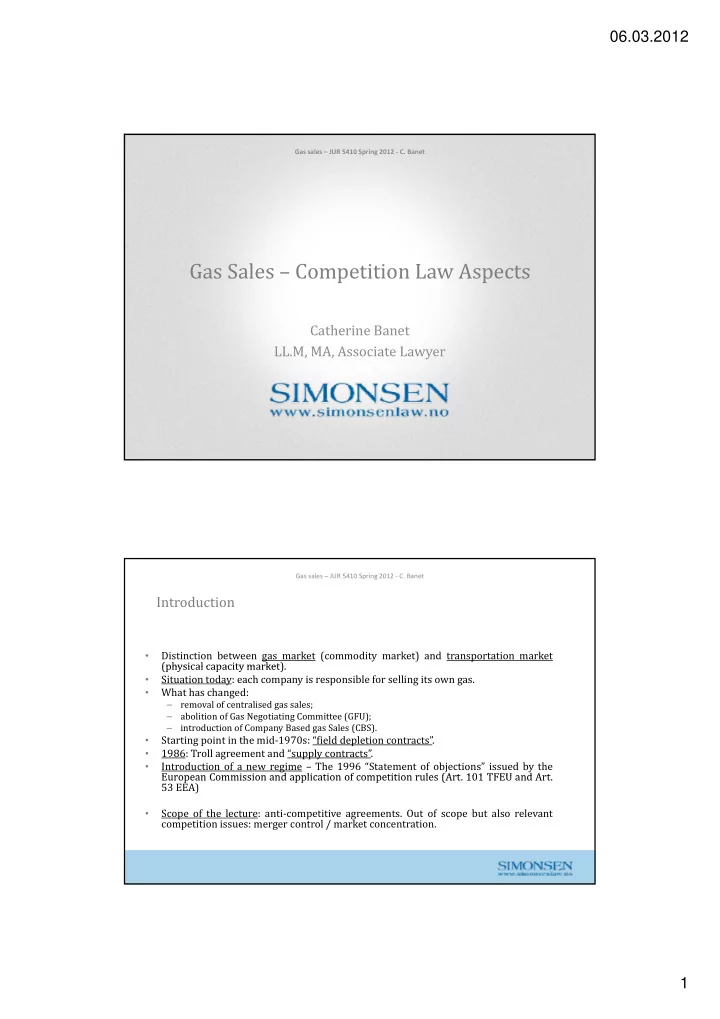
Catherine Banet LL M MA Associate Lawyer LL.M, MA, Associate Lawyer Introduction

  • Distinction between gas market (commodity market) and transportation market

(physical capacity market)

Gas sales – JUR 5410 Spring 2012 ‐ C. Banet

(physical capacity market).

  • Situation today: each company is responsible for selling its own gas.
  • What has changed:

– removal of centralised gas sales; – abolition of Gas Negotiating Committee (GFU); – introduction of Company Based gas Sales (CBS).

  • Starting point in the mid‐1970s: “field depletion contracts”.
  • 1986: Troll agreement and “supply contracts”.
  • Introduction of a new regime – The 1996 “Statement of objections” issued by the

European Commission and application of competition rules (Art 101 TFEU and Art European Commission and application of competition rules (Art. 101 TFEU and Art. 53 EEA)

  • Scope of the lecture: anti‐competitive agreements. Out of scope but also relevant

competition issues: merger control / market concentration.

slide-2
SLIDE 2

06.03.2012 2

  • 1. The former system of gas sales in Norway

Former structure of gas sales in Norway:

Gas sales – JUR 5410 Spring 2012 ‐ C. Banet (From Norwegian Natural Gas, Ole Gunnar Austvik, 2003, p.32)

Gas Supply Committee (FU)

License holders Ministry of Petroleum and Energy (OED)

Gas Negotiating Committee (GFU)

Market / Buyers

port Companies

Fields Producers Transportation System Norwegian Continental Shelf Transport Companies Large Consumers Industry

Im

  • 2. The removal of the common sales system and the abolition
  • f the GFU

2.1. The reasoning behind the reform Offi i l i ti ti d i 1996 F t S t d t ll di tl t Wi (G ) b t ti bl k d b Gas sales – JUR 5410 Spring 2012 ‐ C. Banet

  • Official investigation opened in 1996. Facts: Saga wanted to sell directly to Wingas (Germany), but operation blocked by

GFU.

  • Statement of Objections (SO) issued by the European Commission in 2001. See SO procedure in relation to rights of

defence in Art. 19.1 of Regulation No 17, and Art. 18.3 of the Merger Regulation.

  • Negative effects of the past system: concentration of Norwegian gas production on few large fields (not efficient

management of the resources); concentration on a few companies and owners. 2.2. The issue of jurisdiction

  • Pursuant to Article 56 EEA Agreement, European Commission competent to apply Article 53 EEA Agreement (modeled on
  • Art. 81 EC, now Art. 101 TFEU): trade in the EU affected to an appreciable extent. The “effect on trade” criteria. See

Britannia Gas Condensate Field case.

  • Reasoning of the parties. Arguments raised by the Norwegian government. Reference to the State compulsion doctrine (Jf.

Joined cases C‐359 and C‐379/95 Ladbroke Racing)

  • See Pooling and Settlement Agreement Notification case in England and Wales (1990): agreement between competitors in

relation to Public Service Obligations. 2.3. The application of competition rules to the energy sector

  • No specific provisions on energy in the EU treaties before the adoption of the TFEU Title XXI (Article 194).
  • Was determined by case law that the energy sector, as an economic activity, falls under EU competition rules.
  • + Definition of energy as good (and sometimes service).
  • See Costa v. Enel 6/64, Campus Oil 72/83, C‐393/92 Municipality of Almelo, C‐158/94 Commission vs. Italy.
slide-3
SLIDE 3

06.03.2012 3

The natural gas value chain and gas sale agreements

Production

Long-term supply contracts Long-term Gas sales – JUR 5410 Spring 2012 ‐ C. Banet

Production Purchase- Trading / Import Transportation & Storage Wholesale business distribution Supply to final

Long-term transport contracts Sales contracts

Householdb usiness Main elements in long‐term supply contracts: final customers ‐ duration; ‐ risk sharing; ‐ volumes; ‐ pricing; ‐ price review; ‐ arbritration.

2.4. Review of competition issues in upstream gas supply contracts

  • EU competition law provisions prohibit two main types of anti‐competitive activities:
  • 1. anti‐competitive agreements between businesses (Art. 101 TFEU)

Gas sales – JUR 5410 Spring 2012 ‐ C. Banet

p g ( )

  • 2. businesses abusing their dominant market position (Art. 102 TFEU)

– See Council Regulation (EC) No 1/2003 on the implementation of the rules on competition laid down in Articles 81 and 82 of the Treaty. – Exemptions to the prohibition addressed in Art. 101.3 TFEU.

  • Of particular relevance for joint gas sales are anti‐competitive agreements between

businesses (Article 101 TFEU prohibition) – Review:

– The meaning of “agreement”, “decision” and “ concerted practice”. Prohibition of horizontal and vertical agreements – Prohibition of horizontal and vertical agreements. – Types of agreements and appreciable effect on competition (in addition to the 10% market shares criteria), in particular: agreements which have as their effect or object:

  • direct or indirect price fixing; restricting or controlling production (quotas, volumes, etc.).
  • joint purchasing or selling; share of information.
slide-4
SLIDE 4

06.03.2012 4

  • Application of Art. 101 TFEU (ex. 81.1 ECT) provisions to the GFU case (COM/36.072)

– Horizontal issues in relation to joint selling of gas, through a single seller (GFU), from the whole Norwegian continental shelf (one single country). Evaluation of the nature of the agreement (GFU Cooperation agreement of 3 March 1989). – Infringement at least since signature of 1989, signature of the GFU Cooperation Agreement between Statoil, Norsk Hydro and Saga. – Issues: long term adverse effects; restriction of competition; all gas production from NCS encompassed; no individual sales; resulted and aimed to “uniform, artificially high prices.” – See Press release: IP/02/1084.

Gas sales – JUR 5410 Spring 2012 ‐ C. Banet

  • The DONG/DUC case (COMP/38.187)

– Similar case: joint selling from only one or several fields. – EC competition law issues:

  • Joint marketing of gas (horizontal), resulting in “joint coordination of sales”.
  • Restrictive provisions as contained in the gas supply contracts (vertical).

– Exemptions Art. 81.3 ECT not applicable (no benefit on production), neither “joint distribution” of goods qualification under Regulation (EC) No.2658/2000. – See Press release: IP/03/566.

  • The Corrib case examination

– Joint marketing from a single field. Applied to exemptions Art.81.3 ECT (now Art. 101.3 TFEU) for the first 5 years, arguing measure necessary “to balance the countervailing purchasing power of the incumbent Irish companies.” – See Press Release: IP/01/578. – Examination closed after withdraw Corrib field owners and decision to market individually.

  • 3. Remedies to the infringement of competition rules

3.1. The transitional regime adopted in Norway

  • Remedies agreed in the GFU case with the European Commission.

Gas sales – JUR 5410 Spring 2012 ‐ C. Banet

– 3 groups of undertakings: permanent members of GFU; six companies selling gas under conditions negotiated by GFU; other defendants. – Range of remedies: termination of joint marketing; review of existing contracts; reservation of gas volume to new buyers; removal of territorial restrictions (vertical issue – See point 4.6)

  • Similar approach adopted in DONG/DUC case.

– Similar range of remedies + removal of additional restrictions clauses (obligation on DONG to report to DUC, “use restriction”; priority right to DONG). 3.2. The new regime for gas sales in Norway

  • Fully introduced in 2003.
  • All parts of the gas chain concerned.
  • Each company responsible for its own gas sales. Ex: Snøhvit.
slide-5
SLIDE 5

06.03.2012 5

  • 4. Competition law under the new gas sales regime:

persistent and new issues

4.1. The shape of today’s gas market

  • From the qualification of the value traded

Gas sales – JUR 5410 Spring 2012 ‐ C. Banet

  • From the qualification of the value traded …

– Particularities of the gas market. – Definition of the value traded: natural gas as a ”commodity”. Global nature of gas marketing? The role of LNG. Competition on the price element. – Existing trading markets for natural gas. – Relation to trading hubs (Ex: Zeebrugge Hub ”Huberator”). – The different levels of trading (see supporting document + next slide).

  • … to the structure of the trading market.

– The different contractual forms of trading: evolution of gas sales contracts. – Interaction between physical and financial gas markets. – The development of gas trading hubs and trading contracts. ≠ Trading exchange (APX) Ex: Zeebruge Hub Natural Gas Trading Terms and Conditions – Evolution: towards standardisation of gas sales contracts?! See: S. Dyrland, Det Nye Gassmarkedet (Fagbokforlaget, 2008).

4.2. Definition of the relevant market for competition law assessment

  • The relevant product market

– Substituability in energy markets: inter‐fuel competition v. fuel specific competition. R t C i i ti t ti h b th id tifi ti f th

Gas sales – JUR 5410 Spring 2012 ‐ C. Banet

– Recent Commission practice: systematic approach by the identification of the different levels in the gas chain + distinction between customers – See European Commission’s Notice on Market Definition (1997).

  • The relevant geographic market

– Definition: see the Notice. – Again, approach of the Commission: separation of the different parts of the value chain (production, transport, transmission, distribution, retail).

  • Impact of liberalisation on the definition of the rele ant market
  • Impact of liberalisation on the definition of the relevant market

– See Britannia case (joint forward sell): Commission identified 2 separate markets. – German wholesale transmission network (COMP/M.2822): regional wholesale of gas is the relevant product market.

slide-6
SLIDE 6

06.03.2012 6

4.3 Remaining horizontal issues of concern

  • A. Individual sales governed by Joint Operating Agreement (JOA)
  • Art. 101 TFEU and JOA. Joint operating/production JV.

G Lifti A t (GLA) d f h li

Gas sales – JUR 5410 Spring 2012 ‐ C. Banet

  • Gas Lifting Agreements (GLA) agreed for each licence.
  • B. Exchange of information through licensees
  • Possible infringement of Article 101.1 TFEU.
  • See: British Gas Network Code Case.
  • Nomination procedure under lifting and balancing agreements.
  • C. Joint buying of forward gas (= indirect joint selling)
  • The argument of security of energy supply.
  • The purpose of joint buying of forward gas from other producers: production or resale.

4.4 Vertical issues in gas competition

  • A more recent practice from the European Commission. Includes: exclusive/long‐term

supply agreements, restrictions on use, and territorial restrictions on exports.

Gas sales – JUR 5410 Spring 2012 ‐ C. Banet

  • Primarily, tooks at “destination clauses” and “exclusivity clauses”.
  • Vertical issues under Art. 101.1 TFEU. Definition and possible Block exemptions. See:

– Commission Notice “Guidelines on Vertical Restraints” (2000); – Commission Regulation (EC) No. 2790/99 on the application of Article 81.3 ECT.

  • Recent cases:

– Russian gas: Gazprom/ENI (2003); Gazprom/E.ON Ruhrgas (2005); Gasprom/OMV (2005) (2005) – Nigerian gas: Nigeria LNG Ltd, destination clause + profit‐splitting mechanisms (IP/02/1869). – Algerian gas: Sonatrach ‐ Algerian gas supply contracts (IP/07/1074)

slide-7
SLIDE 7

06.03.2012 7

Indicative bibliography

  • AUSTVIK Ole Gunnar, The Norwegian State as Oil and Gas Entrepreneur (VDM, 2009).
  • CAMERON Peter, Competition in Energy Markets (Oxford, 2002).
  • DELVAUX HUNT and TALUS (Eds ) EU Energy Law and Policy 2nd Edition (Euroconfidentiel

Gas sales – JUR 5410 Spring 2012 ‐ C. Banet

DELVAUX, HUNT and TALUS (Eds.), EU Energy Law and Policy, 2nd Edition (Euroconfidentiel, 2010). In particular Chapters 2 and 3 under Section II on competition law.

  • Van Bael & Bellis, Competition Law of the European Community (Kluwer, Vth ed., 2009).
  • WILLIS Peter (Ed.), Introduction to EU Competition Law (Informa professional, 2005).
  • FAUL Jonathan and NIKPAY Ali, The EC Law of Competition (Oxford, 1999). In particular, Chapter

10: Energy. + Distributed documents in class.

Kontakt

Catherine Banet

SIMONSEN Advokatfirma DA Shipping, Offshore and Energy Department Filipstad Brygge 1, 0252 Oslo Postboks 2043 Vika, 0125 Oslo Tel.: +47 21 95 55 00 Dir.: +47 21 95 56 97 Mob : +47 97 07 38 44 Mob.: +47 97 07 38 44 E‐mail: cb@simonsenlaw.no

Gas sales – JUR 5410 Spring 2012 ‐ C. Banet