Gaming On Linux November 1st 2019 Henry Keena Please sign in! - - PowerPoint PPT Presentation

gaming on linux
SMART_READER_LITE
LIVE PREVIEW

Gaming On Linux November 1st 2019 Henry Keena Please sign in! - - PowerPoint PPT Presentation

Gaming On Linux November 1st 2019 Henry Keena Please sign in! https://signin.ritlug.com Keep up with RITlug outside of meetings: ritlug.com/get-involved, rit-lug.slack.com Who here plays video games? what about on Linux? But can it run


slide-1
SLIDE 1

Please sign in! https://signin.ritlug.com Keep up with RITlug outside of meetings: ritlug.com/get-involved, rit-lug.slack.com

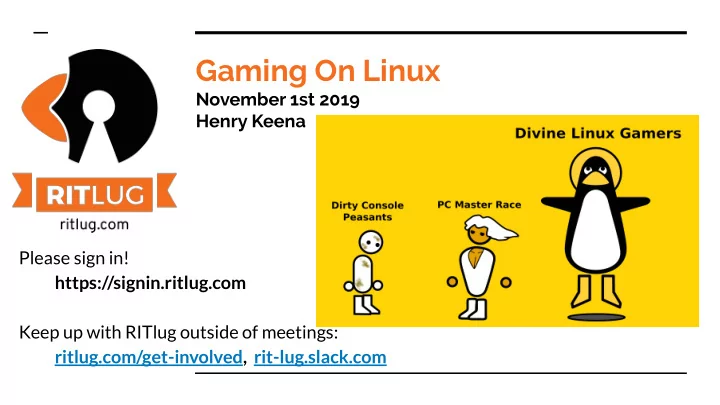
Gaming On Linux

November 1st 2019 Henry Keena
slide-2
SLIDE 2

Who here plays video games?

… what about on Linux?

slide-3
SLIDE 3
slide-4
SLIDE 4

But can it run Doom?

slide-5
SLIDE 5
slide-6
SLIDE 6

But first, a little History...

slide-7
SLIDE 7

Humble Beginnings (1993-1997)

  • Wine is first released in 1993
  • The Linux gaming scene started as an extension to the

Unix gaming scene… which was practically nothing...

  • Linux “officially” started being a commercial gaming

platform in 1994 when idSoftware employee Dave

  • D. Taylor ported Doom to Linux, then Quake in 1996
  • Games on Linux started as ports, made by enthusiastic

game company employees

slide-8
SLIDE 8

Linux Gaming has some ups… and a lot of downs... (1998-2010)

  • In 1998, Loki Entertainment, the first commercial Linux

gaming company is born… but is defunct by 2002.

  • Some others companies take up the mantle:

○ Tux Games, Linux Game Publishing, Tribsoft, Hyperion Entertainment, Xantrix Entertainment, RuneSoft

  • Mainstream game developers mostly give up on Linux
  • By this time, Linux users start looking looking for other

ways of getting their games… mostly through running Wine and packaging on Desura

slide-9
SLIDE 9

Things are... good? (2011-2017)

  • The 2010’s brought a lot of progress for gaming on Linux
  • In 2012 Linux got native support for the Unity Engine and

the Source Engine

  • In 2013 SteamOS was released by Valve, based on

Debian

○ “Linux and open source are the future of gaming.” - Gabe Newell

  • In 2014 Linux got native support for Unreal Engine 4 and

CryEngine

  • But… developers are still not making the games native
slide-10
SLIDE 10

The Future is Here… almost… (2018-Present)

  • In 2018, Valve changed the way we game on Linux, by

releasing the Proton API

  • With the Proton API we now have the tools to run

Windows native games much more efficiently

  • Provides near native support
  • Companies are starting to recognize the Linux market…

let’s see how it goes

slide-11
SLIDE 11

So how can we run all the games?

slide-12
SLIDE 12

Native Ports of Games

  • Plug and Play, native ports of games do exist, and they

play just as well as natively on Windows or OSX

  • Steam is your friend
  • SteamOS
  • Unfortunately, the number of officially ported titles is

rather limited

slide-13
SLIDE 13

Virtual Machines

  • One of the easiest way to play games on Linux is to play

the game itself on a Windows or OSX VM

  • Heavy system requirements
  • VMWare
  • VirtualBox
  • But that isn’t really gaming on Linux so no...
slide-14
SLIDE 14

Graphics APIs

  • OpenGL (1992)

○ APIs purely focused on rendering, but no APIs for input, audio, or windowing ○ GPU memory and synchronization typically hidden ○ Operations are sequential ○ Extensive error checking

  • Vulkan (2016)

○ APIs offer support for rendering, input, audio, windowing, etc. ○ Explicit control over memory management ○ Multi-threading support ○ Limited error checking, but there is a validation layer

slide-15
SLIDE 15

Wine and PlayOnLinux

  • First released in 1993, just released version 4.0 in August

2019

  • “Wine Is Not an Emulator” (it’s a compatibility layer)
  • Originally made to generally emulate Windows

applications on Linux, but now is pretty much mostly used for game compatibility Layer

  • PlayOnLinux
  • Game/App Reviews and HowTo: https://www.winehq.org/
slide-16
SLIDE 16

Game/Hardware Emulation

  • The main way to play games on Linux was through

emulating the hardware of a the game’s native system

  • Some popular emulators:

○ Dolphin (Nintendo GameCube and Wii) ○ Cemu with Wine (Wii U) ○ RPCS3 (PlayStation 3) ○ DGen/SDL (Sega Mega and Sega Genesis)

  • Depending on your emulator
  • ROM Files
slide-17
SLIDE 17

Proton

  • In 2018, Valve released Proton, an open source fork of

Wine, which is more finely tuned to work specifically games

  • Steam Compatibility Support
  • Very good support with OpenGL, Vulkan, DirectX11, and

DirectX12

  • Game Reviews and HowTo: https://www.protondb.com/
slide-18
SLIDE 18

So what games can we play?

slide-19
SLIDE 19

The Linux/FOSS Classics

  • Some Classic Linux/FOSS Games you can play:

○ Super Tux ○ SuperTuxKart ○ Super Tux Party ○ OpenArena ○ FreeCiv ○ Tuxemon

  • https://www.gamingonlinux.com/free-games/
slide-20
SLIDE 20

Proton Silver

slide-21
SLIDE 21

Proton Gold

slide-22
SLIDE 22

Proton Platinum

slide-23
SLIDE 23

Questions?