SLIDE 1
15-251: Great Theoretical Ideas in Computer Science
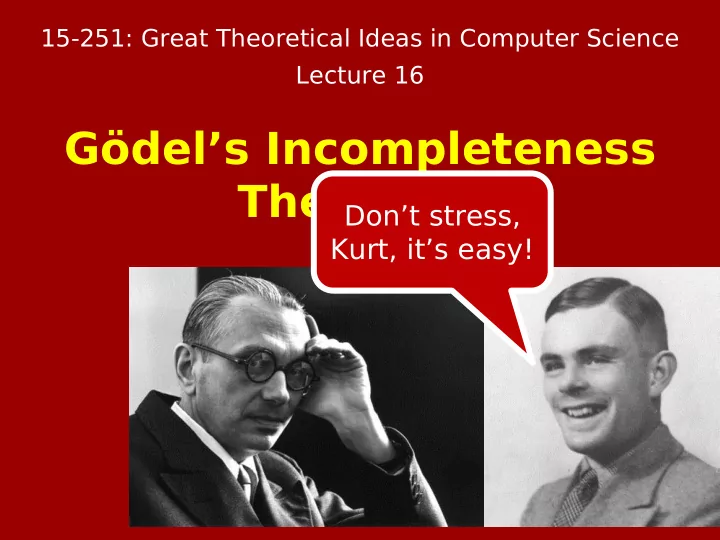
Gödel’s Incompleteness Theorems
Lecture 16
Don’t stress, Kurt, it’s easy!
SLIDE 2
Proving the famous “Gödel Incompleteness Theorems” is easy if you use computer science. It’s a Great Application of Theoretical Computer Science to mathematics. It’s so easy, let’s spend some time learning and reviewing
SLIDE 3
Given a vocabulary, some sentences are “tautologies”: e.g.: (∀x(x=a))→(Next(a)=a) ∀x ∀y ((x=a∧y=b)→(Func(x,y)=Func(a,b))) IsCool(c)→(∃x IsCool(x)) i.e., “true for all possible interpretations”, “automatically true, for ‘purely logical’ reasons”. stuff like ∀x (¬(x=a)→IsSmarter(Father(a),Father(x))).
First Order Logic:
SLIDE 4 Gödel’s Completeness Theorem (1929):
“There’s a (computable) Deductive Calculus for tautologies.” This “Deductive Calculus” has: a bunch of axioms, (all of which are obviously tautologies);
- ne deduction rule: from A and A→B, deduce B.
Everything deducible is a tautology. Gödel showed: every tautology is deducible.
SLIDE 5
Gödel’s Completeness Theorem (1929):
“There’s a (computable) Deductive Calculus for tautologies.” Actually, Deductive Calculus does not have finitely many axioms. It has finitely many “axiom schema”. For example…
“if A is any sentence, then A∨¬A is an axiom” “if IsR is any relation-name and c is any constant-name, then IsR(c)→(∃x IsR(x)) is an axiom”
SLIDE 6
Gödel’s Completeness Theorem (1929):
“There’s a (computable) Deductive Calculus for tautologies.” “Computability”: There’s an algorithm (say, a TM) which, given a sentence, decides if it is an axiom.
“if A is any sentence, then A∨¬A is an axiom” “if IsR is any relation-name and c is any constant-name, then IsR(c)→(∃x IsR(x)) is an axiom”
SLIDE 7
Upshot of the Completeness Thm.
There is a TM algorithm which, given a tautological sentence S, finds a deduction of it in the Deductive Calculus. Corollary: for k = 1, 2, 3, … for all strings x of length k, check if x is a deduction of S Proof:
SLIDE 8 The set of tautologies is interesting, but it’s not THAT interesting.
- 1. Think of some universe you want to reason about.
- 2. Invent an appropriate vocabulary
(constant, function, relation names).
- 3. ADD in some computable axioms (schemas)
which are true under the interpretation you have in mind.
- 4. See what these axioms entail.
(By Gödel’s theorem, equivalent to what you can deduce from the axioms in Deductive Calculus.)
More typical use of first order logic:
SLIDE 9
- Ex. 1: Arithmetic of ℕ (Peano axioms)
∀x ¬(Successor(x)=0) ∀x ∀y (Successor(x)=Successor(y))→(x=y) ∀x Plus(x,0)=x ∀x ∀y Plus(x,Successor(y))=Successor(Plus(x,y)) ∀x Times(x,0)=0 ∀x ∀y Times(x,Successor(y))=Plus(Times(x,y),x) “Induction:” For any parameterized formula F(x), (F(0)∧(∀x F(x)→F(Successor(x)))) → ∀x F(x)
function-names: Successor(x) Plus(x,y) Times(x,y) extra axioms: constant-name:
SLIDE 10
- Ex. 2: Set Theory (ZFC axioms)
∀x ∀y ( (∀z z∈x ↔ z∈y) → x = y ) ∀x ∀y ∃z (x∈z ∧ y∈z) … 7 more (computable) axioms & schemas … constant-names, function-names: none relation-name: IsElementOf(x,y) [“x∈y”] extra axioms, catchily known as “ZFC”:
SLIDE 11 How would you state/prove some theorem about random walks on graphs??
First, define natural numbers in terms of sets. Next, define ordered pairs in terms of sets. Next, define graphs in terms of pairs. Next, define ℤ in terms of pairs (ℕ, ±). Next, define ℚ in terms of (ℤ, ℤ). Next, define functions in terms of pairs. Next, define infinite sequences in terms of functions of ℕ. Next, define ℝ in terms of infinite sequences from ℚ. Next, make some basic definitions for probability theory. Finally, state the theorem you want to prove!
ZFC: standard basic axioms (of set theory)
that can be used to model and prove almost anything in mathematics
SLIDE 12
Bertrand Russell Alfred Whitehead Principia Mathematica, ca. 1912 Developed set theory, number theory, some real analysis using set theory & FOL. page 379: “1+1=2”
SLIDE 13 It became generally agreed that you could rigorously formalize pretty much all mathematical proofs. But nobody wants to!
(by hand, at least)
SLIDE 14 Computer-assisted proof
Proof assistant software like HOL Light, Mizar, Coq, Isabelle, does two things:
- 1. Checks that a proof encoded
in ZFC + Deductive Calculus for First Order Logic (or typed lambda calculus theory) is valid.
- 2. Helps user code up such proofs.
Developing proof assistants is an active area of research, particularly at CMU!
SLIDE 15
Computer-formalized proofs
Fundamental Theorem of Calculus (Harrison) Fundamental Theorem of Algebra (Milewski) Prime Number Theorem (Avigad++ @ CMU) Gӧdel’s Incompleteness Theorem (Shankar) Jordan Curve Theorem (Hales) Brouwer Fixed Point Theorem (Harrison) Four Color Theorem (Gonthier) Feit-Thompson Theorem (Gonthier) Kepler Conjecture (Hales)
SLIDE 16
Remember: There is a TM which will print out and certify a proof of, say, the Four Color Theorem, coded up in ZFC+Deductive Calculus. for k = 1, 2, 3, … for all strings P of length k, check if P is a valid deduction of 4CT
SLIDE 17
15-251: Great Theoretical Ideas in Computer Science
Turing & Computability
Lecture 7
SLIDE 18 Decidable languages
Definition: A language L ⊆ Σ* is decidable if there is a Turing Machine M which:
- 1. Halts on every input x∈ Σ*.
- 2. Accepts inputs x∈L and rejects inputs x∉L.
SLIDE 19
The Halting Problem is Undecidable
Turing’s Theorem: Let HALTS ⊆ {0,1}* be the language { ⟨M,x⟩ : M is a TM which halts on input x }. Then HALTS is undecidable.
It’s not: “we don’t know how to solve it efficiently”. It’s not: “we don’t know if it’s a solvable problem”.
We know that it is unsolvable by any algorithm.
SLIDE 20
Proof
Here is the description of another TM called D, which uses MHALTS as a subroutine: Given as input ⟨M⟩, the encoding of a TM M: D executes MHALTS( ⟨M, ⟨M⟩⟩ ). If this call accepts, D enters an infinite loop. If this call rejects, D halts (say, it accepts).
D:
Assume MHALTS is a decider TM which decides HALTS. By definition, D( ⟨D⟩ ) loops if it halts and halts if it loops. Contradiction.
SLIDE 21
15-251: Great Theoretical Ideas in Computer Science
Gödel’s Incompleteness Theorems
Lecture 15
Don’t stress, Kurt, it’s easy!
SLIDE 22 Suppose you just really cannot believe we proved that HALTS is undecidable. How would you try to write a program H which,
- n input ⟨M,x⟩, decides if M(x) eventually halts?
Sample input: M = “for k = 4, 6, 8, 10, 12, 14, …
if k is not the sum of 2 primes then HALT.”
x = ϵ (empty string)
SLIDE 23 Sample input: How would you try to write a program H which,
- n input ⟨M,x⟩, decides if M(x) eventually halts?
- Dunno. Best idea I can think of is:
Let H simulate M(x). If M(x) halts after 1,000,000,000 steps, output “it halts”. If M(x) still hasn’t halted after 1,000,000,000 steps, um… M = “for k = 4, 6, 8, 10, 12, 14, …
if k is not the sum of 2 primes then HALT.”
x = ϵ (empty string)
SLIDE 24
I have a crazy and sort of awesome idea for how to write H. Kurt, you mathematicians always make things too complicated. Let me explain it. All right, fine.
SLIDE 25 How would you try to write a program H which,
- n input ⟨M,x⟩, decides if M(x) eventually halts?
Idea for H:
“ for k = 1, 2, 3, … for all strings P of length k,
- Check if P is a valid ZFC + Deductive Calculus
proof of the statement ‘M(x) eventually halts’ If so, let H halt and output “yes, M(x) halts”
- Check if P is a valid ZFC + Deductive Calculus
proof of the statement ‘M(x) eventually loops’ If so, let H halt and output “no, M(x) loops” ”
SLIDE 26 Idea for H:
“ for k = 1, 2, 3, … for all strings P of length k,
- Check if P is a valid ZFC + Deductive Calculus
proof of the statement ‘M(x) eventually halts’ If so, let H halt and output “yes, M(x) halts”
- Check if P is a valid ZFC + Deductive Calculus
proof of the statement ‘M(x) eventually loops’ If so, let H halt and output “no, M(x) loops” ”
By my theorem: this TM H, like all algorithms, does not decide the Halting Problem.
SLIDE 27
Conclusion:
There is some TM M and some string x such that ZFC+Deductive Calculus cannot prove either of ‘M(x) eventually halts’ or ‘M(x) eventually loops’. But M(x) either halts or it loops! One of these two statements is true! There is a true mathematical statement that cannot be proved (in ZFC+Deductive Calculus).
SLIDE 28
This is basically Gödel’s First Incompleteness Theorem.
SLIDE 29 “ for k = 1, 2, 3, … for all strings P of length k,
- Check if P is a valid ZFC + Deductive Calculus
proof of the statement ‘M(x) eventually halts’ If so, let H halt and output “yes, M(x) halts”
- Check if P is a valid ZFC + Deductive Calculus
proof of the statement ‘M(x) eventually loops’ If so, let H halt and output “no, M(x) halts” ”
Conclusion: There is some TM M and some string x such that ZFC+Deductive Calculus cannot prove either of ‘M(x) eventually halts’ or ‘M(x) eventually loops’.
SLIDE 30 Actually, this is not a correct conclusion, because there’s another possibility: ZFC+Deductive Calculus might have a proof that ‘M(x) eventually halts’ even though it loops,
- r ‘M(x) eventually loops’ even though it halts.
Conclusion: There is some TM M and some string x such that ZFC+Deductive Calculus cannot prove either of ‘M(x) eventually halts’ or ‘M(x) eventually loops’.
SLIDE 31 Actually, this is not a correct conclusion, because there’s another possibility: ZFC+Deductive Calculus might have a proof that ‘M(x) eventually halts’ even though it loops,
- r ‘M(x) eventually loops’ even though it halts.
I.e., ZFC might be unsound: it might prove some false statements. This would kind of upend all of mathematics. Now, almost everyone believes ZFC is sound. But theoretically, it’s a possibility.
SLIDE 32
What we’ve actually proven so far:
ZFC + Deductive Calculus cannot be both complete and sound. Complete: for every sentence S, either S or ¬S is provable. Sound: for every S, if S is provable then S is true.
SLIDE 33 Question: What did this proof use about ZFC? Answer: Not too much.
- You can define TM’s and TM computation in it.
- Its axioms/axiom schemas are computable.
What we’ve actually proven so far:
ZFC + Deductive Calculus cannot be both complete and sound.
SLIDE 34
Any mathematical proof system which is “sufficiently expressive” (can define TM’s) and has computable axioms cannot be both complete and sound.
Gödel’s First Incompleteness Theorem:
Side remark: Even Peano Arithmetic is “sufficiently expressive”.
You can define TM’s and TM computation in it, though it is a pain in the neck.
SLIDE 35
A smart-aleck’s attempt to circumvent Gödel’s First Incompleteness Theorem:
“Let’s assume ZFC is sound. Gödel’s Theorem says that there’s some true statement S which can’t be proved in ZFC. Let’s just upgrade ZFC by adding S as an axiom!” Doesn’t help: ZFC+S is a sufficiently expressive system with computable axioms. So by Gödel’s Theorem, there’s still some other S/ which is true but can’t be proved.
SLIDE 36 A smart-aleck’s attempt to circumvent Gödel’s First Incompleteness Theorem:
“Maybe add in S/ as another axiom?” Still doesn’t help: Apply Gödel’s Theorem to ZFC+S+S/, get yet another true statement S// which is true but cannot be proved. “Maybe add in all true statements as axioms?” Okay fine, but now the set of axioms is not
- computable. So it’s kind of a pointless system.
SLIDE 37
Any mathematical proof system which is “sufficiently expressive” (can define TM’s) and has computable axioms cannot be both complete and sound.
Gödel’s First Incompleteness Theorem:
Sound: for every S, if S is provable then S is true. Whoahhhh, dude. How can you say a statement S is true if you can’t prove it?
SLIDE 38
Response 1
Don’t get all confused. If I asked you yesterday, “Hey, is it true that 1 is the only number which appears in Pascal’s Triangle more than ten times?”, you wouldn’t be, like, “Whoahhhh dude, what does true mean?” Ordinary mathematical concepts and reasoning don’t suddenly become invalid just because you’re studying logic. Don’t get all confused.
SLIDE 39
Response 2
Just so that nobody gets confused, I’ll prove an even stronger version which doesn’t mention “truth”.
SLIDE 40 Any mathematical proof system which is “sufficiently expressive” (can define TM’s) and has computable axioms cannot be both complete and consistent.
Gödel’s 1st: full version
(with strengthening by J. Barkley Rosser)
Complete: for every sentence S, either S or ¬S is provable. Consistent: for every S, you can’t prove both S and ¬S.
SLIDE 41
Not only will we prove this, there will be a bonus plot twist at the end! For simplicity, we fix the mathematical proof system to be ZFC.
SLIDE 42 Outline of previous proof:
- 1. Assume ZFC sound.
- 2. Reason about a certain TM.
- 3. Deduce that ZFC is incomplete.
Outline of upcoming stronger proof:
- 1. Assume ZFC consistent.
- 2. Reason about a certain TM.
- 3. Deduce that ZFC is incomplete.
SLIDE 43
We’re going to need a lemma. Some statements are so simple that, assuming they’re true, they definitely do have a proof in ZFC. Example: “There are 25 primes less than 100.” This definitely has a proof: the brute-force, brain-dead enumeration proof!
SLIDE 44
Our Brain-Dead Lemma:
If a particular TM has a particular t-step execution trace, then there is a proof of this fact (in ZFC).
Why?
Can always write (in ZFC) proofs that look like: “Initially M in the starting state/head/tape configuration. After 1 step, M is in state/head/tape configuration blah. After 2 steps, M is in state/head/tape configuration blah. After 3 steps, M is in state/head/tape configuration blah. … After t steps, M is in state/head/tape configuration blah. QED.”
In particular, if M(x) halts, there is a proof of ‘M(x) halts’.
SLIDE 45 Outline of upcoming proof of the “truth”-free stronger version of Gödel’s 1st:
- 1. Assume ZFC consistent.
- 2. Reason about a certain TM.
- 3. Deduce that ZFC is incomplete.
SLIDE 46 Proof of stronger Incompleteness Theorem
Assume ZFC consistent. Let D be the TM which on input ⟨M⟩ does:
for all strings P of length 1, 2, 3, …
- If P is a ZFC proof of ‘M(⟨M⟩) halts’, enter ‘go right forever’ state.
- If P is a ZFC proof of ‘M(⟨M⟩) loops’, then halt.
What can ZFC prove about D(⟨D⟩)? What can ZFC prove about D(⟨D⟩)? By consistency, at most one of ‘D(⟨D⟩) halts’ or ‘D(⟨D⟩) loops’.
Perhaps ZFC can prove ‘D(⟨D⟩) loops’?
Then D on input ⟨D⟩ will find this proof, and thus halt. But if D(⟨D⟩) halts then ZFC can prove ‘D(⟨D⟩) halts’
(by Brain-Dead Lemma). This contradicts consistency.
SLIDE 47 Proof of stronger Incompleteness Theorem
Assume ZFC consistent. Let D be the TM which on input ⟨M⟩ does: What can ZFC prove about D(⟨D⟩)? What can ZFC prove about D(⟨D⟩)? By consistency, at most one of ‘D(⟨D⟩) halts’ or ‘D(⟨D⟩) loops’.
Perhaps ZFC can prove ‘D(⟨D⟩) halts’?
Then D(⟨D⟩) will run for some t steps, find this proof, and then enter the ‘go right forever’ state. But by Brain-Dead Lemma, there’s a proof of this fact (the t+1 step execution trace). Thus ZFC can prove ‘D(⟨D⟩) loops’, contradicting consistency. for all strings P of length 1, 2, 3, …
- If P is a ZFC proof of ‘M(⟨M⟩) halts’, enter ‘go right forever’ state.
- If P is a ZFC proof of ‘M(⟨M⟩) loops’, then halt.
SLIDE 48 Proof of stronger Incompleteness Theorem
Assume ZFC consistent. Let D be the TM which on input ⟨M⟩ does: Great! We just showed ZFC cannot prove either ‘D(⟨D⟩) loops’ or ‘D(⟨D⟩) halts’. So ZFC is incomplete. Incidentally… does D(⟨D⟩) actually halt or loop? It loops. It does not find a proof of either statement.
for all strings P of length 1, 2, 3, …
- If P is a ZFC proof of ‘M(⟨M⟩) halts’, enter ‘go right forever’ state.
- If P is a ZFC proof of ‘M(⟨M⟩) loops’, then halt.
SLIDE 49 Proof of stronger Incompleteness Theorem
Assume ZFC consistent. Let D be the TM which on input ⟨M⟩ does: Great! We just showed ZFC cannot prove either ‘D(⟨D⟩) loops’ or ‘D(⟨D⟩) halts’. So ZFC is incomplete. It loops. It does not find a proof of either statement. Wait a minute.
for all strings P of length 1, 2, 3, …
- If P is a ZFC proof of ‘M(⟨M⟩) halts’, enter ‘go right forever’ state.
- If P is a ZFC proof of ‘M(⟨M⟩) loops’, then halt.
SLIDE 50 Proof of stronger Incompleteness Theorem
Assume ZFC consistent. Let D be the TM which on input ⟨M⟩ does: Great! We just showed ZFC cannot prove either ‘D(⟨D⟩) loops’ or ‘D(⟨D⟩) halts’. So ZFC is incomplete. Wait a minute. We just showed that D(⟨D⟩) loops. If we formalize the last 3 slides in ZFC, we get a proof of ‘D(⟨D⟩) loops’.
for all strings P of length 1, 2, 3, …
- If P is a ZFC proof of ‘M(⟨M⟩) halts’, enter ‘go right forever’ state.
- If P is a ZFC proof of ‘M(⟨M⟩) loops’, then halt.
SLIDE 51
Did we just find a contradiction in mathematics?
SLIDE 52 Proof of stronger Incompleteness Theorem
Assume ZFC consistent. Let D be the TM which on input ⟨M⟩ does: Great! We just showed ZFC cannot prove either ‘D(⟨D⟩) loops’ or ‘D(⟨D⟩) halts’. So ZFC is incomplete. Wait a minute. We just showed that D(⟨D⟩) loops. If we formalize the last 3 slides in ZFC, we get a proof of ‘D(⟨D⟩) loops’.
for all strings P of length 1, 2, 3, …
- If P is a ZFC proof of ‘M(⟨M⟩) halts’, enter ‘go right forever’ state.
- If P is a ZFC proof of ‘M(⟨M⟩) loops’, then halt.
SLIDE 53 Proof of stronger Incompleteness Theorem
Assume ZFC consistent. Let D be the TM which on input ⟨M⟩ does: Great! We just showed ZFC cannot prove either ‘D(⟨D⟩) loops’ or ‘D(⟨D⟩) halts’. So ZFC is incomplete. Wait a minute. We just showed that D(⟨D⟩) loops. If we formalize the last 3 slides in ZFC, we get a proof of ‘ZFC consistent → D(⟨D⟩) loops’.
for all strings P of length 1, 2, 3, …
- If P is a ZFC proof of ‘M(⟨M⟩) halts’, enter ‘go right forever’ state.
- If P is a ZFC proof of ‘M(⟨M⟩) loops’, then halt.
SLIDE 54 Proof of stronger Incompleteness Theorem
Assume ZFC consistent. Let D be the TM which on input ⟨M⟩ does: Great! We just showed ZFC cannot prove either ‘D(⟨D⟩) loops’ or ‘D(⟨D⟩) halts’. So ZFC is incomplete. If we formalize the last 3 slides in ZFC, we get a proof of ‘ZFC consistent → D(⟨D⟩) loops’.
The only way to avoid a contradiction: ZFC cannot prove ‘ZFC consistent’
for all strings P of length 1, 2, 3, …
- If P is a ZFC proof of ‘M(⟨M⟩) halts’, enter ‘go right forever’ state.
- If P is a ZFC proof of ‘M(⟨M⟩) loops’, then halt.
SLIDE 55 Assume ZFC (or any “sufficiently expressive” proof system)
is consistent. Then not only is it incomplete,
here’s a true statement it cannot prove: “ZFC is consistent”.
Gödel’s Second Incompleteness Theorem
(proved independently by von Neumann)
SLIDE 56
Assuming ZFC is consistent, here’s another statement which cannot be proved or disproved in ZFC:
There is a set A with |ℕ| < |A| < |ℝ|.
Paul Cohen (1963)
i.e., the continuous hypothesis is independent from ZFC.
SLIDE 57 The statement and proof
- f Gödel’s First and Second
Incompleteness Theorems.
Study Guide