SLIDE 1
Fundraising for complex projects Case Study:The Leonard Wolfson - - PowerPoint PPT Presentation
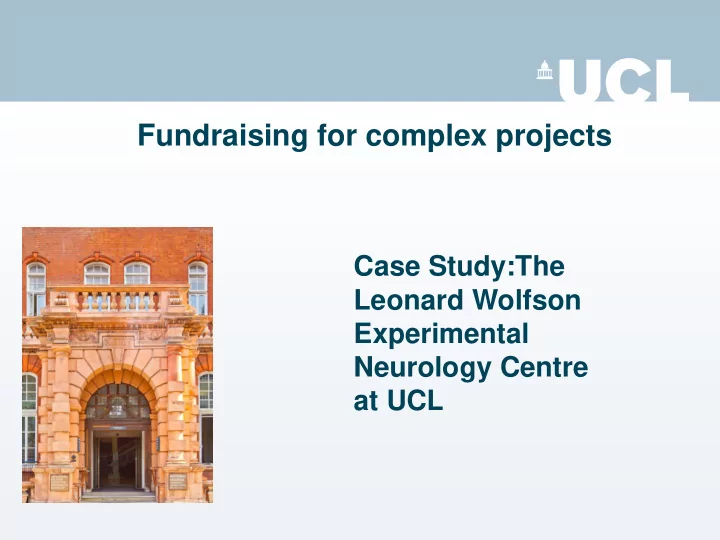
Fundraising for complex projects Case Study:The Leonard Wolfson Experimental Neurology Centre at UCL The academic need Neurodegenerative diseases include Alzheimers disease and Parkinsons disease, as well as less common but equally
SLIDE 2
SLIDE 3
The academic potential
- Year long 2 stage bid process in response to a specific call
- Collaborative working across UCL involving:
– SLMS – Institute of Neurology – Dementia Research Centre – Institute of Cognitive Neuroscience, – UCLH – National Hospital for Neurology and Neurosurgery ……including Provost, Vice Provosts and Deans
- Eight Principal Researchers and a wider group of 20+ key neuroscientists
- Specialists in Neurodegeneration - Alzheimer’s, Parkinson’s, CJD, Prion
disease and Huntingdon disease
- Wolfson Foundation awards £20million to UCL
SLIDE 4
The vision
- Clear academic vision of the opportunity
- Project board set up immediately
- Key staff from across the University brought in early
- Wide consultation
- High level leadership
- High level involvement
- Development involved from the earliest stage
SLIDE 5
The process
- Regular board meetings with leadership, PIs, DARO, Estates teams
and partners
- Project board met fortnightly over a six month period
- Involvement across the institution
- Each PI and board member taking responsibility for a specific area of
the programme
- Close contact
- Two principle writers
- Development involved from the earliest stage
SLIDE 6
The Leonard Wolfson Experimental Neurology Centre
- Accelerate the development of treatments and identify future therapeutic
targets for neurodegenerative diseases, with the aim of earlier intervention for patients.
- Focus on early intervention
- Slow or delay progression of neurodegeneration
- Sharing knowledge across disease areas
SLIDE 7
What will happen in the Leonard Wolfson Centre?
- Refurbishment, decanting and equipping of existing space at the heart of the NHNN
- Staffing – Researchers, physicists, analysts, pharmacists, technicians, nurses
- Day to day running
- Teaching programme
SLIDE 8
What worked well
- Clear vision and leadership
- Will of everyone involved to work quickly and take responsibility for
specific areas
- Academic excellence
- Involvement of Development function early
- Open and supportive process
- Good institutional knowledge by all
SLIDE 9
Challenges!
- Booking time across many diaries!
- Coordinating key people to make decisions on programme elements
- Maintaining coherent voice when many people working on different
elements of the writing – even tense and tone
- Creativity – where Development can really add value
SLIDE 10
Paul Ramsbottom, Chief Executive of The Wolfson Foundation, said:
“The grant reflects our commitment to supporting this vital area of science and addressing the crisis of neurodegenerative disease facing an ageing
- population. In these times of austerity, the Foundation has taken the bold
decision to commit £50 million of funding during 2011 including our largest single grant of £20million – recognising that much other philanthropic support is under pressure. “We developed an extremely rigorous review process for the award, with advice provided by a team of internationally acclaimed scientists, chaired by the former Dean of the Harvard Medical School. The standard of the competition was extremely high and UCL’s bid was of exceptional quality. “This award is an appropriate legacy for our former chairman, Lord
- Wolfson. During his lifetime and under his guidance his family trusts
committed over £1 billion of funding in real terms for good causes.”
SLIDE 11