FUNDAMENTALS OF OBSTETRICS Christine Pecci, MD Department of - - PowerPoint PPT Presentation

fundamentals of obstetrics
SMART_READER_LITE
LIVE PREVIEW

FUNDAMENTALS OF OBSTETRICS Christine Pecci, MD Department of - - PowerPoint PPT Presentation

3/19/2015 No disclosures FUNDAMENTALS OF OBSTETRICS Christine Pecci, MD Department of Family and Community Medicine March 2015 Dating Gestational Age Discrepancy for redating w US date Tanya is a 23 yo G1P0 who presents for early


slide-1
SLIDE 1

3/19/2015 1

FUNDAMENTALS OF OBSTETRICS

Christine Pecci, MD Department of Family and Community Medicine March 2015

  • No disclosures
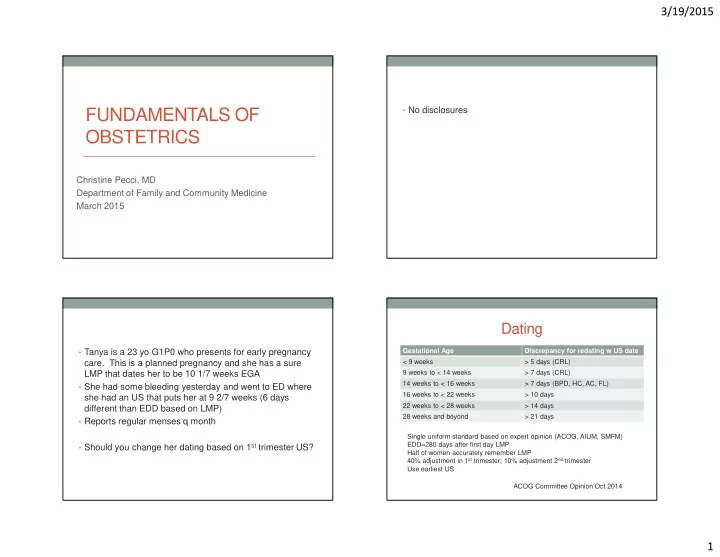
  • Tanya is a 23 yo G1P0 who presents for early pregnancy
  • care. This is a planned pregnancy and she has a sure

LMP that dates her to be 10 1/7 weeks EGA

  • She had some bleeding yesterday and went to ED where

she had an US that puts her at 9 2/7 weeks (6 days different than EDD based on LMP)

  • Reports regular menses q month
  • Should you change her dating based on 1st trimester US?

Dating

Gestational Age Discrepancy for redating w US date < 9 weeks > 5 days (CRL) 9 weeks to < 14 weeks > 7 days (CRL) 14 weeks to < 16 weeks > 7 days (BPD, HC, AC, FL) 16 weeks to < 22 weeks > 10 days 22 weeks to < 28 weeks > 14 days 28 weeks and beyond > 21 days ACOG Committee Opinion Oct 2014 Single uniform standard based on expert opinion (ACOG, AIUM, SMFM) EDD=280 days after first day LMP Half of women accurately remember LMP 40% adjustment in 1st trimester; 10% adjustment 2nd trimester Use earliest US

slide-2
SLIDE 2

3/19/2015 2

  • We confirm that Tanya has a “sure” LMP
  • We will calculate her EDD based on her LMP
  • US discrepancy is 6 days but between 9-14 weeks we

would use the US based EDD only if it differs by >7 days

Will my baby be normal?

  • She has been reading about a new test for making sure

the baby is normal. She wants to know if you can order this test. Will having a normal test guarantee that this baby will be okay?

Aneuploidy Screening

  • First trimester 10-15 weeks
  • Serum testing (free bhg + PAPP-A)
  • Ultrasound (Nuchal transluncey)
  • Second trimester screening 15-20 weeks
  • Serum testing (AFP, inhibin, bhcg, estriol)
  • Ultrasound (fetal survey)
  • Sequential vs integrated testing
  • NOT diagnostic (need CVS or Amniocentesis)

Non-invasive Prenatal Testing (NIPT)

  • Cell free fetal DNA
  • Comes from placental cells and clears from maternal

system in hours

  • Tests for Trisomy 18, 21, 13
  • Can be checked 10 – 22 weeks gestation
  • Only for high risk patients
  • Age >35, abn US, history of trisomy, parent with balanced

translocation

  • If positive result, refer to genetic counseling and offer

invasive testing

  • False positive 0.5%, 98-99% Trisomy 21 detected
slide-3
SLIDE 3

3/19/2015 3

Staying Healthy IOM weight gain guidelines

PrePreg BMI BMI Total Weight Gain Underweight <18.5 28-40 Normal 18.5-24.9 25-35 Overweight 25.0-29.9 15-25 Obese >30 11-20 Institute of Medicine 2009

Exercise in Pregnancy

  • Goal: 30 minutes most days of the week
  • If sedentary, start out slowly i.e. 5 min daily
  • Avoid contact sports or high risk of falling
  • Avoid sports that involve balance changes
  • No scuba diving
  • Keep off back, drink lots of water
  • Listen to your body
slide-4
SLIDE 4

3/19/2015 4

Nutrition in Pregnancy

Folic Acid: 600 mcg folic acid Iron: 27 mg Calcium: 1000-1300 mg Vit D: 600 IU

ACOG Sept 2013

I love my hot dogs!

  • Pregnant women more likely to be affected
  • Avoid refrigerated smoked seafood, pate, unpasteurized

milk/cheese

  • Deli meats/hot dogs need to be steaming hot

I love my cat!

  • Ingestion of raw/undercooked meat, unwashed

fruits/vegetables, soil or litter contaminated with cat feces

  • Wash hands
  • Have someone else clean cat litter
  • Use gloves
  • Change litter box daily
  • Do not feed raw meat to cats

I’m glad I don’t like fish!

  • Fish is good for you and provides necessary nutrients for

growing fetus

  • Should eat on average two meals a week
  • Avoid swordfish, tilefish, king mackerel, shark
slide-5
SLIDE 5

3/19/2015 5

Diseases in Pregnancy

Preeclampsia: You will see it! And it matters…

  • Incidence 2-8%
  • Has increased by 25% in last two decades
  • More likely in patients with hypertension
  • Unrecognized has serious health consequences for mom

and baby

  • Risk factor for future CV and metabolic disease

Task Force for Hypertension in Pregnancy, 2013

Task Force for Hypertension in Pregnancy, 2013

  • 17 experts (OB, MFM, htn, nephrology, anesthesia,

physiology, patient advocacy)

  • Changes in terminology
  • Changes in management

Categories

  • Preeclampsia-eclampsia
  • With or without severe features
  • Chronic hypertension
  • Gestational hypertension- hypertension without

proteinuria after 20 week

  • Chronic hypertension with superimposed preeclampsia

Task Force for Hypertension in Pregnancy, 2013

slide-6
SLIDE 6

3/19/2015 6

Diagnosis

  • >140/90 on two occasions 4 hours apart
  • SEVERE FEATURES
  • >160/110
  • Plts <100K
  • LFTs twice normal
  • Persistent RUQ pain or epigastric pain
  • Creatinine >1.1 or double
  • Pulmonary edema
  • New onset cerebral or visual disturbance

Proteinuria

  • >300 mg /24 hrs
  • Spot urine: creatinine ratio > 0.3
  • Dipstick 1+
  • Proteinuria is classically part of the syndrome
  • But NOT required to make diagnosis of preeclampsia

Who should take ASA?

  • Initiate ASA 81 mg in late first trimester
  • History of preeclampsia < 34 0/7 weeks
  • Preeclampsia in more than one pregnancy
  • Patient with history of preeclampsia <34 wks.
  • Prevalence 40%
  • NNT 1:20 (moderate Q; qualified SOR)
  • NNT 1:500 low risk (prev 2%)
  • NNT 1:50 high risk (prev 20%)

Management

  • Chronic hypertension
  • Deliver after 38 0/7 wks
  • Gestational hypertension:
  • Deliver at 37 0/7 weeks
  • weekly dip for proteinuria + BP check (can be at home)
  • NST q week
slide-7
SLIDE 7

3/19/2015 7

Management

  • Preeclampsia without severe features:
  • Deliver at 37 0/7 weeks
  • 2x week BP, once a week labs
  • 2x week NST
  • Preeclampsia with severe features
  • Deliver at 34 0/7 weeks
  • Monitor in hospital
  • Severe uncontrolled htn, eclampsia, pulm edema,

abruption, DIC, NRFHR, IUFD

  • Immediate delivery after initial stabilization

Intrapartum Interventions

  • Mg with severe preeclampsia only (low/qual)
  • Anti hypertensive meds only for > 160/110 (mod/strong)
  • Administer steroids prior to delivery (high/ strong)

Postpartum follow-up

  • Incidence unknown
  • ALL patient should receive education on warning signs
  • Check BP 72 hours post delivery and 7-10 days

postpartum

  • Treat for >150/100 on two occasions 4-6 hrs apart
  • Preconception- glycemic control, weight loss

Diabetes in Pregnancy

  • Overall incidence of diabetes in pregnancy 6%
  • 90% of these are GDM
  • Hyperglycemia and Adverse Pregnancy Outcome (HAPO)

trials show continuous relationship- neonatal hyperglycemia, macrosomia

  • Increased hyperbilirubinemia, operative delivery, shoulder

dystocia

ACOG Practice Bulletin Aug 2013

slide-8
SLIDE 8

3/19/2015 8

Gestational Diabetes

  • Screen at 24-28 wks
  • Early screening- if prior GDM, known impaired fasting

glucose, BMI >30

  • 2010 International Association of Diabetes and Pregnancy

Study Group (endorsed by ADA) (92, 180, 153)

  • No data regarding therapeutic intervention

Diagnosis

  • 2013 NICHD recommends 2 step test (50 gm then 100

gm)

  • Consider prevalence of diabetes
  • Consider resources
  • One hour glucola: range 135-140

fasting 1 hr 2hr 3hr NDDG* 105 190 165 155 CC** 95 185 165 140 *National Diabetes Data Group **Carpenter Coustan

Treatment

  • QID finger sticks
  • ADA and ACOG 140 on 3 hr and 120 2 hr
  • Carbs 33-40% of diet
  • Protein 20%; fat 40%
  • Mod exercise
  • If fasting consistently >95, consider insulin
  • Insulin does not cross the placenta
  • Glyburide and metformin not approved but being used
  • Glyburide crosses placenta but no measurable levels in

cord blood

  • ? Long term effects? No short term effects

Mode of delivery

  • Prevention of a single permanent brachial plexus palsy
  • Cesarean delivery for 4500 gm NNT 588
  • Cesarean delivery for 4000 gm NNT 962
slide-9
SLIDE 9

3/19/2015 9

Postpartum follow-up

  • 15-50% with GDM develop DM 20+ years later
  • Varies by ethnicity (60% Latina within 5 years)
  • Fasting or 2 hr GTT 6-12 wk postpartum
  • IGT picked up by 2 hr
  • Repeat testing q 3 years if normal

Infections in Pregnancy HSV

  • Genital herpes affects 20% women in US?
  • Incidence of new infection in pregnancy 2%
  • Women with recurrent HSV-75% can expect episode

during pregnancy, 14% at delivery

  • 80% of infected infants born to women with no reported

history

  • 20% neonatal survivors have long-term neurosequalae

HSV-Give prophylaxis at term

  • Primary infection transmission to neonate 30-60% at delivery
  • Recurrent infection transmission 3% at delivery; no lesions

2/10,000

  • Acyclovir, famcyclovir, valcyclovir all class B, most data on

acyclovir

  • Routine screening not recommended
  • Genital Sx or lesions- c/s decreases transmission from 7.2% to

1.2% even after ROM

  • Acyclovir 400 mg TID @ 36 weeks

til delivery

slide-10
SLIDE 10

3/19/2015 10

HIV

  • Opt out screening for all women
  • Low threshold for testing in third trimester; offer testing on

L&D

  • Viral suppression is of upmost importance
  • Elective cesarean if VL >1000 near delivery
  • Intrapartum AZT unless consistent VL <1000
  • Neonatal AZT (NVP, 3TC high risk)
  • No breastfeeding (developed countries)
  • http://nccc.ucsf.edu/ Perinatal hotline 24/7

GBS

  • Screen all women at 35-37 wks, unless
  • Previous child with early onset GBS disease
  • GBS bacteruria in index pregnancy
  • Treat with intrapartum IV penicillin first line
  • Ask for sensitivities if has pcn anaphylaxis to see if can give

Clinda/erythro

  • Cefazolin if stated allergy (not anaphylaxis)
  • Vanco reserved for those with anaphylaxis or those without

sensitivities

  • Adequate treatment >4 hours pcn or cefazolin

39

Rubella

  • Do not give during pregnancy and avoid pregnancy x 28

days

  • Not an indication for termination
  • If lab evidence of immunity, no need to repeat
  • If neg or equivocal titer after 1-2 doses, give third dose

and stop checking titers

  • Ok for children of pregnant women to get
  • May give with Rhogam, check titer in 3 months

MMWR June 2013

slide-11
SLIDE 11

3/19/2015 11

Varicella

  • Lab evidence of immunity or

disease

  • Birth in US before 1980 is not

sufficient for pregnant women

  • Diagnosis or verification of

history of varicella or zoster by health care provider

  • Should have link to a typical case
  • r lab confirmation if testing done

during acute infection

  • Mary is 36 yo G2P2 delivered 2 days ago via cesarean
  • delivery. She had declined the Tdap and flu shot

pregnancy because she was afraid of it hurting the baby. Now she is willing to accept these two immunizations if you still recommend them. She got the flu shot last season and got a Tdap after her last pregnancy in 2011.

  • Which immunizations would you give her?

Tdap in each pregnancy

  • Tdap is indicated in EVERY pregnancy 27-36 wks EGA

for transmission of antibodies to fetus

  • Once baby is out, indication for Tdap is based on

maternal indications; she is up to date

  • Flu shot is indicated

Summary

  • Establish accurate dating
  • Provide primary care
  • Immunizations, healthy lifestyles
  • Watch for pregnancy related diseases
  • Translates to risk of these diseases later in life
  • We have interventions to prevent perinatal transmission of

disease