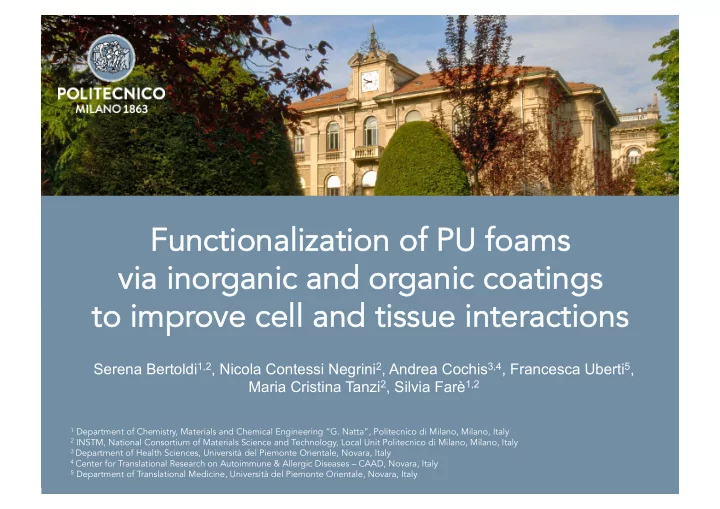
Functionalization of PU foams Functionalization of PU foams via - - PowerPoint PPT Presentation

functionalization of pu foams functionalization of pu
SMART_READER_LITE
LIVE PREVIEW

Functionalization of PU foams Functionalization of PU foams via - - PowerPoint PPT Presentation

Functionalization of PU foams Functionalization of PU foams via inor via inorganic and or ganic and organic coatings ganic coatings to improve cell and tissue interactions to impr ove cell and tissue interactions Titolo presentazione


slide-1
SLIDE 1

Titolo presentazione sottotitolo

Functionalization of PU foams Functionalization of PU foams via inor via inorganic and or ganic and organic coatings ganic coatings to impr to improve cell and tissue interactions

  • ve cell and tissue interactions

Serena Bertoldi1,2, Nicola Contessi Negrini2, Andrea Cochis3,4, Francesca Uberti5, Maria Cristina Tanzi2, Silvia Farè1,2

1 Department of Chemistry, Materials and Chemical Engineering “G. Natta”, Politecnico di Milano, Milano, Italy 2 INSTM, National Consortium of Materials Science and Technology, Local Unit Politecnico di Milano, Milano, Italy 3 Department of Health Sciences, Università del Piemonte Orientale, Novara, Italy 4 Center for Translational Research on Autoimmune & Allergic Diseases – CAAD, Novara, Italy 5 Department of Translational Medicine, Università del Piemonte Orientale, Novara, Italy

slide-2
SLIDE 2

Scaf Scaffolds pr folds production and r

  • duction and requir

equirements ements

1

  • scaf

scaffolds folds intended for tissue r issue regenerat egeneration ion must match specific r specific requir equirements ements

  • versat

versatile formulat ile formulations ions to tune the structural pr structural propert

  • perties

ies

slide-3
SLIDE 3

Scaf Scaffolds pr folds production and r

  • duction and requir

equirements ements

1

  • scaf

scaffolds folds intended for tissue r issue regenerat egeneration ion must match specific r specific requir equirements ements

  • versat

versatile formulat ile formulations ions to tune the structural pr structural propert

  • perties

ies

slide-4
SLIDE 4

Scaf Scaffolds pr folds production and r

  • duction and requir

equirements ements

2

  • a corr

a correct surface bioact ect surface bioactivity ivity is fundamental to properly guide cel guide cells fate ls fate and tissue issue infil infiltrat tration/r ion/regenerat egeneration ion

http://www.composites.polito.it

different bioactive coatings can be used to promote a desired response

slide-5
SLIDE 5

Aim of the work Aim of the work

3

  • use of polyur

polyuret ethane foams hane foams as scaffolding materials

  • coat

coating ing of polyurethane foams either by using

  • calcium phosphates

calcium phosphates à to target the regeneration of bone tissue

  • gelat

gelatin hydr in hydrogels

  • gels à to target the regeneration of soft tissue
slide-6
SLIDE 6

Pr Production of polyur

  • duction of polyurethane foams

ethane foams

4

  • polyur

polyuret ethane foams hane foams used as por porous structur

  • us structures

es for scaf scaffolds pr folds product

  • duction

ion

  • one-step gas foaming
  • ne-step gas foaming reaction
  • water

water (2% w/wpolyols) used as expand expanding agent ing agent

  • versat

versatile formulat ile formulations ions to tune the structural pr structural propert

  • perties

ies

slide-7
SLIDE 7
  • PU

PU foams foams coated by inor inorganic ganic or or

  • rganic

ganic coating to target different tissues regeneration

Polyur Polyurethane foam coating to obtain hybrid scaf ethane foam coating to obtain hybrid scaffolds folds

5 Inor Inorganic ganic coating coating Or Organic ganic coating coating

1) 1) PU PU samples 2) coating of the PU samples in an vacuum chamber 3) 3) inor inorganic ganic/or

  • rganic

ganic coated samples

Calcium Calcium phosphates phosphates

PU_CaP PU_CaP

Gelatin Gelatin hydr hydrogel

  • gel

(6 or 15% (6 or 15% w/v) /v)

PU_gel PU_gel

slide-8
SLIDE 8

Morphology: Scanning Electr Morphology: Scanning Electron Micr

  • n Microscopy
  • scopy

6

PU PU PU_CaP PU_CaP PU_gel PU_gel

Inorganic coating Organic coating

slide-9
SLIDE 9
  • influence of

influence of gelat gelatin in hydr hydrogels on por

  • gels on pore inter

e interconnect connections ions

7

PU PU PU_gel PU_gel

Morphology: Micr Morphology: Micro-CT

  • -CT
slide-10
SLIDE 10
  • influence of gelat

gelatin in hydrogels on pore interconnections

  • influence of hydrat

hydration ion on por pore inter e interconnect connection ion

8

Morphology: Micr Morphology: Micro-CT

  • -CT

10 20 30 40 50 60 70 80 90 100 dry hydrated

  • pen por
  • pen porosity [%]
  • sity [%]

PU PU_GEL6 PU_GEL15

slide-11
SLIDE 11
  • Stabil

Stability ity and water uptake water uptake at 37 °C 37 °C (physiological temperature)

  • PU foams

PU foams: stable at 37 °C

  • Gelat

Gelatin hydr in hydrogels

  • gels improve water uptake
  • PU_gel6

PU_gel6 higher water uptake compared to PU_gel15 PU_gel15

Water uptake: ater uptake: PU_gel PU_gel

10

100 200 300 400 500 600 100 200 300 400 500 600 700 Water uptake [%] Time [h]

PU PU_GEL6 PU_GEL15

slide-12
SLIDE 12
  • Stabil

Stability ity and water uptake water uptake at 37 °C 37 °C (physiological temperature)

  • PU foams

PU foams: stable at 37 °C

  • CaPs

CaPs coating: stable at 37°C

Water uptake: ater uptake: PU_CaP PU_CaP

11

50 100 150 200 250 300 350 400 100 200 300 400 500 Water uptake [%] ater uptake [%] Time (h) Time (h) PU PU_CaP

slide-13
SLIDE 13
  • stress/strain behavior PU_gel6

PU_gel6 and PU_gel15 PU_gel15 comparable to that of contr control PU

  • l PU
  • PU_GEL15

PU_GEL15: behavior slightly different from PU PU and PU_gel6 PU_gel6

Mechanical compr Mechanical compressive pr essive properties:

  • perties: PU_gel

PU_gel

12

5 10 15 20 25 30 35 40 10 20 30 40 50 60 Stress (kPa) Strain (%) PU PU_GEL6 PU_GEL15

slide-14
SLIDE 14
  • no significant difference between PU_gel6

PU_gel6 and PU_gel15 PU_gel15 versus PU PU scaffolds

  • low contribut

low contribution ion of gelat gelatin coat in coating ing to mechanical properties

Mechanical compr Mechanical compressive pr essive properties:

  • perties: PU_gel

PU_gel

13

10 20 30 40 50 60 70 E (kPa) R10-30 (kPa) strain@max (kPa) [kPa] [kPa] PU PU_GEL6 PU_GEL15

slide-15
SLIDE 15
  • PU_CaP

PU_CaP: no improvement in the mechanical properties of the PU PU

Mechanical compr Mechanical compressive pr essive properties:

  • perties: PU_CaP

PU_CaP

14

0.05 0.1 0.15 0.2 0.25 0% 10% 20% 30% 40% 50% 60% Str Stress [MPa] ess [MPa] Strain [%] Strain [%] PU PU_CaP

slide-16
SLIDE 16
  • PU_CaP

PU_CaP: values of the mechanical parameters à no significant difference compared to PU PU

Mechanical compr Mechanical compressive pr essive properties:

  • perties: PU_CaP

PU_CaP

15

50 100 150 200 250 300 350 E (kPa) R10-30 (kPa) strain@max (kPa) [kPa] [kPa] PU PU_CaP

slide-17
SLIDE 17
  • Ind

Indir irect cytotoxicity ect cytotoxicity on PU_ge PU_gel with ad adipose derived stem cel ipose derived stem cells ls

  • Target: soft t

soft tissues r issues regenerat egeneration ion

  • PU

PU and PU_gel PU_gel showed no cytotoxic ef no cytotoxic effects fects

In vitr In vitro cytotoxicity tests:

  • cytotoxicity tests: PU_gel

PU_gel

16

20 40 60 80 100 120 PU PU_GEL6 PU_GEL15 Cell viability [% vs contr Cell viability [% vs control]

  • l]

day 1 day 3 day 7

slide-18
SLIDE 18
  • Dir

Direct cytocompat ect cytocompatibil ibility ity on PU_GEL with ad adipose derived stem cel ipose derived stem cells ls

  • Target: soft t

soft tissues r issues regenerat egeneration ion

  • Cel

Cells ad ls adhesion hesion and lipid dr ipid droplets accumulat

  • plets accumulation

ion à suitable for ad adipose t ipose tissue issue regenerat egeneration ion

In vitr In vitro cytocompatibility tests:

  • cytocompatibility tests: PU_gel

PU_gel

17

day 1 day 1 day 3 day 3 day 7 day 7 PU_GEL6 PU_GEL6 PU_GEL15 PU_GEL15 !

slide-19
SLIDE 19
  • Dir

Direct cytocompat ect cytocompatibil ibility ity on PU_CaP with amnionic amnionic mesenchymal cel mesenchymal cells ls

  • Target: bone t

bone tissue r issue regenerat egeneration ion

  • PU_CaP

PU_CaP: cel cells ad ls adhesion hesion and inorganic matrix deposit deposition ion

In vitr In vitro cytocompatibility tests:

  • cytocompatibility tests: PU_CaP

PU_CaP

PU PU PU_CaP PU_CaP

18

slide-20
SLIDE 20

Conclusions Conclusions

  • PU foam

PU foam scaffolds à à successful successfully coated ly coated by inor inorganic ganic and or

  • rganic

ganic coatings

  • possible

possible use as scaf scaffolds folds for bone t bone tissue issue and soft t soft tissue issue regeneration

  • morphological analyses:

morphological analyses:

  • ef

effect fective coat ive coating ing by CaPs CaPs à à to mimic mimic the inor inorganic ganic bone bone component

  • gelat

gelatin hydr in hydrogel

  • gel à

à to impr improve cel

  • ve cells ad

ls adhesion hesion

  • adequate mechanical pr

adequate mechanical propert

  • perties

ies for har hard and soft soft tissue r regenerat egeneration ion

  • cel

cells successful ls successfully ad ly adher hered ed and pr prol

  • liferated

iferated on the scaffolds à à corr correct funct ect functional ionality ity

  • depositing inor

inorganic extracel ganic extracellular matrix lular matrix à à bone t bone tissue issue regeneration

  • accumulating lipid dr

ipid droplets

  • plets à

à ad adipose ipose tissue issue regeneration

19

slide-21
SLIDE 21

Titolo presentazione sottotitolo

THANK YOU