Functional Older Adults Modernisation of East London NHS Foundation - - PDF document

functional older adults
SMART_READER_LITE
LIVE PREVIEW

Functional Older Adults Modernisation of East London NHS Foundation - - PDF document

6/8/2015 Overview of proposal Functional Older Adults Modernisation of East London NHS Foundation Trust (ELFT) services for older people with functional mental illness in City & Hackney and Tower Hamlets through: Consultation Report &


slide-1
SLIDE 1

6/8/2015 1

  • Functional Older Adults

Consultation Report & Recommendations

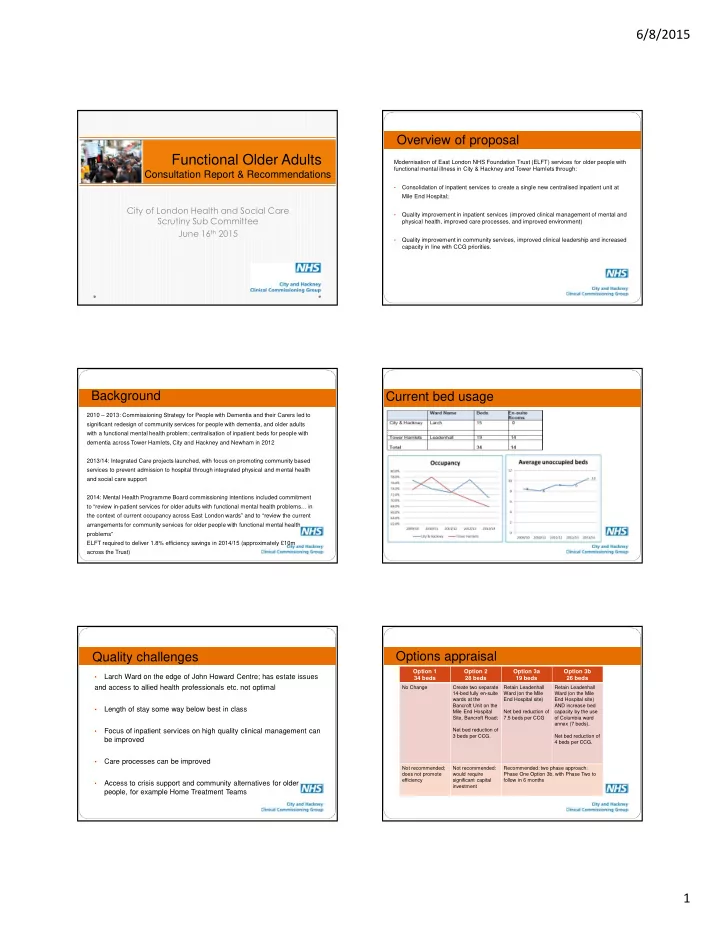
Overview of proposal

Modernisation of East London NHS Foundation Trust (ELFT) services for older people with functional mental illness in City & Hackney and Tower Hamlets through:

  • Consolidation of inpatient services to create a single new centralised inpatient unit at

Mile End Hospital;

  • Quality improvement in inpatient services (improved clinical management of mental and

physical health, improved care processes, and improved environment)

  • Quality improvement in community services, improved clinical leadership and increased

capacity in line with CCG priorities.

Background

2010 – 2013: Commissioning Strategy for People with Dementia and their Carers led to significant redesign of community services for people with dementia, and older adults with a functional mental health problem; centralisation of inpatient beds for people with dementia across Tower Hamlets, City and Hackney and Newham in 2012 2013/14: Integrated Care projects launched, with focus on promoting community based services to prevent admission to hospital through integrated physical and mental health and social care support 2014: Mental Health Programme Board commissioning intentions included commitment to “review in-patient services for older adults with functional mental health problems… in the context of current occupancy across East London wards” and to “review the current arrangements for community services for older people with functional mental health problems” ELFT required to deliver 1.8% efficiency savings in 2014/15 (approximately £10m across the Trust)

Current bed usage Quality challenges

  • Larch Ward on the edge of John Howard Centre; has estate issues

and access to allied health professionals etc. not optimal

  • Length of stay some way below best in class
  • Focus of inpatient services on high quality clinical management can

be improved

  • Care processes can be improved
  • Access to crisis support and community alternatives for older

people, for example Home Treatment Teams

Options appraisal

Option 1 34 beds Option 2 28 beds Option 3a 19 beds Option 3b 26 beds

No Change Create two separate 14-bed fully en-suite wards at the Bancroft Unit on the Mile End Hospital Site, Bancroft Road; Net bed reduction of 3 beds per CCG. Retain Leadenhall Ward (on the Mile End Hospital site) Net bed reduction of 7.5 beds per CCG Retain Leadenhall Ward (on the Mile End Hospital site) AND increase bed capacity by the use

  • f Columbia ward

annex (7 beds). Net bed reduction of 4 beds per CCG. Not recommended; does not promote efficiency Not recommended: would require significant capital investment Recommended: two phase approach: Phase One Option 3b, with Phase Two to follow in 6 months

slide-2
SLIDE 2

6/8/2015 2

Commissioner resource for reinvestment

Resource for commissioner reinvestment will be released in line with the proposed phases of the project.

  • 1. Reapportionment of the clinical inpatient time - liberated through centralisation (as outlined in

the business case) - to enhance the older adult mental health community services, in line with both TH and C&H's integrated care strategies. The value of this resource is £211k and could, subject to achieving joint plan for the service, be realised in the latter part of 2014/15, ie Phase One of the business case.

  • 2. An additional £120k to be released in 2015/16, subject to achievement of Phase Two of the

business case, ie moving from 1 1/2 wards to 1 ward. The total resource released from this proposal for C&H and TH commissioners is therefore £331k, ie 2/3rds of the original £500k agreed for the tri-borough initiative.

  • Benefits

For in-patients:

  • Higher staff to patient ratio
  • Focussed expertise, with professional development available for staff
  • Improved access to other mental health specialists (e.g. dementia) and allied health professionals for

physical health

  • Improved out of hours support
  • Improved access to Improved care processes, modelled on dementia ward, e.g. focus on discharge

planning

  • Improved estate

For community patients:

  • Improved clinical leadership and care processes within community mental health teams for older people
  • Improved offer from Home Treatment Teams for older people

For health economy:

  • Delivers significant efficiencies for ELFT whilst improving quality (phase one £357k,

phase two £853k)

  • Promotes opportunity for redesign of community services to drive CCG priority for

integrated care and development of primary care mental health services.

Risks and mitigations

Impact on journey times for patients and carers travelling to a centralised ward There will be an impact for some City & Hackney patients, however ELFT have committed to implementing their transport assistance policy through which some carers will be eligible for payments to support taxi travel Management of care processes to deliver phase two and achieve full benefits realisation ELFT have set out management and governance process to oversee delivery and performance in the business case. The East London Mental Health Consortium will monitor and hold ELFT to account for delivery via the joint Transformation Board and will only approve progression to Phase Two when it is clinically appropriate Older adult population growth ELFT have established that service is able to address increased demand from ageing population up until 2021, through continuing to deliver improvements in care pathway management and achieving reductions in ALOS in line with national best practice.

Consultation Outcomes

Pre consultation engagement

The proposals were shared with MPs and local authority corporate directors, at the Healthwatch City of London AGM meeting and Hackney Older People’s reference group; Tower Hamlets Health Scrutiny Panels; City of London Scrutiny Panels and staff from The Lodge, Leadenhall Ward and ELFT Mental Health Care of Older People (MHCOP). In City and Hackney, the proposals were approved by:

11

Mental Health Programme Board sign-off 10th March 2014 Agreed to proceed to full public consultation Clinical Commissioning Forum 3rd April 2014 Agreed to proceed to public consultation Clinical Executive Committee 9th April 2014 Agreed to proceed to full public consultation MHPB Service User Advisory Group 28th May 2014 Agreed to proceed to full public consultation CCG PPI Committee 29th May 2014 Further clarification on issues required. CCG Governing Body 30th May 2014 On the basis of PPI concerns, further clarification on issues required CCG PPI Committee 26th June 2014 Concerns clarified and agreed to proceed to full public consultation CCG Governing Body 25th July Agreement to proceed to full public consultation sought

Who engaged in the consultation?

12

  • The consultation started on 16 December 2014. It was intended to conclude on 16

March 2015 but was extended until 27 March 2015 to allow further time for people to

  • participate. The NEL Commissioning Support Unit were engaged to support the

consultation to ensure it was independent of both ELFT and CCG bias. Their report is appended.

  • At least 250,000 people had the opportunity to see the publicity of the consultation

(local newspapers, emails to trust members, GP and patient letters, posters, websites etc).

  • Over 70 people positively engaged with the consultation, attending one of the six public

meetings or nine other meetings, or visiting the websites or making their views known by post or email.

  • Approximately 80 people responded to the consultation.
  • 37 people responded to the questionnaire (66% were from Hackney; 28% from Tower

Hamlets and 3% from the City of London).

  • Approximately 40 people made their views known at one of the meetings and

Healthwatch Tower Hamlets and Healthwatch Hackney submitted responses.

slide-3
SLIDE 3

6/8/2015 3

Key findings and concerns

  • Of those that responded to the questionnaire fewer people (37%) preferred a single site solution

compared with 46% who preferred a solution with more than one site.

  • 55% of respondents to the questionnaire thought services should be at Mile End and The Lodge.
  • The majority of Tower Hamlets residents supported the preferred solution (two wards based at Mile

End).

  • The majority of Hackney residents supported a two site solution.
  • Two wards (for additional capacity) were preferred to one ward by those who supported a single

site.

  • There was concern from Hackney residents regarding the difficulty in travelling to Mile End. Some

respondents highlighted the difficulty this would cause on the Sabbath. Respondents felt that there must be mitigations to issues caused by a single site solution including improving parking; providing accommodation for visitors and carers; providing transport; better security and improving the Mile End facilities.

  • There was support for investing savings back into community and home services for older people

with mental health problems (53% of respondents) – particularly in Hackney where there was a perceived downgrading of existing services and the Felstead site was considered not well known and in a somewhat remote location.

  • There were concerns about continuity and integration of care for people treated outside their

borough.

13 14

  • Q2. Please tell us which of these

statements best describes your views about our proposal about the number of inpatient sites we should have for older people with mental health problems in Tower Hamlets and City and Hackney? In Tower Hamlets 60% of respondents supported the proposed solution of one

  • site. However in Hackney,

54% support the proposal

  • f providing inpatient

services on more than one site.

The results

  • Q3. I think inpatient services for
  • lder people with mental health

problems should be at…

15

55% 33% 12%

Mile End Hospital in Tower Hamlets and at The Lodge in Hackney Mile End Hospital in Tower Hamlets Somewhere else

  • Mile End Hospital in Tower

Hamlets and at The Lodge in Hackney Mile End Hospital in Tower Hamlets Somewehere else

Tower Hamlets residents generally supported the proposals and the preferred solution (two Wards based at Mile End). City and Hackney residents generally supported the 2 site option.

What patients said

16

Reasons for supporting the option of a site at Mile End There was little commentary on the support for Mile End, although one respondent said: Because as I have understood the services are good. Female, Hackney, aged 65-80 Reasons for opposition In opposition to this proposal, respondents cited their opposition to travelling and concerns regarding the friendliness and staffing at Mile End. The ward at Mile End Hospital is not as attractive or as welcoming as the ward at The Lodge. Also, if all services are at Mile End many patients, their carers and their families and friends will have to travel further. Female, NHS employee, aged 26-40 ... patients are better being near their friends and families and are visited more frequently. This also means that the patients are often return to their homes in the community sooner. The Lodge is a small nursing home and the staff have worked there long term and they are very familiar with their patients. Also there are few bank staff so the staff are very familiar with the patients. When my husband was at Columbia Ward, there were often bank staff who did not really know the patients. Female carer, Hackney, aged 65-80

The results

  • Q4. If we locate the inpatient services at Mile

End, do you think this should be on one 19 bedded ward (option 3a) on Leadenhall Ward OR do you think inpatient services should be provided on two wards providing 26 beds. That is Leadenhall Ward and a smaller high needs unit in the annex of Columbia Ward in The Bancroft Unit at Mile End Hospital (option 3b, our preferred option).

17

Two wards (for additional capacity) were preferred to

  • ne ward by those who

supported a single site solution.

What patients said

18

Reasons for supporting option 3b (the preferred option) The arguments for supporting option 3b focused on the perceived advantage of two wards with extra capacity over one ward with more limited capacity. Only one person selected option 3a. Demand and needs can vary - it is good to have a choice and extra beds and care. Service user, Hackney, 65-80 Reasons for opposition The arguments against two wards with 26 beds centred around the opposition to one site (transport issues) and the belief that each borough should have its own facility, rather than a judgement. between one or two wards. I believe that people in Hackney should be staying in Hackney and treated in their borough. Male service user, Hackney, aged 65-80

slide-4
SLIDE 4

6/8/2015 4

Concerns from Healthwatch 1

19

Healthwatch published an Enter and View report on the proposed ward at Mile End. There report raised a Number of concerns which have been clarified below:

  • How will management ensure staff that have ‘good patient interaction skills’ are retained in

employment? We had some positive feedback about staff at Larch Ward and slightly less positive feedback of staff (and observation) at Leadenhall Ward. Staff will be interviewed for the post and good patient interaction will be a priority. The ward will operate under the 6Cs to ensure good and positive interaction with service users and carers (Compassion, Care, Communication, Competencies, Commitment, Courage).

  • Representative feel space might be an issue once Leadenhall Ward is at full capacity, on the day of our

visit even with 11 patients the communal space seemed slightly crowded. Have management given due consideration to the potential space issue once the ward is at full capacity? Consideration has been given by management regarding space on Leadenhall and a bid has already been submitted to capital works for an extension of a conservatory to the ward. This would be built outside the dining room area and would provide extra space on the ward. On Leadenhall there is also a small sitting room (which is being fitted out with carpet) a therapy room a group/ multi-function room and another small room that service users have use of other than their rooms and the communal lounge/dining area.

Concerns from Healthwatch 2

20

  • What ‘respite care’ is there for mental patients in the community? (Hackney and Tower Hamlets) & under

the new proposal will respite care still be provided at Leadenhall Ward? If not where will these provisions be provided? Respite care is provided by the local authority and is not provided on Leadenhall ward. When respite care is required for service users with dementia it is provide on Thames House/ Columbia which are both on the Mile End site. For Hackney residents respite would be provided on Cedar ward which is a continuing care ward at the Lodge.

  • How much money will be spent in the community? And where is the money being reinvested (which

services)? The money spent in the community is £213k for Phase 1, the funding is split equally across both localities and will fund additional clinician time. This is in the context of significant new investment in community services

  • ver the past 5 years and further additional investment in memory and integrated care services this year.

Concerns from Healthwatch 3

21

  • What are future plans for Larch Lodge?

At present there are no definite plans for the Lodge, the building is owned by the trust but a decision has not yet been made with regards to its use.

  • How do ELFT intend to promote the taxi service for Hackney residents (under the proposed changes) and

how will this be administered? The promotion of the taxi service will be in the format of a flyer which will be included in the welcome pack for service users and the flyers will be given to carers on admission. The service will be administered directly from the ward and the administrator will make the bookings.We already have this service on Columbia and relatives

  • ccasionally use it.

Programme Board recommendations

The Mental Health Programme board recognises the following patient benefits to this reconfiguration:

  • Community services strengthened through redeployment of ward resources
  • Higher staff to patient ratios on inpatient ward, with expertise centralised on the Mile End site to deliver

better outcomes

  • Opportunity to modernise functioning of teams and specifically refocusing consultants’ roles as clinical

leaders

  • Improvements in management and referral to physical health services at Mile End site
  • Improved environment, particularly for City & Hackney residents.

The Mental Health Programme Board recommends that the City and Hackney OSC endorse the proposals prior to submission to the CCG Governing Body for review & sign off. The Mental Health Programme Board makes this recommendation on the basis that the East London Foundation Trust:

1.

Work with City and Hackney Healthwatch to establish an Implementation Group who will oversee the development of the facilities at Mile End Hospital. This will ensure any concerns raised by Healthwatch at the consultation stage are addressed through the implementation stage.

2.

The CCG Board will receive a report back from Healthwatch in October 2015 confirming that their concerns have been addressed and agreeing that Phase 1 can formally proceed.

22